

DfI
Data for Impact
This project is a national data collection initiative aimed at improving the quality, equity, and effectiveness of private musculoskeletal (MSK) physiotherapy across the UK. By collecting standardised data through patient and clinician surveys, the DfI provides participating practitioners and clinics with meaningful insights into treatment outcomes and patient experiences. This enables benchmarking, supports evidence-based practice, and contributes to a national research database used to for research and to inform best practice in MSK care.

Aims of the project
The primary goal of the DfI is to support private MSK physiotherapists in delivering high-quality, evidence-based care. Through systematic data collection and analysis, the project helps clinics to identify best practice and implement data driven quality improvements in patient care.
Project advancements
Established in 2014 at the University of Brighton, the DfI project moved to Keele University in 2024, where it has been aligned with the Keele's National MSK Audit, enabling comparisons across private and NHS settings.
Since moving to Keele University, the DfI project has undergone significant development, with a focus on streamlining the data collection to reduce administrative burden and enhancing the reporting to improve the way in which data is used to inform clinical practice. By integrating automated, standardised data collection and developing secure, user-friendly dashboards, the project aims to deliver meaningful and relevant analysis and benchmarking that supports reflective practice and quality improvement in musculoskeletal physiotherapy.
In parallel, anonymised DfI data is contributing to a national database that enables academic research, with access made available to MSc and PhD students at Keele to support high-quality research and the development of evidence-informed care pathways.
|
Chief Investigator: |
|
|
Principal Investigator: |
Dr Shemane Murtagh |
|
Co-investigators: |
Professor Kelvin Jordan, Dr Roanna Burgess, and James Bailey |
|
Study Co-ordinator: |
|
|
Funder name: |
Private Practitioner Education Foundation (PPEF) |
|
Ethics: |
This study has been reviewed by Keele University’s Research Ethics Committee (reference 2024-0995 1204) |
|
Year: |
Ethics Approval December 2024-2029 |
Study timeline and key milestones
2009
Development of a standardised data collection system for MSK physiotherapy by researchers at the University of Brighton.
2009
Data for Impact (DfI) Project launched at the University of Brighton, funded by the Private Physiotherapy Educational Foundation (PPEF) and Physio First (PF).
2009-2014
Series of snapshot surveys examining various aspects of MSK physiotherapy.
2014
Launch of the short-form online data collection to improve ease of data entry.
2014
Introduction of Quality Assurance Schemes (QAP/QAC) aimed at improving MSK care quality.
2015
Launch of individualised practitioner reports, providing feedback on treatment outcomes.
2024
DfI moves to Keele University, aligning with the National MSK Audit and Research Database (NHS data collection) to facilitate integrated data analysis.
2025
Development of a revised data collection system, aligning with NHS data standards, including the creation of a new website and real-time clinician dashboard.
2025
Launch of stakeholder engagement forums, involving clinicians, practice managers, software providers, and insurers to ensure a collaborative approach to data use.
2025
Pilot of the revised DfI data collection.
Patient and clinician surveys
Figure 1 outlines the data collection process for both clinicians and patients. Data entry begins at the point of booking, either through manual input into the DfI website (by clinician or practice administrator) or automated transfer of data via practice management software (PMS) integration. Patients then receive an initial survey by text and email before their appointment. Patients are sent a link (via email and text) a 3-month follow-up survey. At the same time, clinicians are prompted to complete a brief 6-question follow-up survey.
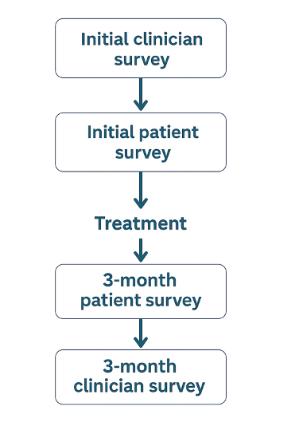
Figure 1. The data collection process
Table 1. Outline of the clinician and patient surveys
|
Survey |
Data collected |
|
Initial Clinician Survey |
- Patient name |
|
(Before first appointment) |
- Pain site |
|
(3-months after the initial appointment) |
- MSK HQ |
|
(3-months after the initial appointment) |
- Body site |
As part of the data collection, we collect a core set of organisational-level variables from participating clinics once a year. This data provides essential contextual information about service provision, access, capacity, and referral pathways. When combined with patient and clinician-level outcomes, this allows for a more comprehensive understanding of musculoskeletal care delivery and supports ongoing national benchmarking, quality improvement, and research. See Table 2 for an overview of the data collected.
Table 2. Outline of the organisational survey
|
Survey |
Data collected |
|
Organisational survey (completed annually by the practice principal)
|
- Practice name - Contact details - Practice principal name - Number of clinicians - Number of new patients in the - Number of new patients in last 6 months - Number of follow up in last 6 months - Average wait for new appointment in last 6 months - Average wait for follow up appointment in last 6 months - Length of appointment - MSK onward referrals - MSK onward referrals (other) - MSK interventions - Other MSK interventions - MSK clinical decision support system - MSK signpost - Other MSK signpost - Referral options - Factors about your MSK service that may have affected your service - Length of initial appointment - Length of follow up appointment - Cost of initial appointment - Cost of follow up appointment - Organisational Survey time/date stamp |
The Musculoskeletal Health Questionnaire (MSK-HQ) is a validated patient-reported outcome measure designed to capture overall
To reduce respondent burden while maintaining measurement precision, a short-form version of the MSK-HQ (MSK-HQ 6) was
Please click below to access the short-form version of the MSK-HQ (MSK-HQ 6):
MSK-HQ 6 (PDF)
2024 - 1,196 clinicians and 122,714 patients
2023 - 1,159 clinicians and 113,714 patients
2022 - 1,121 clinicians and 105,377 patients
2021 - 1,062 clinicians and 92,912 patients
2020 - 818 clinicians and 71,958 patients
2019 - 750 clinicians and 55,852 patients
2018 - 441 clinicians and 36,906 patients
2017 - 249 clinicians and 23,498 patients
2016 - 141 clinicians and 10,911 patients
2015 - 84 clinicians and 5,619 patients
- Murtagh, S., Touloumis, A., Olivier, G., Butterworth, J., and Hammerbeck, U., (2024) Early delivery and a greater number of musculoskeletal physiotherapy sessions improve therapy outcomes. Musculoskeletal Science and Practice. DOI: 10.1002/msc.1924
- Murtagh, S. Hammerbeck U., Touloumis A. and Olivier G. (2023). A delay in musculoskeletal physiotherapy and a low number of therapy sessions both have a negative impact on therapy outcomes." Abstract submitted to CSP Annual Conference 2024.
- Murtagh, S., Bryant, E., Hebron, C., Ridehalgh, C., Horler, C., Trosh, C., Olivier, G. (2021). Management of low back pain: Treatment provision within private practice in the UK in the context of clinical guidelines. Musculoskeletal care. https://doi.org/10.1002/msc.1553
- Fiddler, H., Bryant, L., Murtagh, S. & Olivier, G. (2022). How does the use of standardised data collection inform the educational needs of physiotherapists working in private practice? Physiotherapy. 114, Supplement 1, p. e216 1
- Bryant, E., Murtagh, S., Trosh, C. & Olivier, G. (2022) Implementation of an online PROM in private practice in the UK. Physiotherapy, 114, Supplement 1, p. e218 1 p. For full text click here.
- Murtagh, S., Bryant, E., Hebron, C., Ridehalgh, C., Horler, C., Trosh, C., Olivier, G. (2021). Management of low back pain: Treatment provision within private practice in the UK in the context of clinical guidelines. Musculoskeletal care.
- Bryant, L., Murtagh, S., Olivier, G., Lewis, S., & Moore, A. (2019). Gathering and utilising musculoskeletal data from private physiotherapists to demonstrate the value of their services: a UK based project. Abstract from World Confederation of Physical Therapy 2019, Geneva, Switzerland.
- Murtagh, S., Bryant, L., Olivier, G., & Lewis, S. (2019). The development of the Quality Assured Practitioner (QAP) Scheme in Private Physiotherapy Practice in the UK. Abstract from World Confederation of Physical Therapy 2019, Geneva, Switzerland.
- Murtagh, S., Bryant, L., Olivier, G., & Lewis, S. (2019). Exploring the feasibility of implementing an online patient reported outcome measure for patients attending private physiotherapy treatment in the UK. Abstract from World Confederation of Physical Therapy 2019, Geneva, Switzerland.
- Olivier G, Murtagh S, Bryant E. (2018). DfI: why should I? Invited presentation at the Physio First Annual Conference 2018, Nottingham 27th-29th April 2018.
- Murtagh, S., Bryant, E., & Olivier, G. (2018). Duration of symptoms and outcomes of treatment in musculoskeletal patients in private practice. Abstract from Physiotherapy UK Conference, Birmingham, United Kingdom. For full text click here.
- Murtagh, S., Bryant, E., Moore, A., Canby, G., McCrum, C., Mercer, C., Finucane, L., & Smith, T. (2018). Exploring the psychometric properties of the Brighton musculoskeletal patient reported outcome measure. Abstract from Physiotherapy UK Conference, Birmingham, United Kingdom. For full text click here.
- Bryant, E., Murtagh, S., Olivier, G., & Moore, A. (2018). Data for Impact: exploring the benefits of standardised data collection in private physiotherapy practices across the UK. Abstract from Physiotherapy UK Conference, Birmingham, United Kingdom. For full text click here.
- Olivier, G., Bryant, E., & Murtagh, S. (2017). Quality, quality assurance and quality assured practitioners. In Touch: The Journal of Physio First, 160, 36-40.
- Bryant, E., Moore, A., Olivier, G., Murtagh, S., Defever, E., Lewis, S., Simpson, P., Winrow, K., Lewis, E., & Donnelly, P. (2016). The use of standardised data collection in private physiotherapy practice to provide information for clinicians, clinics and private practice organisations. 0-0. Abstract from IFOMPT 2016.
- Moore, A., Bryant, E. & Olivier, G. (2012). Development and use of standardised data collection tools to support and inform musculoskeletal practice. Manual Therapy. 17, 2012, p. 489-496.
We are exploring how children and young people (aged 0–15 years) with musculoskeletal (MSK) conditions experience physiotherapy care within private practice settings. This study aims to understand whether gathering information from families through a short questionnaire is both feasible and acceptable in real‑world clinical environments.
By listening to the voices of young people, parents, and physiotherapists, we hope to shape future approaches to MSK care and ensure that services truly reflect the needs and experiences of those who use them.
Please see the links below for the documentation to support the study:
MIDAS study: https://www.keele.ac.uk/midas/
NHS National MSK Audit: https://www.keele.ac.uk/nationalmskaudit
DfI integrates with leading Practice Management Systems (PMS) to make outcome data collection part of routine clinical practice - not an extra admin task.
What does the integration do?
It securely links your PMS with the DfI platform, allowing relevant patient and appointment information to flow automatically from your PMS to the DfI platform. This reduces duplicate data entry and supports timely outcome and follow-up data collection.
Why it matters for clinicians
- Less admin
- Reduced risk of missing or incomplete data
- Outcomes collected within existing workflows
- Easier follow-up at discharge and beyond
Simple setup, supported throughout
Integrations are quick to set up and supported by a clear user guide (download below). Our team is also available to help if needed.
Available and upcoming PMS integrations
- Nookal
- Cliniko
- TM3 (coming soon)
- PPS (coming soon)
If you use a different Practice Management System and would like to explore integration, please email the project team to discuss options.
The following materials are available to support those who were unable to attend, or who would like to revisit the session content:
Workshop 1 (13 February 2026)
These documents provide a summary of the platform updates, areas discussed for feedback, and the next stages of development.
Workshop 2 (13 March 2026)
MSK-HQ license information: https://innovation.ox.ac.uk/outcome-measures/musculoskeletal-health-questionnaire-msk-hq/