

Forensic Science - MSc
Our Forensic Science MSc is designed to develop your technical capabilities, research skills and subject-level knowledge across various aspects of forensic science. We offer routes through the programme for those students that have both science and non-science undergraduate qualifications. If you are already have a forensic science degree, this programme will allow you to build skills and knowledge in a specific specialism of your choice. If this is your first venture into the world of forensic science, we offer a choice of modules that will suit your academic background and take you from the crime scene to the court. From our innovative teaching methods to the use of modern laboratories and indoor and outdoor crime scene facilities, you'll become equipped with high-level skills and innovative views to enhance your career prospects.
Month of entry
- September
Mode of study
- Full time, Part time
Fees for 2026/27 academic year
- UK - Full time £11,700 per year. Part time £6,400 per year.
International - £18,200 per year.
Fees
Duration of study
- Full time - 1 year, Part time - 2 years
This course is no longer accepting applications from international students for the 2026/27 academic year.
Why study Forensic Science at Keele University?

Course summary
Keele's MSc in Forensic Science provides a foundation of knowledge and master's-level skills to build upon your expertise, enabling you to explore forensic science investigation through a range of different methods.
You will gain an in-depth understanding of research and technical skills across a range of disciplines within Forensic Science, whilst developing your own analytical and critical thinking skills. Throughout the programme, you will demonstrate your ability to apply knowledge and expertise, showcasing originality in your arguments and judgement of complex issues.
This will be demonstrated through reflective writing, discussions with peers, presentations and practical/group sessions. All of which will contribute towards your personal and professional development to aid your future employment. You will learn to communicate effectively to different audiences when reporting on findings, using your knowledge and new skills to support or challenge various theories and opinions. For those of you who think that you may wish to get involved in the reporting of results in a court room as part of your career, we also offer training and practical experience of being an expert witness.
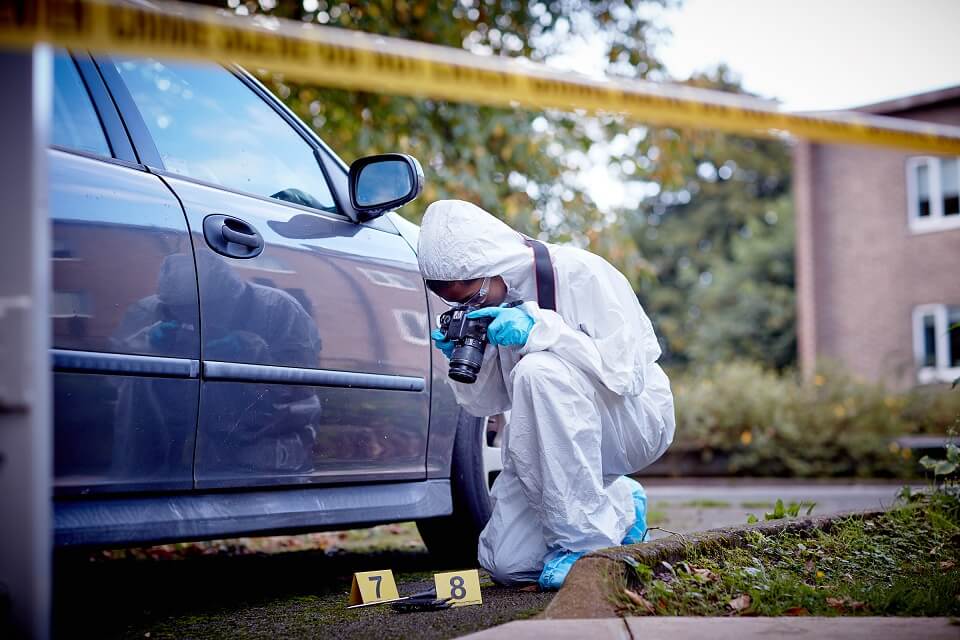
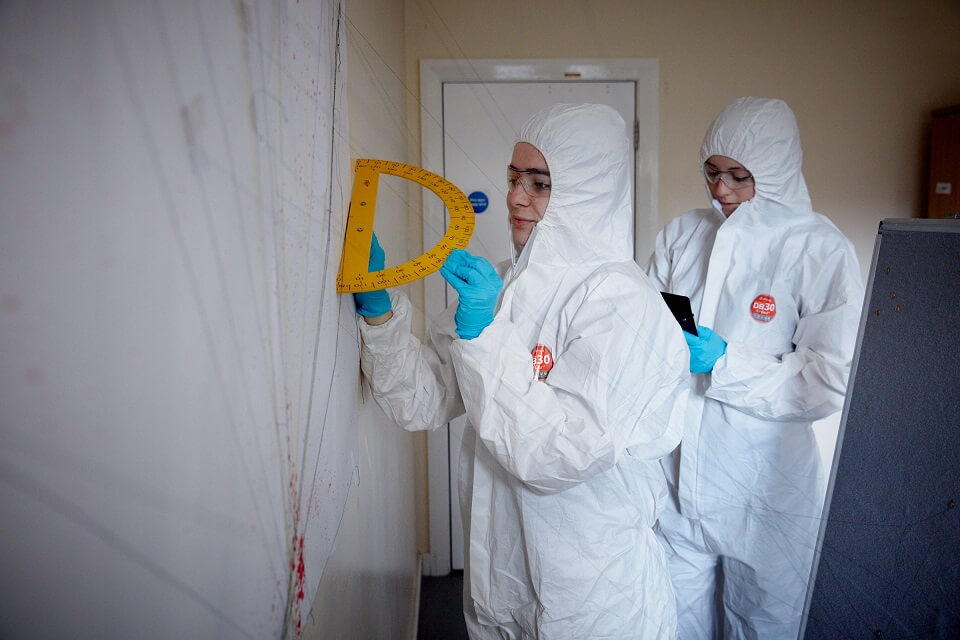
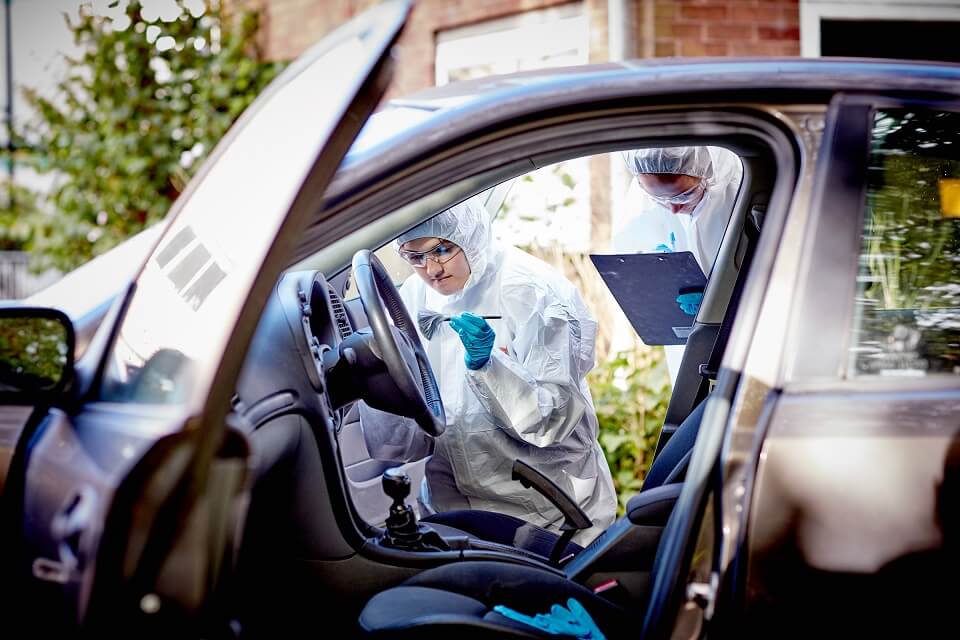
Our teaching is delivered in modern laboratories which are supported with specialist technical staff and industry-standard equipment. You will also have access to our DEFRA-approved outdoor anthropological and taphonomic facility as well as our crime scene facilities and the wider campus.
As part of this programme, you will also have the opportunity to choose a specialism which will form the basis of your intensive research project/dissertation. You will identify your subject specialism during your application process on to the MSc and will choose from the following themes:
- Forensic Chemistry
- Forensic Investigation
- Forensic Anthropology and Archaeology
- Digital Forensics
- Forensic Search
- Wildlife Forensics
- Environmental Forensics
- Forensic Biology
Your independent project will equip you with advanced skills in research design, management and data analysis as well as communication skills, as you work with academic staff and have the possibility of liaising with external professionals on case work.

Course structure
The MSc in Forensic Science comprises four compulsory modules (105 credits) and you will choose additional optional modules to the weighting of 75 credits. The information below is based on the full time, 180 credit MSc programme, with a September start. The module list is indicative and may be subject to change.
Our programme can be undertaken either full or part-time. This allows you to undertake this programme alongside other commitments you may have. Irrespective of the route you take, the programme will start in September. The programme will last 1 year if you study full-time, or 2 years if you choose the part-time route. Throughout the programme there is a chance to tailor your studies with a range of option modules that run alongside the core content.
Modules
The module details given below are indicative, they are intended to provide you with an idea of the range of subjects that are taught to our current students. The modules that will be available for you to study in future years are prone to change as we regularly review our teaching to ensure that it is up-to-date and informed by the latest research and teaching methods, as well as student voice. The information presented is therefore not intended to be construed and/or relied upon as a definitive list of the modules available in any given year.
Compulsory modules
FSC-40035: Research Project Design and Management (15 credits)
This module aims to provide training to successfully manage your research and career through reflective practice, a short progress report of research and research training activities carried out throughout the year, and a poster presentation of preliminary results. The content of the module will be delivered via a combination of one-to-one meetings with your project supervisor(s), independent research and self-learning techniques. It is expected that supervision meetings take place at least once every two weeks.
FSC-40045: Forensic Research Skills (15 credits)
This module aims to build on your research skills developed from your Level 6 research project. You will enhance your ability to design and manage a research project. You will use self-reflection on your research skills to enhance your scientific writing skills and will further develop the ability to professionally present the findings of scientific research. These fundamental skills will help you succeed in carrying out your research project under guidance from your supervisor.
FSC-40051: Contemporary Topics in Forensic Science (15 credits)
You will explore the current cutting-edge research topics on forensic sciences, critically evaluating these topics in terms of their strengths, weaknesses and significance for both the discipline and society. This module will be based on a combination of guest lectures and workshops covering computer aided literature searching, reviewing research manuscripts, web authoring techniques, and writing an article for a popular scientific magazine, as well as independent research. By the end of the module you will have further developed your research skills, have acquired in depth knowledge of forensic science topics at the forefront of the discipline, will have acquired the necessary skills to design and produce a web site to a professional standard and will have further developed your scientific communication skills.
FSC-40061: MSc Forensic Research Project (60 credits)
This forensic research project module focuses on a student-led research project culminating in the write-up of the research project in the form of a masters dissertation, which is arguably the most important module of the whole course. The module is delivered via a combination of one-to-one meetings with the project supervisor(s), independent research and self-learning techniques. It is expected that supervision meetings take place at least once every two weeks.
Optional modules
FSC-40015: Literature Review (15 credits)
The emphasis of this module will be to develop your information literacy and skills in searching for, selecting and critically evaluating peer reviewed research literature relevant to your masters research dissertation and then synthesising these appraisals into a literature review. This module will be a combination of seminar/tutorials with the project supervisor and self-learning techniques. It is expected that supervision meetings will take place at least once every two weeks and will develop your confidence in discussing and critiquing natural and social science, and issues within the field of research.
FSC-40029: Environmental and Wildlife Forensics (15 credits)
Through this module, you will have the opportunity to apply your forensic expertise to environmental and wildlife crime, exploring advanced topics ranging from industrial contamination of land to the illegal trade of exotic animal products. We will equip you with the advanced skills to investigate environmental crime scenes, interrogate a range of natural and artificial evidence types, and to combine different types of data to protect the environment and wildlife in the U.K. and beyond.
FSC-40037: Forensic Science Principles (30 credits)
This module will provide you with the necessary scientific background for you to be able to complete a MSc in forensic science. You will develop the ability to carry out the forensic examination and reporting of evidence within the professional context of crime scene examiner, forensic scientist and expert witness. The semester 1 content will focus on developing your understanding of forensic science as an academic discipline. It will also provide you with a background in chemistry and biology that is required for the semester 2 content and assessments. Semester 2 will take you from the crime scene to the court. You will process a crime scene and collect the key evidence needed for your investigation. This evidence will be taken back to the lab where you will analyse and evaluate it in the context of the case. Finally, you will produce an expert witness report which you will present in a mock courtroom setting.
FSC-40039: Major Scene Investigation: From Crime to Trial (15 credits)
Throughout this module you will gain professional, expert experience, skills and knowledge, whilst strengthening skills learnt through previous modules that are transferrable for use in professional forensic practice. Focussing on Forensic Strategy and how joint investigations are managed - you will investigate major crime scenes, report to Senior Investigating Officers and undertake practical work. Ultimately, making you a credible ‘Expert Witness’ to present your evidence in court.
FSC-40041: Marks and Traces Advanced Examination (15 credits)
This module provides advanced knowledge and practical experience of marks and trace examination that will prepare you for the forensic laboratory practitioner workplace. Working through current SOPs and guidelines at the forefront of the discipline will provide valuable employability skills. An emphasis will be made on the documentation of advanced forensic physical trace evidence that will be usable in court.
FSC-40043: Forensic Analysis: From Academia to Industry (15 credits)
As you start your final year, thoughts turn to what you are going to do after university. This module is designed to aid the transition from the academic laboratory to one in industry. This module will build on the analytical skills that you have developed throughout the course and teach you some of the key concepts that are important in an industrial laboratory. This will give you an insight to being an analytical scientist in industry which will be invaluable for interviews and your future career. This module will be more hands on than lecture based, and the assessments are centred on activities that are carried out in industry.
FSC-40049: Forensic Anthropology: Complex Scenes, Recovery and Analysis
In this module you will build on your existing knowledge of forensic anthropology and taphonomy, practicing more specialist techniques and developing your critical analysis skills. You will spend time working out in the field, practicing the methods used to locate and recover skeletal remains, as well as in the laboratory where you will gain experience in microscopy, virtual anthropology, photography and soil sampling. The module will encourage you to apply environmental evidence, such as botany, diatoms, and entomology to casework, and you gain confidence in differentiating between human and animal bone.
FSC-40055: Digital Forensics: Applications and Advanced Examinations
This module will provide leading knowledge and understanding of Digital Forensics at the forefront of the discipline. Using AXIOM, software used within industry, you will work through a number of tasks to gain the critical skills vital for working within a digital forensics unit. You will be asked to complete written assessments, one of which will be a court report focusing of digital evidence and take an external examination to become a certified examiner within the software.
FSC-40057: Advanced Topics in Forensic Biology (15 credits)
This module will allow you to build advanced skills in collecting and interpreting forensic biological data. This will involve expanding your abilities in working with soft tissue, DNA analysis, teeth and entomology. This will involve learning in the lab to grow practical skills in both collecting and analysing forensic biological evidence. Assessment is aimed at assessing your abilities in a practical sense through forensic reports. This module aims to provide career prospects in forensic biology at the forefront of the discipline, and is ideal if you have an academic interest in biology and/or aspirations to work within forensic biology in the future.

Entry requirements
The following section details our typical entry requirements for this course for a range of UK and international qualifications. If you don't see your qualifications listed, please contact us to find out if we can accept your qualifications.
Typical offer
Please ensure that you read the full entry requirements by selecting your qualifications from the dropdown menu below. This will include any subject specific, GCSE/Level 2 Maths, and English language requirements you may need.
Please select your country from the drop-down list below for the full entry requirement information
UK
2:2 degree in any subject
or
demonstrated relevant professional qualifications or experience
You will also need: an English language qualification (see below)
Algeria
12/20 or Assez Bien degree in any subject
or
demonstrated relevant professional qualifications or experience
You will also need: an English language qualification (see below)
Bahrain
Bachelor's degree with a minimum CGPA of 2.7/4.0 in any subject
or
demonstrated relevant professional qualifications or experience
You will also need: an English language qualification (see below)
Bangladesh
60% in a 4-year degree or 3-year degree with a 2-year Master's in any subject from a public university or CGPA 2.8 in a 4-year degree or 3-year degree with a 2-year Master's in any subject from a private university
or
demonstrated relevant professional qualifications or experience
We don’t accept degrees from certain universities, please see our Bangladesh Country Page for more information
You will also need: an English language qualification (see below)
Canada
70% or C or a GPA of 2.5 in a degree (Ordinary or Honours) in any subject
or
demonstrated relevant professional qualifications or experience
You will also need: an English language qualification (see below)
China
70% in a degree in any subject or 65% in a degree in any subject from a '211' university
or
demonstrated relevant professional qualifications or experience
You will also need: an English language qualification (see below)
Egypt
Bachelor degree from a Public or Private University with 65%/CGPA = 2.7/Good in any subject
or
demonstrated relevant professional qualifications or experience
You will also need: an English language qualification (see below)
Ghana
Second class degree in any subject
or
demonstrated relevant professional qualifications or experience
You will also need: an English language qualification (see below)
Hong Kong
Bachelor's Honours degree with 2:2 or CGPA of 2.5 OR Bachelor Ordinary degree with a CGPA of 3.4 in any subject
or
demonstrated relevant professional qualifications or experience
You will also need: an English language qualification (see below)
India
55% or CGPA 6/10 in any degree of three years or longer
or
demonstrated relevant professional qualifications or experience
You will also need: an English language qualification (see below)
Kenya
Second class degree in any subject
or
demonstrated relevant professional qualifications or experience
You will also need: an English language qualification (see below)
Kuwait
Bachelor's degree with a minimum CGPA of 2.75/4.0 or 3.5/5.0 in any subject
or
demonstrated relevant professional qualifications or experience
You will also need: an English language qualification (see below)
Nepal
60% / 2.4 in a 4-year Bachelor's degree in any subject
or
65% / CGPA 2.8 in a 3-year Bachelor's degree in any subject
or
demonstrated relevant professional qualifications or experience
You will also need: an English language qualification (see below)
Nigeria
Second class degree in any subject
or
demonstrated relevant professional qualifications or experience
You will also need: an English language qualification (see below)
Oman
Bachelor's degree with a minimum CGPA of 2.5/4.0 in any subject
or
demonstrated relevant professional qualifications or experience
You will also need: an English language qualification (see below)
Pakistan
We accept a range of qualifications from Pakistan. Please visit our Pakistan Country Page for more information
or we will consider demonstrated relevant professional qualifications or experience
You will also need an English language qualification (see below)
Qatar
Bachelor's degree with a minimum CGPA of 2.75/4.0 in any subject
or
demonstrated relevant professional qualifications or experience
You will also need: an English language qualification (see below)
South Africa
Second class division 2 / 60% in a Bachelor's degree with Honours in any subject
or
Second class division 1 / 70% in an Ordinary Bachelor's degree in any subject
or
demonstrated relevant professional qualifications or experience
You will also need: an English language qualification (see below)
Sri Lanka
55% in a Special Bachelor's degree in any subject
or
demonstrated relevant professional qualifications or experience
You will also need: an English language qualification (see below)
Turkey
A CGPA of 2.5/4.0 in a Bachelor degree (Lisans Diplomasi) in any subject
or
demonstrated relevant professional qualifications or experience
You will also need: an English language qualification (see below)
UAE
Bachelor's degree with a CGPA of 2.5/77%/B- in any subject
or
demonstrated relevant professional qualifications or experience
You will also need: an English language qualification (see below)
Uganda
Second class degree in any subject
or
demonstrated relevant professional qualifications or experience
You will also need: an English language qualification (see below)
USA
Bachelor's degree with a minimum CGPA of 2.6 in any subject
or
demonstrated relevant professional qualifications or experience
You will also need: an English language qualification (see below)
Zimbabwe
Second class degree in any subject
or
demonstrated relevant professional qualifications or experience
You will also need: an English language qualification (see below)
English language requirements
All of our courses require an English language qualification or test. For most students, this requirement can be met with a 4 or C in GCSE English. Please see our English Language guidance pages for further details, including English language test information for international students. For those students who require an English language test, this course requires a test from Group C.
References
Normally, you will need to provide at least one academic reference to support your application unless you have been out of study longer than two years. If it has been more than two years since you last studied on a degree-level programme, you will normally need to provide an employment reference instead. For more information about Academic References, please see our Postgraduate how to apply web pages.
Personal Statement/Statement of Purpose
Please see our Postgraduate how to apply web pages for guidance on what to include in your personal statement.
Recognition of Prior Learning
The Recognition of Prior Learning (RPL) is a process which enables applicants to receive recognition and formal credit for learning acquired in the past through formal study or work and life experiences.
RPL can also be requested for admission onto the start of a programme in lieu of the admission requirements. For more information, see our Recognition of Prior Learning web pages.
Professional qualifications and work experience
The majority of our courses will consider relevant work experience and/or professional qualifications at the appropriate level, as an alternative to an undergraduate degree for entry. The work experience should be for a sustained period and at a suitable level, based within a relevant sector to your chosen course.
Admissions staff will review your work experience and/or professional qualifications during the assessment of your application to ensure suitability in terms of relevancy, level and appropriate learning outcomes.
General information
The entry grades outlined in this section indicate the typical offer which would be made to candidates, along with any subject specific requirements. This is for general information only. Keele University reserves the right to vary offer conditions depending upon a candidate's application. For international students, find out how we work with approved agents as part of our admissions process.
Social life, societies and sports
Find out moreAccommodation
Find out moreLocal area and travel
Find out moreBoost your employability
Find out more
Postgraduate funding and scholarshipsFees, funding and scholarships
Fees
For continuing students, fees will increase annually by RPIX, with a maximum cap of 5% per year.
Funding
Whether you're continuing from undergraduate study or returning to education, our dedicated financial support team is here to help.
Please note, if your course offers a January start date, the January 2026 start date falls in the 2025/26 academic year. Please see the tuition fees archive for the 2025/26 fees.
Planning your funding
It's important to plan carefully for your funding before you start your course. Please be aware that not all postgraduate courses and not all students are eligible for the UK government postgraduate loans and, in some cases, you would be expected to source alternative funding yourself. If you need support researching your funding options, please contact our financial support team.
Scholarships
We are committed to rewarding excellence and potential. Please visit our scholarships and bursaries webpage for more information.
For continuing students, fees will increase annually by RPIX, with a maximum cap of 5% per year.
Scholarships
We know that understanding what support is available for postgraduate students is an important step in planning your future and we are committed to rewarding excellence and potential.
Visit our scholarships and bursaries webpage to find out more about our scholarships, including:
- Keele Global Scholarship – up to £5000 tuition fee discount for international students (2027/28)
- Keele Graduate Scholarship – up to £3000 tuition fee discount for home students (2027/28)
Terms and conditions apply.
Additional costs
You may incur optional costs which can enhance your learning experience (e.g., fieldwork or specialist equipment). Details are outlined below. For general information, see the university's additional costs information.
If students lose or require replacement PPE/laboratory items these are available at the cost of:
- Laboratory Book: £1.50
- Laboratory Glasses: £3.50
- Laboratory Coat: £13

Teaching, learning and assessment
How you'll be taught
Teaching on this programme will be delivered by staff in the School of Engineering and Physical Sciences, with research interests across a range of scientific disciplines.
You will be taught using various methods and will be required to engage with independent learning as well as lectures, seminars, workshops and tutorials, in addition to practical laboratory classes and problem-based learning. You will have the opportunity to work with peers and academics delivering the programme, through group discussions and presentations.
Teaching throughout the programme will equip you with advanced skills including data analysis, academic writing and how to undertake postgraduate-level literature reviews, which will prepare you for your assessments and dissertation/research project.
How you'll be assessed
You will engage with different assessment methods to challenge the knowledge and skills you attain and have developed on this programme. This will enable you to demonstrate original thinking, independent research and sound academic skills that are evident throughout your studies.
Assessment methods may include:
- Case reports
- Court presentations
- Literature review
- Poster presentations
- Reflective diary
- Group report
- Dissertation