

History and Heritage
Ranked 6th in the UK for the quality of research outputs (Research Excellence Framework 2021)
Historical Breadth, Contemporary Relevance
Our research spans periods from the medieval to the contemporary, and encompasses regions including Britain, Europe, the United States, South Asia and the wider global world. Diverse in chronological and geographical scope, our work is united by a shared commitment to understanding how societies are shaped through power, conflict, culture, economy, environment, and belief.
This breadth is matched by a strong commitment to contemporary relevance. We examine how historical processes from law and governance to social movements, environmental change and cultural life continue to inform debates about inequality, identity, conflict and justice today.
We draw on a wide range of historical methods, including archival research, oral history, and visual and spatial analysis, as well as interdisciplinary approaches informed by political theory, cultural studies, and the environmental humanities. Digital tools and methods further support research, collaboration, and dissemination, extending both the reach and accessibility of our work.
Research in Practice
History and Heritage research at Keele contributes to the University's interdisciplinary research culture, working with Keele's research institutes and external partners. Our work spans five interconnected areas: Law, Politics and Conflict; Economy, Labour and Society; Identity, Culture and Everyday Life; Environment, Technology and Society; and Global and Transnational Histories. This research is strengthened through collaborations with archives, museums, heritage organisations, schools, policymakers and community groups. Alongside our internationally recognised research, we support a thriving postgraduate research community and a growing portfolio of collaborative and externally funded projects.
Research in this area explores systems of authority, governance, and political change across time, encompassing work on medieval canon law, the English Civil War and political ideologies such as fascism. It also examines how conflict is remembered and commemorated through war memorials, architecture and the material and visual cultures through which power finds expression.
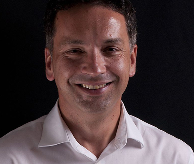 Iconic Fascism (Bloomsbury, 2025) explores the paradox at the heart of fascist politics: fascist movements and regimes were both passionate makers of new political icons and ruthless destroyers of those associated with their enemies. Through a comparative study of street violence, mass spectacle, political ritual, and monumental architecture, it shows how fascism sought to make politics emotionally powerful and visually inescapable. The book reveals how fascism's "iconic compulsion" (its need to condense moral absolutes into visible, emotionally potent symbols) was bound up with a wider struggle to dominate public life, erase rival meanings, and create new sacred symbols of authority, unity, and national rebirth.
This area examines economic life and its social consequences, from mercantile culture and economic practice to the structures of slavery and inequality. It explores how economic systems shape social relations and political dynamics, and how labour, capital and power have intersected across different historical contexts.
Project: Knowledge, Information and Business Education in the Early Modern Atlantic World

Accurate information is essential to successful business activity. The early modern period was shaped by an increase in printed commercial information, including newspapers, printed exchange rates, and educational texts – a ‘print revolution’ that has rightly attracted scholarly attention. However, increased focus on printed material means that we know much less about the ways in which manuscript, oral, and informal transmission of business information persisted. My research explores the ways in which business information was created, disseminated, and used in the early-modern Atlantic World. This work, funded by the AHRC (Arts and Humanities Research Council) and the British Academy has resulted in a monograph, a co-edited collection, and several articles and critical editions investigating aspects of knowledge acquisition, including commercial education, the application of legal knowledge, the oral exchange of information, and the spaces in which dissemination took place. My research poses questions about the ways in which business knowledge is created and consumed today, a timely issue for public understanding of news and information exchange in an increasingly digital age. This research directly informs my teaching, especially in my final-year module News and Knowledge in the early modern Atlantic World.
Related external funding:
- 2022-2023 - British Academy Mid-Career Fellowship (PI; £145,351 fec).
- 2017-2022 - AHRC Leadership Fellowship, AH/P009034/1 (PI; £180,888 fec)
Research here focuses on how identities are formed, represented, and contested. Topics include the history of sexuality, religion and belief, migration and citizenship, and civil rights struggles. This work explores how cultural practices and belief systems interact with broader social and political change, from the life and afterlife of figures such as Oscar Wilde, to the everyday experiences of communities navigating belonging and exclusion.
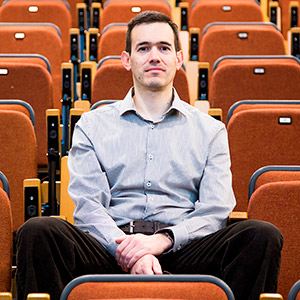
Dominic Janes is working on a project that investigates queer student life at the Universities of Oxford and Cambridge during Britain's imperial height (1870s to 1930s). This employs extensive archival research to explore student lives, attitudes and cultural practices. Articles have been published in a range of journals and a book will follow.
From 2025-2027 he is PI on a Leverhulme Project grant with Douglas Pretsell as postdoctoral researcher which investigates homosexuality as a diagnosis within the International Classification of Diseases. This is the World Health Organisation's system which has been used in the UK since World War Two.
He is also co-editing the Oxford Handbook of LGBTQ History with Howard Chiang (UC Santa Barbara). This will evidence and consolidate the development of queer history as a sub-discipline.
This area explores the historical relationships between people, environments, and technological systems. Drawing on topics including environmental change, mountaineering, nuclear decommissioning, and disability, it examines how societies have engaged with the natural world and with the technologies that shape everyday life.
Museum of Possibilities
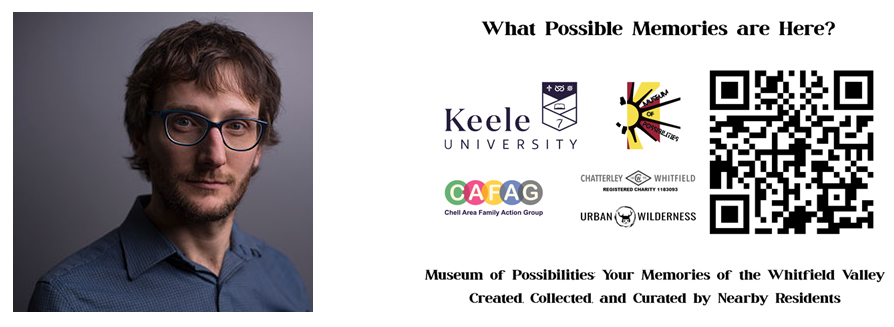
I often work in ways that encourage members of the public to think again about history and heritage, and their power to shape what we think of the past. Since 2020, I've worked with Stoke-based arts organisation Urban Wilderness on methods to capture a 'dynamic heritage' emerging from everyday interactions with the environments around us, methods we collectively call the 'Museum of Possibilities'. Most recently, I worked with the Chell Area Family Action Group to capture an alternative, emergent memory of the Whitfield Valley to complement more familiar narratives of coal mining and closure. We conducted a collaborative evidence collection exercise on ourselves as we walked around the Whitfield Valley Country Park, and then, a couple of weeks later, we met again to co-curate an online exhibition of our findings. What emerges from these exercises are often surprising, playful and visual stories, that connect to established narratives of mining in complex ways, and reveal new and emerging threads of connection to the site - from Elvis impersonators, to memories of play in 'Banky Brook' and the place as a wildlife site. You can visit our co-curated exhibition via the QR code below.
Several colleagues work on histories that cross national and regional boundaries, tracing the movement of people, ideas and political movements across the world. Research in this area includes work on migration, diaspora, slavery and the Atlantic world and transnational activism.
From empire to citizenship: a Digital Archive of British Nationality, 1844–1948 (DABN)
Funded by a Major Research Fellowship, Leverhulme Trust (2025). https://media.leverhulme.ac.uk/feature/rbright
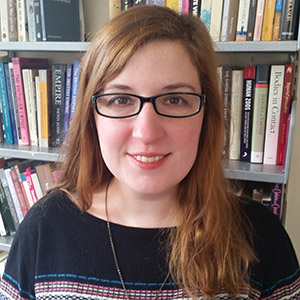
Rachel Bright's project is the first global history of British nationality, analysing over 300,000 records to explore how legal Britons were identified, made, or denied across Britain and its empire between 1844 (Britain’s first naturalisation act) and 1948 (the year of Windrush, Britain’s first citizenship Act, and the beginnings of decolonisation).
It is surprising how little we know about who is British, even in the most basic legal sense. it has never required universal documentation, and the Windrush Scandal revealed how poorly existing records were preserved. The empire complicates matters further, with colonial systems across Africa, Asia, and beyond developing their own nationality processes, most of which are now held at the National Archives in Kew – from former African colonies (8,000), Asian colonies (28,000), and other colonial outposts (5,000).
Using archival catalogues alongside biographical life stories, the project examines how naturalisation and denaturalisation connected to gender, family, economics, and social inclusion. It will culminate in an open-access digital archive and resources for family historians, researchers, and educators.
Anyone interested in the project personally or professionally is encouraged to contact Dr Bright directly.
Cross cutting themes
Across these areas, our research engages with:
- Power and political authority
- Social inequality and justice
- Cultural expression, religion and belief
- Conflict, memory and commemoration
- Environment, technology and society
- Visual and material cultures of power
- Public history, heritage and the uses of the past
- Digital research methods and public engagement