

English Literature and Creative Writing
90% of our Research was rated ‘world-leading’ or ‘internationally excellent’ (Research Excellence Framework 2021)
Research in English and Creative Writing is innovative, creative, and impactful, forging links with the wider region and external partners. Our wide-ranging, interdisciplinary research focuses on literature from the Renaissance period to the Contemporary, interpreting these texts – and their relationship to the cultures that produced them – for a range of audiences. Inspired by Stoke-on-Trent’s vibrant cultural identity, much of our work focuses on the ways in which words and stories can connect and strengthen local or regional communities and encourage broader engagement with the region’s literary history and heritage.
Research in English and Creative Writing aligns with and supports Keele’s Institute for Social Inclusion (KISI), particularly the Institute’s strategic themes related to ‘Place, Participation, and Heritage’ and ‘Fostering Inclusion’. Our research clusters blend critical and creative approaches and include ‘Literary History and Textual Editing’, ‘Creativity and Wellbeing’, and ‘Place, Region, and Heritage’. We also support a range of postgraduate research students, some of whom are pursuing collaborative projects with external partners.
Literary History and Textual Editing
Dr Rebecca Bowler is leading on an innovative new scholarly edition of the collected works of May Sinclair, which will be published by Edinburgh University Press. This influential modernist writer, philosopher, and public intellectual has not received the critical attention she deserves, and the editions will make it easier for readers to find her work. The edition will publish her work in themed tranches, the first of which will be ‘philosophy and mysticism’, positioning her two books of philosophy side by side with her two most philosophical novels. The publication of the editions in tranches is intended to create opportunities for editors, readers and scholars to read Sinclair’s texts thematically and to trace parallels and cross-currents between texts. Her characters, in the fiction, read the very books she discusses in her non-fiction; they encounter and discuss the same philosophical ideas. They also have love affairs, financial trouble, and experience despair and happiness! The project draws on archival material from the Kislak Center, University of Pennsylvania and The Keep, University of Sussex, and examines Sinclair’s manuscripts for information about her writing process.
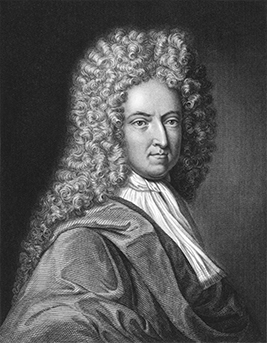
Professor Nicholas Seager’s scholarly edition of the Correspondence of Daniel Defoe (Cambridge University Press, 2022) won The Literary Encyclopedia’s prize for scholarly contributions to our understanding of literature originally in the English language.
Defoe is now most famous as a novelist, the author of Robinson Crusoe (1719) and Moll Flanders (1722). However, his fictions are not mentioned in the surviving correspondence, which instead chart his chequered career as a political agent and propagandist. The letters cover a fascinating period of history, a time which included the establishment of a two-party political system, the parliamentary union of England and Scotland, a controversial war with France, and an explosion of hostile political journalism.
Editing the letters from original manuscripts required careful textual transcription and detailed explanation of Defoe’s movements and motivations, such as when he went to Edinburgh to spy on behalf of English politicians, and when he adopts pseudonyms, writes in code, or uses disguised handwriting to cover his tracks when working as a government agent.
Seager is working on new editorial projects: an edition of the eighteenth-century poet and satirist Alexander Pope’s correspondence, and an edition of Frankenstein-author Mary Shelley’s historical romance Perkin Warbeck (1830), about a man who claimed to be one of the surviving Princes in the Tower and so the true King of England in the late fifteenth century.
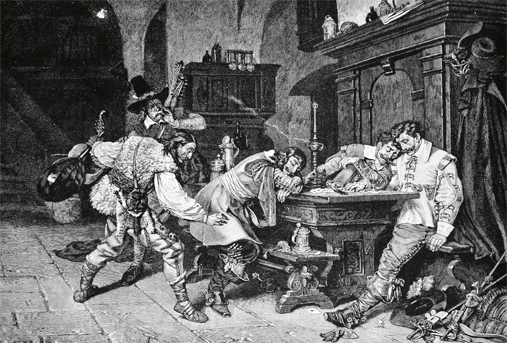
Professor Jonathon Shears’s work centres on literary history and the development of ideas through poetic inheritance and intertextuality. But this is an area he engaged with most extensively when writing his monograph, The Hangover: A Literary and Cultural History (2020). The book charts the cultural status of hangovers – that is the aftermath of alcohol consumption – in Western literature and culture from the Renaissance to the present day, arguing that hangovers are one of the clearest indicators of personal and social attitudes to alcohol use.
Constructing a history of this sort that spans more than 400 years of literature presented challenges and Jon’s approach had to be continually adjusted to account for historical factors. Perhaps the most significant of these factors was that word hangover was only introduced to the English language at the start of the twentieth century. In order to find material, he therefore needed to learn the vocabulary of the hangover in earlier periods. Then there was the challenge of sifting through huge amounts of drinking literature where the hangover rarely featured before striking gold. One of the most rewarding dimensions of the research was that it meant recovering work by writers who had previously been neglected in literary histories as well as finding new dimensions in works by the likes of Shakespeare, Dickens, Fitzgerald and Bukowski.
Dr Rachel Adcock is currently participating in an AHRC project to produce a comprehensive edition of the work of Aphra Behn (1640–1689), an author celebrated by Virginia Woolf as the first professional woman writer. This new edition seeks to encourage greater appreciation of Behn’s achievements and her significance in literary history.
Rachel has edited two of Behn’s political comedies, The Roundheads (1681/2) and The City-Heiress (1682), which were produced during a turbulent time in English politics. As is characteristic of her work, Behn found interesting ways to reimagine current conflicts and controversies for theatre audiences, connecting debates about power (and consent to power) to the treatment of women.
Rachel’s edition of The City-Heiress was published in the fourth volume of The Cambridge Edition of the Works of Aphra Behn which went on to win the 2023 Modern Language Association Prize for a Scholarly Edition, and the 2021 Josephine Roberts Prize for a Scholarly Edition by the Society for the Study of Early Modern Women and Gender. She is now beginning work on editing the correspondence of the influential seventeenth-century divine, Richard Baxter.
Creativity and Wellbeing
Actor and theatre maker Anna Deveare Smith lived in New York City when the Crown Heights riots broke out in 1991. She felt that what was happening in her community was not being adequately reported on by the media, so she took her tape recorder into the street and began recording interviews. She transcribed the material and then performed every character in the one-person show Fires in the Mirror at the Public Theater. Deveare Smith is regarded as one of the pioneers of verbatim theatre, a technique which has spread around the world, capturing unheard voices and giving them an audience.
Together with theatre practitioner Kristine Landon-Smith, Freddie Machin regularly leads verbatim theatre projects, supporting participants to make their own verbatim production based on interviews that they conduct, edit and perform. In performance the actors wear headphones so they can listen to the recorded interviews and speak along with the words they hear.
Most recently, Freddie led an Arts Council Funded project at Nottingham Playhouse with a cast made up of amateur performers drawn from a range of diverse communities. The content of the interviews they captured was astounding – intimate, personal, and frequently very moving. At every stage of the process the actor/interviewer is required to engage in the practice of deep listening – in the interview, in the editing process, and in performance – and it makes for incredible theatre. In a fast-moving world listening can feel like a radical act, and whenever Freddie leads these projects he feels the immense privilege of being able to witness people’s stories. The verbatim technique has been used successfully in a wide range of contexts, indeed wherever the truth is concealed, ignored or misrepresented there is a place for verbatim theatre to restore pride, give comfort and bear witness.
Dr Becky Yearling was the lead researcher on a British Academy/Leverhulme Small Grant that investigated how scenes of violence in Shakespeare’s plays are taught in UK secondary schools. As part of this project, she and her co-investigator, a Professor of Education at Bristol University, collected data from teachers and pupils through surveys and focus groups. Their aim was to find out whether teenagers typically find Shakespeare’s violence disturbing and, if so, in what ways, and to explore how common it is for teachers to use content warnings with this material.
This project’s overall goal was to gain new insights into the strategies, challenges and ethical implications involved in teaching Shakespeare’s violence. It led to the publication of an article - ‘Shakespeare’s violence and the use of content warnings in UK secondary schools: what do students think?’ - in the Cambridge Journal of Education (2025), and a collection of downloadable resources for teachers teaching these plays at GCSE and A-Level, available at https://teachingshakespearesviolence.co.uk/
The research is part of Becky’s larger interest in Shakespeare and audience response to his works. She has recently published a book on violence in Shakespeare, with a final chapter that discusses content warnings and the question of how modern reactions to Shakespeare’s violence might be similar to, or different from, the reactions that people had in Shakespeare’s own time. At Keele, Becky also teaches a final-year undergraduate module on Shakespeare on Film, which thinks more widely about how we respond to Shakespeare’s plays in the modern age, and how we adapt them to fit our own tastes and interests.
Stories into Song is a research project led by Dr Nick Bentley and Dr James Peacock and funded by the British Academy. It draws on the research and practice expertise of literary critics and musicians to discover new knowledge about fiction-to-song adaptation and new methods of co-creative literary analysis and teaching.
There are many examples of pop/rock songs being inspired by fiction such as Kate Bush’s ‘Wuthering Heights’, David Bowie’s ‘1984’, and Joy Division’s ‘Colony’. However, there has been no academic study into the creative processes of this kind of adaptation. The Stories into Song Project fills this gap.
It began by analysing selected fiction and song pairings with respect to theme, mood, genre, voice and structure by focusing on some well-known examples like Bush’s ‘Wuthering Heights’ and Jefferson Airplane’s ‘White Rabbit’. Then, in a series of workshops with volunteer participants from the University and the local community, we put the method into practice using ‘Don’t Look Now’, a short story by Daphne du Maurier, as a case study. The group read, analysed and discussed the story, before working together to write the lyrics and music of an original song adaptation. We then drew on the expertise of music production students at Keele to record the song. The fruits of that co-production can be heard here: https://soundcloud.com/storiesintosong.
The final stage of the project included performances of the songs at Keele’s postgraduate clubhouse and at a venue in the local area.
Professor Jonathon Shears’s research explores the intersections of creativity and wellbeing, particularly in the field of literary gerontology. Combining literary study with other disciplinary approaches and elements of practice-based research, it challenges the perception that later life is a period of inevitable decline and cultural marginalisation.
The British Academy Landmark Conference, ‘Narratives of Old Age and Gender’, brought together specialists in literature, history, theatre, psychology, sociology, fashion and film, alongside creative practitioners, campaigners, arts educators and charity workers. The results were published in the multidisciplinary Journal of the British Academy (2023). In many of Jon’s publications, he analyses the ways poetry can provide an alternative mode of expression to narratives of foreclosure.
Public engagement is a central factor in Jon’s work on the life course. He has disseminated work on ageing and wellbeing as part of exhibitions held at the British Academy and The Royal Society. In 2023 he addressed Global Intergenerational Week on the challenges and opportunities experienced by different age cohorts in the Stoke-on-Trent region. Much of his work in this area proposes that intergenerational connections are invaluable in generating positive age-outcomes. His project with the age-advocacy charity, The Beth Johnson Foundation, demonstrates the value of imaginative play and the importance of green spaces for wellbeing for different generations.
Place, Region, and Heritage
Dr Lisa Blower, Reader in Creative Writing, worked with New Vic Borderlines to produce a piece of commemorative theatre to mark 40 years of the North Staffs Miners’ Wives Action Group, a group founded to support miners and their families affected by the 1980s Miners’ Strikes. These women not only made social and political history but took their fight way beyond the coalfield and still do.
With support from Keele’s Institute for Social Inclusion, ‘The Miner Birds’ has taken flight beyond all expectations. Written as a celebration of these women’s history though poetry, performance, and song, the play is a reminder of what our local mining community experienced during the strike and beyond. It also brings to life the assiduously documented files full of letters, speeches, photographs and pit camp diaries that the group have collected and preserved since their inception.
The New Vic staged five outdoor performances of ‘The Miner Birds’ with a touring caravan backdrop to replicate the women’s 1993 Trentham pit occupation. The play sold out and it took to the streets for the Chartist and Appetite Festivals. On 6 March 2025, the New Vic staged a new longer version of the play in the main house with the original cast to mark both 40 years since the end of the strike and International Women’s Day. A special exhibition of the group’s photographs taken by Kevin Hayes was shown at Keele in Town and their archive has now been rehomed in Keele University Library’s Special Collections.
Ceri Morgan, Professor of Place-Writing and Geohumanities, draws from the post-industrial landscapes of Stoke-on-Trent and in Quebec with her AHRC Project Heartlands/Pays du Cœur. The project explores how new regional writings can be shaped by our relationships with urban and ex-urban spaces and how our bodies engage with those spaces as part of the creative process.
Supported by an Arts and Humanities Research Council Leadership Fellowship, ‘Heartlands/Pays du cœur: Geohumanities and Québec’s “regional” fiction’ was a two-stranded project. One strand considered representations of Québec’s Eastern Townships in twenty-first century fiction and creative nonfiction. The other strand saw Ceri work with artists and community members to make new place-art, including a digital literary map, audio walk, dance solo, and dance-poetry film. Made with Restoke and Junction15, the film, Heartlands: Earth & Bones (2024), has been screened at twenty-five international festivals so far.
Dr James Peacock has recently completed a monograph for Bloomsbury Academic called Gentrification in Contemporary Fiction: Domestic Spaces, Neighbourhoods and Global Real Estate (2025). The book is the major output to emerge from a research project on which James has been working since 2016, and which itself emerged from his previous project on Brooklyn fictions (an interview with James can be found here: Examining Brooklyn’s Fictions – RhysTranter.com). The latest project explores how twenty-first-century novels in English from Australia, Canada, India, the UK and the US depict the varied experiences of characters living in urban neighbourhoods undergoing gentrification. James is particularly interested in the way domestic spaces – houses and apartments – are important sites of both financial and emotional investment. In these spaces, anxieties about changing neighbourhoods, displacement, class and ethnic tension are keenly felt by inhabitants, who begin to understand the key sociopolitical role real estate plays, and how their private, domestic spaces cannot be separated from the global demands of capital. James has presented on this topic at conferences in Germany, Sweden and the UK.
James is also involved in the British Academy-funded ‘Stories into Song’ project with his colleague Dr Nick Bentley. His research on gentrification novels has inspired a number of his songs: two examples can be found here Cranes by James Peacock | ReverbNation and here This Isn’t Brooklyn by James Peacock | ReverbNation
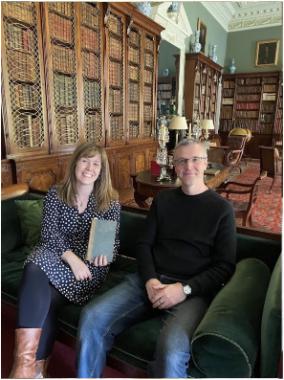
Professor Jonathon Shears, Dr Rachel Adcock, and AHRC-DTP postgraduate researcher, Rachel Daley, are currently working on a project to illuminate the history of the library at Tatton Park, Knutsford, a property owned by the National Trust. Tatton is one of the largest but least researched libraries maintained by the Trust, and the team are building up a picture of the ways in which individual family members (men as well as women) contributed to shaping the library’s collection of over 8,000 books, particularly during the eighteenth and nineteenth centuries. Among the books gathered by the Egerton family at Tatton are first editions of novels by Jane Austen, Sir Walter Scott, and Maria Edgeworth, as well as verse by Lord Byron, William Wordsworth, Anna Laeticia Barbauld, and many more.
More recently, the team have published on what book collecting and book use can tell us about emerging gentry values and identities in the early nineteenth century. Understanding the family’s reading allows us to draw conclusions about their social and cultural values, individual and collective interests, while at times simply illuminating intimate moments of family life that were mediated by books. The history of the Egertons at Tatton is a history that cannot be understood without opening up and throwing light on the hidden treasures of their library.
The team have run various pop-up exhibitions in the library for National Trust visitors. This year Rachel Daley is contributing to Tatton’s new exhibition, ‘Beyond the View – Canaletto at Tatton Park’ (28 March – 1 October 2026), illuminating Samuel Egerton’s connections with leading artists forged during his travels in Venice.