


Advanced Clinical Practice - MSc
The MSc Advanced Clinical Practice is a programme for multi-professional groups which aims to meet the contemporary challenges of advanced clinical practice and is accredited by NHS England’s Centre for Advancing Practice. On successful completion of this programme you will be a recognised Advanced Clinical Practitioner (HEE, 2017) with an expert knowledge base, complex decision-making skills and clinical competencies for expanded autonomous scope of practice, the characteristics of which are shaped by the context in which you practice.
Month of entry
- September, March
Mode of study
- Part time
Fees for 2026/27 academic year
-
Type of study Fees (per year) UK - part time £3,800 This is a Band C course. For modular fees please refer to the modular tuition fees.
Fees
Duration of study
- Part time: 3 years | Modular: Up to 5 years
This course is no longer accepting applications from international students for the 2026/27 academic year.
Why study Advanced Clinical Practice at Keele University?

About the course
The MSc Advanced Clinical Practice pathway offers a broad range of contemporary options for prospective students and reflects the University mission statement in learning and teaching to deliver high quality education with an emphasis on interprofessional and multi-professional learning opportunities.
There are three formal progression points:
- Postgraduate Certificate in Advanced Health Assessment and Clinical Decision Making (60 credits)
- Postgraduate Certificate in Advanced Health Assessment and Non Medical Prescribing (60 credits)
- Postgraduate Diploma in Advancing Clinical Practice (120 credits)
- MSc Advanced Clinical Practice (180 credits)
Applications via this course page are for the standard/HEE funded route only. If you are looking to apply via the apprenticeship route and have employer support for this please contact our apprenticeship team.
This programme is accredited by NHS England’s Centre for Advancing Practice

Accreditation and professional recognition
This programme is accredited by the Centre of Advancing Practice.
Health Education England’s Centre for Advancing Practice has been established to standardise post-registration education by accrediting advanced practice courses that achieve the standards outlined in the multi-professional Advanced Practice Framework. Practitioners who have completed accredited education programmes will be eligible to be listed on the Centre’s Advanced Practice Directory. Programme accreditation from the Centre for Advancing Practice will bring a new level of consistency to the workforce and help showcase advanced practice within health and social care. Welcome - Advanced Practice (hee.nhs.uk)

Course structure
The MSc Advanced Clinical Practice pathway is delivered by a team who have specialist knowledge in advanced practice and its four pillars. Approximately 80% of the curriculum for the MSc Advanced Clinical Practice is recognised as curriculum applicable to an Advanced Clinical Practitioner working in any health discipline and setting. The other 20% of the curriculum will be negotiated between Keele and yourself to consider the education, training and modules required to support your advanced clinical role and areas of interest. You can select modules from within the School of Nursing and Midwifery and the wider Faculty of Medicine and Health Sciences and other, indeed, relevant modules within the University and other Universities through negotiation with the Award Lead.
The allocation of study time is 150 hours per 15 credit module which usually amounts to 5 days of face to face teaching (or equivalent with online learning) and the remainder is personal study time. The teaching is often split into smaller 1 to 3 day blocks.
What you will study
The module details given below are indicative, they are intended to provide you with an idea of the range of subjects that are taught to our current students. The modules that will be available for you to study in future years are prone to change as we regularly review our teaching to ensure that it is up-to-date and informed by the latest research and teaching methods, as well as student voice. The information presented is therefore not intended to be construed and/or relied upon as a definitive list of the modules available in any given year.
Postgraduate Certificate in Advanced Health Assessment and Clinical Decision Making
Health Assessment in Clinical Practice (30 credits)
This practice-focused module aims to equip you with the skills and knowledge to take a comprehensive patient history and a thorough physical and psychosocial assessment. The module is designed to augment and enhance assessment skills along with the ability to apply the findings from a comprehensive health assessment to clinical decision making that is relevant to your clinical role.
Research Application in Clinical Practice (15 credits)
This module will provide you with the opportunity to understand the importance of best evidence in contemporary nursing and healthcare practice, and the ability to locate, evaluate, and use best evidence in developing aspects of the healthcare you deliver. It will also equip you with the ability to critically reflect upon clinical effectiveness while demonstrating creativity, reasoning, and evaluative reflection. The module combines a mixture of lecture presentations, small group tutorials, personal reading, and personal reflective exercises in order to increase your research-mindedness and confidence in your skills to improve clinical practice.
Advanced Decision Making (15 credits)
This module will challenge you to critically reflect on your current practice. The opportunity to explore the associated theoretical models will develop your expertise in consultation, clinical reasoning and clinical decision making within your field of practice.
Postgraduate Certificate in Advanced Health Assessment and Non Medical Prescribing
Health Assessment in Clinical Practice (30 credits)
This practice-focused module aims to equip you with the skills and knowledge to take a comprehensive patient history and a thorough physical and psychosocial assessment. The module is designed to augment and enhance assessment skills along with the ability to apply the findings from a comprehensive health assessment to clinical decision making that is relevant to your clinical role.
Independent and Supplementary Prescribing for Allied Health Professionals (30 credits)
This module will equip allied health professionals acting within their scope of professional practice, to prescribe safely, appropriately and cost effectively as independently and supplementary prescribers. This will enhance their role within clinical practice and enable them to contribute further to the achievement of effective patient outcomes.
OR
Independent and Supplementary Prescribing for Nurses and Midwives (30 credits)
This module will equip nurses and midwives to prescribe safely, appropriately and cost effectively as independent and supplementary prescribers. This will enhance their roles within clinical practice and enable them to contribute to effective patient outcomes and improved service delivery.
OR
Independent Prescribing (Pharmacy) (45 credits)
This module prepares registered pharmacists to practise safely, effectively and autonomously as independent prescribers within their chosen area of clinical practice. Accredited by the General Pharmaceutical Council (GPhC), the module develops the knowledge, skills and clinical reasoning required for patient assessment, diagnosis, evidence-based prescribing decisions and ongoing medicines management. Delivered through a blended learning approach, the module combines online learning, interactive study days and a minimum of 90 hours of supervised clinical practice with a Designated Prescribing Practitioner (DPP). Students develop their clinical assessment, consultation and prescribing competencies through a combination of academic and practice-based learning. Assessment includes a professional practice portfolio, patient case study and clinical and consultation skills assessment. Successful completion enables eligible pharmacists to apply for annotation as an Independent Prescriber with the GPhC.
Postgraduate Diploma in Advancing Clinical Practice
Health Assessment in Clinical Practice (30 credits)
This practice-focused module aims to equip you with the skills and knowledge to take a comprehensive patient history and a thorough physical and psychosocial assessment. The module is designed to augment and enhance assessment skills along with the ability to apply the findings from a comprehensive health assessment to clinical decision making that is relevant to your clinical role.
Research Application in Clinical Practice (15 credits)
This module will provide you with the opportunity to understand the importance of best evidence in contemporary nursing and healthcare practice, and the ability to locate, evaluate, and use best evidence in developing aspects of the healthcare you deliver. It will also equip you with the ability to critically reflect upon clinical effectiveness while demonstrating creativity, reasoning, and evaluative reflection. The module combines a mixture of lecture presentations, small group tutorials, personal reading, and personal reflective exercises in order to increase your research-mindedness and confidence in your skills to improve clinical practice.
Advanced Decision Making (15 credits)
This module will challenge you to critically reflect on your current practice. The opportunity to explore the associated theoretical models will develop your expertise in consultation, clinical reasoning and clinical decision making within your field of practice.
Independent and Supplementary Prescribing for Allied Health Professionals (30 credits)
This module will equip allied health professionals acting within their scope of professional practice, to prescribe safely, appropriately and cost effectively as independently and supplementary prescribers. This will enhance their role within clinical practice and enable them to contribute further to the achievement of effective patient outcomes.
OR
Independent and Supplementary Prescribing for Nurses and Midwives (30 credits)
This module will equip nurses and midwives to prescribe safely, appropriately and cost effectively as independent and supplementary prescribers. This will enhance their roles within clinical practice and enable them to contribute to effective patient outcomes and improved service delivery.
OR
Independent Prescribing (Pharmacy) (45 credits)
This module prepares registered pharmacists to practise safely, effectively and autonomously as independent prescribers within their chosen area of clinical practice. Accredited by the General Pharmaceutical Council (GPhC), the module develops the knowledge, skills and clinical reasoning required for patient assessment, diagnosis, evidence-based prescribing decisions and ongoing medicines management. Delivered through a blended learning approach, the module combines online learning, interactive study days and a minimum of 90 hours of supervised clinical practice with a Designated Prescribing Practitioner (DPP). Students develop their clinical assessment, consultation and prescribing competencies through a combination of academic and practice-based learning. Assessment includes a professional practice portfolio, patient case study and clinical and consultation skills assessment. Successful completion enables eligible pharmacists to apply for annotation as an Independent Prescriber with the GPhC.
Applied Advanced Healthcare Leadership and Management (45 credits)
This module is designed to enable you to develop your understanding and awareness of advanced health care leadership and management to support the complex, demanding needs of current and future health sector environments. You will learn through a range of flexible blended learning modalities, within a supportive community of practice.
Advanced taught module (15 credits)
This is a module of your choice, which aligns with your professional development, selected from the available 15 credit modules at level 7.
MSc Advanced Clinical Practice
Health Assessment in Clinical Practice (30 credits)
This practice-focused module aims to equip you with the skills and knowledge to take a comprehensive patient history and a thorough physical and psychosocial assessment. The module is designed to augment and enhance assessment skills along with the ability to apply the findings from a comprehensive health assessment to clinical decision making that is relevant to your clinical role.
Research Application in Clinical Practice (15 credits)
This module will provide you with the opportunity to understand the importance of best evidence in contemporary nursing and healthcare practice, and the ability to locate, evaluate, and use best evidence in developing aspects of the healthcare you deliver. It will also equip you with the ability to critically reflect upon clinical effectiveness while demonstrating creativity, reasoning, and evaluative reflection. The module combines a mixture of lecture presentations, small group tutorials, personal reading, and personal reflective exercises in order to increase your research-mindedness and confidence in your skills to improve clinical practice.
Advanced Decision Making (15 credits)
This module will challenge you to critically reflect on your current practice. The opportunity to explore the associated theoretical models will develop your expertise in consultation, clinical reasoning and clinical decision making within your field of practice.
Independent and Supplementary Prescribing for Allied Health Professionals (30 credits)
This module will equip allied health professionals acting within their scope of professional practice, to prescribe safely, appropriately and cost effectively as independently and supplementary prescribers. This will enhance their role within clinical practice and enable them to contribute further to the achievement of effective patient outcomes.
OR
Independent and Supplementary Prescribing for Nurses and Midwives (30 credits)
This module will equip nurses and midwives to prescribe safely, appropriately and cost effectively as independent and supplementary prescribers. This will enhance their roles within clinical practice and enable them to contribute to effective patient outcomes and improved service delivery.
OR
Independent Prescribing (Pharmacy) (45 credits)
This module prepares registered pharmacists to practise safely, effectively and autonomously as independent prescribers within their chosen area of clinical practice. Accredited by the General Pharmaceutical Council (GPhC), the module develops the knowledge, skills and clinical reasoning required for patient assessment, diagnosis, evidence-based prescribing decisions and ongoing medicines management. Delivered through a blended learning approach, the module combines online learning, interactive study days and a minimum of 90 hours of supervised clinical practice with a Designated Prescribing Practitioner (DPP). Students develop their clinical assessment, consultation and prescribing competencies through a combination of academic and practice-based learning. Assessment includes a professional practice portfolio, patient case study and clinical and consultation skills assessment. Successful completion enables eligible pharmacists to apply for annotation as an Independent Prescriber with the GPhC.
Applied Advanced Healthcare Leadership and Management (45 credits)
This module is designed to enable you to develop your understanding and awareness of advanced health care leadership and management to support the complex, demanding needs of current and future health sector environments. You will learn through a range of flexible blended learning modalities, within a supportive community of practice.
Advanced taught module (15 credits)
This is a module of your choice, which aligns with your professional development, selected from the available 15 credit modules at level 7.
Advanced Work-based Practice Project (60 credits)
This module, follows a work-based learning direction. It is structured to take into account a number of factors affecting education and professional role development for health-care professionals to embody an emphasis on the researching professional as a reflective practitioner. This module is grounded in professional practice and will offer you the opportunity to negotiate, design, implement and evaluate the effectiveness upon service of an advanced work-based project. This will inform the development of professional practice, significantly contribute to service enhancement and contribute to your continuing professional development.
Clinical Competence for Advanced Clinical Practice (pass/fail)
This module evidences close working with your clinical supervisor in order to demonstrate competency in the fours domains of advanced clinical practice, education, research; and clinical leadership and management. This is achieved by completing an online portfolio spanning the duration of the full MSc programme.

"I found the modules to be clinically and educationally challenging and also professionally rewarding. In addition, opportunities to work alongside specialist clinicians such as Emergency Department Consultants and other specialists has been an invaluable experience. The wide choice of modules has enabled me to specialise in areas of specific professional interest."

Entry requirements
The following section details our typical entry requirements for this course for a range of UK and international qualifications. If you don't see your qualifications listed, please contact us to find out if we can accept your qualifications.
Typical Offer:
UK: 2:2 degree in any subject and 3 years relevant experience in clinical practice
and
- Hold current first level Professional Registration with a relevant regulatory body
- Confirmed defined/protected Advanced Clinical Practice role for the trainee to be moved into on successful completion of the programme
- Appropriate named clinical supervisor to support trainee through programme of training
- Employer commitment to provide protected learning time for the trainee (1 day a week in University and 1 day a week for supported clinical practice)
Applicants that do not hold a first degree at 2:2 but have substantial and relevant clinical or prior study experience may also be considered
All applicants will be required to provide 1 employment reference and a CV.
You will also need: an English language qualification (see below)
International applicants: This course is part time and only available for students who do not require a visa. If you are unsure if this applies to you, please contact our admissions team at enquiries@keele.ac.uk
Existing practitioners
Existing Practitioners who are currently working in an Advanced Clinical Practice role and do not have a MSc level of education have options to either complete the Masters or continue in the role and update in-line with their CPD requirements.
There are arrangements for existing Practitioners who do not have a full Masters degree. They have the option to complete the degree and to do this they would need to be in a relevant Advanced Clinical Practice post and supported by their organisation.
Employers
All organisations supporting staff to undertake an Advanced Clinical Practice course will need to ensure as part of their workforce plans the role of Advanced Clinical Practitioner is embedded within their organisation structures. Once the trainee is a qualified Advanced Clinical Practitioner, there will need to be on-going support from the Trust.
If your application and aforementioned documentation are satisfactory you will be invited to an informal interview.
English language requirements
All of our courses require an English language qualification or test. For most students, this requirement can be met with a 4 or C in GCSE English. Please see our English Language guidance pages for further details, including English language test information for international students. For those students who require an English language test, this course requires a test from Group E.
References
Normally, you will need to provide at least one academic reference to support your application unless you have been out of study longer than two years. If it has been more than two years since you last studied on a degree-level programme, you will normally need to provide an employment reference instead. For more information about Academic References, please see our Postgraduate how to apply web pages.
Personal Statement/Statement of Purpose
Please see our Postgraduate how to apply web pages for guidance on what to include in your personal statement.
Recognition of Prior Learning
The Recognition of Prior Learning (RPL) is a process which enables applicants to receive recognition and formal credit for learning acquired in the past through formal study or work and life experiences.
RPL can also be requested for admission onto the start of a programme in lieu of the admission requirements. For more information, see our Recognition of Prior Learning web pages.
General information
The entry grades outlined in this section indicate the typical offer which would be made to candidates, along with any subject specific requirements. This is for general information only. Keele University reserves the right to vary offer conditions depending upon a candidate's application. For international students, find out how we work with approved agents as part of our admissions process.



Postgraduate funding and scholarshipsFees, funding and scholarships
Fees
- Modular (up to 5 years) charged on a modular basis. Prices can be found here.
Fees
2026/27 academic year
For start dates between September 2026 and July 2027.
| Type of study | Fees (per year) |
|---|
| Type of study | Fees (per year) |
|---|---|
| UK - part time | £3,800 |
This is a Band C course. For modular fees please refer to the modular tuition fees.
2027/28 academic year
For start dates between September 2027 and July 2028.
| Type of study | Fees (per year) |
|---|
| Type of study | Fees (per year) |
|---|---|
| UK - part time | £4,067 |
This is a Band C course. For modular fees please refer to the modular tuition fees.
For continuing students, fees will increase annually by RPIX, with a maximum cap of 5% per year.
Funding
Whether you're continuing from undergraduate study or returning to education, our dedicated financial support team is here to help.
Please note, typically students on the programme are supported financially via their employer.
Please note, if your course offers a January start date, the January 2026 start date falls in the 2025/26 academic year. Please see the tuition fees archive for the 2025/26 fees.
Planning your funding
It's important to plan carefully for your funding before you start your course. Please be aware that not all postgraduate courses and not all students are eligible for the UK government postgraduate loans and, in some cases, you would be expected to source alternative funding yourself. If you need support researching your funding options, please contact our financial support team.
For continuing students, fees will increase annually by RPIX, with a maximum cap of 5% per year.
Scholarships
We know that understanding what support is available for postgraduate students is an important step in planning your future and we are committed to rewarding excellence and potential.
Visit our scholarships and bursaries webpage to find out more about our scholarships, including:
- Keele Global Scholarship – up to £5000 tuition fee discount for international students (2027/28)
- Keele Graduate Scholarship – up to £3000 tuition fee discount for home students (2027/28)
Terms and conditions apply.
Additional costs
There are no additional costs for this course. However, students may incur general expenses related to university study, such as for printing, textbooks and other materials. Students who undertake a placement may be responsible for additional costs, such as travel, accommodation, and subsistence costs. For further information, please refer to the additional costs information.

Teaching, learning and assessment
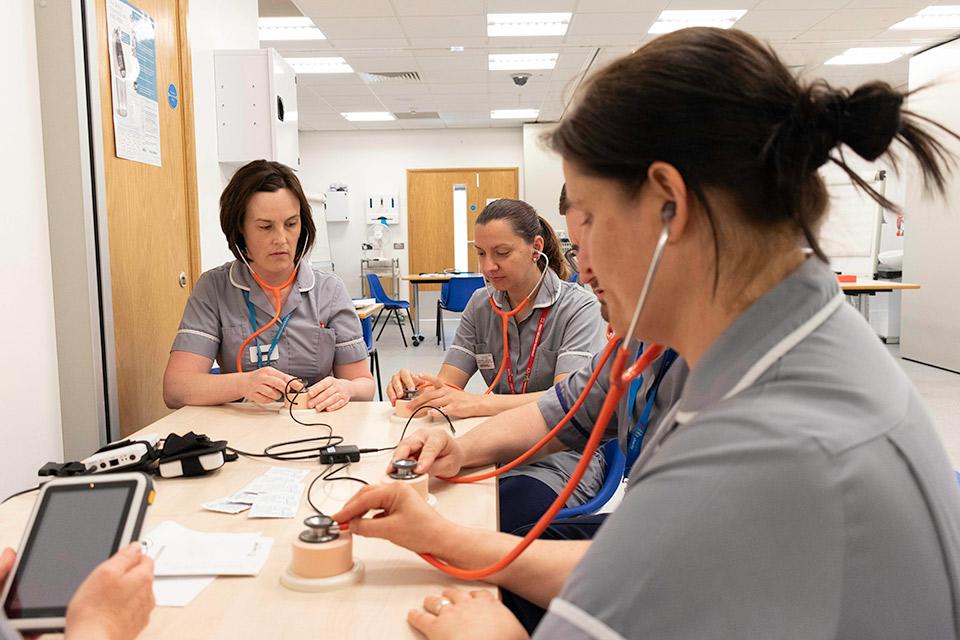
In your programme you will sometimes be expected to role play and engage in simulated clinical scenarios with other students, such as the practice and observation of practical skills in physical contact with other students. For some specific practices, this may necessitate modification of dress - e.g., to shorts and t-shirt. These activities will be conducted in a professional, safe, respectful and culturally sensitive way, under the supervision of academic staff, according to a defined protocol.
Assessment
A variety of assessment methods are used, including essays, task-based assignments, group presentations, assessment of communication skills and a portfolio. Each method of assessment is supported by clear criteria for marking.
In addition, the modular assessments you will also complete a Clinical Competency Handbook and Portfolio throughout the duration of the programme. These documents should illustrate and map your progress towards becoming an Advanced Clinical Practitioner and demonstrate the knowledge, skills and outcomes across all the four competency domains evidencing that you have achieved a level of independence relating to each competency.