
Speech and Language Therapist Apprenticeship
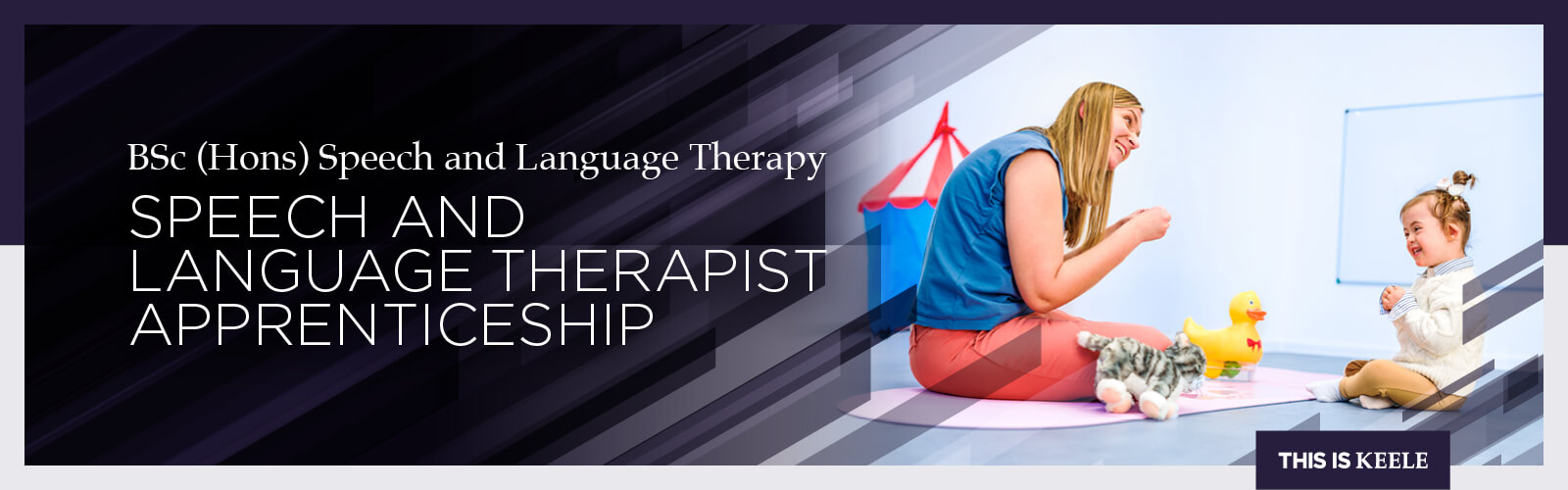
Speech and Language Therapists assess, treat, support and care for individuals of all ages who have difficulty with speech, language, communication or with eating, drinking and swallowing. This BSc (Hons) Speech and Language Therapy apprenticeship programme is mapped to deliver the Level 6 Speech and Language Therapist apprenticeship standard, supporting the professional development of practitioners across the NHS, local authorities, community groups and voluntary services. It has been tailored for delivery in a work-based learning context, where learning and assessments provide opportunities for you to apply your training into your workplace context and beyond.
Duration: 3 years.
Qualification: BSc (Hons) Speech and Language Therapy Apprenticeship.
Application: We typically require applications 8 weeks before programme starts.
Ofsted: 'Good' Ofsted rating for Apprenticeships at Keele University in Full Inspection, June 2023.
This apprenticeship programme is ideal for individuals working towards becoming a Speech and Language Therapist and with further aspirations to step into leadership roles.
The apprenticeship focuses on:
- Safe and effective practice within professional and legal standards
- Enhancing your skills and knowledge through evidence-based practice
- An understanding of the values, philosophy and beliefs within the profession
- Delivering inclusive practises, recognising equality and diversity amongst service users
- Developing skills in critical thinking, professional reasoning, research and leadership
- Demonstrating confidence in the assessment and management of speech, language and communication disorders as well as difficulties with eating, drinking and swallowing
- Autonomy in learning and practice, planning and implementing your continuing professional development
- A strong sense of professional identity, core knowledge and skills
Approximately 20% (one day per week) of the course will consist of online lectures (with 6 on-campus days per year), 20% of time (one day per week) is allocated for guided study time and placement, and 60% is carried out with the employer undertaking work-based learning.
The apprenticeship learning is aligned to industry needs ensuring participants can implement relevant knowledge, skills and behaviours.
Examples of indicative modules include:
- Clinical and Professional Development
- Clinical Research
- Linguistics, Phonetics and Phonology
- Language Acquisition and Psychology for Speech and Language Therapy
- Biomedical Science for Speech and Language Therapists
- Developmental Speech and Language Disorders
- Acquired Speech and Language Disorders
- Conditions Across the Lifespan
- Leadership and lifelong learning
To complete an apprenticeship, you must be employed in an organisation with your employer's support. We typically require apprentice applications 8 weeks before programme starts and by undertaking an apprenticeship, you commit to completing the End Point Assessment (EPA).
The Speech and Language Therapist Apprenticeship typically requires:
- Three A-levels at grades BBB, or equivalent such as BTEC Nationals.
- Applicants at the start of the apprenticeship must hold GCSE qualifications in Maths and English at Grade C (4) or an equivalent qualification.
- Interview and selection process, including a satisfactory DBS certificate confirmed by your employing organisation
- Current employment and role must showcase the demonstration of Level 6 competencies
- Prior learning must be mapped and approved via the Recognition of Prior Learning (RPL) process
We will work in partnership with you to ensure you are supported throughout the apprenticeship process.
- Our Business Engagement Manager will provide tailored support and offer guidance on applying for an apprenticeship at Keele University, direction on eligibility and contracting, or any other questions you may have.
- We offer a personalised approach to apprentices, ensuring you have the assistance you need from Keele University as your Training Provider, every step of the way.
- Throughout the programme we will work with you and your employer to ensure that you progress through your apprenticeship. This will involve regular (4 per year) tripartite review meetings, between you, your employer and a member of the programme team.
Apprenticeships are paid for by employers, not apprentices. Depending upon agreements with each employer, apprentices may be responsible for the costs of travel to academic and placement learning experiences.
- Employers with a payroll of more than £3 million can typically use their apprenticeship levy contributions to pay for places on apprenticeship programmes.
- Any business with a payroll below £3 million is usually eligible for government funding that will cover at least 95% of the cost of an apprenticeship course.
Additional incentives are also available to employers based on differing circumstances.
Contact us to find out more.
You make an application to study an apprenticeship through your employer with their support.
Applicants must meet several key criteria:
- Employment in a relevant role: Applicants must be currently employed in a position relevant to the apprenticeship or be recruited into a new role that aligns with the apprenticeship focus.
- If you are seeking a new role with apprenticeship training: Employers will typically advertise apprenticeship vacancies through their own recruitment sites and browse apprenticeships before you apply.
- Meet entry requirements: You must satisfy the specific entry requirements for the apprenticeship, including necessary educational qualifications and/or relevant professional experience.
- Employer support for upskilling: Existing employees are encouraged to discuss with their employers the potential for support in upskilling through the apprenticeship, which can enhance their professional development and benefit the organisation.
Why Keele University?
Keele University is proud to offer a variety of apprenticeships across different sectors and specialisms. We provide a personalised approach to apprenticeships and have an evolving programme portfolio, based on employer needs through consultation.