

Researchers find evidence of red dwarf stars “eating” their planets
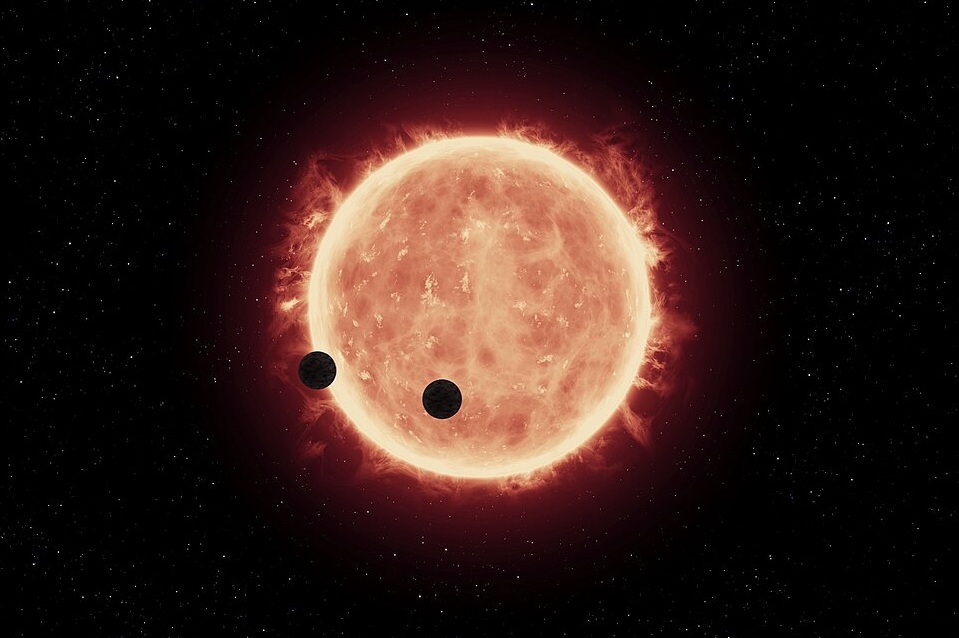
Researchers led by a Keele scientist have found evidence of red dwarf stars completely engulfing their surrounding planets; a phenomenon which has been predicted but never conclusively supported.
Led by astrophysicist Professor Robin Jeffries, the team studied young star clusters using data from the Gaia-ESO Spectroscopic (GES) survey and found a small number of red dwarf stars with high lithium content, which was unexpected as red dwarf stars should not have any lithium at all.
Red dwarfs are lower mass, cooler counterparts of the Sun. However, their interiors are very hot and turbulent, so much so that all their lithium content, originally present in the material they were born from, should be rapidly consumed in nuclear fusion reactions.
Because of this, there have been previous predictions that finding the presence of lithium in their atmospheres could signpost the engulfment of still lithium-rich material accreted from a surrounding planetary system.
In this study, the researchers looked at these stars using spectroscopic data, which refers to the study of how different matter interacts with electromagnetic radiation. The spectroscopic data covered thousands of stars, but in their analysis the team identified six different red dwarfs in three separate clusters which had much higher lithium content than other stars of a similar spectral type.
Their analysis suggests that these stars had engulfed their surrounding Earth-like planets, or about 3 to 10 Earth-masses of planetary material in total, providing a fresh burst of lithium to their otherwise lithium-depleted atmospheres.
These engulfment events have long been theorised as a possible and even probable outcome during early planetary system formation, and may even have happened earlier in our own Solar System.
If this explanation proves correct, a new window is opened onto the early lives of planetary systems, allowing the quantity and timing of planetary engulfment to be investigated. Unlike isolated stars, those found in clusters have well-understood ages and masses, and the presence of many similar siblings, born from the same initial material, means even small chemical abundance differences are easier to establish.
The findings have been published today in the Monthly Notices of the Astronomical Society.
Professor Robin Jeffries from Keele University, who led the research, said: “Because these low-mass stars should have depleted all their lithium, the addition of even a trace from their forming planetary systems is readily seen – like throwing paint onto a completely blank canvas.”