

Keele expertise strengthens cold case investigations
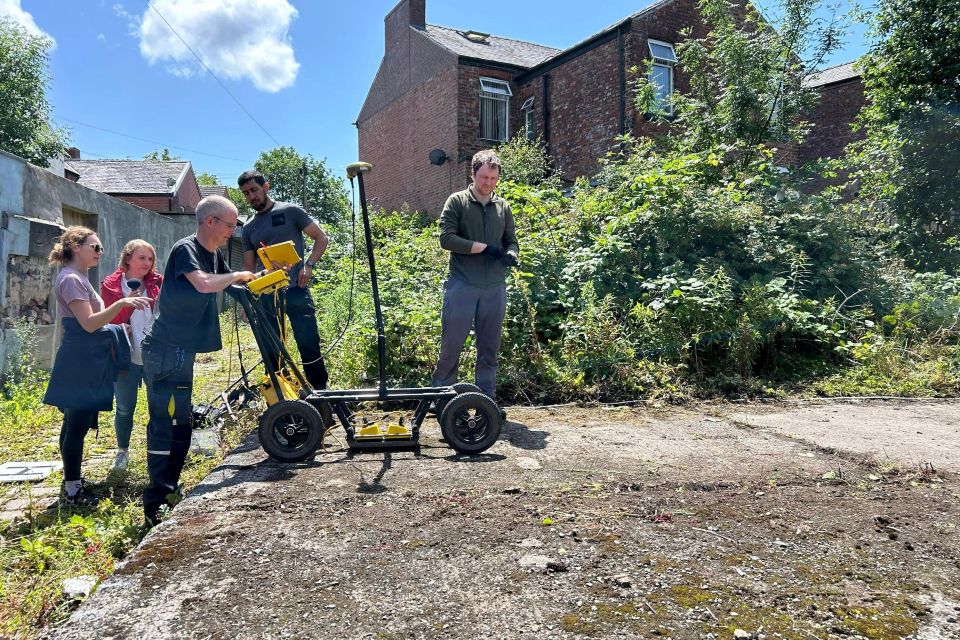
Forensic scientists at Keele University are playing a vital role in helping investigators with long-standing missing persons' cases, using cutting-edge techniques to support police forces and families searching for answers.
Staff from Keele's Faculty of Natural Sciences have been involved in a number of recent cold case investigations across the UK, bringing together expertise in forensic geoscience, archaeology, and environmental science. Their work forms part of a growing effort to apply multidisciplinary scientific approaches to some of the most challenging unsolved cases - delivering both investigative insight and reassurance to families.
Cold case forensic investigations are critical not only in supporting potential criminal convictions where evidence is limited, but also in providing answers for loved ones and reinforcing public confidence that justice continues to be pursued.
In one case in 2025, Keele researchers supported a search in Manchester relating to the disappearance of a woman, who was last seen in 1969. The investigation was led by UK charity Locate International, working in collaboration with the University of Lancashire and RSK Group.
Over the course of a year, Keele staff conducted a detailed forensic geoscience investigation of disused land, combining historical witness testimony with advanced remote sensing, geophysical survey techniques, forensic archaeology, and ground investigations. The case will also feature in a BBC podcast called The Forgotten Dead later this year, highlighting the scientific work behind modern cold case investigations.
In a separate case, Keele experts were approached by Police Scotland earlier this year to assist with further investigation into the disappearance of an 18-year-old in 1998. Officers from the force’s Major Investigation team returned to the address where he lived at the time of his disappearance, to carry out further investigations, with Keele experts supporting the work by carrying out a careful forensic geophysical survey of the site.
Keele's involvement in these cases reflects more than a decade of experience in forensic search investigations, with academics contributing their expertise since 2009. By combining scientific innovation with practical fieldwork, the team is helping to transform how cold cases are approached, with controlled on-campus studies helping to refine and optimise search workflows and protocols.
-400x300.jfif)
Dr Jamie Pringle, Reader in Forensic Geoscience at Keele University, said: "We have extensive experience supporting missing persons investigations, with our forensic work in this field spanning more than 15 years.
"Participation in these projects - some of which actively involve students - provides invaluable experience for those engaged in specialised research activities. At the same time, it enables staff to develop research-informed teaching approaches and design more realistic, practice-based search exercises for students across the faculty.
"These cases demonstrate how interdisciplinary research can deliver real-world impact. By combining geoscience, forensic archaeology and advanced survey techniques, we are able to generate robust evidence that directly informs investigations and decision-making, while also providing families with much-needed answers, even when that means ruling out potential locations."
The university has Memorandums of Understanding with Locate International and Humberside Police, enabling joint research initiatives, staff development, and valuable student placement opportunities.
Dave Grimstead, founder of Locate Internatioal, said: "These collaborations are vital because they go beyond supporting individual investigations. They enable us to test new methods, build evidence, and learn lessons that strengthen future searches and investigations across the UK.
"When universities, industry, charities, and the police work together, we apply our expertise and new techniques in practical, cost-effective ways. Ultimately, this work is about finding answers for families.”
-400x300.jfif)
Dr Vivienne Heaton, Lecturer in Forensic Biology and Anthropology at Keele, said: "Each year, approximately 170,000 people are reported missing in the UK. While the vast majority are found quickly, it is estimated that hundreds of cases become genuinely unresolved annually.
"If our expertise in forensic geoscience and anthropology can be used to support police investigations and provide clarity and peace of mind for families and friends, this represents a meaningful and valuable contribution."
Keele's forensic science programme is highly ranked in the UK, and was named as the best place in England to study Forensic Science in the Complete University Guide 2027.
The University's geology programme is also highly ranked, being in the top 25 in the UK in both the Complete University Guide 2026 and the Guardian University Guide 2026.