

Researchers reach ‘milestone’ in ability to determine the age of old stars
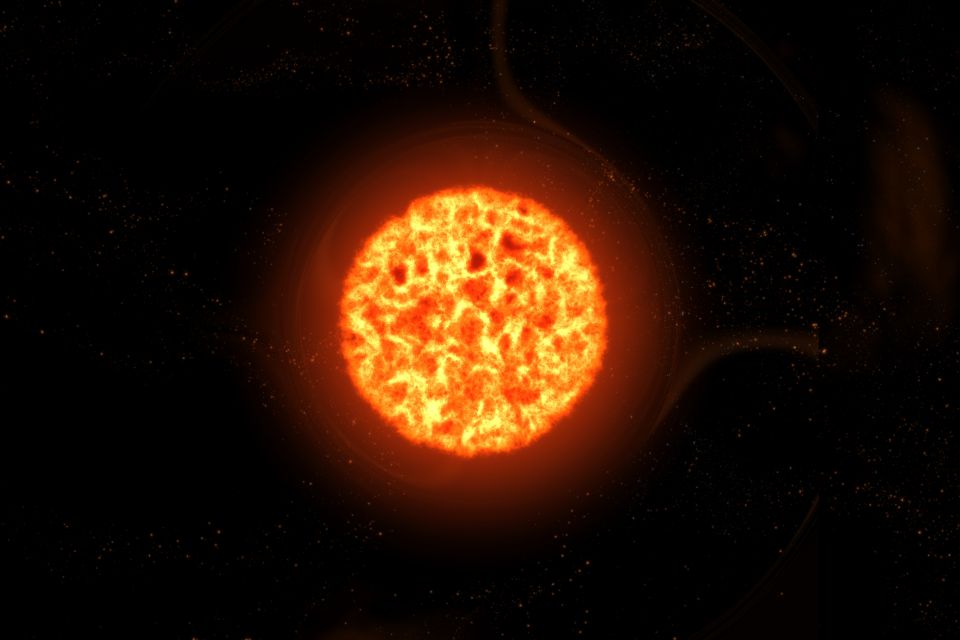
An international team, including astronomers from Keele University, have performed a unique cosmic test to measure the mass of an ancient star which will help them learn more about the history of our galaxy.
The team, including Keele’s Dr John Southworth and Dr Pierre Maxted, used two entirely different methods to analyse the star and found they gave very similar results, giving researchers a good indication of the star’s past and the conditions in which it formed. The team says the result marks a milestone in our ability to determine the ages of old stars and use them as living fossils to study the Milky Way's distant past. This investigative technique makes it possible to analyse thousands of ancient stars in our galaxy, reconstructing the Milky Way's evolution over billions of years.
The team analysed the red giant in the binary star system KIC 10001167 using two independent approaches - both by studying the objects orbiting around the star, and by modelling the pulsations of the red giant (a technique called asteroseismology). They found the pulsational and orbital masses agree to within 1.4%, enabling the researchers to determine the star's age with an accuracy of 10%.
"This is the first time we’ve been able to say that a mass measured from an old star's pulsations agrees within around one percent with a mass weighed from its orbit," said Jeppe Sinkbæk Thomsen, the leader of the study. Jeppe is a PhD student at the Dipartimento di Fisica e Astronomia, Università di Bologna, and did part of the analysis while on a research visit to Keele University.
Binary-star orbital motion is a powerful tool to measure and validate the mass of stars determined with other methods. It is well described by the classical theory of gravity, which was established in the 17th century by Johannes Kepler and Isaac Newton.
The implications go beyond a single star. Because a star's mass is the key to determining its age, this result validates the use of asteroseismology (analysis of pulsations) to accurately age-date old stars across the Galaxy. That, in turn, provides a powerful tool for reconstructing how the Milky Way galaxy was formed over billions of years.
John Southworth, a co-author of the study and a Senior Lecturer in Astrophysics at Keele University, said: "Science is our description of reality, and astrophysics provides our description of the Universe. Checking different methods against each other to confirm that they agree is the basis of the scientific method and vital for our understanding of stars, the universe they are in, and the planets they host."