
Graduate Success Stories: Hannah – Environmental Science
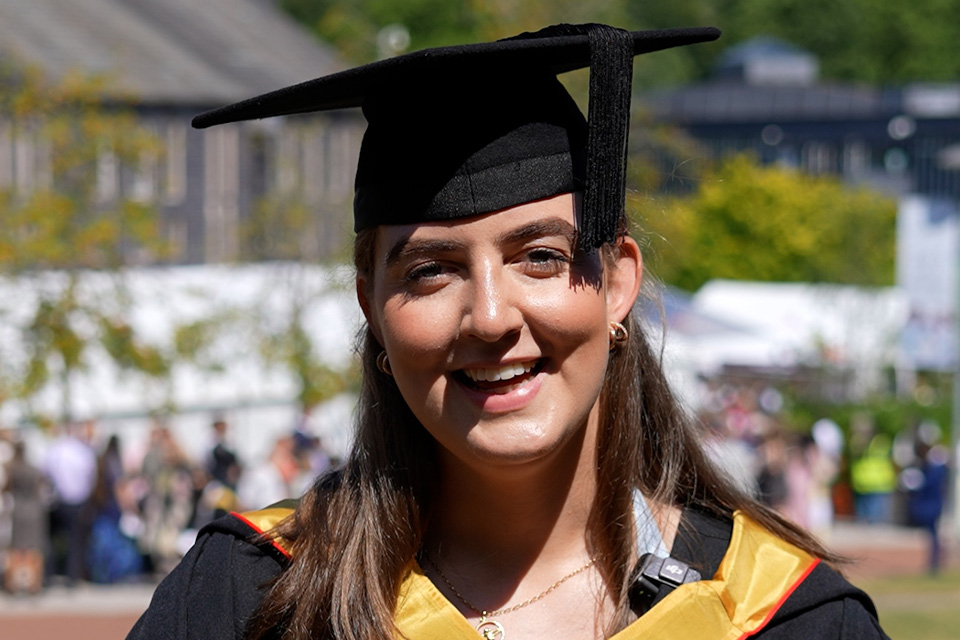
Since graduating from Keele University with a degree in Environmental Science, Hannah has been preparing to start her career in the water sector. Find out more about her journey in this Q&A.
What are your plans after graduation?
I will be starting work as a graduate consultant within the water sector at WSP in Belfast. I will be working in the wastewater team as a consultant wastewater modeller on a range of wastewater projects in the UK and Ireland. This involves building and using virtual models of real-life sewer networks to assess flooding within them, and I will be looking for solutions to flooding.
I will also assess the impact of new building developments on the capacity of the wastewater network in that area, identify any issues that arise, and present solutions to flooding or other problems to clients.
How did you find your graduate job?
I was offered this graduate job after completing my work placement year with the company. So, it really started as a search for a work placement role at the start of my second year at Keele. I used websites such as Gradcracker and Indeed. However, for this specific job, it came from the Life Sciences Careers team. They would send emails each week with a list of work placement opportunities, open applications, and details of the closing dates and qualifications required for each. This was really useful when trying to find a suitable placement.
What has your Keele experience been like?
I have had the best time and really enjoyed my Keele experience; it has been amazing. I have made friends for life and gained so much from my time here. I have grown both academically and personally throughout my time at Keele. I have gained more confidence, really pushing myself out of my comfort zone at times, e.g., volunteering to do careers webinars and this interview, and it has always paid off.
I’ve been a member of two different sports societies, and in my second year, I was on the committee for one of them, something I never would have imagined I would do in my first year.
I have also felt very supported by my lecturers and other staff within my school. Several of my lecturers constantly went out of their way to help support both myself and other students whenever we needed it.
I also have dyslexia, and I have had a lot of support and access to different resources from the university during the past 4 years, which has really benefited me. I couldn’t have done it without some of these resources.
I have so many fantastic memories from my time at Keele, and I made some amazing friends. I am sad to leave, but I am excited for this next chapter and what the future holds.
How did Keele help you secure your graduate role/prepare you for the world of work?
I secured this role because I had completed a work placement year with the company last year. The life sciences career team helped me secure this role through the resources they provide and the information they share about available roles and the qualifications needed for each.
The careers department has so many resources, from CV writing to a mock interview service to practise psychometric tests used in the selection process for many graduate roles. There is so much support to help you secure both work placement roles and graduate roles.
My degree has really helped me prepare for the world of work because we often learn how to use new technologies and software that are extremely relevant in the workplace. For example, in Environmental Science, being able to use GIS is vital, and it was taught throughout my degree. Similarly, skills in report writing, public speaking, group collaboration, etc., are really important in the workplace and are all skills I developed throughout my time at Keele.
Any advice for students who are looking for their first graduate roles?
I think if possible, I would recommend doing a work placement year or a work placement module, or volunteering, anything that will get your experience up in the area you would like to go into. That is really important to employers. Similarly, having experience on your CV, such as playing sports or being part of a team, is really good to show that you can work in a team.
Apply for everything. It is good not to put all your eggs in one basket, apply for lots of different roles and be open-minded. If I had known exactly what I would have been doing in my role when I applied, I probably wouldn’t have applied, as I wouldn't have felt I was ready or knew how to do that kind of work. However, I have really enjoyed it, loved learning more about it each day, and I am looking forward to returning in September.
It can be disheartening, and it is hard work when you’ve applied for so many roles and haven’t secured one yet, but it is all good interview practice that will really benefit you in your next interview. Don’t give up; a job for you will come along.
It is also super important to use all the resources you have available, both from the university and online. The Keele careers team is good and has lots of valuable resources that will help you get a step ahead.
Finally, when you get to the interview stage, make sure you have done research on the company and your role. There are always questions about what you know about the company and the role you are applying for, and it is really important to have some knowledge of it. Don’t be like me: when asked what they manufacture at the Toyota factory, don't say "cars"; they want to know the specific model they make there. I had researched all the environmental factors and the company mission, but not the car models.