


Pharmacology - MSc
Our career-focused Pharmacology MSc aims to provide you with the advanced theoretical knowledge, practical and analytical skills required for career advancement within drug research and related industries.
Month of entry
- September
Mode of study
- Full time
Fees for 2026/27 academic year
- UK - Full time £11,700 per year.
International - £18,200 per year.
Duration of study
- Full time - 1 year
This course is no longer accepting applications from international students for the 2025/26 academic year.
Why study Pharmacology at Keele University?

Course summary
The Keele MSc Pharmacology programme aims to provide you with advanced-level study into the theoretical and practical aspects of molecular and cellular pharmacology, and modern drug discovery.
Building from core concepts in biochemistry, cell biology, physiology and drug design you will explore approaches to drug development and the molecular mechanisms of drug action relevant to the treatment of a range of conditions.
Throughout the programme you will develop your practical and analytical skills in the execution of a range of core and advanced procedures common in pharmacology research laboratories.
You will integrate and apply concepts from an advanced understanding of pharmacokinetics and pharmacodynamics to the mode of action of select drugs and their therapeutic application to individual patients and diverse populations. You will also strengthen your understanding of modern approaches in drug development and learn about the principles of project management and business planning.
In semester three you will complete a research project. This will provide you with the opportunity to utilise a number of key learning outcomes from across the programme and to take responsibility for the formulation, management, execution, and final interpretation and presentation of a new piece of scientific research in an area of pharmacology.

Course structure
The MSc in Pharmacology is studied full-time over one year, starting in September, split into three equal-credit semesters.
Modules
The module details given below are indicative, they are intended to provide you with an idea of the range of subjects that are taught to our current students. The modules that will be available for you to study in future years are prone to change as we regularly review our teaching to ensure that it is up-to-date and informed by the latest research and teaching methods, as well as student voice. The information presented is therefore not intended to be construed and/or relied upon as a definitive list of the modules available in any given year.
Compulsory modules
Semester 1
LSC-40135: Pathophysiology and Pharmacology (30 credits)
This module will develop students' knowledge and understanding of core principles in pharmacokinetics and pharmacodynamics to an advanced level, and deepen understanding of drug design and development, the application of select pharmacological agents in the treatment of disease, and their mode of action. This will be underpinned by establishing core knowledge in human physiology and anatomy relating to the roles and functions of a range of tissues and organ systems in health and disease, and will be applied to the dysregulation of cellular and tissue
homeostasis associated with the pathophysiology of select conditions and how this is integrated with other areas of pharmacology and the wider biosciences in the treatment of disease and drug development.
LSC-40123: Scientific Leadership and Innovation (30 credits)
This module will focus on key professional competencies, equipping you with the the knowledge, insight and frameworks to identify emerging issues in the field, develop innovative solutions and lead on new scientific endeavours.
Semester 2
LSC-40137: Advanced Drug Design and Future Medicine (30 credits)
The module aims to give students a comprehensive knowledge of modern drug design and the development of new medicines, vaccines and formulations that focus upon meeting the needs of patients, populations and service providers. This includes advanced knowledge and understanding in the fields of cheminformatics, applied medicinal chemistry, pharmacodynamics and pharmacokinetics.
LSC-40101: Research Methods in Pharmacology (30 credits)
This module will develop your practical and analytical skills in the execution of a range of core and advanced procedures common in pharmacology research laboratories. You will further develop skills in the analysis of experimental data and its critical evaluation in context to recent literature, communicating outcomes through research reports and posters.
Semester 3
LSC-40131: Research Project (60 credits)
This module represents the culmination of student learning across their MSc programme. Students will conduct an extensive, independent research project, which could include laboratory-based studies, advanced computational/bioinformatic analysis, systematic reviews or a work-based project (exclusions apply). Students will cite the study in context to a wide body of current literature in the chosen area, analyse, present and critique study outcomes with full critical evaluation and appraisal.

Entry requirements
The following section details our typical entry requirements for this course for a range of UK and international qualifications. If you don't see your qualifications listed, please contact us to find out if we can accept your qualifications.
Typical offer
Please ensure that you read the full entry requirements by selecting your qualifications from the dropdown menu below. This will include any subject specific, GCSE/Level 2 Maths, and English language requirements you may need.
Please select your country from the drop-down list below for the full entry requirement information
UK
2:2 degree in a bioscience (Biochemistry, Biology, Biomedical Science), medical, or pharmacology related subject
or
demonstrated professional or relevant qualifications or experience
You will also need: an English language qualification (see below)
Algeria
12/20 or Assez Bien degree in a bioscience (Biochemistry, Biology, Biomedical Science), medical, or pharmacology related subject
or
demonstrated professional or relevant qualifications or experience
You will also need: an English language qualification (see below)
Bahrain
Bachelor's degree with a minimum CGPA of 2.7/4.0 in a bioscience (Biochemistry, Biology, Biomedical Science), medical, or pharmacology related subject
or
demonstrated professional or relevant qualifications or experience
You will also need: an English language qualification (see below)
Bangladesh
60% in a 4-year degree or 3-year degree with a 2-year Master's in a bioscience (Biochemistry, Biology, Biomedical Science), medical, or pharmacology related subject from a public university
or
CGPA 2.8 in a 4-year degree or 3-year degree with a 2-year Master's in a bioscience (Biochemistry, Biology, Biomedical Science), medical, or pharmacology related subject from a private university
or
demonstrated professional or relevant qualifications or experience
We don’t accept degrees from certain universities, please see our Bangladesh Country Page for more information
You will also need: an English language qualification (see below)
Canada
70% or C or a GPA of 2.5 in a degree (Ordinary or Honours) in a biomedical, pharmacology or bioscience (Biochemistry, Biology, Biomedical Science), related subject
or
demonstrated relevant professional qualifications or experience
You will also need: an English language qualification (see below)
China
70% in a degree in a bioscience (Biochemistry, Biology, Biomedical Science), medical, or pharmacology related subject
or
65% in a degree in a bioscience (Biochemistry, Biology, Biomedical Science), medical, or pharmacology related subject from a '211' university
or
demonstrated professional or relevant qualifications or experience
You will also need: an English language qualification (see below)
Egypt
Bachelor degree from a Public or Private University with 65%/CGPA = 2.7/Good degree in a bioscience (Biochemistry, Biology, Biomedical Science), medical, or pharmacology related subject
or
demonstrated professional or relevant qualifications or experience
You will also need: an English language qualification (see below)
Ghana
Second class degree in a bioscience (Biochemistry, Biology, Biomedical Science), medical, or pharmacology related subject
or
demonstrated professional or relevant qualifications or experience
You will also need: an English language qualification (see below)
Hong Kong
Bachelor's Honours degree with 2:2 or CGPA of 2.5 OR Bachelor Ordinary degree with a CGPA of 3.4 in a bioscience (Biochemistry, Biology, Biomedical Science), medical, or pharmacology related subject
or
demonstrated professional or relevant qualifications or experience
You will also need: an English language qualification (see below)
India
55% or CGPA 6/10 in a degree of at least 3 years in a bioscience (Biochemistry, Biology, Biomedical Science), medical, or pharmacology related subject
or
demonstrated professional or relevant qualifications or experience
You will also need: an English language qualification (see below)
Kenya
Second class degree in a bioscience (Biochemistry, Biology, Biomedical Science), medical, or pharmacology related subject
or
demonstrated professional or relevant qualifications or experience
You will also need: an English language qualification (see below)
Kuwait
Bachelor's degree with a minimum CGPA of 2.75/4.0 or 3.5/5.0 in a bioscience (Biochemistry, Biology, Biomedical Science), medical, or pharmacology related subject
or
demonstrated professional or relevant qualifications or experience
You will also need: an English language qualification (see below)
Nepal
60% / 2.4 in a 4-year Bachelor's degree in a bioscience (Biochemistry, Biology, Biomedical Science), medical, or pharmacology related subject
or
65% / CGPA 2.8 in a 3-year Bachelor's degree in a bioscience (Biochemistry, Biology, Biomedical Science), medical, or pharmacology related subject
or
demonstrated professional or relevant qualifications or experience
You will also need: an English language qualification (see below)
Nigeria
Second class degree in a bioscience (Biochemistry, Biology, Biomedical Science), medical, or pharmacology related subject
or
demonstrated professional or relevant qualifications or experience
You will also need: an English language qualification (see below)
Oman
Bachelor's degree with a minimum CGPA of 2.5/4.0 in a bioscience (Biochemistry, Biology, Biomedical Science), medical, or pharmacology related subject
or
demonstrated professional or relevant qualifications or experience
You will also need: an English language qualification (see below)
Pakistan
We accept a range of qualifications from Pakistan. Please visit our Pakistan Country Page for more information
or we will consider demonstrated relevant professional qualifications or experience
You will also need an English language qualification (see below)
Qatar
Bachelor's degree with a minimum CGPA of 2.75/4.0 in a bioscience (Biochemistry, Biology, Biomedical Science), medical, or pharmacology related subject
or
demonstrated professional or relevant qualifications or experience
You will also need: an English language qualification (see below)
South Africa
Second class division 2 / 60% in a Bachelor's degree with Honours in a bioscience (Biochemistry, Biology, Biomedical Science), medical, or pharmacology related subject
or
Second class division 1 / 70% in an Ordinary Bachelor's degree in a bioscience (Biochemistry, Biology, Biomedical Science), medical, or pharmacology related subject
or
demonstrated professional or relevant qualifications or experience
You will also need: an English language qualification (see below)
Sri Lanka
55% in a Special Bachelor's degree in a bioscience (Biochemistry, Biology, Biomedical Science), medical, or pharmacology related subject
or
demonstrated professional or relevant qualifications or experience
You will also need: an English language qualification (see below)
Turkey
A CGPA of 2.5/4.0 in a Bachelor degree (Lisans Diplomasi) in a bioscience (Biochemistry, Biology, Biomedical Science), medical, or pharmacology related subject
or
demonstrated professional or relevant qualifications or experience
You will also need: an English language qualification (see below)
UAE
Bachelor's degree with a CGPA of 2.5/77%/B- in a bioscience (Biochemistry, Biology, Biomedical Science), medical, or pharmacology related subject
or
demonstrated professional or relevant qualifications or experience
You will also need: an English language qualification (see below)
Uganda
Second class degree in a bioscience (Biochemistry, Biology, Biomedical Science), medical, or pharmacology related subject
or
demonstrated professional or relevant qualifications or experience
You will also need: an English language qualification (see below)
USA
Bachelor's degree with a minimum CGPA of 2.6 in a bioscience (Biochemistry, Biology, Biomedical Science), medical, or pharmacology related subject
or
demonstrated professional or relevant qualifications or experience
You will also need: an English language qualification (see below)
Zimbabwe
Second class degree in a bioscience (Biochemistry, Biology, Biomedical Science), medical, or pharmacology related subject
or
demonstrated professional or relevant qualifications or experience
You will also need: an English language qualification (see below)
English language requirements
All of our courses require an English language qualification or test. For most students, this requirement can be met with a 4 or C in GCSE English. Please see our English Language guidance pages for further details, including English language test information for international students. For those students who require an English language test, this course requires a test from Group C.
References
Normally, you will need to provide at least one academic reference to support your application unless you have been out of study longer than two years. If it has been more than two years since you last studied on a degree-level programme, you will normally need to provide an employment reference instead. For more information about Academic References, please see our Postgraduate how to apply web pages.
Personal Statement/Statement of Purpose
Please see our Postgraduate how to apply web pages for guidance on what to include in your personal statement.
Recognition of Prior Learning
The Recognition of Prior Learning (RPL) is a process which enables applicants to receive recognition and formal credit for learning acquired in the past through formal study or work and life experiences.
RPL can also be requested for admission onto the start of a programme in lieu of the admission requirements. For more information, see our Recognition of Prior Learning web pages.
Professional qualifications and work experience
The majority of our courses will consider relevant work experience and/or professional qualifications at the appropriate level, as an alternative to an undergraduate degree for entry. The work experience should be for a sustained period and at a suitable level, based within a relevant sector to your chosen course.
Admissions staff will review your work experience and/or professional qualifications during the assessment of your application to ensure suitability in terms of relevancy, level and appropriate learning outcomes.
General information
The entry grades outlined in this section indicate the typical offer which would be made to candidates, along with any subject specific requirements. This is for general information only. Keele University reserves the right to vary offer conditions depending upon a candidate's application. For international students, find out how we work with approved agents as part of our admissions process.
Social life, societies and sports
Find out moreAccommodation
Find out moreLocal area and travel
Find out moreBoost your employability
Find out more
Postgraduate funding and scholarships
Funding
Whether you're continuing from undergraduate study or returning to education, our dedicated financial support team is here to help.
Please note, if your course offers a January start date, the January 2026 start date falls in the 2025/26 academic year. Please see the tuition fees archive for the 2025/26 fees.
Planning your funding
It's important to plan carefully for your funding before you start your course. Please be aware that not all postgraduate courses and not all students are eligible for the UK government postgraduate loans and, in some cases, you would be expected to source alternative funding yourself. If you need support researching your funding options, please contact our financial support team.
Scholarships
We are committed to rewarding excellence and potential. Please visit our scholarships and bursaries webpage for more information.
For continuing students, fees will increase annually by RPIX, with a maximum cap of 5% per year.
Additional costs
You may incur optional costs which can enhance your learning experience (e.g., fieldwork or specialist equipment). Details are outlined below. For general information, see the university's additional costs information.
- Optional poster submission for project module - printing cost to be borne by student
- A lab coat will be provided to all students free of charge upon enrolment. Replacement lab coats will be at the student's expense (£10)

Teaching, learning and assessment
How you'll be taught
Diversity, flexibility and inclusivity is at the heart of our Education Strategy. Your Student Voice helps us to shape what we do and we include students, local employers and professional bodies in our decision-making process.
Types of teaching methods used on the programme include:
- Digital learning resources
- Campus-based tutorials and workshops
- Laboratory practicals
- Case-based learning (CBL) tutorials
- Live, online tutorials, workshops and drop-in sessions
- Independent study
- Extended research project
How you'll be assessed
This programme has a rich and varied assessment strategy to ensure development of key employability and academic skills. This will provide you the opportunity to demonstrate both professional and academic attainment.
Assessment design is largely driven by a number of key principles which include promotion of independent learning, student autonomy, responsibility for personal learning, and development of innovation and originality through a range of authentic and applied assessment types.
Types of assessment methods used on the programme include:
- Literature review
- Oral presentation
- Online tests
- Essays
- Laboratory reports
- Extended research project
- Research poster

Facilities
The David Attenborough Laboratories have significantly expanded the School of Life Sciences’ teaching and research areas, and provide two additional state-of-the-art teaching laboratories with space for 120 students between them and two additional research laboratories.
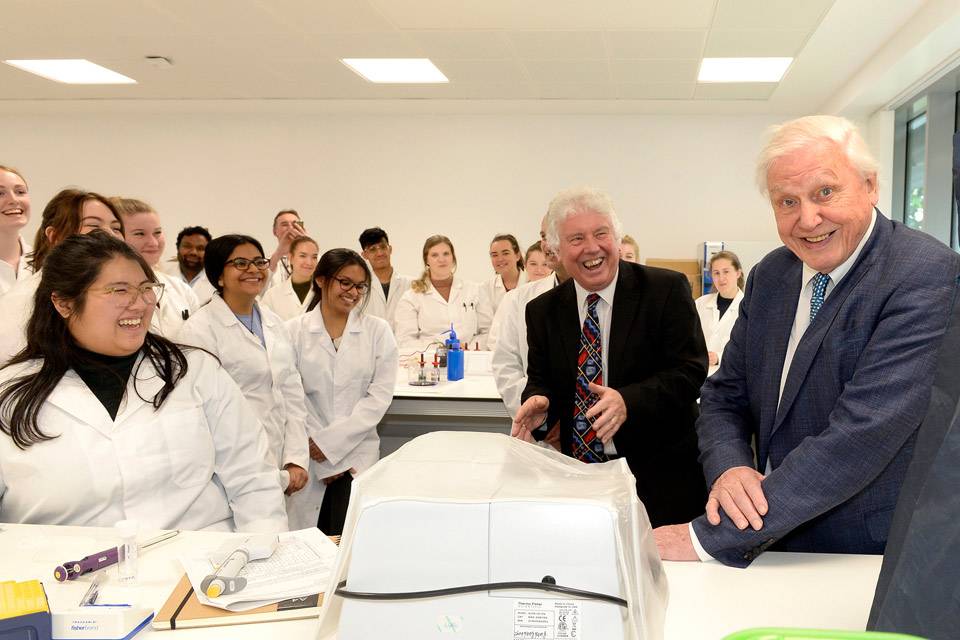
Equipment and methods you will become familiar with during practical laboratory work include:
- Preparative and analytical methods in biochemistry and pharmacology, including enzyme kinetics and metabolite quantification
- Analysis of receptor-ligand binding interactions through a combination of practical and computational methods
- In vitro methods for the study of drug action in cells and tissues, including core cell culture techniques.
The research laboratories will make a significant contribution to the Global Health Initiative at Keele, and will be home to researchers working on neurological disorders including Parkinson’s disease, spinal injury, oncology, viral infections and carbohydrate biochemistry. You may also carry out some of your practical laboratory work in Keele's state-of-the-art Central Science Laboratory (CSL) building - which is part of the biggest single investment in learning and teaching in the University’s history.