
From Keele University to Avanti West Coast
Aaron Yule, Decarbonisation and Energy Manager
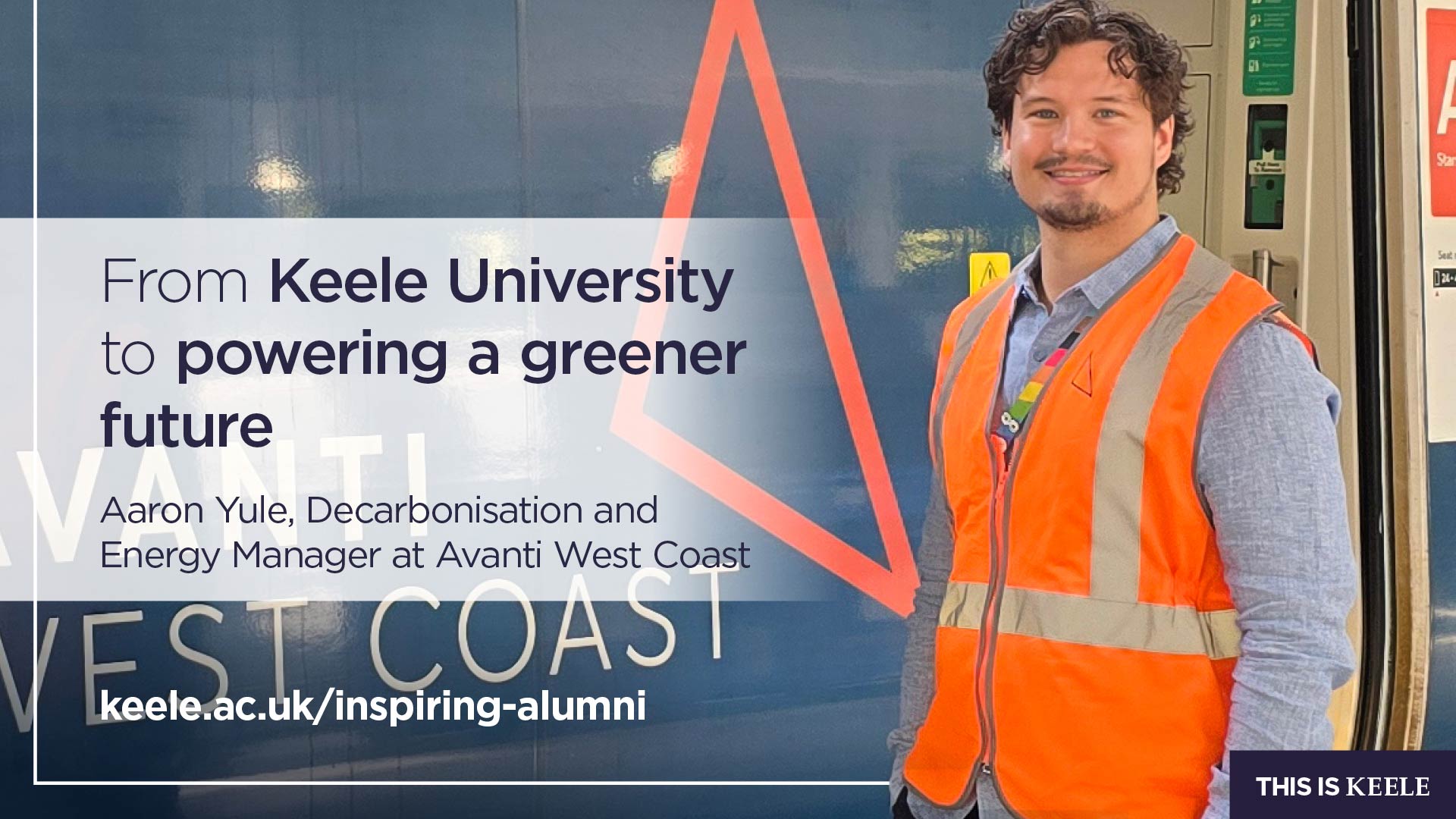
As the UK rail industry works to become more sustainable, cut emissions, strengthen energy resilience and adapt to the realities of climate change, Keele alumnus Aaron Yule is helping lead that transition for one of the country’s major transport operators.
Now working as Decarbonisation and Energy Manager at Avanti West Coast, Aaron is responsible for driving energy efficiency and carbon reduction strategies across a complex multi-site rail operation, helping deliver projects that support the future of low-carbon transport in the UK.
From solar energy installations and heat pump deployment to long-term net zero planning and science-based carbon targets, his work sits at the intersection of sustainability, infrastructure and national impact.
Aaron said: “In my role, I act as the organisation’s subject matter expert on energy management, carbon reporting and net zero delivery. I’m responsible for measuring our carbon footprint , setting science-based targets, and the development of a zero‑carbon roadmap. I also work closely with colleagues in engineering, property, procurement and senior leadership to drive measurable reductions in energy use and emissions. It’s a role that involves a lot of data monitoring and management on a day-to-day basis.
“My main motivation is to work in sustainability where I can make significant impact, and working in transportation, especially with rail being a key part of our national infrastructure, certainly fits that bill.”
Aaron and his team have received national recognition for their sustainability achievements in 2026, making the shortlist in the Environmental Excellence category at the National Rail Awards in September, and being highly commended in the Exemplary Contribution to Net Zero category at the National Transport Awards, in October.
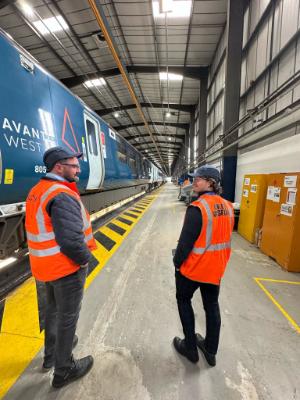 Aaron at Oxley rail depot, where Avanti trains are maintained.
Despite his current role, Aaron’s route into decarbonisation and energy management did not begin in transport. After completing an undergraduate Geography degree and beginning a career in recruitment, he realised he wanted to make a more direct contribution to environmental sustainability.
That decision led him back to North Staffordshire and to Keele University, where a postgraduate degree in MSc Environmental Sustainability and Green Technology in 2019-20 gave him the technical knowledge, practical experience and industry exposure needed to build a career in sustainability.
During his time at Keele, Aaron deepened his understanding of environmental policy, sustainability communication and real-world green technologies. A pivotal opportunity came through Keele’s partnership with Big Solar Co-op, where he secured his first role in the sustainability sector, helping deliver solar panel installations on commercial and community buildings.
That experience became the foundation of a career that has since taken him through consultancy at Ricardo Energy & Environment (recently acquired by WSP) and into a leadership role helping shape the future of sustainable rail travel.
Aaron, who grew up in Staffordshire and attended Newcastle-under-Lyme High School, as well as Newcastle and Stafford Colleges Group, said: “When exploring postgraduate options, Keele stood out immediately. Its well-established reputation for sustainability, combined with a course structure that offered a strong focus on real-world applications and technological solutions, made it the ideal choice.
“My course provided me with a strong foundation of technical knowledge, which has been invaluable in my current role, particularly in enabling me to communicate confidently with both senior directors and technical specialists. This ability to bridge the gap between strategic and engineering perspectives has been a key benefit.
“As my course was a one-year masters and I lived off campus, I didn’t get the opportunity to take full advantage of some of the softer-skilled opportunities such as networking. However, Keele fostered a strong sense of independence and personal responsibility. The university environment offered a wide range of resources, and it was largely up to me to make the most of them.
“This experience helped me develop important skills in decision-making and self-determination and direction, and capabilities that have translated directly into my professional career. Overall, Keele gave me the confidence and autonomy to take ownership of my development and perform effectively in a professional setting.”
Aaron recently welcomed two Keele University students to Avanti for work placements, providing them with valuable industry experience. Inspired by the internship opportunity at Keele that helped launch his own career, Aaron was keen to create similar opportunities for the next generation of talent.
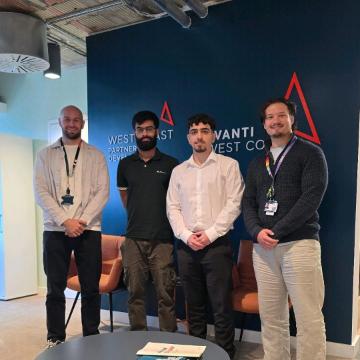
Aaron, far right, with two Keele students on work placements at Avanti.
Looking to the future, Aaron highlights sustainability, climate change, infrastructure resilience, and energy efficiency as some of the biggest challenges and opportunities facing the rail industry.
He said: “Rail networks are increasingly having to adapt to changing weather patterns and operational pressures. Increased rainfall and flooding can affect service reliability, while temperature extremes can impact infrastructure.
“Severe weather events can create challenges for safety, maintenance and continuity of service, meaning long-term planning and resilience are becoming increasingly important across the sector. Across the industry, operators are investing in infrastructure resilience, but this requires significant long-term planning and cross-industry collaboration.
“In 2027, we aim to deliver the first solar array systems at two of our stations to improve energy security, install Air Source Heat Pumps at another two stations, introduce voltage optimisers to reduce incoming load and wasted consumption, continue the rollout of LED replacements across our station portfolio, and upgrade building fabric across our station estate to improve heating efficiency and deliver long-term savings.”
“As the energy landscape continues to evolve, rail has an important role to play in delivering efficient, lower-emission transport while improving long-term sustainability across the network.”