

Human-AI Interaction
Human-AI Interaction (HAII) is an interdisciplinary research theme that brings together staff and researcher interests from across Future Systems, Human-Centred Computing and AI. Within this theme, we examine how people understand, use, and collaborate with Artificial Intelligence (AI). We bring together technical, social, ethical, and psychological perspectives to design AI systems, interfaces and interactions that align with human needs, societal values, and ways of thinking.
HAII academics contribute to the leadership, liaison and outputs of the Keele Digital Society Institute, The Turing University Network, the Stoke-on-Trent and Staffordshire branch of the British Computer Society and the International Digital Futures Network.
While broad in scope, we focus on three HAII domains of societal importance:
- Learning, Education and Research
- Health, Medicine and Wellbeing
- Creativity, Culture and Enterprise.
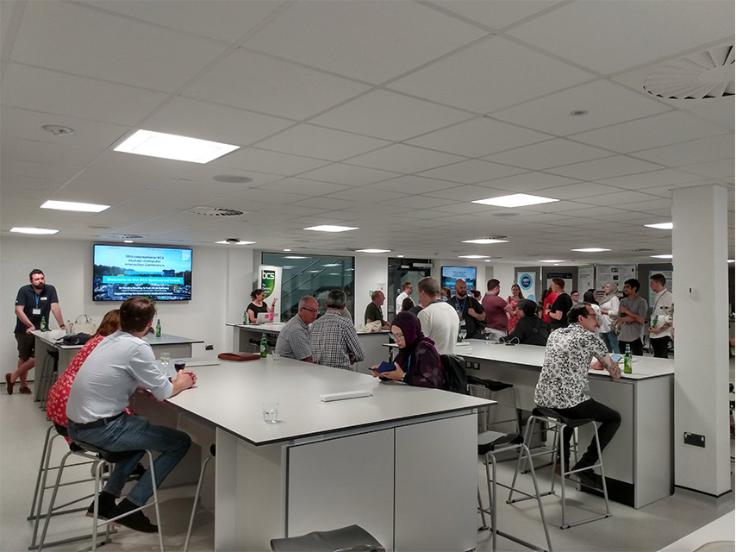
35th International BCS Human-Computer Interaction Conference
Learning, Education and Research
- Two PhD students researching the use of Generative AI to support students with dyslexia, ASD and ADHD
- Two PhD students researching Automated Writing Evaluation from a teacher and student perspective
- Funding from HEFCE and Jisc to research the design of Learning and Curriculum Analytics systems using Human-Centred Design
- Running a series of university wide “Prompting Parties” to share best practice in the use of Generative AI
- Leadership of advanced modules on Data Ethics and AI Governance
Health, Medicine and Wellbeing
- Collaborating with multiple NHS trusts using Human-Centred Design to produce medical guidelines apps and to support the incorporation of AI into information retrieval and guideline production
- Innovative applications of AI for medical diagnosis
- Assistive technologies for injection training
Creativity, Culture and Enterprise
- AI in the workplace
- PhD research in future museology, heritage experiences, VR and serious games
Theme Co-Leads:
- Dr Sandra Woolley
- Professor Ed de Quincey
- Dr Baidaa Al-Bander
- Dr Marco Ortolani
Associate Members:
- Professor Raymond Bond, Ulster University
- Professor Samir Dani, Keele Business School
- Cockayne, M.J., Ortolani, M. and Al-Bander, B., 2025. DermFormer: nested multi-modal vision transformers for robust skin cancer detection. Pattern Analysis and Applications, 28(4), p.194.
- Rehan, S., Al-Bander, B. and Al-Said Ahmad, A., 2025. Harnessing large language models for automated software testing: A leap towards scalable test case generation. Electronics, 14(7), p.1463.
- Taiwo, O. and Al‐Bander, B., 2025. Emotion‐aware psychological first aid: Integrating BERT‐based emotional distress detection with Psychological First Aid‐Generative Pre‐Trained Transformer chatbot for mental health support. Cognitive Computation and Systems, 7(1), p.e12116.
- Drummond, M., de Quincey, E. and Poole, E. (2023). Guidelines for researchers sharing large data sets. Available at: https://doi.org/10.21252/4C2M-7M19
- de Quincey, E. and Parker, M. (2021). User-Centred Guidelines for the Design of Curriculum Analytics Dashboards. In Visualizations and Dashboards for Learning Analytics. Cham: Springer International Publishing, pp. 497–525.
- de Quincey, E., Briggs, C., Kyriacou, T. and Waller, R. (2019) ‘Student centred design of a learning analytics system’, in Proceedings of the 9th International Conference on Learning Analytics & Knowledge. pp. 353–362.
- Woolley, S. and de Quincey, E., 2024. Towards a Human-Centred Digital Society. Interacting with Computers, 36(2), pp.63-64.
- Woolley, S.I., Collins, T., Andras, P., Gardner, A., Ortolani, M. and Pitt, J., 2021, October. Compounding barriers to fairness in the digital technology ecosystem. In 2021 IEEE International Symposium on Technology and Society (ISTAS) (pp. 1-5). IEEE.
- Workshop on Health, Wellbeing and Human-AI Interaction (HAII) organised by theme leads at 5th International Conference on Hybrid Human-Artificial Intelligence, July 6-10, 2026, Brussels, Belgium
- 18 March 2026: Invited talk, 2pm, HUX15, Professor Mike Sharples, Social Generative AI in Education: Opportunities and Risks
- 14th May 2026: Invited talk, 2pm, Professor Ray Bond, How Could AI Impact our Health and Humanity
- 26 April 2026: Ethics and Integrity in AI, Sandra Woolley, Coventry University, Simulation Centre
- 3 March 2026: AI Strategic Conversation, Can AI improve and enhance our teaching and education? Sandra Woolley (Panel member)
- 11 September 2025: Using Copilot to Support Curriculum Redesign: A Case Study, AI in Government & Academia Summit 2025, Ed de Quincey
- 30 April 2025, Matter 2025, AI and Generative AI – Past, Present and Future, Sandra Woolley
- 14 January 2026, AI Safety and Trustworthy, Marco Ortolani and Baidaa Al-Bander, Doctoral Training, University of Sheffield
Contact

Dr Sandra I Woolley
Reader
Computer Science
- Colin Reeves building, CR022
- +44 (0)1782 733259
- s.i.woolley@keele.ac.uk

Professor Ed de Quincey
Professor of Computer Science
- Colin Reeves, CR41
- +44 (0)1782 734090
- e.de.quincey@keele.ac.uk
Dr Baidaa Al-Bander
Lecturer
- Colin Reeves Building, CR0.23
- b.al-bander@keele.ac.uk

Dr Marco Ortolani
Senior Lecturer
Computer Science
- Colin Reeves, CR102
- +44 1782 7 33264
- m.ortolani@keele.ac.uk