

In memory
We remember former Keelites in our Forever Keele magazine, published each winter and summer. This web page enables us to share the full tributes for those which were summarised in the magazine.
If you would like to commemorate a former Keelite in a future Forever Keele issue, please get in touch: alumni.hq@keele.ac.uk
18 August 1932 – 9 July 2024
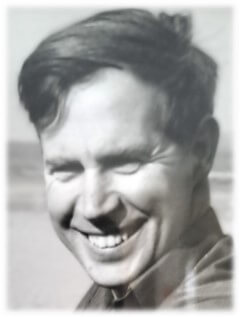
My father, Edward Derbyshire, was born on the 18th of August, 1932, to Kathleen (‘Katie’) Derbyshire (nee Wall) and Edward Derbyshire, at 10, Canterbury Street, Garston, Liverpool, the son of a domestic worker and dock labourer. In later years, Edward Junior recounted how he would walk on his own to the local Catholic primary school, Holy Trinity, navigating the web of backstreets. It showed a determination that became the hallmark of Edward’s life.
Any sense of normality was first interrupted when Edward, aged six, fell ill during a diphtheria outbreak in Liverpool, an issue that was debated in Parliament at the time. Edward spent five months in hospital before being allowed to return home.
After the outbreak of the Second World War, Edward, his elder sister Margaret, and his mother were relocated to North Wales, whilst Edward Senior worked in the aircraft factory established near Speke Hall. Edward told how they would watch the German bombers flying over the mountains of North Wales to drop their munitions on the docks and other industrial sites in Merseyside. 69 out of 144 berths at the docks were put out of action, with nearly 3,000 casualties. The roof of the Anglican cathedral was pierced and stained glass windows damaged during the May 1941 Blitz.
Following the end of the war, Edward’s parents made a decision that was to have a major impact on their lives. Edward Senior decided to emigrate to the United States, ahead of the rest of the family, where he was to find work as an engineer, whilst Katie was to move south to Stone in Staffordshire with the children. Edward gained a place at Alleyne’s Grammar School in the days when such schools were more effective tools of social mobility. This was another vital piece of the jigsaw in Edward’s progress into adult life, as he gained a place at the newly formed University College of North Staffordshire (UCNS; later Keele University) to study English Literature and Geography in his foundation year, before majoring in Geography, with a subsidiary in Geology.
Come 1950, Katie began work in the newly opened ‘factory in a garden’ at the Wedgwood site at Barlaston, hand painting porcelain plates. Edward Senior had established a new life in Baltimore, Maryland, and the marriage was not to last. Katie was to follow her former husband to the United States a few years later, where she worked her way across the continent to California, becoming a companion to the actor Mary Livingstone, wife of the comedian Jack Benny, amongst others.
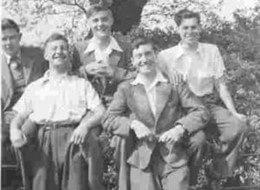
Edward as a foundation year student, UCNS, 1950
Deferring his National Service, a decision which Edward wrote ‘might not have served me optimally,’ he began his studies at UCNS in 1950, driven there by his brother-in-law, and admitting to some nerves about what lay ahead. A resident in the not-so-salubrious quarters of Nissan Horwood Hut 3, with five other male undergraduates, he described being ‘both abandoned and as free as a bird’. Soon, Edward was fully immersed in the joys of student life: playing in the first ever 1st XI Soccer match versus Birmingham University; founding the men’s, and later women’s, table tennis teams (earning the nickname ‘All Balls’); and helping backstage at a production of ‘A Midsummer Night’s Dream’, where he constructed a bridge over a lake. In 1952, Edward was elected President of the Geographical Association, having the distinction of being the only British undergraduate to attend the XVIIth International Geographical Congress in Washington DC in August 1952, at the age of almost 20.
It was at UCNS that Edward met my mother, Maryon Lloyd, his ‘soulmate,’ who was also studying Geography with English Literature, and roots were firmly planted in the soil of the North Staffordshire hills. Keele was to remain crucial to the newlywed couple’s lives, and that of their three children and one grandchild, and helped to define the next few decades. Not only was this where love had sprung, but it was also a place where many friendships and academic links were made.
Once he had graduated from Keele in the first tranche of finalists in 1954, and after gaining a Diploma in Education (and deciding not to teach young people), Edward resumed his National Service, teaching English and Geography to ‘squaddies’ before ending up at the ‘plum posting’ at NATO Headquarters at Fontainebleau, south of Paris, where he was based for 18 months.
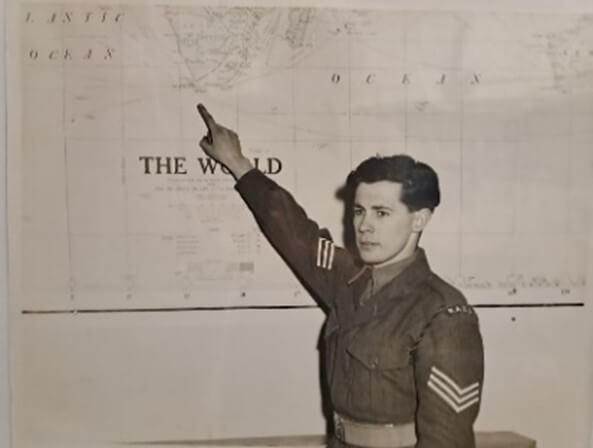
Edward teaching ‘squaddies’, 1955
Released early by the Army, Edward then accepted the offer of a postgraduate scholarship at McGill University in Montreal, Canada, where he planned to continue his studies towards an MSc. Maryon graduated from Keele in 1955 and, before the move to Canada, Edward and Maryon were married on June 2nd, 1956, at St John’s Church in Buckhurst Hill, Essex. The couple returned to Canada for the next few years, with Maryon working at the Arctic Institute of North America for a year to help support Edward’s unfunded year of thesis writing. Training first as a weatherman with the Canadian Meteorological Service, Edward then spent a year at the meteorological station in Schefferville, near Knob Lake, in central Labrador, with Maryon, where he recorded a minimum winter temperature of minus 47.5°F. They both recounted the wonders (and terrors) of being surrounded by forest, lakes, snow and, as he recalled, wolves.
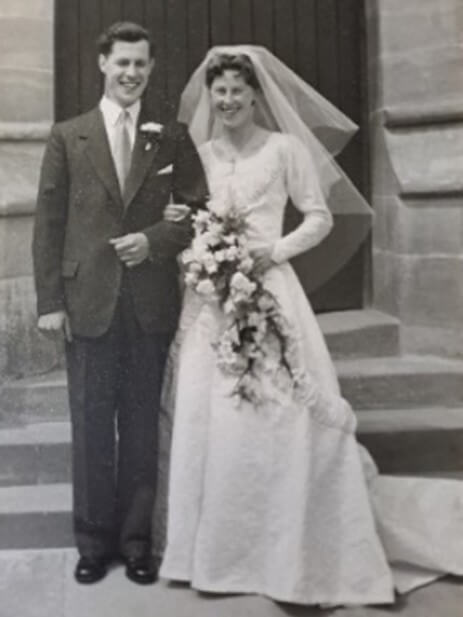
Edward and Maryon on their wedding day, 1956
In 1958, the couple returned to UCNS, and Edward became a Demonstrator in Geography, moving with my mother into the now-demolished Gateside Cottage, where they adopted a tortoiseshell farm kitten called ‘Oedipus’ (a play on words). Their eldest son, Edmund, was born in Stoke General Hospital in January, 1959. Edward’s MSc thesis, entitled, ‘Fluvial erosion in central Quebec-Labrador,’ was completed in May 1959, and awarded by McGill the following year.
Life continued apace as the young family moved in 1960 to Australia, where Edward assumed an appointment in Sydney as a Lecturer at the University of New South Wales, in Newcastle, a post he described as being offered ‘under a false premise.’ Disappointed by this appointment, Edward ‘fell on his feet’ in 1962, moved to 44 Evelina Road in Toorak, adopted a Siamese cat called ‘Mrs Siddons’, subsequently having the pleasure of working as the first full-time lecturer in the Geography Department of Monash University in Melbourne, establishing the subject as a full and integral part of the university offer, and leading the new department in the fields of geomorphology and climatology. His initial research interests included studies of the geomorphology and glaciations of Tasmania and the Antarctic continent. Recalling Edward, one student at the time, Ken Marriott, wrote that, ‘Eddie was always very approachable…but he didn’t suffer fools lightly,’ though he and his fellow undergraduate Howard Brown were nonetheless inspired to be ‘turned into geographers.’
Edward and Maryon returned briefly to the UK for a sabbatical, during which their second son, also named Edward, was born, in April 1965 in Hereford General Hospital. Here they learnt that Mrs Siddons, in a final dramatic act, had been squashed by a motorcar. Edward visited Spain at this time, researching the cordilleras in the Meseta of Castille. Returning to Australia, Edward continued to work as a Senior Lecturer at Monash. In 1966, he was invited by the United States Geological Society (work for which he was in 1974 awarded the Antarctic Service Medal) to contribute to research into the cirque forms and moraines in the dry valley area to the west of the McMurdo Sound, on the southern tip of the Ross Peninsula. Back in Melbourne, Edward continued to work towards his PhD at Monash, whilst collaborating with academics at the 1964-founded Macquarie University in New South Wales, being awarded his doctorate in 1968 for a thesis entitled, ‘Glacial Geomorphology and Climate of the Mountains of Western Tasmania, with special reference to the Northwest Centre.’
In the meantime, the family of four had returned to the UK in January 1967, with Edward taking up an appointment as Lecturer until 1970, then Senior Lecturer until 1974, before becoming Reader, in the Department of Geography at his alma mater, now Keele University. This was followed by the birth of the couple’s third son, Dominic, at the Newcastle-under-Lyme Maternity Unit, in November 1968.
During the period that followed, Edward continued to lead fieldtrips, notably to Norway and Iceland (once dropping his beloved Leica camera in an Arctic lake). It was in 1970 that Edward was invited by Geoffrey Boulton of the School of Environmental Sciences, University of East Anglia (UEA), to join a six-week expedition to Iceland’s small but dynamic ice sheet. Here, and back at Keele, Edward continued to hone his research into glaciology and glacial deposits, and, as he wrote, promote ‘the societal relevance of [that] science in solving real-life problems affecting us all.’ This mantra was one which was to develop throughout Edward’s career and motivate his cooperation with colleagues and institutions worldwide.
A sabbatical year followed in 1975-1976, during which time Edward lectured once again at Monash University, and, for a longer period, Massey University in Palmerston North, New Zealand, whilst continuing his glaciological and earth science research.
Though Edward was based for 18 years at Keele as an established academic, years he described as ‘the happiest of my life,’ many other opportunities opened up. In 1977, Edward first visited China, one year after the fall of the Gang of Four and Chairman Mao’s death, as a member of the UK Royal Society’s delegation of geomorphologists. The links first forged with academics at the Chinese Academy of Science (CAS) were to play a seminal role in the later development of Edward’s research work and international profile. It was at this time that Edward became fascinated by aeolian soil particles deposited as loess, kickstarting what was later described by Professor Slobodan Markovic as a ‘scientific revolution, one which, led by Edward and his eminent Chinese colleague Professor Liu Dongsheng, ‘verified Chinese loess as the most important continental record of changes in Quaternary palaeoenvironments.’ Visiting at the same time as a delegation from the Australian Academy of Sciences (AAS), Edward also forged a relationship with a leading soil scientist, Professor Jim Bowler, both of them determined to develop an understanding of the loess landscape. An invitation followed to spend six months at the CAS Institute of Glaciology in Lanzhou, Gansu Province, in 1980, offered by the legendary Chinese glaciologist, Professor Shi Yafeng. It was here, at Lanzhou University, that Edward led a three month course for international scientists in glacial geomorphology and sedimentology. This period undoubtedly reshaped Edward’s career and provided impetus for his pioneering scientific research into soils. It was seminal in forming important friendships, too, such as with Professors Wang Jingtai (about whom he later wrote a poem and obituary), Li Jijun and Ding Zhongli, later a Vice Premier of China.
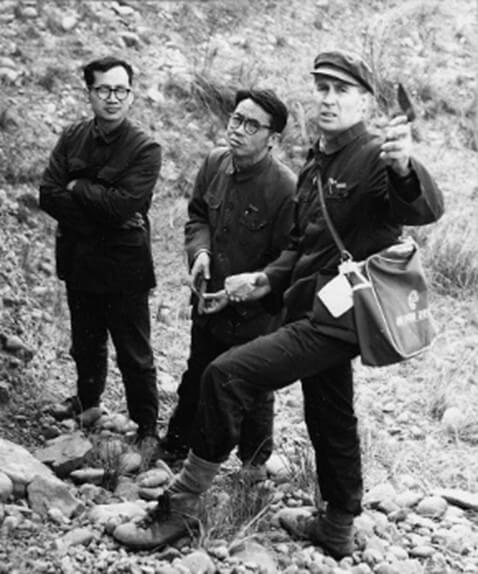
Edward on a field excursion in China, 1980
After Edward’s family flew home from China in 1980, he travelled to Islamabad and joined the International Karakoram Project in the upper Hunza Valley in Pakistan. This collaboration with scientists in a politically sensitive and geomorphologically unstable region of the world proved one of Edward’s great maxims: that no one should have to surrender their right to an education, with open mindedness being the prime ingredient. In this spirit, Edward grew a much-loved beard, which he kept until his death. Edward’s work in the field of soil mechanics, whether at the Kielder Reservoir on the North Tyne River, the Yellow River in China’s northwest frontier region, the precipitous valleys of the Karakoram, or the oil-gas platforms in the North Sea, had a bifold focus: debate, collaboration and innovation based upon international cooperation between scientists from across a broad spectrum of disciplines; and real-life solutions for people, often the poorest, whose lives were threatened by huge movements of soil deposits and the Earth’s crust. This was work that also brought Edward into the field of Quaternary research into palaeoclimates and the evolution of climate change, areas he early on describes as being of ‘huge societal significance.’ Indeed, his work in this climatically crucial region of the world – the Tibetan Plateau often being referred to as ‘The Third Pole’ – allowed Edward to make one of his seminal contributions to geoscience in understanding the extent of the palaeoglacial ice cover over Tibet. This was a busy time for Edward, and as his research interests accumulated, he was honoured to receive the Beck Award of the Royal Geographical Society of London ‘for contributions to glacial geomorphology and research in China’ in 1982.
In 1985, Edward left Keele University for the last time, a decision he wrote later was ‘difficult to understand.’ Indeed, he had been awarded his own Chair at Keele in 1984 as Professor of Geomorphology, but had, overall, felt unappreciated. Nonetheless, after taking up the Professorship and leadership of the Geography Department of Leicester University, Edward continued to explore ways forward in research, despite inheriting a department that had become somewhat ossified. His mission was to modernise the department, an almost Herculean task. Frustratingly, this period also included the loss of the Soil Mechanics Laboratory at Leicester in 1989 when the Department of Civil Engineering was closed. However, Edward had already persuaded the European Union to fund eight years of research into the huge and largely undocumented landslides of western China, for which he later earned the Varnes Medal of the International Consortium on Landslides, awarded to him by the United Nations Educational, Scientific and Cultural Organization (UNESCO) and the International Union of Geological Sciences (IUGS) in 2012. Joint and fruitful research with the Department of Geology at Leicester also allowed for further important scientific analysis of the glacial sediments of the Karakoram, and the loess plateau of Tibet. Research collaboration with Professor Ian Smalley at Leicester and Dr Tom Dijkstra at the University of Loughborough brought further academic papers and European-Chinese collaboration.
The move from Keele also brought the reward of a much-loved townhouse in Brighton, a colourful four-storey bolthole on the southern English riviera filled with a lifetime of memorabilia that was much appreciated by Edward and Maryon. This was followed some years later by a move to a spacious apartment in Hove, and finally, in the late 2000s, to a part of an old mansion house in the somewhat unlikely setting of Bognor Regis.
Back to 1990 it was, of course, typical of Edward to see an opportunity to ‘retire’ from formal academia, aged just 59, as an opening to further international collaboration and supervision of doctoral students. He mentioned being happy that he ‘had the freedom to run my own life; to teach if I wished and/or take on full-time research.’ Approached by Professor Jim Rose, the Director of Quaternary Research in the Department of Geography at Royal Holloway, University of London, Edward, as Emeritus Professor, entered into a decade of work he said included ‘without doubt the happiest and most rewarding teaching of my life.’ It was here that Edward contributed to the MSc in Quaternary Science and supervised and worked with two post-doctoral students who became adoptive members of his personal, and worldwide Quaternary, family, helping with the delivery of a course on sedimentology: Professors Lewis Owen and Meng Xingmin.
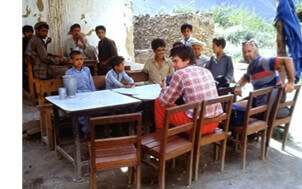
Edward (far right, sitting) in Pakistan, 1995
Furthermore, this period of overlap (1987-1991) saw Edward, as the UK’s national correspondent, join only 16 scientists involved with the International Geological Correlation Programme (IGCP) 252, a joint venture between UNESCO and IUGS on the ‘Past and Future Evolution of Deserts.’ This was combined with Edward’s membership of the Royal Geographical Society’s Earth Resources Committee, which in turn led to his becoming a member of the External Relations Committee of the Geological Society of London. Busy as ever, this was accompanied by an invitation by IUGS to chair its Committee for Research Directions, a thinktank charged with promoting international geoscience research initiatives.
Elected as the Secretary-General of the International Union for Quaternary Research (INQUA) for 1991-1995 at the annual Congress in Beijing, China, Edward used this opportunity to develop internationally based Quaternary research initiatives with likeminded scientists from across the globe, including in China, Australia, Europe, North America, South America, and India, notably with Professor A.K. Singhvi, whom he encouraged and supported in a mission to establish INQUA within the important Indian subcontinental academic hemisphere. At the Great Hall of the People in Beijing, Edward was able to chat on several occasions to the paramount leader of China, Deng Xiaoping, about climate change and its societal impacts. In 1992, the government of Gansu Province in China made Edward an ‘exemplary foreign expert.’ The following year, 1993, brought a collaboration with An Zhisheng and A.K. Singhvi, through IGCP 349, on ‘Desert Margins and Palaeomonsoons since 135ky: 1993-1997’, resulting in a co-editing with A.K.Singhvi of a book entitled, ‘Methods for Paleoenvironmental Research in Drylands.’ During this part of the 1990s, Edward also found the time to contribute to the IUGS’s Commission on Environmental Management as a member of the Medical Geology Working Group. In 1995, he was coopted on to the Scientific Board of the IGCP), prior to being elevated to its Chair for five years (1996-2001), the longest term yet served by an IGCP chairperson. It was also at this time that Edward attended four of UNESCO’s biennial General Conferences, working with the UK’s Permanent Delegation.
1995 was important for another reason: a spin-off from the main loess project initiated at Leicester was a meeting in Loughborough to discuss loess and other collapsing soils. Support from NATO also enabled other leading scholars to attend, with the outcome being a book edited by Edward, Dijkstra and Smalley, entitled ‘Genesis and Properties of Collapsing Soils.’ Further research in 1997 brought insights into the correlation between climate and desertification, highlighted by a submission to ‘Earth Science.’
The year 1999, when Edward was 67, brought two important turning points in his still developing career. The Loessfest ’99 Conference, organised by Edward, Smalley and Professor Ludwig Zöller in Heidelberg and Bonn to commemorate the 175th anniversary of the naming of ‘loess,’ resulted in further international collaboration, as well as two more edited volumes of research and analysis in 2001: ‘Recent research on loess and paleosols, pure and applied’; and ‘Loess and Paleosols: characterization, chronology and climate.’ The other highlight of Edward’s year in 1999 was his appointment as an Honorary Life Member at INQUA, in acknowledgment of his contributions to Quaternary science. Still on the twin-track approach to loess research projects, Edward, Dijkstra and Meng edited ‘Landslides in the Thick Loess terrain of Northwest China’, the culmination in 2000 of the ‘Loess Landslides in Lanzhou’ project.
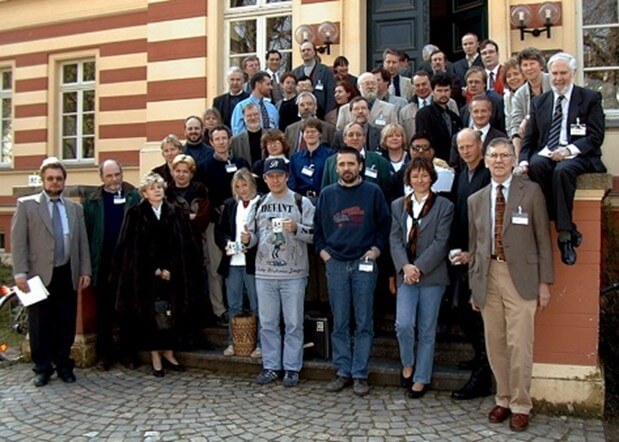
Edward (far right, sitting) at Loessfest ’99, 1999
Rather than slow down his academic research interests and international collaborations, Edward’s work seemed only to accelerate. In 2001, he was appointed to the Chairmanship of the Science Programme Committee of the proposed United Nations International Year of Planet Earth (IYPE), 2008. Such a role, Edward wrote, included ‘the range of skills expected being well beyond that of chairing committees; the learning curve in diplomacy and politics is as steep as ever.’ Typically, Edward modestly attributed his success in lobbying national delegations at the United Nations (UN) in New York and the Foreign and Commonwealth Office in the UK to declare 2008 the IYPE at the UN General Assembly of December 2005 to his experience advocating the establishment of departmental programmes and student societies during his foundation year at UCNS. Also during this period, 2000-2004, Edward co-led, with Professors Olle Selinus and Peter Bobrowsky, IGCP 454, focussing on medical geology. Journeys to Europe, working with the likes of Professor Ted Nield at the Geological Society, allowed others to collaborate with Edward, ‘this most dedicated servant.’
In 2004, Edward was awarded the Prix d’excellence pour les sciences de la Terre, by the Organisation mondiale de mineralogy, Monaco. Continuing to visit colleagues in China and beyond, Edward saw no need to end his first ‘retirement.’ After his much-touted second ‘retirement’ in 2010, he continued his work on medical geology, with an emphasis on airborne natural mineral particles. This allowed continued contact with international geoscience institutions, supervision and editing of scientific papers and a chance to act as a series co-editor with Professor Eduardo de Mulder of the legacy volumes that provided state of the art records of the IYPE’s ten major themes.
Typically, an investment in the 2000s in a property on the southern coast of Gran Canaria did not simply mean the occasional relaxation by the pool, but rather scientific cooperation with researchers such as Dr Inmaculada Menéndez González at the Instituto Oceanografía y Cambio Global in Las Palmas. This was archetypically Edward: as he stated when at UCNS, ‘vacations were generally too long for my taste.’ Summer camping holidays with his family around Europe had, indeed, been sold as breaks, but included in-situ seminars on the glaciations of the Alps or the Dolomites, or the import of Quaternary soil sections exposed by the roadside. Life was work, and work was life, however varied. Indeed, in a paper harking back to his earlier life in North America, Edward’s article ‘Notes on the Social Structure of a Canadian Border Town’, was published in ‘Sociological Review’ in 2011.
Still based in Bognor Regis, Edward sustained a dramatic injury in July when hitting his head on an iron girder of the basement of the property, having delved underground to extract academic papers for his continued research. Bleeding on the brain ensued, as did an air ambulance flight to Southampton Hospital to save his life. A miraculous escape, aided by an excellent team of health professionals, allowed Edward to continue to work. In early 2012, Edward effectively compiled, edited and produced the 40th Anniversary volume for IGCP, providing an historical overview of the outstanding contributions of global scientists to the IUGS-UNESCO IUGS legacy. As recognition of his academic work, Edward was subsequently awarded the James M. Harrison Award and Medal for Outstanding Achievement by the IUGS. His citation supported the view of many colleagues throughout the decades, who were inspired and impressed by Edward’s commitment, rigour and generosity of spirit, as one who ‘exemplifies the voluntary service to the Union most cherished and appreciated by its members.’
In his eightieth year, 2012, Edward was headlined at an international conference in his honour. Called ‘ED@80’, this international gathering of earth scientists at Novi Sad, co-led by Professor Slobodan Markovic, and including field trips to the loess deposits of northern Serbia, was a fitting recognition of Edward’s contribution to the greater understanding of the physical and human significance of loess transportation and deposition.
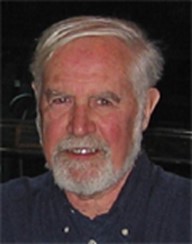
Ed@80, a celebration of Edward’s life and career, 2012
Later in 2012, Edward and Maryon made their final move, this time to Cheltenham, in southwestern England. Edward quickly installed their extensive library in their new home, as well as filing cabinets and shelves inhabited by academic papers and research documents. In his neatly defined and organised study, lined with photographs from around the world, he continued to write and edit scientific papers, in particular co-authoring papers on medical geology and the ‘impact of airborne mineral dust on human health.’ This was a continuation of initial work with thoracic specialists in China and Europe into the quality, composition, distribution and properties of loess and global silt and their profound societal relevance, a parallel project which had resulted in the publication of three co-authored books: ‘Essentials of Medical Geology’ (2005); ‘Pollutants, human health and the environment: a risk based approach’ (2012)’; and ‘Essentials of Medical Geology’ (2013).
One final move within Cheltenham in 2015, to a smaller house, did not dim Edward’s work ethic, and it was here, in 2017, at the age of 85, that his last paper of more than 200 manuscripts and books, concerning the human health impacts of wind-blown Saharan dust particles, was written. This followed titles such as, ‘Geomorphology and Climate’ (1976), ‘Landslides in the Thick Loess Terrain of North-West China’ (2000) and ‘Geomorphological Processes’ (2013). Contributions to international journals and memoranda of collaboration with geoscientists and others too many to mention lay, meticulously archived, in Edward’s last, sunshine-filled study. At last, now, Edward began to slow down as dementia and a diagnosis of Alzheimer's disease started to take their toll. Maryon was, as she had always been, the mainstay of Edward’s work, health and happiness, and life was adjusted to include cruises around the Mediterranean and northward past the Arctic Circle, revisiting old haunts. Language became increasingly sparse, though the twinkle in Edward’s eye remained, as did his occasionally sharp wit. His love of literature, and especially Shakespeare, brought immense comfort; he was thrilled to win an award with a national bookseller for his satirical poem ‘The Duntisbourne Leer,’ based upon a pun around this Gloucestershire village’s name. Edward was always tickled pink by wordplay, and it was therefore fitting that his poems were professionally performed during a tour of regional venues in 2021-2022. Visits to the opera and classical concerts also provided balm. A near fatal meeting with Covid-19 on Christmas Day, 2022 led to Edward’s move into Wentworth Court Care Home, where he continued to delight with the odd incisive remark, an eyebrow-raising rendition of the word ‘Wow!’, endless smiles, and dances with the carers, until his health finally failed.
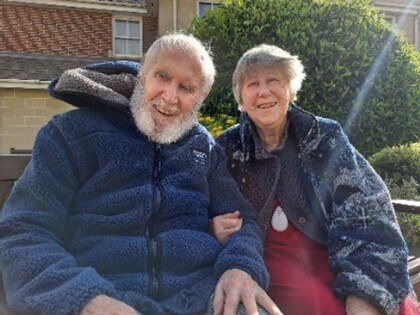
Edward and Maryon at home in Cheltenham, 2024
Professor Edward Derbyshire died on July 9th, 2024, at Wentworth Court, Cheltenham, and is survived by his wife, Maryon. They shared three children, Edmund, Edward and Dominic, nine grandchildren, Lizzie, Emily, Frederick, Isaac, Ralph, Daniel, Jacob, Henry and Beatrice, and two great-grandchildren, Sophie and Martha.
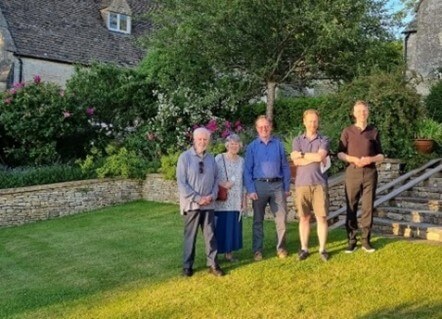
Edward, Maryon and sons Edmund, Dominic, and Edward (left to right) at a professional performance of ‘From Age to Age,’ including Edward’s poetry, Syde Manor, 2021
Written by Edward Derbyshire. Cheltenham, July 2024
Not a whit, we defy augury. There’s a special providence in the fall of a sparrow. If it be now, ’tis not to come; if it be not to come, it will be now; if it be not now, yet it will come.
The readiness is all.
William Shakespeare, Hamlet
1936 - 2025
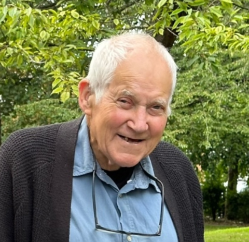
Written by Jeremy Steele: Friday 31 January 2025
Childhood viewpoint of an only just younger brother. (The other two were sister Sandra, and Rory, born in Perth, W.A., after the family moved there in 1938.)
Michael was born in Adelaide South Australia in 1936, on the anniversary of the Battle of Hastings, 14 October 1066, and one year, eleven months and three weeks before me, both facts which he drummed into me. He was my loved, admired older brother, in whose shadow I grew up. He won prizes at school, was always noticed and shone. In our family he was the eldest son of the eldest son of the eldest son going back numerous generations He was always first, and there were no prizes for coming second. I grew up in his thrall, which never quite went away.
He was wonderful though, always showing the way, with the ability to impose himself and his knowledge, on me anyway. I can still recite the cases of Latin nouns, learnt from him even before I was exposed to Latin at school. He could recite the names and dates of the kings and queens of England from William the Conqueror, and could probably have given a summary of the lives of each, knowing where each stood in history’s flow of events. He could rattle off the states of America, from a mnemonic learnt from our father.
I was lost without him, as I found out on the first trip home on my own to Darlington from primary school in East Guildford, when changing trains at Midland Junction. Without Michael’s guidance I got on the wrong train, jumping off when the train paused at signals, and walking the numerous miles home. This was in Perth Western Australia where Michael went on to complete his schooling at Guildford Grammar School.
By 1952, Father’s health, always precarious, was failing again. Somehow very acute Mother came up with the preposterous notion of moving the whole family to healthier climes, to escape the pollens of the world-renowned biological hotspot that is south-west Western Australia. The place she had chosen was Italy. Italy! We lived in Perth, in those days an national backwater. The plan was that our parents and two younger siblings would travel first, and we two oldest children, for sea-passage ticketing reasons, six months later. Everything had to go. House and furniture were sold, and pet dog passed on to a friend. The rest was packed in crates on which we daubed the word ‘London’. The family then drove east across the Nullabor Plain desert to Adelaide, the ancestral seat of the Steele family where the car too was sold. The final stage was a rail trip to Melbourne to see more family before, as planned, four boarded the Shaw Savill liner Arawa for England, and thence to Italy. Michael and I stayed on in Melbourne.
It was on the rail journey to Melbourne that Michael looked to see which team he would support in the VFL, the Victorian Football league of the Australian Rules football competition. He soon settled on Richmond, a team having the same colours as Claremont, his team in Perth. Thereafter he followed the Richmond Tigers passionately to the very end, adding West Coast as a second favourite when years later WA joined the expanded national completion.
In Melbourne Michael and I stayed with an aunt, one of our mother’s five sisters. Michael would go to watch Richmond play, with some of our Cropley cousins. We both had jobs as office boys,
where he worked in the postal department. He was fascinated by the postcodes then in use in Victoria (in primitive Perth at the time there had been no postcodes—or traffic lights, or electric petrol pumps), and learnt most of them, bestowing one of them, S20 for the town of Moorabbin, on me as a nickname, after innumerable predecessor names. Michael coined nicknames for all sorts of things throughout his life, some being She’s (Sandra), Heed (short for ‘rat-head’), for Rory), the jazz (for the toilet, or lavatory, after the Duke of Plaza Toro (G&S The Gondoliers))— (later ‘the talls’, presumably for ‘toilet’), Strawb (strawberry, for Yvette), Laundromat Steve (for Yvette’s former husband), and RQ (probably for Red Queen, for Sonia). There were endless more.
Michael was 17, practically grown up, when the two of us eventually boarded the P&O Strathaird in 1954 for Europe, and he relished the fact that I, only 15, was classified as ‘in charge of the master’. We stopped in Colombo and Bombay, and went through the Suez Canal. Michael opted to go on an excursion to the pyramids (I was too scared) while the ship was passing through this waterway. We disembarked at Marseilles in France (where we tried out some schoolboy French), and caught a train to Genoa, being met by the family. Then in the dark through innumerable tunnels to Lerici, the fishing village where they then lived. Three days later Father drove Michael to England to begin his university education, and so he missed the extraordinary Italian experience of the rest of us were to have.
In late 1954 Michael ended up in Keele, then the new University College of North Staffordshire, where he became president of the Social Committee, and was to make many friends, one notably William Clark, a friendship which continued throughout his life.
Michael graduated in 1958, with the looming possibility of two years British national service (only three months then being obligatory in Australia). To avoid this he went to Turkey to teach English, where he met Beryl Swift, and her young son Nicholas, and married her in 1962 on returning to England.
Michael was always fascinated by politics and, settling in London, he began to pursue a career in journalism. He was of the centre-left politically, a supporter of underdogs. He attached himself to the British Liberal party, and eventually obtained a position as lobby correspondent in the House of Commons, occupying what he claimed to be one of the world’s most recognisable office locations, its window being just at the point where the Big Ben tower met the rest of the Palace of Westminster. While in this role he secured contracts to appear regularly on Welsh television to give a Welsh view of happenings in Westminster, and another contract to provide similar insights for the Japanese. He loved the environment of the parliament, meeting or brushing past the great and famous of the day. He became treasurer of the lobby correspondents group, and gained some notoriety for organising annual marathon running events for correspondents and politicians.
Michael and Beryl had two daughters, Yvette and Jessica, whom he loved dearly, and of whom he was extremely proud.
Although his identity as an Australian and his enthusiasm for Australian Rules football remained important to him throughout his life, after leaving Australia in 1954 at the age of 17 Michael never returned to Australia to live. As I chose to sail to Sydney with my young family in 1969 and have made my life there, Michael and I—who shared so many life-shaping early experiences with each other exclusively—although we kept in touch, have met on only rare occasions since the 1960s.
Michael had his share of misfortune. His stepson Nicholas was killed in a motorcycle crash. His first marriage failed. But he was resilient. One early scheme he embarked on was to buy an old Thames barge, the San Riou, big enough to live on; but within weeks it sank. Another scheme was to invest in crates of wine. The most remarkable of his enterprises was a jukebox-hiring business which he set up, and named West Coast Eagles Jukeboxes. He acquired several jukeboxes, naming each after a notable West Coast Eagles footballer, and accumulated an extensive collection of records. He drove these cumbersome instruments in a trailer to hirers’ locations anywhere in south Britain though mostly around London, setting them up and retrieving them the next day. All much easier said than done.
Michael was always keen on sports. He would make a point of attending a day in any Ashes England-Australia test series; and for many years would travel to Australia in the years Olympic Games were held so he could enjoy them the better by hearing parochial Australian commentary on the media rather than the commensurately biassed British coverage in England.
On one such trip Michael married Sonia, on our back lawn in Sydney, surrounded by gum trees, on 3 September 1992. They shared a colourful life together which I would see occasional glimpses of.
Throughout his life, right from primary school, Michael kept a diary, handwritten of course. When he eventually decided to copy it out, by dictating it onto his computer, he discovered that many of the people who featured in it were recorded by nicknames that after multiple decades he had forgotten.
Michael was keenly interested in people and his family was very dear to him. His direct and enquiring manner often led those whom he met for the first time to feel they were being interviewed. He loved movies, and history. He was intrigued by war memorials, noting the much greater numbers of fatalities in the first world war than in the second.
He was well read, and would often go to the literary festival in Hay-on-Wye. And he had an amazing memory. He learnt dates. He could unhesitatingly tell you some fact, or several, in connection with any date in the year, whether a battle, triumph, disaster, or a family member’s birthday or anniversary. Curiously though, I discovered when I visited England last year to see him for what turned out to be the last time, he had never been to the site of the Battle of Hastings associated with his own birthday, until we detoured there together on a trip to Hastings to see Jessica.
Michael would no doubt have found fault with this summary. So, in closing, why not hear authentically from him, himself, quoting from an email he wrote in June 2023:
“The Hay literary festival is an event that takes place in Hay on Wye in east Wales in late May and early June each year. Hay is a town renowned for its second hand book shops, and the Wye is a river on the English Welsh border.
I have two daughters – Yvette and Jessica. Yvette is a dedicated attender of the Hay festival and Jess goes quite often as do I. My wife Sonia is cool towards Hay but sometimes comes to keep me company as she did this year, not least because Yvette, born on May 26 1963, was having a birthday party in Hay to celebrate being 60.
I am not a particularly religious individual but I do believe in God. I think it is much more interesting to consider that there is a God and some sort of spiritual afterlife. However, particularly since reading Julian (the apostate) by Gore Vidal some years ago I have not been able to accept the divinity of Jesus Christ. Of course I accept that like Oliver Cromwell, Julius Caesar and Abraham Lincoln, he was a very significant mortal.
I pray to God briefly before going to sleep, and mention in my prayer 8 individuals who are closest to me. The remarkable thing about the Hay Festival is that seven of those eight individuals were present when Sonia and I were at the festival [including] my first wife Beryl, who now calls herself Emily.
The one person in my praying octet who was not at Hay is a fine boy who turned 16 the day before yesterday and who is the son of Sonia's daughter by her first husband. This lad is called Sullivan, and I have known him very well from the moment he was born. Because, at that time, he had two living grandfathers, I did not want him to be calling me ‘step grandad’, … for reasons that are a different story I told his parents that I wanted Sullivan to call me ‘Cicero’, after the great Roman democrat and republican. They cooperated fully, so their son mostly calls me ‘Cic’ for short. He Is a serious competitive motorbike rider and has been since the age of 6.
He and his parents used to live very close to us and we would see a lot of Sullivan. Unfortunately, from my point of view, they decided to leave South East London and go and live in Silverstone, which at a rough guess I would say is about us far from London as Mildenhall. Silverstone is the headquarters of motorbike riding in Britain. Sullivan goes to the school associated with it, and he's doing very well. He did not come to Hay but still features in my nightly prayers.
The other seven in those prayers and were at Hay were Sonia and the two above-mentioned daughters, together with Eve, aged 22, who is Jessica's daughter, and both Yvette’s sons. They are Danny, aged 33, who now lives in British Columbia, of all places. He went to [that] side of North America because he met a girl from BC when both were working in a place near Hay .…
Danny, who is very close to his mother, comes over here reasonably often and is by chance a very good cook, though that is not his profession. He has just been taken on as a trainee paramedic. He was in charge of all the food arrangements at his mother's 60th birthday party in Hay the other day, and did very well.
His younger brother, my grandson as well, has just been signed on as the third doctor in my immediate family. His mother Yvette, who went to Aberdeen University, became a GP Connor, [this grandson], married Arialym, a very nice Kazakh woman whom he met at Newcastle University, where they were both students. Connor did engineering and has now got a PhD in it .
His aunt Jessica is also a PhD, and I went to Leicester a few months ago for her graduation ceremony for that. Connor and Arialym got married in Kiev about six months before the loathsome Putin tried and failed to capture it.”
Michael, I always called him Michael, died on 17 January 2025, aged 88, 25 years after our father, who died on 11 January 2000, aged 91. I shall miss this elder-brother dominant figure in my life, and already do.
Keith Philip Johnson
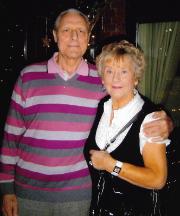 Pictured: Keith and Pauline
When Her Majesty The Queen opened the University College of North Staffordshire in 1951 she spoke of acts of courage and imagination, and that those early students would have a special responsibility to endow the university with 'a tradition which will enrich it long after you have gone'.
Arriving from North London just a few years later Keele soon became Keith’s home. He spoke fondly of those early years and boarding in the campus’s nissen huts. His fondest and most cherished memory was when his eyes met those of a young woman in the refectory of Keele Hall. Pauline Yardley was a local girl and had begun her studies at Keele the year before he arrived. By then, Pauline knew ‘the ropes’ and was an established student. Of course she knew a good thing when she saw one and in 1957 they were married at St John The Baptist Church in Keele Village. After leaving Keele they had a short stint living back in London before returning to the Potteries to set up home, raising three children along the way. Keith enjoyed a successful career in industry and became Sales & Marketing Director of Doulton Sanitaryware in Stoke. After many years in an ever-changing industrial world he moved on to pastures new, going on to work for a marketing company who were coincidentally based on the early phase of the Science Park at Keele. With such fond memories of his early life on campus it was like coming home for Keith!
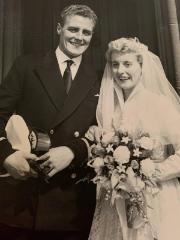 Pictured: Keith and Pauline on their wedding day in 1957
He kept in touch with a number of ‘pals’ from his days at Keele, including the late Brian Stokes. His son often remembers him going for a ‘jar’ with Brian, either at The Sneyd in Keele village or at the KPA bar. Brian’s passing was a real loss for him; they were great pals with great stories to tell.
Old age and heart issues took their toll on Keith. His dedication and care of his dear beloved wife who had suffered with dementia for some time finally became too much for him. Pauline moved into a nursing home during the summer of 2024. Keith passed away peacefully in hospital just before Christmas, with dignity and his family around him. His family feel blessed that his pioneering spirit will continue to live on and enrich Keele University for generations to come. It’s a legacy that Keith deserves to be very proud of.
1948 - 2024
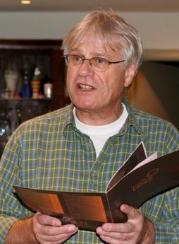
Philip Kendrew was born in Manchester on 28 September 1948, the younger of two boys. Football was the family ritual: regular trips to both Manchester United and Manchester City’s home games laid the foundation for a lifelong love of the Beautiful Game for both brothers. He attended Shrewsbury Public School and retained many memories and lessons from his boarding school experience. At Keele, Philip studied French and German, developing a particular love for German language, literature and poetry, and spending a year in Stuttgart. He graduated in 1971.
Soon after graduation, Philip was offered a position with the European Commission in Brussels, to train as an interpreter. Britain had recently started the process of joining the growing European economic union, and the Brussels-based institutions were keen to recruit Britons with language skills to support the new member state’s participation. Following some years working as an interpreter, traveling on missions around Europe and beyond, he transitioned to working in the administration of the European Commission’s interpretation service - ensuring that meetings were sufficiently staffed in Brussels or abroad, that interpreters were recruited as new member states joined the European Union, and overseeing the operations of the service. He retired in 2010.
In Brussels he met and married Christiane; they had two children. The family lived in the Flemish suburbs of Brussels, where Philip developed a great love for, and considerable expertise in gardening. He also became fluent in Dutch, adding to his language skill set. Following their divorce in the early 2000s, he moved back to Brussels, and later remarried. He took great joy in traveling - from leisurely summer trips around Europe, in particular to France and Italy, and further afield to South East Asia, the South Pacific and the United States. He loved good food and wine, classical music and opera, and remained an avid reader of literature, poetry and non-fiction throughout his life. He retained his connection with the UK through the family’s shared passion for football, and he stayed devoted to Manchester City regardless of the club’s fortunes. Such was his enthusiasm for his interests and passions, he managed to transfer many of them to his friends, colleagues and his children.
Philip passed away on 25 November 2024 after a long illness, in Brussels. He is greatly missed by his wife Hannah, his brother Geoff, his children Stefan and Sarah and their mother Christiane, his stepchildren Simon and Astrid, and his many friends and colleagues.
John Lanning Davnall
1948 – 2023
John Davnall (“Dav”) was born in April 1948 in Birkenhead, of which he was rather proud, but while he was still quite young the family moved to West Cumberland where his father worked for the Atomic Energy Authority. Like most Lake District dwellers, he developed a love of hill walking that never left him.
After education at Millom School where he was Head Boy, and a gap year working at the Atomic Energy Authority, he came to the University of Keele in 1967 to read Chemistry and Economics. He quickly became involved in student politics, joining three of the Party Societies until being told this was against Student Union regulations – he settled for the (then) Liberal Party.
From September 1969 to February 1971 he edited Concourse, the student newspaper. It was a time when much was happening, both murky and zany, at Keele, so there were plenty of contributors, students and staff, to fill the pages. He forever lamented his “Biggest Missed Scoop Ever”: an edition was rolling off the press far away in Ripley, while the “Nude Sunbathing Incident” happened in 1970. Even if the story could have been phoned through, it would have been too late to be included.
After graduating in 1971 and spending six months as Student Union Secretary, Dav became an Administrative Assistant in the Department of Management Sciences at the University of Manchester Institute of Science and Technology (UMIST). Shortly before this, he had married Sarah (Norman, 1970), and they moved to the Manchester outskirts where they have remained. Dav retained his Keele link by becoming the Alumni Representative on the Keele Council for a number of years.
After about seven years at UMIST, Dav retrained as a Chemistry teacher and took up a post at Hadfield School near Glossop. He stayed there until he and Sarah started a family in 1987, at which point he became the family carer while Sarah continued to work.
Over the next twenty years he worked part-time at a number of teaching-related activities, starting with research into management in education, supervised by his old department, for which UMIST awarded him a Masters Degree in 1991.
His last job, for several years, was a as a peripatetic home tutor In which role, he covered almost every subject from the sciences and maths to latin and drama, made possible by the breadth of his interests and engagement with life.
On retirement, he and Sarah moved to a house with a large sloping garden which he spent the next few years reconstructing to their liking. He also renewed his interest in mathematics and its applications, joining the Manchester Statistical Society, and obsessively built a vast carefully researched family tree.
A love of hill-walking persisted throughout his life. He loved his home area, the Lake District, but even more the Cuillin Mountains on the Isle of Skye. The family holidayed there every other year, and he knew, and had climbed, every part of the ridge. His other life-long pleasure was music, especially classical music, and by the end of his life he and Sarah were patrons of most of the major music organisations in Manchester, resulting in frequent and greatly enjoyed concert-going.
He died very suddenly and rapidly of a brain stem haemorrhage in November 2023. It was a terrible shock for family and friends alike. The only good thing about such a swift death was that it allowed his wish to be fulfilled to bequeath his body to the University of Manchester Medical School for anatomy classes. It is a great comfort to family and friends that he continued to be involved in teaching for a little longer.
Daniel Joseph Keohane
1941-2025
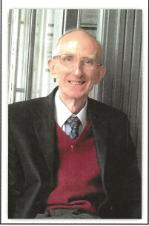
Known in Ireland as Dónal, Dan Keohane was born in 1941 in a village outside the town of Bantry on the southwest of Ireland. Having concluded his education in Ireland, he left for London in 1959 where he spent 10 years working in industry before returning to formal education. Dan secured a place at Ruskin College, Oxford, where he completed a university diploma. He subsequently graduated with a degree in international relations from Sussex University and a master’s degree from Warwick university. In 1977, he secured a position in international relations at Keele university and was subsequently promoted to senior lecturer. He remained there until his retirement.
A work colleague describes Dan as “very careful, very reliable and very sensible.” Dan loved supervising students and especially enjoyed graduation days – meeting students with their proud parents. Many of Dan’s students have fond memories of him. They describe him as “inspirational”, “gently spoken and thoughtful”, and having a “wicked sense of humour”. A former PhD student said that “three years of research under Dan’s supervision did not just earn me a PhD degree, but also taught me what one cannot find in university books: patience, perseverance, discipline, a type of wisdom that makes one truly the moral and intellectual human that one ought to be”.
Dan was a respected authority on issues of conflict. An active member of the Labour party, his Labour Party Defence Policy Since 1945 was published in 1993. While the central concern of the monograph is with Labour's defence policy, the book examines many questions about the United Kingdom's defence arrangements and is a study of the wider post-war British as well as the Labour party defence policy. In 1994, Dan co-edited (with A. Danchev) International Perspectives on the Gulf Conflict, 1990-1991. This was followed by his Security in British Politics, 1945-99 published in 2000 by Springer. That book focuses on the attitudes of the Labour, Conservative, and Liberal parties; it analyses how these parties viewed conflicts like Suez, the Falklands, and the Gulf War, their stances on nuclear weapons, and their approaches to Northern Ireland.
Dan was exceptionally happy at Keele University, where his grandchildren Danielle and Kerstin are currently students. In his retirement he took the opportunity to travel extensively with his wife and also maintained a very strong interest in international affairs. Dan’s funeral took place on 21st May 2025. Our heartfelt condolences to his wife Modesta, his sister Mairéad and the wider Keohane family.
Iain Robin Simpson
1940-2025

Pictured: Iain and his wife Barbara
We are saddened to share the news of the death of Iain Robin Simpson, who died on 20 April 2025 at New Cross Hospital, Wolverhampton, aged 84.
Iain was born on 31 August 1940 and arrived at Keele in 1958 - then the University College of North Staffordshire - as a Fresher alongside his future wife, Barbara Davies. They began going out together in their first term, married on 10 August 1963 in Shrewsbury, and remained devoted partners for over 61 years.
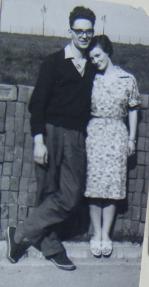 Pictured: Iain and his wife Barbara
Iain graduated in 1962 and began his career in computing at a time when the field was still in its infancy. He joined Cerebos Salt in London in July of that year, later working for British Oxygen in Swinton, Manchester, and then NCR in Birmingham and Dayton, Ohio. On their return to Stafford, Iain worked for a software firm in Birmingham before setting up his own business in 1983, providing bespoke computer systems for small businesses. Barbara, who had trained in accountancy, supported the business from their home in Doxey.
The couple retired together in 2004 and remained active in family and local life. They had three daughters, all now married, as well as five grandchildren and two great-grandchildren. One granddaughter, Jasmine Lord, is currently studying Mathematics at Keele, continuing the family’s connection with the university. Iain and Barbara often reflected on how much had changed since their own student days - though were pleased to see that Walter Moberley Hall still stood.
Iain contracted pneumonia in late 2024 and, after a period of declining health, died from urosepsis and frailty. He is deeply missed by Barbara and their extended family.
Barbara graduated from Keele in 1962 with a degree in English and History and a Diploma in Education.
Dr Stan Beckensall MBE
Class of 1954
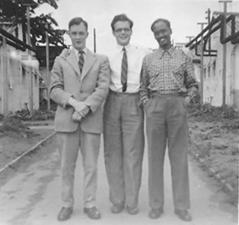
Stan is pictured in the middle
"Stan Beckensall sadly passed away on 1 October 2025, aged 93, in Hexham, Northumberland. Part of the university’s Founding Class of 1950-1954, Stan graduated with a First Class BA (Hons) in History, English and Education. He led a full and rich life as a dedicated family man, educationalist, historian, archaeologist, playwright and poet. After teaching stints in Sussex and Malta, he settled in Northumberland in 1966, where he developed strong interests in ancient rock art and place-names, publishing books about them in the 1970s and 1980s.
After retirement as Head Teacher of Rothbury Middle School, in 1989, Stan expanded his research interests. More books followed on ancient rock art and place-names, but he also included in his repertoire books on various aspects of Northumberland’s archaeology, history and landscapes, Hexham, and poetry. In all, he published about 40 books.
He was awarded an Honorary Doctorate by Newcastle University in 2004 for his contribution to rock art studies and an MBE, in 2017, for a ‘Lifetime of voluntary work of recording, safeguarding and sharing information on pre-historic rock-art and local history in Britain.’
He is survived by Jane, his wife of 69 years, four children, Sonia, Sylvia, Julian and Rachel, seven grandchildren and five great grandchildren.
He was much loved and respected in Hexham and around Northumberland and is going to greatly missed by his family, friends and all who knew him."
Written by Dr Aron Mazel
View a video of Stan from our Pioneers Reunion in 2024 on this web page.
Hedley George Martin
Hedley Martin passed away on July 16, 2024, at the age of 93. He will be remembered for his intellect, humour, and diverse passions that spanned academia, the workshop and the stage.
His love for the theatre began early at Keele University, where he was a driving force in the Drama Society, directing and acting in many productions. He often reminisced about his memorable turn as the comic Sir Andrew Aguecheek in Twelfth Night.
After Keele, his academic pursuits led him to Trinity College, Cambridge, for his doctorate. This time was paused for National Service in the Navy at Abbotsinch in Scotland, where he met his wife-to-be, Sheila Rutherford, a Wren at the time. They married in 1959.
After completing his PhD, Hedley dedicated his career to teaching, serving as the Head of Mathematics at Staffordshire University in Stafford until his retirement.
Away from the university, his curiosity found new avenues. He became an expert antique clock repairer in his spare time; many friends and family still cherish a clock ticking away today because of his meticulous work. Influenced by Sheila, he also became an avid Scottish dancer, and they enjoyed many happy holidays dancing abroad with friends.
Hedley leaves behind his three children, David, Jonathan, and Kathryn. He was very proud when two of his grandsons, Danny and Louie, followed in his academic footsteps and went on to study at Cambridge.
Hedley lived a life rich in learning, laughter, and lasting impact.
Christopher Brookes Oliver
(Physics & Maths, Class of 1957)
15 November 1934 – 22 June 2025
-217x225.jpg)
Chris was born in Solihull and spent much of the first few years of his life in hospital, having been born with club feet. During the war, when bombing began on Coventry and Solihull, his mother took her three children to Ilfracombe, in Devon, where they stayed, until the aircraft factory in Solihull, where his father was working, was bombed. The family then spent the remaining years of the war in Yorkshire, where the aircraft factory moved to.
On their return to Solihull in 1945, Chris returned to primary school and went on to Grammar school and then to the ‘new’ University at Keele, one of the fourth-year pioneers, intake in 1953.
Chris met his wife Marina in their first week at Keele University and married in 1958. They spent the next 70 years together, celebrating their 65th wedding anniversary in August 2023, a few weeks before Marina’s death. Chris and one of his daughters, Cindy, attended the pioneers celebrations for the 75th anniversary of Keele in April 2024, which he enjoyed very much.
He started his working life at the English Electric Company in Stafford, doing research on thin magnetic films. In 1960 he moved to the General Electric Company in Wembley and then to Mullard in Southampton as a Senior Development Engineer, where he was involved in the development of transistors and integrated circuits.
During his spare time, he studied to gain his Institute of Personnel Management Diploma in Management Studies, and he became a Personnel Officer in 1974 at Mullard in Southampton, moving to London in 1978 to take up a Personnel Manager position at Mullard (Philips Electronics).
There, he managed a department providing personnel and training services to 1,100 staff. He introduced PCs to the department, helping staff to become comfortable with this new technology. He was always learning, writing databases to replace spreadsheets to improve productivity, learning about other software packages and training people to use them.
In 1985 Chris celebrated 25 years of working with GEC/Mullard/Philips and retired in 1990 aged 55.
He was busy during his retirement, spending a lot of time gardening, doing DIY and developed a love for painting. He also became a councillor with High Wycombe Council. He started his own consultancy business offering support to managers setting up databases and embracing new technology.
He and Marina loved travelling and enjoyed visiting many places around the world, including Madeira, which became their winter home for 12 years.
Chris had a deep-seated Christian faith and spent many hours studying the scriptures. He wrote summaries of his understanding of the readings for every Sunday in each of the three Liturgical years and published them as ebooks.
Marina published 85 fiction and non-fiction books and Chris supported her in various ways, including using his technical skills to create a website to promote her books and keeping up with the digital age by creating ebooks of both her and his books.
Chris and Marina have four children, seven grandchildren and three great-grandchildren.
For more about Chris’ books, see www.chris-oliver.net and Marina’s www.marina-oliver.net
Vernon James Smith
15th July 1944 - 12th August 2025
Vernon Smith grew up in in Southend-on-Sea. He attended Keele University from October 1962 to June 1966, graduating in Physics and Maths , along with a Diploma in Education. It was at Keele that he met his future wife, Carol Hancock and they were married at Keele Chapel on 27th July 1968.
Spending his career in education, Vernon taught Science at Adams Grammar School, Newport, Shropshire for 7 years, and Garibaldi Comprehensive School, Forest Town, Mansfield for 24 years. He retired early at the age of 53, after which he invested in property.
Vernon’s Christian faith was central to his life, and he was deeply involved in community and faith-based initiatives, including being a Gideon, and the trustee of a Christian Bookshop. He was active in the Christian Union at both school and university.
Vernon had a love of travel and exploration, including caravan trips across England, Scotland, and Wales; Jamaica; Austria for winter sports; Zambia for voluntary work with St. John’s Church in Mansfield; the Channel Islands and France – once by sailing a small boat; a church exchange in Germany; and travelling in Southern USA states.
Vernon and his wife had one daughter, Catherine, born in 1970. He was a proud grandfather to six grandchildren and a great-grandfather to one.
His legacy lives on through his family, his students, and the many lives he touched with his kindness, wisdom, and unwavering faith.
James David Jones
Class of 1961
1939 - 2025
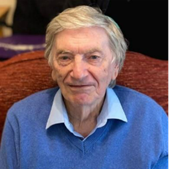
James David Jones, known as “David” or “Dave” (1939 - 2025) was born into a North Staffordshire mining family on 19 March 1939. He grew up in Little Chell, Stoke-on-Trent, which as luck would have it connected him to a bus route on High Lane where his future high school was located. David attended the Stanfield Technical High School, where in the 6th-form he excelled in Mathematics. He and two of his school classmates, from different Jones families, qualified to attend the then new Keele University (at the time University College of North Staffordshire) in 1957, each following different areas of science study.
David graduated with B.A. Honours in Mathematics and Physics in 1961 from the about to become University of Keele. Looking back, it seems amazing that staff members at Keele took such an interest in the futures of their students. In David’s case a maths professor from Keele accompanied by the Headmaster of the West Bromwich Grammar School visited David’s home for a meeting including David’s parents. Out of that meeting David was offered a maths teachers position at West Bromwich Grammar School, which he took up immediately following graduation. By way of analogy, my Chemistry mentor at Keele obtained a grant from the Harrison Memorial Fund, Stoke-on-Trent Education Committee for me to do graduate studies for a higher degree.
David took up his teaching position at West Bromwich Grammar in time for the beginning of the school term in 1961. His long-term girl-friend Pauline “Jean” Seaman had secured a transfer for her own work and had moved earlier to Birmingham. They stayed in separate boarding houses until their marriage in July 1962 and moved into their newly completed house at Great Barr in October that year. David and Jean had three daughters, twins Karen and Jacqueline born in 1963, and Deborah born in 1965, Deborah married Colin McIntyre and presented David and Jean with a much-loved grand-daughter Sarah in 1995.
David remained at West Bromwich Grammar (which later became the Menzies High School) as a mathematics teacher until 1971. Throughout David’s youth he was a keen football (soccer) and cricket player (we played on the same football team as teenagers at Stanfield Technical High School), David continued with these pursuits at Keele University in representative teams. His family tells me he also took up Rugby at Keele. It should not be too surprising that once David started teaching he dropped rugby but continued to play football and cricket in the teacher’s teams for many years, and importantly he coached the football teams at West Bromwich Grammar.
In 1971 David took up the position as Head of Mathematics at the Handsworth Comprehensive School also maintaining his role as coach of their football teams and playing football and cricket in the teacher’s teams until his “so- called” retirement in 1989. However, David’s work ethic also led him to teaching at more than one school, and so he took on teaching maths at the Handsworth Girls School a couple of days a week as well at the Comprehensive.
David’s initial 1989 retirement did not quite go according to plan and within two weeks he was approached to do a couple of days teaching maths at Aldridge Girls School and some supply teaching at his old stomping ground, by then renamed as the Menzies High School. Teaching at Aldridge Girls School turned into a full-time role, but 4 years later in 1993 he finally retired. David had established a career as a mathematics teacher of excellence, appreciated by all his students for his wisdom and capability, and respected by his peers.
Another passion David had picked up at Keele was playing “Bridge”, a “hobby” he maintained until very recently. He was a member of the Sutton Coldfield Bridge Club, which he represented in many competitions, and where he also taught new starters.
David was introduced to “Golf” by one of his older early pupils and it was not long before he was hooked. This reversed his earlier view that “golf ruined a good walk”. He actively played golf up to the day of his surgery in May 2025. David’s select spot for his dedicated walking was the “Peak District”, where the family established a static caravan and he, his wife Jean, and granddaughter Sarah spent a lot of time, with David and Sarah taking off on long walks, leaving Grandmom trailing behind.
He died in a Birmingham hospital on 17 June 2025 following complications after surgery for kidney cancer, which had been detected in December 2024. His parting with friends and family was held at his golf club, just sorry I could not be there.
I particularly want to thank David’s daughter Deborah and his wife Jean for providing me with more details of his teaching life than I could have ever known, and at the time of their bereavement.
Written by Dr Alan J Jones, BA(Hons), MSc, PhD, FRACI C Chem.
Timothy Doyle
Sadly, Timothy Doyle, Emeritus Professor of Politics and International Relations in the School of Social Sciences, passed away in Adelaide on Thursday 9th October, after a long illness.
Tim was a prolific and internationally-recognised scholar in the study of international environmental political economy. He served as Professor of Politics and International Studies at the University of Adelaide in Australia. He was a Distinguished Research Fellow at the Australia-Asia-Pacific Institute (AAPI), Curtin University, Western Australia. Additionally, he was the former Chair of the Indian Ocean Rim Association Academic Group and the Chief Editor of the Journal of the Indian Ocean Region.
Tim’s remarkable academic contributions will not, however, be his only legacy to the world. His personality was a mosaic of contradictions. He was a charismatic, pragmatic, principled dreamer. He was a mischief-maker, a problem-solver, and a mentor to countless emerging academics. These qualities made him an excellent teacher as well as a wonderful collaborator, capable of building and maintaining networks of scholars from around the globe. Those who worked with Tim quickly became his friends; Tim collected friends. His passionate love of life, curiosity, and sense of humour meant that, at the time of his death, his collection was vast.
Tim lived many lives at once. He was a political activist, environmentalist, and human rights campaigner. He supported the Collingwood Aussie Rules Football Club throughout his life and firmly believed in the superiority of the Australian cricket team. A farmer, sailor, and singer, he also wrote two novels, one of which was published this year. His final years were spent in Adelaide, in the loving company of his wife, children, and grandchildren. However, his favourite place on earth was his farm in Second Valley, where he watched the sea while replanting native species of pre-colonial flora and tending to his sacred olive trees.
Tim was always very proud of his Irish roots, so it is fitting to say goodbye with the words Go Raibh Suaimhneas Síoraí Air — Eternal Rest be Upon Him. He is deeply missed by all of us whose lives had the fortune to encounter him.
Written by former colleague, Barry Ryan
Julian Comer
English and French, Class of 1971
7th July 1947 – 16th August 2024
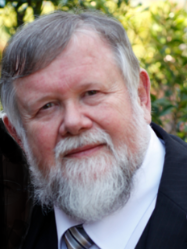
Julian Comer died peacefully on 16 August 2024. Though unwell for some time, nothing stopped him from engaging deeply with his world of books and music, keeping in touch with his Keele friends, and above all, remaining devoted to his family – enriching it in countless ways that were uniquely his.
Just before leaving Bristol Cathedral School, Julian attended a retreat at Lee Abbey with a group of young Christians. It affirmed his sense of belonging – to the world around him and to God – and led to a year’s VSO placement in Cameroon, teaching English at the French-speaking School of Lebamba. His memories of that time stayed forever vivid.
Julian’s years at Keele were among his most treasured memories. He lived first in the Hawthorns and later, in his final year, in the coveted ‘O’ Block. These years forged a life-long circle of friends, one of whom he married in 1973.
A keen performer, Julian was a key member of the Keele Drama Group between 1967 and 1970. Some may recall – as he often did – a spirited performance of The Knight of the Burning Pestle when news broke backstage that Keele had triumphed on University Challenge. The cast deftly wove the news into the dialogue, to the audience’s delight.
A defining influence on Julian throughout his life was a love of literature and the English language. He learned to use his voice to breathe life into the spoken word, whether it be from the lectern or the pulpit in Church, the stage, or simply across the dining table.
After graduating from Keele, Julian began his career in sales and marketing, which later took him to Sydney, Australia. Though his work did not always bring the depth he sought, his fulfilment came through family, faith, and enduring friendships.
Julian is deeply missed by his wife, Anthea, his sons, James and Jeremy, and his many friends and loved ones.
Written by Anthea Comer (née Hickman)
Biology and Geography, Class of 1971
Sheila Binns (née West)
Class of 1972, BA French & Russian Studies
-141x211.jpg)
The Keele community is saddened to learn of the death of Sheila Binns (née West) on 18 May 2025. Sheila arrived at Keele in the late 1960s, drawn- by her own admission - to a university far enough from home to offer independence, yet close enough for occasional weekends back in London. It was here that she built some of the friendships that would sustain her for the rest of her life, and where her intellectual curiosity, love of languages, and appetite for new experiences truly flourished.
Studying French and Russian, Sheila embraced the breadth and openness of a Keele education. She was diligent in her studies and seized the opportunities that came with them - including a memorable trip to Russia that left a lasting impression. But it was the life-long friendships forged at Keele, as much as the academic experiences, that she cherished most deeply.
After graduating in 1972, Sheila brought the confidence and independence nurtured at Keele to a varied and adventurous career. She joined the British Council, where she temporarily became the first woman to serve as Assistant Representative in Sierra Leone. Her time there was, in her words, “life‑changing”.
Her career later took her into higher education administration and teaching, before a so‑called “retirement” that was anything but. Sheila continued to study - earning further degrees including an MBA, PGCE and MA - and went on to become a respected authority on Victorian architecture. Her biography of architect W. H. Crossland, creator of Royal Holloway’s Founders Building, established her national profile in the field.
Though her life took her far from Keele, she carried its values with her: a belief in lifelong learning, a commitment to community, and a deep appreciation for history, culture and social justice. These qualities shaped her contributions as a volunteer archivist, researcher, writer, village hall committee member, and dedicated guide for heritage groups and societies.
Sheila is remembered by her family as determined, dynamic, compassionate, intellectually curious, and fiercely fair - a woman whose encyclopaedic knowledge was matched only by her warmth and humanity. She leaves behind her husband, Peter, her sons Rowan and Lawrence, her grandchildren, and a wide circle of friends whose lives were enriched by her generosity, humour and insight.
Eric Batten
Class of 1957, Economic & Politics
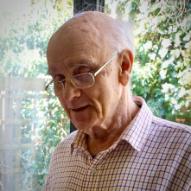
Eric came to Keele in 1953 after a year’s National Service. His main subjects were Politics, Philosophy and Economics, plus a teaching qualification. While at Keele he met his future wife, Elizabeth “Betty” Dutton. They were married in 1959.
Some of the things Eric enjoyed at Keele were table tennis (sometimes playing for the team) and helping backstage at a wonderful production of “A Midsummer Night’s Dream” staged by the lake.
After graduating, Eric took up teaching, first at William Penn School in Peckham, one of the first Comprehensive schools. After teaching for a short time at London College of Printing he moved, in 1965, with his wife and baby girl to Manchester University to take up a research post. This involved interviewing families to assess the connection between family situations and its influence on the academic achievement of its children, based on the Plowden report.
While at Manchester, Eric became a lecturer in the Education Department and gained his doctorate, PhD. After more than twenty years at Manchester University, on his retirement Eric worked for Stockport MIND.
On being diagnosed with Alzheimer’s disease, Eric immediately wanted to be involved in, in his words, “something to make things better,” and became involved with a charity called EDUCATE whose aim is to “make the environment more dementia-friendly” and to help make the general public more able to understand these debilitating illnesses.
Eric died on September 19th, 2025. He is sadly missed by his friends and family, his wife, three children, foster son and two grandchildren.
Hilary Gee
Class of 1966, Biology & Geology
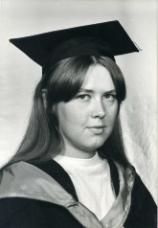
Written by Tom Fraser:
“My partner Hilary died of biliary sepsis and related complications on Sept. 3 2025. She spent 8 years as a student and/or employee at Keele: 1st degree in Biology & Geology 1962-66, returned as a Biology Demonstrator from 1973 to 1976, and then studied for a PGCE in 1976-77. She was also Resident Tutor in Sneyd Hall from 1973 to 1977.
Hilary was born in Uganda in 1943, second daughter of Frank & Muriel Gee – Frank taught Physics at Makerere University, Kampala. He retired in 1953 and the family returned to the UK, settling in Totnes, Devon where Hilary attended the Girls’ High School (and Frank also taught part-time).
Keele was Hilary’s first choice of university as she was attracted by the Foundation Year. Her father wanted her to go to Oxford where he had been an undergraduate, but on visiting the dreaming spires, Hilary found the girls’ colleges too monastic in the early 1960s – co-ed at Keele was the place for her!
First time round at Keele saw Hilary enjoy a fairly wild social life with music concerts and dancing. (Isn’t that what University life is for?) She remembered seeing the Graham Bond Organisation playing a concert there before Ginger Baker & Jack Bruce teamed up with a youthful Eric Clapton to form the legendary band Cream. Contemporaries Al Donaldson and John Christopher both remember Hilary dancing with Martin Guha – with her long hair flying around her! She also developed a lifelong support for pacifism and CND after the Cuban Missile Crisis, attending at least one local CND demo. where she was included in a newspaper article.
Hilary obtained one of only 4 Upper 2nd class degrees in the Science Department in 1966 (there were only 2 science 1st class degrees granted). This was remarkable as she was later diagnosed with fairly severe dyslexia. She obtained a place to study for a MA in plant growth at London University, Ontario; it was supposed to be for one year, but Hilary strung it out to nearly 3 in order to fit in as much travel as possible, including Mammoth Cave, Kentucky, the Grand Canyon and the Everglades in Florida – all done by driving. She also picked up lifetime brownie points bragging that she saw the Doors live while there.
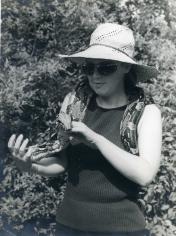
She returned to the UK in summer 1969 via a leisurely westwards route taking in Hawaii, Japan, India and Africa, thus completing her circumnavigation of the globe she started in 1966. She spent a year with her parents in Devon before obtaining a place to study for a PhD. at Reading Univ., following up her MA work. She had not completed this by summer 1973 – so got the Demonstratorship at Keele largely to finish her PhD – which she duly did in June 1974.
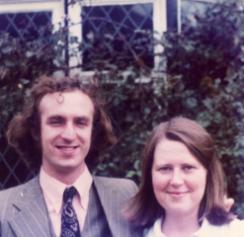
I exploded into her life in December 1975, a slightly mature Oxford graduate, doing a MA in American History & Politics in the American Studies Dept., when we met at the Postgrads’ Xmas party. We made a good team – e.g. I’ve got a photographic memory so I could always tell her how to spell a word – and Hilary could always tell me what it meant! She was the most widely-read and intelligent individual I ever met. The Resident Tutor’s job came with a flat, which I moved into in the summer to save money – after which we considered ourselves co-habitees.
We signed on the legal line in Sept. 1977, moved to Shropshire where Hilary lectured Biology & Geology at Shrewsbury FE College, and for most of the time I was Head of History at the Marches School, Oswestry.
We shared a common interest in travel and mountains, but as we both hated airports, most summers we took a car ferry to Europe and headed to the Alps with our tent, via various wine regions. Norway, Spain and California came into the equation in other years.
One of the things that endeared Hilary to me way back in 1976 was that she fell in love with my family caravan in the Lake District, situated on a farm rather than a site. It was totally quiet apart from the Swaledale alarm clocks! It led to Hilary sharing my only real ambition in life: to move to the Lake District, which we achieved in 2000 when we both managed to retire early. Hilary always wanted a big garden, and we ended up in a ramshackle dormer bungalow near Cartmel with an acre attached, half of it an old orchard, into which Hilary planted a lot of shrubs, plants and trees, and managed the place largely as a nature reserve as our contribution to saving the planet from impending climate disaster.
Sadly, from about 2010 Hilary became increasingly disabled by osteoarthritis, crumbling ankles being the main problem. We gave up the camping in 2015, but continued the summer trip using hotels, B&Bs & holiday lets till 2019; when we emerged from Covid, her arthritis precluded any further long-distance travel.
She was always a passionate conservationist, supported wildlife charities and was a defender of the downtrodden and underprivileged, as well as a pacifist – she was still a CND member right to the end, but her disability increased her fervour as she conducted a one-woman armchair campaign, writing to MPs and ministers and making a huge number of small donations to the charities she supported.
The celebration of her life was held on Sept. 24 at the scenic crematorium at Beetham near Milnthorpe; it was a beautiful send-off. 70+ friends & relations from all periods of our life together including Keele got there and “enjoyed” a get-together afterwards at the Netherwood Hotel in Grange. By the time you read this obituary, her ashes will be buried under (another) Coast Redwood to be planted in her garden.
Hilary: best pal, best lover, soulmate, laugh-mate and Sugar Magnolia. You are missed by all who knew you.
By all means contact me if you remember her. Tom Fraser: frasertom22@gmail.com”
Arthur Alan Treherne
Class of 1961, Philosophy & Mathematics
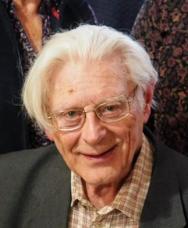
Alan was born in Hammersmith on 24 April 1938 and raised in Cobham and Barnes. At the age of 5 he received a good school report, particularly with regard to Mathematics, but was also described as being ‘somewhat disobedient’ - a term which the family like to think was a clear indication that he was an independent thinker from a very early age!
Proving to be academically gifted, Alan attended Richmond and East Sheen Grammar School, was awarded a State Scholarship in 1956, and went on to read Mathematics and Philosophy at Keele University where he met his wife of 63 years, Roberta. As an undergraduate, he spent time helping fellow students with sparser academic backgrounds and explaining in detail how they should go about working out solutions to mathematical problems – usually very late the night before they had to be handed in!
Awarded a double First-Class Degree from Keele, Alan went on to work on one of the first computers as a Mathematical Logic research student in Manchester. He then went on to lecture in Mathematics at Glasgow University before returning to Keele to lecture in Philosophy in 1967. At the age of 47, he undertook a post-graduate Conversion Course in Computer Science at Imperial College, London, returning to Keele the following year to lecture in the Department of Computer Science. He became Head of Computer Science in 1988, and we are told that those he worked with greatly appreciated his people management skills. During his time at Keele he also worked as Admissions Tutor for both Philosophy and Computer Science and travelled abroad to recruit students.
Later in life, Alan became a member of a group calling themselves the ‘Inquirers’, and the following email thread from 2014 reveals something of the nature of their meetings: -
Alan’s friend, Rick Marshall, writes: –
‘Dear all – first New Year’s greetings. Second, the attached is in the latest ‘Physics World’ - A nice bite-sized bit of food for thought’.
and Alan replies: –
‘As suggested at our Christmas lunch . . . I have booked a table at the Sheet Anchor on 30th January 2014 . . . I am happy to introduce a discussion (arising from our recent deliberations and the comments attached from ‘Physics World’ circulated by Rick) on the relationship between Basic Belief Systems, Abstract Mathematical/Scientific Theories, and ‘Reality’ - if no-one wants to introduce some other topic. With New Year Greetings and best wishes . . . !
Clearly the group enjoyed a fine mix of friendship, lunch and, in particular, intellectual discussion!
Apart from very much enjoying teaching and mentoring his university students, and interacting with his academically-inclined friends, Alan had a several other passions in life -
A member of the Methodist Church throughout his childhood, he qualified as a Methodist Lay Preacher in his late teens and preached on the Newcastle-under-Lyme circuit (including Madeley) both throughout his time studying at Keele (with his wife-to-be, Roberta, playing the church harmonium or piano) and after his marriage to Roberta, when they returned to the area from Glasgow. His faith was deep-rooted and so intellectually thought-through that when, as a teenager, his daughter Fiona asked him what made his belief in God so unshakeable, he was still answering her question in considerable detail 3 days later!
During his teens, after World War 2, Alan travelled to East Germany to help rebuild a church. It was on this trip that he met Hannelore, who was to become his life-long pen-friend. Recently, while being cared for in Belong in Newcastle, he read his carers a letter written to him in German from Hannelore and then translated it into English for them – a remarkable feat given the progression of his Alzheimer’s!
During his school days Alan learnt to play the church organ, developing a life-long passion for Bach’s music, and at Keele (following a plea for a volunteer learner from George Pratt, the conductor of the University Orchestra) he took up the trumpet and spent a good deal of time concentrating on counting bars rest! Later, fascinated by the musical process, he sat in on the Lindsay String Quartet’s rehearsals at Keele and, inevitably, befriended its members. Their ‘cellist, Bernard, would eventually source a beautiful ‘cello for Alan’s daughter, Fiona, and, by happy accident, end up teaching her at Manchester University.
Much later in life, Alan tried his hand at playing the double bass and ‘cello, eventually passing his ‘cello on to his grand-daughter Jasmine.
Alan’s daughters, Fiona and Sue, are immensely thankful for the inordinate amount of time and energy he spent encouraging their musical pursuits - transporting them to music lessons, rehearsals and concerts, and sourcing great instruments and teachers. Without his help, support and interest, it seems unlikely that the paths they both went on to follow - reading Music at university, followed by postgraduate performance courses at London Music Colleges - would have been achievable.
In addition to Classical Music, particularly Baroque, Alan adored Jazz - a passion he shared with his brother, Stuart. Chris Barber, Bessie Smith, Ella Fitzgerald and Ottalie Patterson were among his long-term and regularly-listened-to favourites.
Soon after moving to ‘Moorside’, the long-term family home, Alan and Roberta bought a grandfather clock from a local antique shop, sparking off Alan’s long-term passion for antique clocks and watches. His true appreciation of all that is finely crafted and well-engineered within such beautiful objects led Alan to make contact with, and regularly visit, an elderly Lancashire clockmaker called Mr Atherton who taught him many clock-making skills. Eventually Mr Atherton’s clock lathe became Alan’s, and Alan went on to spend many hours perfecting his clock and watch-making skills in his own study and workshop, completely oblivious to the fact that he was knee-deep in wood and metal shavings, and thoroughly absorbed in the technical and practical challenges of making replacement clock parts and repairing clock cases.
In time, Alan became specifically interested in a Newcastle-under-Lyme clock, watch and nautical instrument maker called Edward Massey, and he carried out extensive and meticulous research on Massey’s escapement designs. A member of the Antiquarian Horological Society since 1977, Alan was appointed an AHS fellow in 2020.
Alan contributed substantially to his local community, fighting all kinds of causes on behalf of local people. In addition to serving on Madeley’s Parish Council for over 20 years, including a period serving as Chairman, he was highly instrumental in the planning and building of the Madeley Centre.
Having enjoyed free rail travel as child (because his father worked for British Rail), Alan was a well-seasoned, confident and adventurous traveller who loved meeting new people and discovering new places. After his children had grown up and left home he spent a number of very happy holidays in Crete with daughter Sue and her partner Steve, times during which Sue and Steve learnt much about his past life and beliefs as they enjoyed sun, good food, wine and lengthy walks together. Sue remembers one year when the ever-practical Alan was stopped at the airport with a suitcase containing hammer, screwdrivers and other assorted tools, and was forced to explain their presence to security staff - ‘Well, you know what it’s like – nothing ever works in these places . . .’ Luckily, following his explanation, he was allowed to proceed to Crete and all was well!
Alan later continued with his yearly excursions to Crete without Sue and Steve, meeting up regularly with the friends he had made out there from all around the world, and very much enjoying his political and intellectual discussions and various excursions with them. He once remarked to Sue ‘You see, love - we all think the same’ . . .
One of Alan’s ‘Crete’ friends, Doug from Canada, describes Alan as having had a very particular ‘knack for friendship’ - a trait which enabled him to connect with many different and diverse people over his lifetime. He was full of optimism, generous to a fault, reliable, tenacious, meticulous, would fight fearlessly on anyone’s behalf for a good cause, loved working with his hands, and appreciated fine engineering, beautifully-made objects, art, music and nature. He valued everyone, never spoke down to anyone, respected others’ opinions and outlooks, and devoted much of his life to helping others and trying to make the world a better place to live in. He loved and took good care of his family and, in his wife Roberta’s apt words, he has left a very particular ‘Alan-shaped hole’ in all our lives. The family will never forget his love, kindness, patience and understanding, and all that he was and always will be to us - and we thank God for his rich life and for our being a part of it. A wonderful husband, father, grandfather and friend, who is, and always will be, sorely missed - may his soul truly rest in peace for all eternity.
Alan passed away peacefully on Thursday 4th December 2025 in the presence of loving family in Newcastle-under-Lyme, aged 87. Dearly beloved and loving husband of 63 years to Roberta, much loved and respected father to Fiona and Sue, dear father-in-law to Adrian and Steve, much loved and treasured Grandad to Sam, Jasmine and Isobel, and loving brother to Stuart, brother-in-law to Sherna and uncle to Matthew and Louisa, Alan will be sadly missed and fondly remembered by all his family and many friends and colleagues.
More on Alan’s passion for clocks:
Alan was Council Member of the Antiquarian Horological Society from 1977-2018, being appointed a Fellow of the Society (FAHS) in 2020.
In modern journalism there is a phrase used for political figures of long experience and quiet authority: they are called “big beasts”. Alan was very much that in horology. Not a front-runner or a showman, but part of the firm architecture of the subject in this country for decades.
The serious study of clocks and watches has been going on for well over a century. Generations of scholars and enthusiasts have trawled archival material, writing the history, but for a long time the emphasis was naturally on famous makers, prestigious names, and above all on London. One of Alan’s great contributions was to insist that this was not the whole story.
Again and again, he drew attention northwards — to Lancashire, Cheshire, the Midlands — and to the networks of suppliers, craftsmen and factories that underpinned that wider trade and made it possible. He had an instinctive grasp of how industries really work: that the name on the dial often disguises a much more complex story of who actually made what, and where. In the 1980s, he was responsible for an exhibition of clocks by Nantwich makers, and he would remain vital in the creation of other important exhibitions over the years.
Two long-term research projects stand out as central to his legacy. The first concerned the firm of Peter Stubs of Warrington, whose extensive business papers survive in Manchester Library. Stubs began in the early nineteenth century as a maker of files, but grew into a major supplier of tools, steel, components and materials to clock- and watchmakers across Britain, Europe and America. Alan patiently worked on this vast and difficult archive, showing how interconnected the trade really was, and how provincial workshops could compete successfully on price, scale and skill. His work advanced our understanding of nineteenth-century making.
Alan was a determined and methodical gatherer of evidence. He delighted in figures, invoices and order books, not for their own sake, but because they allowed him to reconstruct the lived reality of making things in the past. Those who heard his talks will remember how vividly he could bring this world to life, showing how provincial workshops could out-compete London, and how British manufacturing fed a growing international market.
His second great scholarly cause was Edward Massey and the wider Massey family. Massey was one of those rare figures whose inventions genuinely changed how people worked. He developed practical instruments — for measuring speed, distance and depth — that sailors could rely on in real conditions. At the same time, he designed a form of watch escapement that became widely known as the “patent lever”, a term that travelled far beyond its inventor’s name. Massey stands at the meeting point of craft skill and applied science, and it was largely down to Alan’s persistence that his importance has come to be properly recognised.
This work culminated in a major two-day conference at Alan’s old university, Keele, in 2018, and this also marked Alan’s retirement from Council after forty-one years of service. He was made a Vice-President of the Society, and in 2020 was elected a Fellow — a remarkably rare honour for us, and a fitting recognition of a lifetime’s commitment.
Alan was not a prolific publisher, but that should not be mistaken for a lack of impact. His accumulated research papers, notes, card indexes, images and digital files are preserved in our archives, where they will support the work of others long into the future. In that sense, his influence is ongoing.
Beyond research, Alan brought invaluable practical skills to the Society. He pioneered the computerisation of our membership records, building systems that served us for decades. He was a central figure in the Northern Section, many members of which are here today, and he forged strong international links, particularly with scholars in the United States.
Alan Treherne did not need to be at the front of the room. But for more than half a century he helped hold a scholarly community together — quietly, diligently, and with immense generosity. Much of what future researchers will take for granted will rest on foundations that Alan quietly laid. For that, and for his generosity of spirit, we owe him more than we can easily say.
-256x256.jpg)
Ruth Raymond (née Grainger)
Class of 1956, Mathematics & Physics
10.11.1932 – 27.01.2026
Ruth Raymond (née Grainger) was born in London and spent her childhood between London and Shropshire before attending King Edward VI High School for Girls in Birmingham. She went on to study at Keele University, joining one of its earliest cohorts of students and graduating with a BA in mathematics and physics (1951–56). As a woman studying science subjects in the early years of the university, she was something of a rarity, and she remained a proud alumna throughout her life. She spoke about Keele’s founding vision, particularly its emphasis on interdisciplinary understanding, as formative to her intellectual outlook.
After graduating, Ruth returned to London and began what would become a remarkably wide-ranging and pioneering professional career. She initially worked at Sperry Gyroscope, writing up research and development projects, where she later remarked that she “got into the habit of polishing the mathematics” produced by engineers. When her head of department moved into rocket design in Bracknell, Ruth followed him into aerodynamics, working for several years as a flight analyst, including at Hawker Siddeley Dynamics.
Her career later broadened into computing and applied maths across an unusually diverse range of sectors. She worked in motorway design for the Department of the Environment, in universities, in television optimisation, offshore engineering, healthcare, and banking-related systems. She was a chartered engineer, a chartered mathematician, and a chartered information technologist, and was a member for more than fifty years of both the British Computer Society (BCS) and the Institute of Mathematics and its Applications (IMA).
After her marriage to Eugene Raymond, Ruth lived for several years in the 1960s in Trinidad, where she taught maths and physics at Bishop Anstey High School in Port of Spain. At a time when opportunities for girls to study science were limited, her teaching opened doors for many young women who later went on to careers in medicine, science, and engineering. She later returned to England, living for some years in Leamington Spa before settling back in London, where she spent the final four decades of her life.
Ruth was a committed feminist, humanist and a longstanding member of the Labour Party, opposing discrimination not only in principle but in practice. She travelled widely and retained close international friendships throughout her life, including several with family and friends in Trinidad.
In later years, to the surprise of many, Ruth trained as an actress at the Court Theatre Training Company. Over the following decade she performed in fringe theatre productions across London, appeared in student films, and took various roles on television, including in EastEnders. She also combined her love of education and the arts by tutoring child actors on location, including on film sets for the Harry Potter series.
A voracious reader, Ruth shared her love of books, music and art with her family and friends. She is survived by her two children, Judy and Mark, four grandchildren, and four great-grandchildren. She died aged 93, having lived a life marked by intellectual curiosity, independence, and a determination to do things her own way.
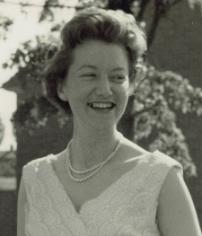
Alan Emerson Tipper
Class of 1954, French & English
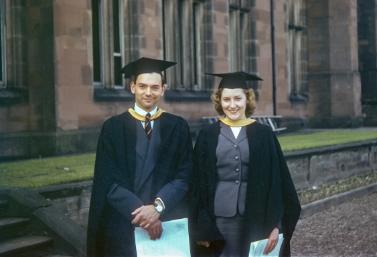
Alan was born in Leek, Staffs and was one of the pioneer students to attend Keele where he met his future wife, Yvonne Jervis. They were happily married for an entire lifetime of 69 years before Alan passed away recently this year in Surrey, where Yvonne still lives.
Alan always had a very strong connection with Keele as after obtaining his ALA Library qualifications at Manchester, he then returned and spent all his working life at the University Library until his retirement. Both his children attended Keele nursery and his daughter was christened at the new University Chapel on its opening in 1965.
He had fond memories of his student days and career at Keele, often telling tales about the early days living in the army huts before the refectory and University Chapel were built and the opening of the New Library Building by Sir Sydney Roberts in 1962.
Both he and Yvonne thoroughly enjoyed attending the Alumni reunions over the years whilst they still lived in North Staffordshire and they made long standing, valuable friendships with fellow students from those early Keele years.
Helen Anne Ross
Class of 1984, Politics & Psychology
Helen died on 3 May 2026 at the age of 64.
Helen loved her time at Keele and threw herself into study, social life and the operation of the university democracy. She was secretary and treasurer of several student societies, coordinator of the Women’s Resource Centre, block rep on the hall council and a student representative to the University Grants Commission. She also held the exalted position of Chipfinder General, whose function was to alert meetings of the SU when the chip van arrived in the car park.
Helen met her future husband Tim at Keele although it wasn’t until their paths crossed again four years later that they became a couple. Nineteen years and three engagement rings after that they were married on a beach in Jamaica. Helen was in hospital when she and Tim celebrated their twenty-first wedding anniversary, two weeks before she died.
Sandra Marjorie Alderton (Née Kelly)
Keele University’s Athletic Union Administrator
Sandra Marjorie Alderton (Née Kelly) born Liverpool 7/06/1939 passed peacefully in her sleep after a short illness, November 25th.
Greatly loved daughter, sister, friend & beloved wife, mother, mother in law and darling nanny to Milly and Lucy.
Reunited with her much loved parents Marge and Ernie.
Survived by husband Bill, Sons Mark and Neil.
Now with her Lord.
Sandra was Keele University’s Athletic Union Administrator for nineteen years, 1985-2004
She enjoyed every aspect of her job, organising and co ordinating the sports clubs, liaising with other Universities to arrange fixtures and being something of a surrogate mother to many of students.
She remained close to her colleagues in the AU admin teams at other universities and had lifelong friendships with a great many students, following their lives and careers with great interest.