

Researchers study how environmental changes may affect migratory butterfly species differently
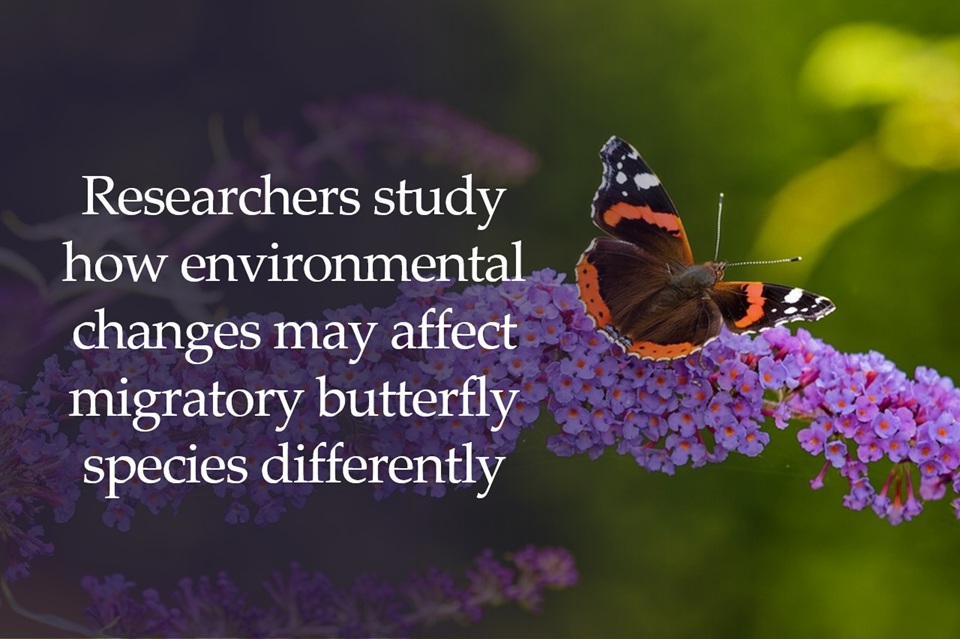
Researchers at Keele University have discovered that migratory butterflies may use different navigation systems to find their way during migrations, highlighting the importance of understanding how different species may respond to environmental changes.
Dr Dmitry Kishkinev and Marie Skłodowska-Curie Postdoctoral Fellow Dr Aleksandr Pakhomov studied how Red Admiral butterflies, one of the most recognisable migratory butterfly species in the UK and Europe, navigate during migration.
Their research focused on understanding how these butterflies determine and maintain their seasonal migratory direction, and whether they rely on the Sun, other visual cues in the sky, or the Earth's magnetic field.
The researchers studied the butterflies' migratory behaviour using a flight simulator, an apparatus in which a tethered insect is exposed to controlled environmental conditions to investigate the cues it uses for navigation during migration. For example, the researchers exposed the butterflies to natural sky conditions, with and without a visible Sun, and experimentally manipulated magnetic fields around them.
Their findings, published in the Journal of the Royal Society Interface, showed that Red Admirals rely primarily on solar cues to maintain their migratory direction. Under experimental conditions in which these cues were unavailable, the butterflies were unable to maintain a consistent migratory direction. The researchers also found no evidence that Red Admirals could use the Earth's magnetic field alone as a compass.
This contrasts with previous findings in the well-studied North American Monarch butterfly, which can use the Earth's magnetic field for navigation under certain light conditions when solar cues are unavailable.
These results suggest that even closely related migratory butterflies may rely on fundamentally different navigation mechanisms. They also highlight why findings from a single well-studied model species may not be sufficient to understand how human-induced environmental changes could affect migration across different butterfly species.
The researchers now want to expand their work to investigate which specific celestial cues butterflies and moths use for navigation. For example, it remains unclear whether Red Admirals rely on the Sun's position in the sky or other visual information, such as colour gradients across the sky, to determine their migratory direction. They also aim to understand how changing environmental conditions may affect the availability and reliability of these cues.
The researchers are also conducting a separate study on Red Underwing moths, which has revealed that these nocturnal migrants mostly rely on the starry night sky to maintain their migratory direction. Migratory butterflies and moths may therefore be particularly vulnerable to artificial light at night, which can interfere with the visibility of natural celestial cues or affect their internal clocks linked to celestial navigational systems.
Lead author Dr Aleksandr Pakhomov said: “Different species of migratory butterflies and moths may rely on very different sensory cues to find their way. Our findings show that we cannot simply assume that what we know about monarch butterflies also applies to other migratory butterflies.
“Climate change, artificial light at night, and electromagnetic pollution may all interfere with the sensory cues that migratory insects rely on for navigation during migration. Without understanding how different species navigate, it will be difficult to assess how vulnerable they may be to these disturbances.
“Migratory butterflies and moths play important ecological roles, including pollination and the movement of nutrients across ecosystems. Their migrations are therefore closely linked to the stability and functioning of many ecological communities. Protecting these species requires a deeper understanding of their navigation systems and how they may be affected by rapidly changing environments.”
Dr Dmitry Kishkinev, Lecturer in Animal Behaviour and Behavioural Neuroscience, added: “Research into butterfly and moth migration is still in its early days, but it’s already revealing fascinating insights. These studies show just how complex migration can be - even in tiny insects that weigh less than a gram and rely on miniature brains to guide them on journeys spanning thousands of miles across entire continents.”