
Our thoughts
Year of Reading Reading Recommendations
To celebrate the National Year of Reading 2026, we have gone all in with recommended reads to add to your bookshelf.
Bradley Rogers recommends Jurassic Park by Michael Crichton
While the movie version has become iconic, one book I have always loved - having read it when I was too young to understand it in many ways – is Michael Crichton’s Jurassic Park. While I will warn that it contains scenes of graphic violence, Crichton’s criticism of capitalistic systems and the impossible manipulation of nature by humanity, complete with satisfying characters and terrifying atmospheres – all elements partially lost in the film - creates a narrative I hold deep fondness and respect for.
Raneem Aljanabi recommends: A Doll’s House by Hebrik Ibsen
A simple opening filled with symbolism and foreshadowing of the play’s themes of gender norms, women under patriarchal rule. Nora, like all characters in the play, has a secret to hide and is written with complexity and while the ending caused massive controversy upon its first publication, it is a play that has stood the test of time by challenging the status quo.
Katie Harrison recommends: Sky Song by Abi Elphinstone
This fantasy book taught me things about the real world through representation. Aimed at children, it’s about prejudice (and overcoming it) and tyranny, and inspires hope through ideas of the found family.
Theo Buckley recommends: Metamorphosis by Franz Kafka
Traveling salesman Gregor Samsa wakes one morning to find that he has transformed into a giant beetle-like insect. This synopsis alone should be enough reason to read this book; however, I shall provide a few more. Firstly, Kafka himself is an exceptional writer, delving into absurd bureaucracy and dehumanizing effects of society. Often providing profound, dark and melancholic stories that observe the human condition, his stories themselves earning and creating the adjective ‘Kafkaesque’, a word of which is applied to all types of intolerable or hopeless situations. If not this book, Franz Kafka’s work is something that must be read. Secondly, the book is classic literature; it connects us with the culture and history of a different time. Writings from long ago offer more complex vocabulary and phrasings. With this, you can find that an abundance of classics with themes that are still highly relevant today. Lastly, the book itself offers an amazing story that takes the reader through the struggle of Gregor and his family as they shun him and lock him in his room. The narrative encapsulates themes of isolation, alienation, and despair, and questioning familial love and the conditional nature of that love, all the while giving an insight into the idea of identity, even after being turned into a bug.
Vinnie Smith recommends: Watership Down by Richard Adams
I have become accustomed to the looks that recommendation draws. It is a controversial novel, to say the least, but I sincerely believe that this proves the idea that all reading is subjective.
At its core, Watership Down is an adventure story. It has the typical structure of a fantasy novel, in fact. It is no less violent and no more plausible than – for example - a Tolkien novel, if less fantastical. The protagonists are all animals, and it can make the story feel realer to a reader, along with the familiar settings and happenings that are all recognisable to (particularly) a British reader. Most importantly, the protagonists are all likable and well-rounded, and this keeps the reader engaged for the duration of the story.
For me, this book is perfection. It’s arguably nostalgia, but also the way that this story shaped my love for reading moving into my treen years. For others, this would not be true. This proves my personal belief that to be a reader is to understand subjectivity, and to enjoy whatever form of writing you choose to consume.
Harri Houlston recommends: The Poisonwood Bible by Barbara Kingsolver
I finished The Poisonwood Bible by Barbara Kingsolver in the backseat of my mum’s car with Cumbria to my left. I cried for an hour. It had followed me around for the entire summer and at one point I spilled chocolate milk on it, so by the end it was looking a little worse for wear. But I was not ready to let it go.
It ended up being the subject of my A-level English coursework and I spent another six months highlighting and underlining and sticky-tabbing and analysing. I don’t want to say this book changed my life, but it definitely changed the way I think about reading. Reading does not have to be a passive experience; it can be something more devotional.
The Poisonwood Bible is my favourite book and the book I would recommend to anyone who, like me, feels very deeply about the world around them, the importance of our nature and the plight of our women. We can learn a lot about men from the way they treat the world around us and this is the book which taught me that.
I do not recommend this book as a writer because now every time I pick up the pen I look up at this book on my shelf and wonder why I bother. I might hide it under my bed, actually.
It is difficult to describe such a dense book in so little words, and harder still to describe how deeply it affected sixteen-year-old me, who wanted nothing more than to learn about religion, feminism and colonisation. But this book has it all. I could probably read it again now and find a million more reasons to love it.
Harun Akyol recommends: 1984 by George Orwell
I highly recommend a book that explores a very dystopian, almost totalitarian society. One with little passion, creativity or individualism: George Orwell’s 1984.
It’s studied in schools for a reason. Its sheer perspective takes on a society controlled by authoritarianism constructs a brilliant array of strings attached to the idea of little individualism, rather it is taking the form of a collectivist regime. It’s a chilling narrative and one which every person should read, not just for its objective truth of a society turned melancholic but purely for its subjective truth, being able to convey notions of loss of individualism, a key concept imperative to the art of reading itself. When that is removed from the equation, life has little meaning, and that is shown through this cautionary tale, and that is scary to think about.
Ella Moss recommends The Nightingale
The story of two sisters living in France during World War II gives an altered perspective. So easy to delve into, it gave me an understanding of life outside of the front line, and into life of a woman at the time. One of the key reasons I would recommend this book is due to the depth of emotion in it. Through the mixture of fear from living with a nazi in her home, and the adrenaline of attempting to cross British and American RAF soldiers back to England, and the limited happiness that the mothers try to bring to their children. This made me feel so emerged into the story. Another reason I would recommend this book is the historical aspect. The story is a fictional retake on the story of the ‘comet line’, which worked to free drowned pilots from nazi invaded Belgium, which I enjoyed, as it taught me a new story from the war, which isn’t widely spoken about. Finally, I would recommend this story, because of its writing style. Despite dealing with a difficult and painful topic, the writing of this book is so beautiful in each and every description, that I could imagine every scene perfectly. The Nightingale was haunting and beautiful to read, and I would recommend it to anyone.
Lily Warner recommends: ‘Japanese Tales of Mystery and Imagination’ by Edogawa Ranpo
I suggest this book for three reasons. The first reason is that Edogawa’s book is a collection of his short gothic tales, making it easier for someone to get through, regardless of their attention span.
The second reason is because of his writing style. Edogawa took influences off Edgar Allan Poe when writing his story, and as a result have the same mysterious feelings for them. That is why when people tell me they like the works of Poe, I often tell them to check Edogawa’s work out as well.
The third reason is that it helped me to find my love of reading again. Before this book, I often procrastinated reading, even when I was actively enjoying a book and the plot, but once I discovered and read ‘Japanese Tales of Mystery and Imagination’, I found myself reading excessively to find out what happened at the end of every story in the book.
Holly Kirby recommends: I who have never known men by Jacquline Harpman
This is a fictional novel that details a post-apocalyptic world from the perspective of a young woman who grew up caged, in an underground bunker with 39 other women. They have no memory of how they ended up there and the protagonist is the only one to have never met a man.
Three reasons why I would recommend this novel are:
- The comments this book makes on not only society, but humanity is groundbreaking. The novel begs the reader to question what it means to be a human in a world devoid of other people and life.
- I have seen criticism of the novel due to the fact that most aspects of the protagonist’s life are influenced by men, such as her relationships with other women, her relationship with her own body, her death and even the pose she intends to position herself in when she dies, even though she has never met a living man. But I think that this is an impactful idea within the novel and presents how patriarchal structures can impact situations, even when men are not present. This presents the philosophical nature of the novel and how it presents questions for the reader without the need for an answer, which I found endearing.
- The novel is split into only three chapters, for the three vastly different circumstances that the protagonist finds herself in. This makes the novel a much more impactful read, as each chapter matters and only contains entirely necessary moments.
Rowan Harris recommends: Homestuck by Andrew Hussie
Now initially over 8,000 pages seemed daunting, but this series gripped me by the throat in my teenage years and threw me into a world of sci-fi fantasy nonsense. The physical copies (with additional author’s commentary – yes, even more words) adorn my shelves almost like medallions. I survived Homestuck, and I’m here to tell the tale.
If you want a mind-bending plot with more foreshadowing than you thought imaginable, you will adore this story.
If you love a host of more quirky characters than you can count on the fingers of you and your entire family, Homestuck is very much for you.
If you feel nostalgic for the earliest days of the internet when everything just seemed a bit simpler, chat forums and blogs with your friends, Homestuck is a love letter to all of that and more.
I lied at the beginning; this isn’t a guilty pleasure of mine. I feel no guilt in obsessing over this multimedia explosion of storytelling. Find out for yourself how weird it gets; I’ll be here waiting for you in 8,000 pages time.
Caolan McKavanagh recommends: The Summoner series by Taran Matharu
Taran is a friend of mine, which makes reading his work even more meaningful, but I’d recommend it regardless. The series follows a young boy drawn into a dangerous magical world of demons, politics, and war. It’s imaginative, fast-paced, and deeply immersive, making it easy to lose yourself in even six minutes of reading.
Another series that deserves a place on any bookshelf is Redwall by Brian Jacques. Set in a richly imagined world of talking animals, Redwall stories are full of adventure, bravery, and community. They are comforting, vivid, and timeless, books that remind you why you fell in love with reading in the first place.
Naomi Johnson recommends: The Alex Rider series by Anthony Horowitz
These novels seamlessly combine both the pain of reality, with the aspiration of fantasy. And that combination is the definition of the word “hope”.
Both relatable, awe-inspiring, and action-packed, these books will have you on the edge of your seat. Horowitz is a master in gripping a reader’s attention and drawing them into a new world, similar to their own, yet magical. This is the realm where the impossible becomes possible. The unthinkable becomes reality. Let the imagination flow, and I guarantee you won’t be able to put it down until you reach the final page. So, what are you waiting for?
Macy Cornes recommends Throne of Glass by Sarah J. Maas
She’s a popular author, I know, and you’ve probably heard so many recommendations of her books, mainly A Court of Thorns and Roses but that won’t stop me from recommending it. The series Throne of Glass is a fantasy about a powerful, female assassin who sacrifices everything for those she loves. She is a survivor of abusive, tyrannical men and an unjust king and her story completely captivated me. Not only this, the story building, and the beautiful imagery of the setting throughout each of the books is stunning, you need to see it for yourself.
The narrative voice is so strong, and she is a character you can see yourself in at points and can vicariously live through which I loved. It’s a book series you have to experience first hand to truly understand its magnificence, and significance.
Source: Penguin Books Australia
Orbital - Book review
By Ken Damon
Fiction serves three purposes. One of them is to entertain, another to inform. It’s the third that is the hardest to achieve: the ability to say something about the world. Not say something in the way of informing people using facts and figures, not informing for the means of persuasion, but to merely say something, and nothing else. It’s this third facet of fiction’s abilities that I find myself drawn to. I want the books I read to present the world in a way that makes me reconsider what I do in my daily life, I want to be challenged, respectfully, and I want to be moved. It’s a tall order, I know. Orbital by Samantha Harvey does this and more.
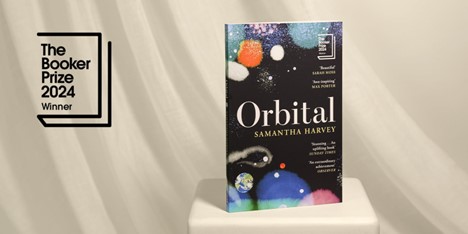
Orbital, Samantha Harvey’s most recent novel was recently awarded the Man Booker Prize for Fiction in December of 2024. This award is gifted by a panel of esteemed literary judges to what they consider to be the most impactful novel published in Great Britain that year. It’s this award that convinced me to give this novella a try; while the Booker is awarded to novels, Orbital barely scrapes more than 130 pages. However, the thinness of its profile does nothing to diminish its effect as a startlingly good piece of literature. After reading, all I can say is that the Booker Prize is wholly deserved.
Orbital is a fictional story that takes place on the ISS (International Space Station) and over the course of a single ‘space day,’ otherwise known as 16 orbits around the earth. In these 16 orbits, Harvey presents a masterclass in saying a lot in a little, and allows the reader to interpret their own meaning to the text. In terms of plot, there is relatively little: a storm, a death, food.
The power of this novel comes from the unique perspectives of the astronauts. Whilst they float thousands of miles above the earth’s surface, they are simultaneously immune and completely in tune with the earth’s natural and social forces. When a lunar mission passes their distance from the earth, they are suddenly forced into social irrelevancy (is this a metaphor? It’s only one of many times I caught myself asking this throughout my read).
Harvey has completely mastered the art of platonic delivery, and it’s this tone that made the novel so powerful in its messaging. When a cataclysmic hurricane is described with the same distanced aplomb as canned tomatoes, it evokes a truly guttural reaction. Is this because neither are important, or are they merely of equal, startling importance?
In 2024, I’ve read some of the best works of fiction in my life. I’ve read Powers, Kesey, Lynch, Woolf, and more. However, when I look back on this year in words, Orbital stands alone. In fact, it became a repeat Christmas present from me to friends and family this past holiday. It would be harder to recommend if it weren’t so succinct in its page count, and if Harvey’s narration wasn’t so thoughtfully written that reading it feels like a warm hug. From page one, she picks you up like a mother reading at bedtime and gives you every reason to trust her ability as a storyteller. Orbital is a gift of words.
If you’re interested in contributing nonfiction essays like this, please send entries to x9n78@students.keele.ac.uk with the subject format Nonfiction – Preferred Name – Title of Piece