

What is 'The Things We Write'?
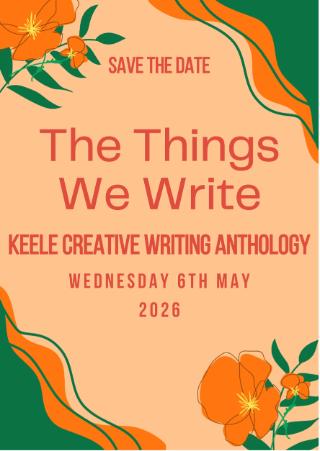
Welcome to ‘The Things We Write’, the creative writing anthology from students at Keele University.
The collection showcases poetry, prose, drama and creative non-fiction pieces from undergraduates to PhD students. It highlights diverse voices, ideas and perspectives from across Keele’s writing community.
Bringing together work that is thought-provoking, experimental and entertaining, the anthology celebrates the things we write, the things we share and the creativity that connects us.
This year’s anthology launch will be at the Keele Chapel on Wednesday, May 6th at 7:30pm.
The Anthology Story: Interview with Emma Henderson
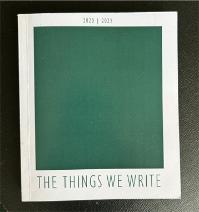
The culmination of the Creative Writing program at Keele rests in its student-contributed anthology, ‘The Things we Write’. This annual publication features work from across the discipline: from PhD portfolios to undergraduate workshopped pieces. What makes the anthology so special is its representation of skilled writing from across the program, and gives many their first publishing credit. To find out a bit more about the anthology’s history, I sat down with Emma Henderson, lecturer in creative writing, who started the anthology in 2020.
The following Q&A is paraphrased.
What was the inspiration for starting the anthology?
I saw other universities had successful student-contributed anthologies and believed we could do it better. I had produced an anthology during my MA program and wanted to help celebrate the Creative Writing program here at Keele. I also believed it’d give students a great introduction to submitting their pieces for publication.
What were the early years like?
The first anthology release unfortunately aligned with COVID-19, so our launch event was an outdoor affair. The going wasn’t easy, glue sticks may have been involved. We’ve learned important lessons since then, and now, our launch events are the best part of the year!
How does it compare to other university anthologies?
The Things We Write is special because it is entirely postgrad led and organized. They handle all submissions, production, and logistics of the launch event. The Anthology team works incredibly hard. The lecturers only get involved in deciding which pieces move from the longlist to the shortlist.
What is the benefit of the anthology having an ISBN?
Having an ISBN means that having a piece placed in the collection counts as a publishing credit: this can be added to your CV and should be included in bios when you send work off to agents. This is a great way to jump the hurdle to calling yourself a published author! A copy even ends up in the British Library!
For people looking to enter the anthology, what pieces of advice would you give them?
Submit pieces that have been workshopped, edited, and redrafted. If not in class, then find peers, friends, or family to proofread for you. Don’t be afraid to submit multiple genres; experiment. Take the style guide seriously, it helps you get off on the right foot with the submission reading team.
Hello, hello! I had the highest honour to be one of the proofreaders for Keele’s annually released anthology, The Things We Write, as well as a now-published poet thanks to this project. Some may think proofreading anything, whether it be their own or somebody else’s, is incredibly monotonous, particularly those who don't dabble in writing. I, however, find it to be quite fun. There's a joy in fixing up a piece of work to make it the best it can be—but, how do you proofread effectively? That is the question.
I am by no means an expert. However, after extensively reading almost fifty pieces of writing in such a short time, I believe I have some semblance of method, considering I was able to attend a Proofreading workshop with the team behind it all, and it was most insightful. Allow me to go through the process with you all.
The most obvious tip I can give is read, read, and reread. I read every piece approximately four times, both to be thorough and because I am cursed with dyslexia. In reading through the first time, I advise that you don't focus on what needs to be corrected, but rather simply making sure that the piece makes sense. It's your second and third time that you need to be on the lookout for corrections, and fix them accordingly. If I were to choose the most important things to look for when making corrections or suggestions, it's grammar and flow. They both go hand in hand. There's very rarely an absolutely perfect piece of writing, with flawless grammar and stellar cohesion, but remember that all the best pieces of literature out there had to be edited by someone. As for the fourth read through, if you'd even feel the need to go for the quadruple check, read it over again with your corrections and see how the changes feel.
Another tip I suggest is to just be nitpicky. Of course, nobody wants to be a nitpick, but I feel as if it's needed in proofreading. If you were, perhaps, a proofreader for a crazy big publishing house, that finickiness might be an actually okay thing. If you think a piece would flow better with different punctuation or a different word, flag it! If you think there might be something wrong with a certain word or phrase but aren’t sure if it’s worth flagging, flag it anyway. It won’t feel great tearing a piece to metaphorical shreds trying to find corrections, but it will be worth it in the end. Being slightly pedantic for a couple of hours isn’t the worst thing in the world, and you’ll be okay.
Proofreading for the anthology has been a treat to experience. It was surprisingly strenuous, but I fully believe that it was worth it in the end. To see something that I helped work on being published and given to the world to behold is so incredibly gratifying.
I truly hope you all find as much joy in reading this as much as I did. It’s been fun.
Hunting for the 2026 Anthology Guest Speaker
They say it’s a jungle out there in the real world, where writers have to survive without the support of tutors, where commercial pressures and a cut-throat world of competition make getting published a challenge. It is possible, we have to believe, to break in, to find a place for your writing to settle. Where you can achieve the goal of every writer, to allow a wider audience to read your words. The Keele Creative Writing Anthology allows our students to achieve this.
Each year we have asked published writers to act as the guest speaker for our Anthology, writing an introduction to the collection and speaking to our audience on Launch night. And they have done so to our great advantage. The writers we have approached all survive out in the jungle, but they are generous, supportive and willing to help new writers.
Emma Henderson wrote the introduction to the first Anthology. It was her idea to create a publication to showcase the talents of Creative Writing students, and Sophie Powell and Sophie Sampson edited this showing what could be done internally at Keele by postgraduates and undergraduates alike. Next year the Anthology grew and Lisa Blower, now our Reader in Creative Writing was our first guest speaker. She made us laugh as we listened to her work and gave us the ambition to grow. A poet, Jean Atkin was next, and she explained the path she had taken without an academic beginning, showing that it can be done, that talent can win out. She was followed the next year by Liz Lefroy who is a past student of Keele and who studied with the father of Creative Writing at Keele, Jim Sheard.
Last year we managed a BOGOF coup. Emma Claire Sweeney the novelist, brought her husband, Jonathon Ruppin who is a retired literary agent with her, and he talked to students before the Launch answering what he termed interesting and thoughtful questions from our writers. With such a tradition, the bar set so high, it was my task this year to find another writer who would be prepared to write the 1000-word introduction and come to our event and give it a kick start.
My secret persuasive weapon, although I didn’t realise it at the time, was Keele Hall Readings. Lisa in her new role at Keele took on the management of a series of events where published writers share their work and answer questions from students and others. It is an inspiring and entertaining way to meet the names behind the published works and Lisa expanded this to include workshops with the Masterclass. Writers, like Melvin Burgess, who had two texts on the degree syllabus, could talk informally about their work.
Casey Bailey was one of these writers and it was obvious from his enthusiasm and energy that he enjoyed his experience as a visiting writer. Casey has written poetry and scripts. We now include scripts and performances of the short plays we publish, with the help of Freddie Machin and Drama Society students, as part of our Launch. He seemed a suitable target to try and recruit. But Casey’s career has been taking off. He is headlining the Birmingham National Conference of Writers, his play has recently been performed to great success, as Ceri Morgan who was in the audience for it, reported.
Would he be willing to come back to Keele again and take on the Anthology job? Would he have time to undertake such a commitment? To write for us? To answer our questions? To lead our Launch? Lisa gave me his email address and encouraged me to ask saying ‘Casey is a star.’ No more prodding needed, I would see if I could ‘get’ him.
Hooked by the bait of his enjoyment of the Keele Hall Readings, it was not difficult to reel him in. He told me he had had a great time at Keele and wanted to support our young writers. He would be delighted to be our guest speaker. Job done!
Then he sent in his completed introduction. You will be able to read what he wrote if you buy an Anthology. And you can hear him read and speak if you come to our Launch in the Chapel on Wednesday 6th May at 19.30. Suffice it to tell you Emma’s reaction, one all her students long for, ‘What a lovely piece of writing from Casey! Perfect.’
We are delighted Casey Bailey will be our guest speaker and are very grateful to him, and to all the other writers who have come before him, for making our Anthology the successful publication it has become.
Caroline Chalkley,
(one of the editorial team for the Keele Creative Writing Anthology 2025/2026)
The Things we Write - Interview with Bradley Rogers.mp4 (~30MB download - mp4 format video)
The Things we Write - Interview with Cal Roberts.mp4 (~100MB download - mp4 format video)
For transcripts, please contact the team.
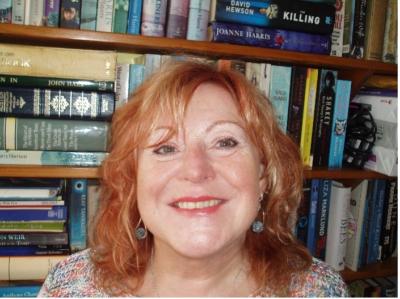 In preparation for the anthology launch tomorrow, Wednesday 6 May, placement student Aaliyah Saffy sat down with one of the anthology’s editors, June Palmer, to find out more about what it takes to see through the anthology, from submission to publication.
What Is Your Role on the Anthology?
I am co-editor specialising in poetry and am the contact for our printers, Panda Press.
What Made You Want to Join the Keele Anthology Team?
In 2021–22, it felt like an opportunity to be more involved with university life during my PhD. I loved the idea that it was student-led. I asked two of my fellow creative writers to make up a team and happily, they agreed. It was only some months afterwards that we realised we would actually be paid for these roles! I am still editing now because I believe in what we are trying to achieve: a platform for creative writers of all ages and experience.
What's Your Favourite Part About This Role?
Editing the individual shortlisted poems, working with the poets to make their piece the best it can be. Throughout the process I stress that the editing and critique I’ve received on my own work has been invaluable: poetry is a craft, a skill, and it takes time to produce great words.
My reward is in emailing the individual writer with the news that their final edited poem is in the anthology, and providing them with the opportunity to read on launch night.
What Have You Learned from This Role?
Teamwork! I and the first two editors I worked with all had quite different personalities, skills and backgrounds, but we found that this was very much to our advantage. We did not always agree on everything, but we published a beautiful book and were delighted with sales. We were told that our launch night had raised the bar whilst being warm and welcoming to all.
We were ‘shipmates’ — circumnavigating new seas — but the journey was fantastic fun and immensely satisfying. Editorial teams will now face different challenges, but a good team is more than the sum of its parts.
What's the Hardest Thing About Your Role?
Collating the shortlist for the judges. This is a team effort, and as creative writers, we understand the disappointment of our work not being ‘picked’ (does anyone ever become blasé about this?) but our message is ‘to keep at it’ as rejection is part of the writing process. Passionate writers will not easily give up.
How Do You Feel About the Progress of the Keele Anthology?
Creatively, the anthology has progressed from a platform for prose and poetry to include short scripts and creative non-fiction. Latterly, the anthology team have procured an ISBN number, showcasing its publication (and contributors) as more professional and credible. The number of submissions for the anthology has increased year on year, as have the numbers attending the launch.
In the early years, the editorial team handled their own budget, channelling all monies from anthology sales exclusively into the production of the next year’s anthology and launch, with printing being the main cost. It worked extremely well.
In recent years, Keele University have become more involved in the process. Student placements have helped the editors with tasks such as publicity, proofreading and administration. More importantly, placements are part of the student experience of creativity, of making decisions and understanding the importance of meeting deadlines that cannot be extended.
The big change for editors, who have been much more than that, is that Keele administration and finance are now in control of the anthology budget, which includes catering for the launch and profits from sale of books, which I believe will become part of Keele Arts’ overall budget. It appears that the anthology will now move into a different, more ‘professional’ direction.
Personally, I have mixed feelings about this. I will not be part of that future but hope it will still centre around creativity and will remain student-led.
Dr June Palmer MA PhD Creative Writing