

Our people
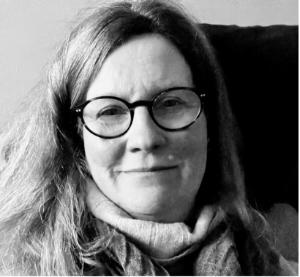
Alumni profile: Liz Lefroy
By Ken Damon
In 2011, Liz Lefroy graduated from Keele University with an MA in Creative Writing. That same year, she won the inaugural Roy Fisher Prize for poetry endowed by the then Poet Laureate, Carol Ann Duffy. Then came recognition from the Bridport Prize and a win at Café Writers. From there, it’s been up, and up further.
But it didn’t start with big prizes. As a child, Liz’s poetry remained tucked between the pages of her notebook. Inspired by Edward Lear’s Book of Nonsense and by Hilaire Belloc’s Cautionary Tales, Liz says that her poetry, “was quite silly at first.” But it didn’t matter. Her love of reading and writing had already asserted themselves within her childhood. When she was eight years old, a teacher asked the class what everyone wanted to be when they grew up. Liz’s answer? A poet.
In secondary school, this love grew further. At 14, she found the work of John Keats, then at 15, Wilfred Owen. Whilst studying TS Eliot and The Wasteland at A-Level, Liz couldn’t help but relate it to her adolescent experience of living in London. She realized then that “poetry sees her,” and that the places, emotions, desires of these poets were “telling her things about herself.” It was through these experiences that Liz realized the true power of poetry.
From there, we divert a bit. In 1986, Liz graduated from Durham University with a BA in History and would go on to care for and teach adults with disabilities. She then achieved an MA in Psychology from Keele in 1998. Throughout all this time, Liz continued writing poetry but kept it still to herself, until joining a writing group in her forties. She learned from this group how to share her poetry with others and give and receive feedback, and then she found her way back to Keele.
Originally, Liz’s plan was to pursue a PhD from Keele related to her work as a lecturer in social care at Wrexham University. While waiting for an introductory interview, Liz flipped through Keele’s prospectus of course offerings and then things changed. She realized here that her 8-year-old self’s dream wasn’t going to come true by sheer luck. She had to study Creative Writing. She had to take it seriously.
Liz said she attributes all her success in poetry publication to the time she spent on the MA Creative Writing programme. The committed lecturers and writing community, she says, “made me more ambitious,” and achieving an MA gave her the confidence to start placing her poetry in competitions and magazines. Her advice to current CW students is to make sure to always keep reading a wide range of writers. She also encourages her social work students to use poetry in their lives and work. “We’re not on our own in this wildly chaotic and wonderful world, we can use poetry to connect.”
At the end of our conversation, Liz recounted a particular experience running a creative writing class for people in recovery from drug and alcohol misuse. The first person to walk through the door was a large man carrying a plastic bag. He sat down in the circle of waiting chairs. Hesitant at first, Liz introduced herself. He explained that he was just released from prison and opened up the bag. Inside were poems written during his time away that he now wanted to share, and he did when the rest of the group arrived. The power of poetry was revealed in that moment. There, among people with diverse and difficult life experiences, poetry became the point of communication. This experience of discovering that people write poetry at the difficult times of their lives and have a longing to share it has been repeated time and again in Liz’s experience. “Perhaps it’s because you only need paper and a pencil to get started.”
A huge thank you to Liz for taking the time to speak with me. Keele Creative Writing wishes you the best of luck in the future.
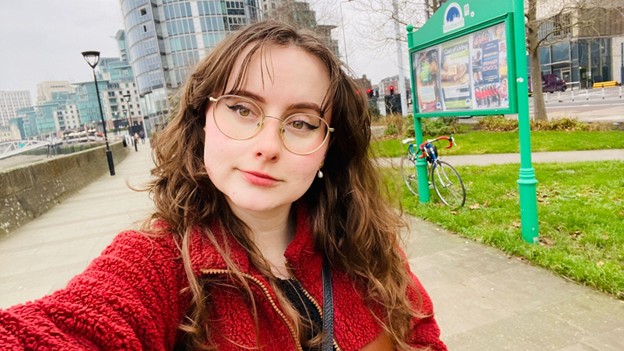
Alumni Profile: Becka Spruce
By Ken Damon
When starting out as a student in creative writing, it’s hard not to look at your first pieces of work, then to the daunting publishing industry, and not become discouraged. The process of plotting, drafting, and editing is already so taxing that afterwards, trying to find a home for your work feels like an impossible mountain to climb. However, Becka Spruce, Keele BA and MA alumnus, has managed to do exactly that, with her acceptance into the 2025 Penguin WriteNow program. You can read more about the program and Becka’s acceptance here.
But before her time at Keele and later success, Becka had already been writing. As a child of the early 2000s living just down the road in Stoke-on-Trent, she wrote short stories on their parents’ computer, on the older brother of Microsoft Word, Microsoft Works. When not writing, she was reading dystopias like The Hunger Games series and 1984. This love for dystopian fiction would inspire much of her fiction writing as she got older.
With the end of sixth form nearing, it was time to make decisions about what to study at university. At first, although she loved reading and writing, Becka was worried about pursuing creative writing for the same reasons many of us were: what kinds of jobs could I get? what if I’m not good enough? what does studying creative writing at university even look like? To put it simply: is there any point? After discussing these questions with a college English teacher, Becka went to a Keele open day, and was immediately drawn to the greenery of campus. She also felt welcomed by the English department, and in the end, Keele just felt right.
During her undergraduate, Becka studied English Literature with Creative Writing. She says that university helped widen the range of fiction she read, her work becoming particularly influenced by modernist and postmodernist ideas, while also allowing her to write the dystopic fictions she had enjoyed as a child. If she were to give a piece of advice to her first year self, she’d tell them that studying creative writing “is not as hard as you think. The world needs stories, and what seems unoriginal to you can seem thoughtful and exciting to someone else. Trust your ideas. Trust yourself to tell the story that only you can tell.”
She would then stay on at Keele, joining the MA in Creative Writing. Becka says that the “feedback received during the masters made me the writer I am today.” Her supportive cohort of peers and tutors allowed her to be vulnerable in her writing and “really gave [her] the confidence to trust her ideas and style of prose.” It was here, in this uniquely supportive environment, where she’d begin work on Elderwing, an adult science fiction/horror novel which deals with themes of addiction and mental health; leaning into a more gothic, psychological side of the genre. This would eventually consummate her MA portfolio, in which she received distinction.
Elderwing was so successful a portfolio that a course tutor suggested she send it to the Penguin WriteNow Program. After making it through the first round of submissions, she was then confronted with a heart-stopping task: write 15,000 words in one month to reach the new required word count. Becka, however, rose to the occasion, with this new version of Elderwing (now at nearly 40,000 words), making it through the final submissions stag. This secured her a place in the Penguin program, where she’ll receive a year’s worth of guidance and editorship from Penguin publishers and editors. For any student of creative writing, this is truly an invaluable experience on the way to being published!
Like many writers, Becka one day hopes to write books for a living. Admission to the WriteNow program is the first step in the long road towards that dream coming true. Her story is also a testament to the tangible impact of studying creative writing at university; being surrounded by creative lecturers and peers. As Becka put it, the Penguin program “takes what was a dream and turns it into a plan.”
A huge thanks to Becka for taking the time to speak with me, and best of luck with writing the rest of Elderwing! If you’d like to follow Becka’s work, you can find more at @beckasjournal on Instagram.