

One of Britain’s 'most dangerous' First World War factories was in Stoke-on-Trent – and its legacy lives on
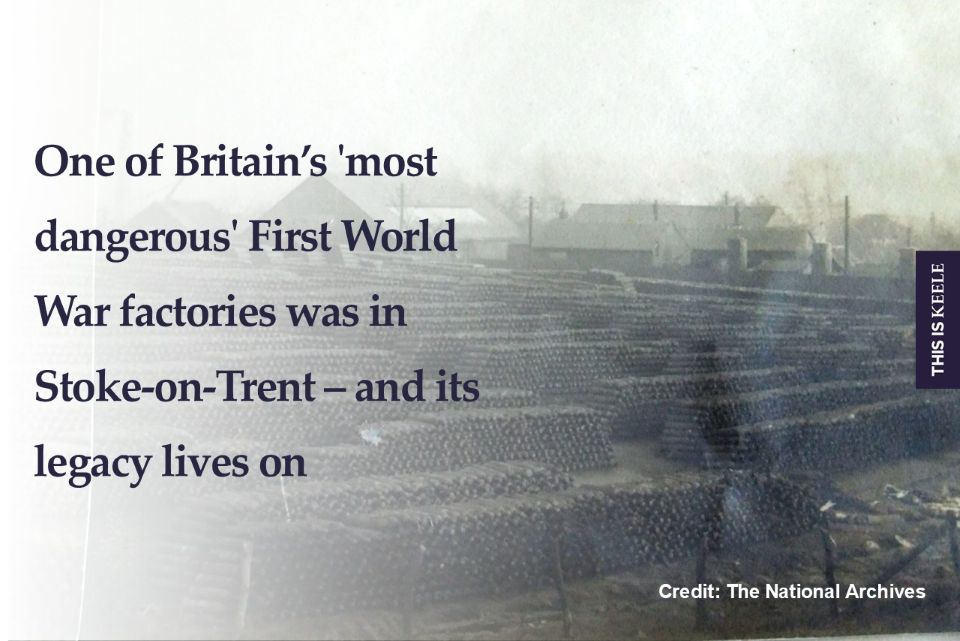
Thousands of accidents at a Staffordshire factory handling poison gas cylinders during the First World War helped pave the way for pioneering medical treatments for people with respiratory illnesses, new research has found.
His Majesty's Cylinder Depot, in Stoke-on-Trent, was established during the war to process and recycle cylinders recovered from the Western Front. Many were damaged, defective or still contained poisonous gas, making the work exceptionally hazardous for the people handling them.
By the end of the war, more than 650,000 cylinders had been processed at the depot. Workers emptied, cleaned and repaired them before they were sent away to be refilled, with women playing a major role in the operation and handling at least 360,000 cylinders.
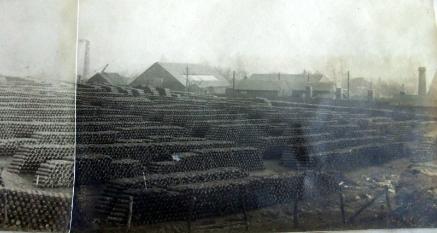
Photograph showing more than 70,000 gas cylinders being stored at the site in Stoke-on-Trent. Credit: The National Archives.
But the scale of the operation came at a considerable human cost.
Historical records held in The National Archives, and examined by researchers from Keele University, Goldsmiths, University of London and The Western Front Association reveal that the depot's workforce, which averaged 284 people in 1918, suffered more than 2,255 accidents, including nine serious injuries and one fatality. This equates to almost eight accidents per worker, four times the average for other munitions factories, leading to it becoming known as one of the most dangerous factories in Britain.
Despite safety measures, workers were regularly exposed to toxic gases, resulting in serious respiratory illnesses and other health complications.
Following successful trials of patients continuously inhaling oxygen in Cambridge in 1917, the nearby North Staffordshire Infirmary developed its own pioneering specialist oxygen treatment wards to help people suffering from the effects of gas exposure.
These wards initially treated affected factory workers, as well as soldiers returning from the Western Front who had been exposed to poison gas. However, their benefits soon extended to the wider local population, including people suffering from asthma, pneumonia and other respiratory conditions.
By the end of 1920, more than 100 patients had been admitted to the wards, with over half being soldiers gassed on the Western Front.
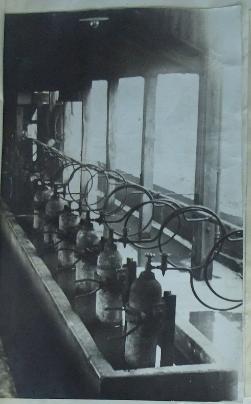
Gas cylinders being emptied. Credit: The National Archives
Dr Jamie Pringle, Reader in Forensic Geosciences at Keele University, said the wards represented a significant but largely overlooked advance in medical treatment.
He said: "Like other scientific breakthroughs necessitated in wartime, the North Staffordshire Infirmary oxygen wards, initially developed for the gassed workers, made amazingly rapid medical progress in the treatment of patients with various pulmonary and lung disorders. It led to the area being recognised as a centre of excellence for this kind of treatment.
"The benefits were not only for those exposed and injured at the factory, and returning soldiers gassed on the Western Front, but subsequently for the wider local population suffering from a range of health issues."
Historical records held in The National Archives (WO 142/253) show that many patients experienced significant improvements in their health, with the wards treating people with conditions including asthma attacks, pernicious anaemia and broncho-pneumonia, as well as respiratory problems associated with work in the local coal mines and pottery industries.
In one particularly striking case, a soldier suffering from severe double basal pneumonia made a remarkably rapid and complete recovery - an outcome his treating doctor said he had never witnessed in 27 years of clinical experience.
Dr Pringle added: "These oxygen wards were a real medical step forward, and this pioneering medical advancement has largely been ignored in the scientific literature."
The research also sheds new light on the extraordinary demands placed on the depot's workforce, and the conditions that made it so dangerous.
Professor Peter Doyle, military historian at Goldsmiths, said the need to recycle gas cylinders was driven by the growing use of chemical weapons on the Western Front.
He said: "Poison gas did not break the stalemates of the First World War, but it became part of an effective array of weapons directed at enemy soldiers on both sides.
"The demand for suitable gas cylinders made it crucial to recycle spent cylinders from the Western Front, where they were salvaged from the battlefield and transported back to the UK and the specialist storage and processing site in Stoke-on-Trent."
However, Professor Doyle said limited funding meant that a purpose-built depot and specialist factory could not be developed, contributing to the dangerous conditions faced by workers.
Comparing the depot's accident figures with a 1941 commissioned report on manufacturing industry accident rates, which recorded rates of up to two accidents per worker in 1901, 1904 and 1938, the researchers argue that the Stoke-on-Trent facility stands out as an exceptionally dangerous workplace.
Professor Doyle said: "By the end of 1917 the number of accidents suffered by the workforce were so large that the depot had become known as one of the most dangerous factories in Britain. The initial gas cylinder extraction and cleaning procedure was very dangerous for the factory workers, with exposure to the gases causing acute ill health, both immediately and long term.
"The research highlights an overlooked connection between the industrial demands of the First World War, the human cost paid by local workers and the development of medical treatment that benefited the wider population.
"It also brings renewed attention to Staffordshire's contribution to the war effort, beyond the better-known stories of the Potteries' manufacturing heritage."
-393x278.png)
Aerial view of the former North Staffordshire Infirmary site. Credit: Jamie Pringle.
Following the end of the war in 1918, depot staff continued processing the remaining stored cylinders until the factory closed in 1919 and the site was cleared. The adjoining railway yard remained operational until the 1970s, before being removed and the site redeveloped as an industrial estate. Today, the site is home to car showrooms, near the Lime Kiln traffic lights.
The research, The Most Dangerous Factory in Britain: First World War Gas Warfare and the H.M. Cylinder Depot, Stoke-on-Trent, has been published in the British Journal for Military History. The paper was also co-authored by Jon Sneddon, from the Newcastle-under-Lyme branch of The Western Front Association and Keele alumnus Joseph Browne.