

Carbon-trapping rocks could demonstrate Earth’s natural ability to store carbon dioxide
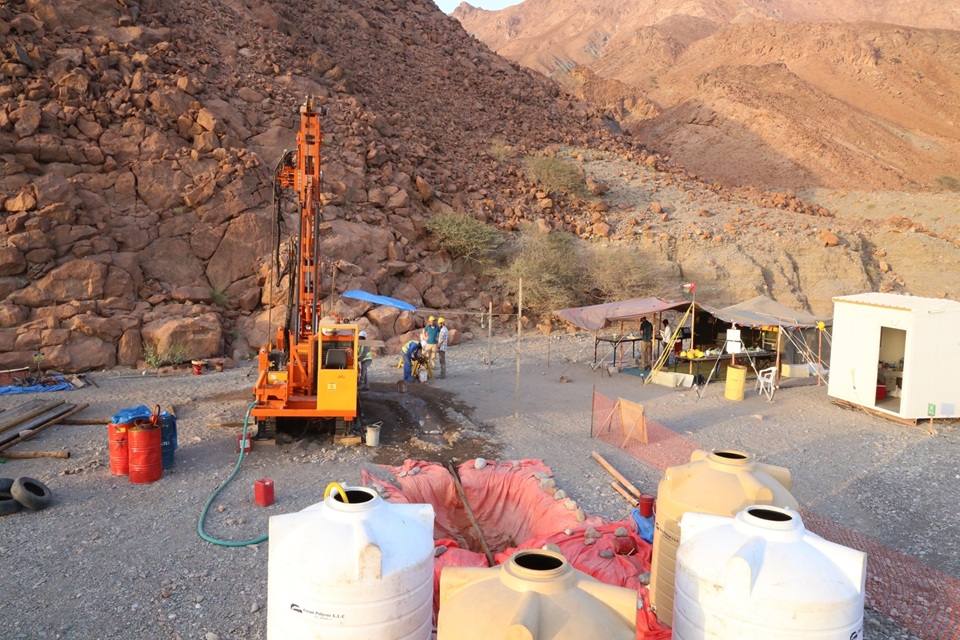
A research team led by a Keele scientist have shed new light on how a mysterious rock formation in Oman was created, which could reveal new details about the Earth’s ability to store carbon dioxide (CO2).
The study, led by Dr Elliot Carter in Keele’s School of Life Sciences in collaboration with the Universities of Ottawa and Manchester, looked at geological evidence from Oman to better understand processes that occur in subduction zones, which is where one of the Earth’s tectonic plates sinks beneath another due to the plates colliding together. This process is active around much of the Pacific “Ring of Fire” today, for example.
These zones are significant because the sinking plate carries a lot of CO2 trapped in ocean sediments, but scientists are unsure what happens to it after it sinks. Some is stored deep in the Earth and some is released back into the atmosphere through volcanic eruptions.
Another recently considered possibility is whether the CO2 is neither transported to the deep Earth nor returned to the atmosphere, but gets trapped in rocks by CO2‑rich fluids reacting with them, forming minerals known as carbonates which lock the carbon away for millions of years. This form what is known as a "hidden carbon sink”, but the reaction processes happen tens of kilometres underground, meaning they are difficult to observe and study.
However, in some regions of the world these rocks have been pushed to the surface, meaning scientists can study them in more detail. These formations are called ophiolites, with one of the biggest in the world being the Semail Ophiolite in Oman. One mountain made of these rocks is estimated to have naturally locked up over 1 billion tons of CO2.
Scientists have frequently disagreed about how these rocks form, with some theories suggesting that the rocks could have formed in a subduction zone, meaning they could be an example of a hidden carbon sink, while others suggesting that they formed after subduction ended in the area.
To investigate this, Dr Carter and his colleagues analysed halogens, chemicals such as chlorine, bromine and iodine, which were present within individual mineral grains and can give a chemical fingerprint of what processes have taken place to form them.
Their results, published in the journal Nature Communications, indicated that there were at least two separate events where CO₂ reacted with the rocks, which is indicated by the presence of different minerals with different chemical signatures. Most of the carbonate minerals formed from fluids that match those usually found in subduction zones, in that they were CO₂‑rich and influenced by ocean sediments.
They also calculated that over 90% of the CO₂ in the sinking plate could have been channelled along the plate boundary fault into the shallow mantle and locked away, indicating that carbon sinks in subduction zones are not only real, but could play a significant role in the Earth’s carbon cycle, by offering a way to store huge amounts of CO₂ for millions of years.
Dr Elliot Carter said: “As our climate warms there’s been increasing attention on these strange and enigmatic rocks and what they can tell us about how the Earth moves carbon around and how humans could store it in the future”
“Zooming into chemical differences between different microscopic crystals really gave us the key to unlock the story of these rocks”
“We can now tell that rocks such as those in Oman likely form an important part of Earth’s long-term carbon cycle.”