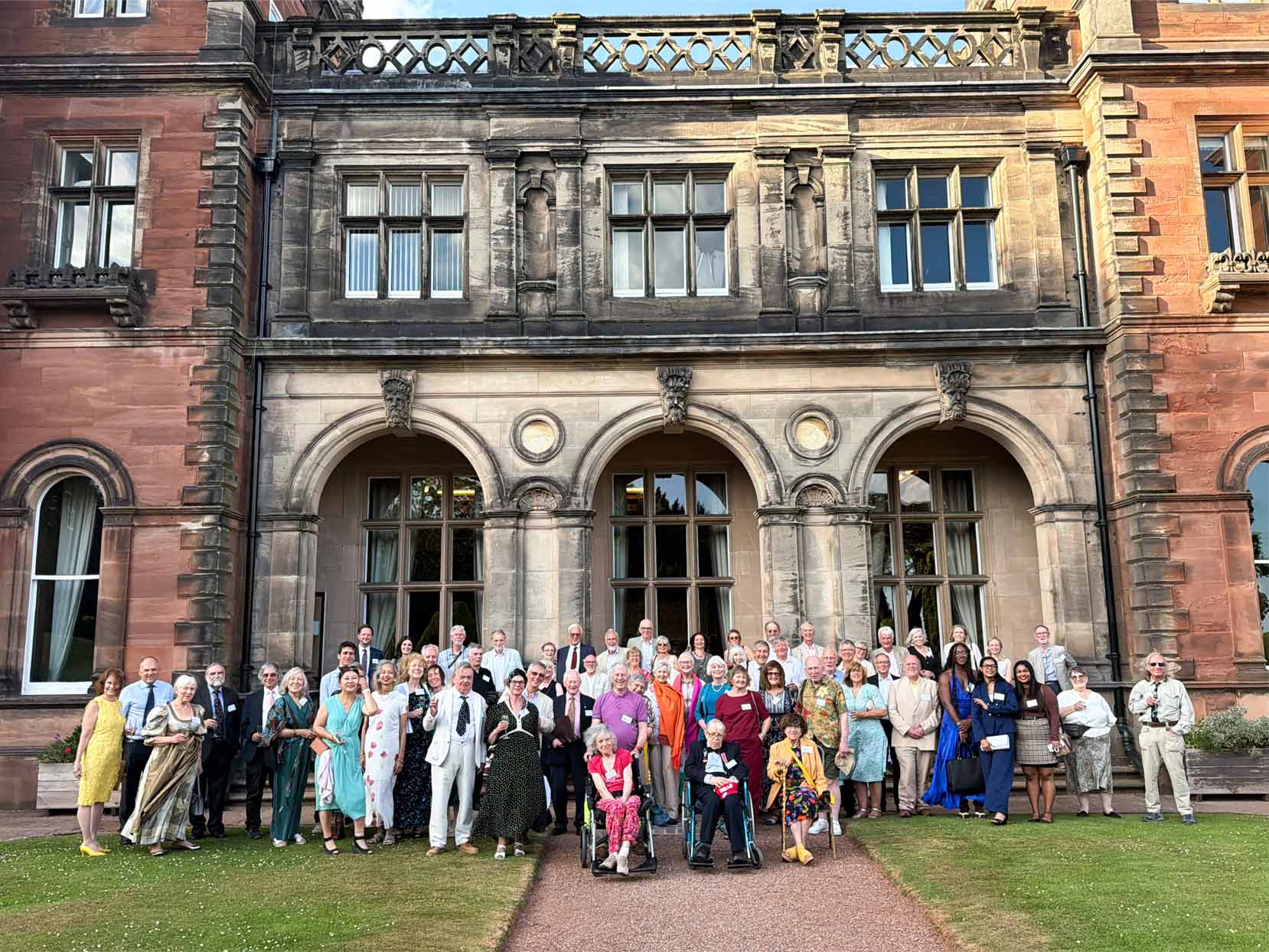

Golden Graduates 2026 Reunion Dinner: Celebrating the Class of 1976 and preceding years
We were thrilled to welcome back our Class of 1976, and preceding years, on Saturday 27 June 2026!
Our attendees enjoyed a three-course dinner in Keele Hall, speeches by our speakers (transcripts below), and there were archive materials from the 1970s available. See who attended, and read the speeches, below.
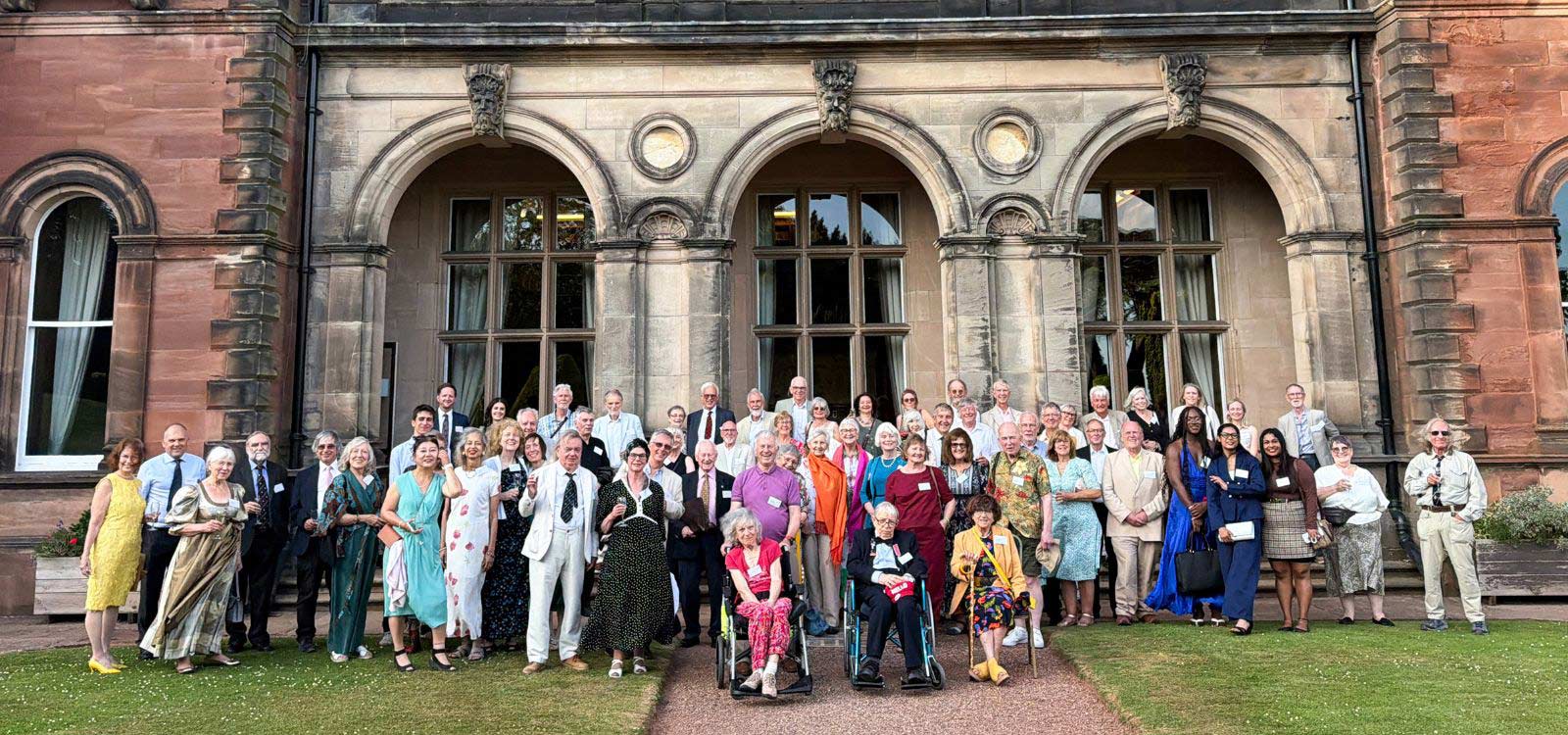
Download the Golden Graduates 2026 Reunion Dinner photo (245 KB)
This file may not be suitable for some users of assistive technology. Request an accessible format.
Pat Agar - 1976: English & American Studies
Hannah Azizollah - 1976: Economics & Psychology
Kath Balderson - 1977: Biology
Neil Baldwin - Honorary Graduate
Andrew Barton & Guest - 1976: American Studies & Economics
Jane Bedford - 1976 American Studies & Economics
Eileen Bernard - 1976: French & Russian
Nick Bowles - 1976: Psychology & Biology
Kenneth Briddon - 1976: Economics & Psychology
Pat Buckmaster - Guest of John Turner
Tony Budd - 1963: Geography & Geology
Geoffrey Castro - 1976: Geography & Geology
Mary Castro - 1979: English & German
Malcolm Clarke - 1969: Philosophy & Sociology and Social Anthropology
Lesley Clarke - 1972: Applied Social Studies & Sociology and Social Anthropology
Keith Clement - 1956: Politics & Applied Social Studies
Harriet Coomber Hewitt & Guest - 1975: French & German
Barbara Crane - 1968: Biology & Geology
Alan Crane - 1968: Geography & Geology; 1971: Geology (PhD)
Margaret Davies - 1976: Law & Politics
Phillip Davies - 1971: American Studies & Sociology and Social Anthropology
Kate Douthwaite - Stakeholder & Supporter Relations Manager, Advancement Team
Tom Fraser - 1976: American Studies
Andrew Ganley - 1976: American Studies & Law
Anne George - Keele Postgraduate Association President
Ginny Griffin-Monk - 1976: English & Psychology
Gillian Gutteridge & Guest - 1976: English & Law
Gina Hall - 1976: French & German; 1993: German & Education
Deborah Hildick-Smith - 1976: American Studies & English
Moira Houghton - 1976: History & German
Lauren Huss - Associate Director of Alumni & Supporter Engagement
Gillian Kay - 1976: Psychology & Biology; 1978: Criminology
Elaine Killerby - 1976: Biology & Psychology
Richard King - 1976: Latin & Law
René Kostka - 1976: Economics & Psychology
Verena Kostka
Jeff Love - 1975: Politics & Law
Dave Maddox - 1976: Economics & Law
Jean Maddox
Dawn May - 1976: French & Psychology
Dave May
Leslie (David) Mitchell - 1968: Sociology, Applied Social Studies
Sylvia Morris - 1976: American Studies and English
Alan Paling & Guest - Class of 1976
Mark Pryer - 1976: History & Law
Russell Reader - Executive Director of Communications and Advancement
Pratima Sarwate & Guests - 1976: French & English
Trevor Semple & Guest - 1976: French & German
Kevin Shakesheff - Vice-Chancellor
Sandra Suresh - Keele Postgraduate Associaton Vice-Preseident
Abby Swift - Stakeholder & Supporter Relations Manager, Advancement Team
Richard Toon & Guest - Class of 1970
John Turner - 1963: Geography & Geology
Fred Turner - 1972: Education
John Ucheagwu - Keele Postgraduate Association President
David Wood - 1976: French & German
Nicholas Wright - 1976: Economics & Politics
Alec Wright
Hello everyone, I'm John Ucheagwu, the President of the Keele Postgraduate Association which is part of Keele Students' Union.
It is my pleasure on behalf of Keele students to welcome you today, and I hope you all enjoy being back on campus!
I hope I can introduce you to student life at Keele, acknowledging the tales of these past few years and the impact this has had on our students.
I've read and heard stories about what Keele was like for many of you throughout the decades, and I'm excited to learn more by exploring some of the archive material and memories that guests have shared with us.
Like many of our students today, I'm sure what Keele means to each of you will be very different, but the one thing that I'm sure unites you all is the feeling of reminiscing, seeing familiar faces and remembering your time here.
As would have been the case for many of our alumni guests today, for many students, Keele is their first time living away from home and the first-time meeting people from so many different parts of the country and all over the world.
The foundation year, despite briefly becoming 'unfashionable' in higher education, is once again a major part of Keele for many students and many of us experience a broad-based, interdisciplinary education giving us a wide view of the world and academia. The choice that our students get, from our electives to the new global challenge pathways, is outstanding, something which we as an institution and we as graduates should always cherish, value and maintain.
Most students study in the grounds of our beautiful campus where you can't walk to lectures without bumping into three or four of your friends. We're a community that we've lovingly come to refer to as 'the Bubble'. And we're maybe one of the few places left in Britain where everyone really does know all their neighbours, and it's lovely.
While some of these attributes have waxed and waned over time, they remain present and remain part of what makes Keele great for many of us.
So, what do the Keele students of 2026 do with their time here and how do we help them along the way? Well, despite the cost-of-living crisis hitting students hard, they still manage to do incredible things…
Our 150+ sports and special interest societies give every student a place to feel welcome and accepted. They put on weekly social events from film screenings to dressing up in the wildest costumes I have ever seen. They are a core part of everyone's time atKeele, and we are so grateful for all that they do.
This year, thanks to our Student Voice Team, our Development and Democracy Officer, and of course our wonderful candidates, we saw our highest election turnout since 2019.
Unfortunately, we lost Varsity this year to Staffordshire University, but it was a very close contest and came right to the last game. Students came out in their 100s to support our sports clubs, showing the real Keele spirit of supporting and cheering each other on.
The mental health crisis keeps growing, with many students still feeling the effects of the pandemic, but we strive to combat this, by hosting wellbeing lounges and an array of activities during the day to prevent loneliness, to our Advice and Support Service signposting students and offering them support; Keele SU continues to put students first and encourage them in every way possible.
Leading into the more positive parts of this year, this year we have seen brilliant engagement from so many fantastic student leaders. The dedication they have shown is incredible.
And finally, we continue to represent students and their interests every day. Our Networks give students a bigger opportunity to get involved with campaigning and representation.
Our Wellbeing Officer ran a Winter Warmer Campaign lobbying for £1500 to give students heated blankets, hot water bottles, draft excluders and so much more, while giving students educational materials to help them reduce their bills as much as possible.
This is just a small little screenshot of some of the work students and the Students' Union have been doing to make sure that students at Keele have their voices heard and their needs met.
As for students now, for some of you - your memories of Keele are inseparable with the somewhat politically turbulent times. A time of demanding your voice be taken seriously by those in positions of authority. Listening to memories like these acts as a reminder that those who went before me would have bitten off my right arm to be sat where I am now.
Student representatives now sit on virtually all decision-making bodies at the University and as a Students' Union we make sure that at every available opportunity we use them to be a voice for students, as I hope my previous examples attest to.
More broadly, Keele Students' Union has undergone significant development since your time at Keele. We are now a registered charity with dedicated staff for our clubs and societies and a team of professional, confidential and impartial advisers who provide support and representation to students - who have dealt with over 700 cases so far this year.
Many of these fantastic, vital, and student-led projects are funded by alumni donations. So, on behalf of the Students' Union, I'd like to thank you all for your generosity. Your contributions help drive forward Keele's fantastic student projects to help our students develop, lead and learn outside the classroom.
Keele remains a fantastic and vibrant community of communities. And more than ever before, students find themselves empowered to influence their life at university.
But none of this means that for students the fight is over.
We see culture wars spilling over to our campuses, making the lives of people who look like me less safe.
Events across the world mean students call on their universities to do better.
Working class students are being priced out of higher education.
As with every generation, we push further and demand more from those in authority and from our society. Issues of education, race, sexuality, gender, the environment, housing, jobs, mental health and finances are on the forefront of most young activists' minds.
While our methods of protest may change, I'm sure many of these causes may sound very similar to those you yourselves championed at your time at Keele and still do.
Once again, I'd like to thank you all for the ongoing support you give to the Keele community. I would also like to use this opportunity to welcome a special guest in our midst, Keith Clement, one of our pioneer alumni from the graduating class of 1956.
I hope you've enjoyed a glimpse into student life today and have enjoyed your time back on campus. Thank you for listening.
I have been to a number of these reunions. I have no trouble remembering what it was like here in the early fifties and the changes still shock for someone from 1952. The Madeley bus coming through the campus – whose crazy idea was that? We’ll all get run over. Men and women in the same Hall of Residence, albeit on separate space – are you sure about that? Sixty companies with their upfront logos calling our campus their home – what are they doing here?
And then I snap out of it and prepare to celebrate change.
For the great majority of you this is a Golden Reunion, dating from 1976. I beat you by 20 years, graduating in 1956, so I suppose this is my Platinum Reunion. I learn that platinum is associated with strength, purity and endurance. I cannot possibly comment of course although I suppose endurance cannot be denied.
My path to Keele was not typical. I had left my Grammar School at 16 with a Higher School certificate, equivalent to A Levels. This was not because I was a prodigy, far from it. After the war there was just a lot of movement between class levels to make the numbers and the ages fit. I do not remember Further Education being mentioned. There was no tradition for it in my family. National Service was less than two years away, a job had to be found for me. Cadburys was within walking distance, just follow the smell of cocoa. So that is where I started, sitting in front of an endless belt of caramels, discarding any mis-shaped ones. You stopped enjoying the taste after two days and it has not returned to this day. I moved to an office job and then came the Army. For my second year I was lucky enough to be posted to Trieste. So there I was in the Summer of 1951, enjoying Italy, with no idea where I would go after demob the following January. Then, out of the blue, a letter from Cadburys telling me about a new College at Newcastle under Lyme (where the heck was that) which had a Foundation Year to which they were keen to include people from industry. Was I interested, with Cadburys footing the bill? It sounded like a no-brainer to me. Within a few months of enjoying the Foundation year programme I knew I wanted to stay for the full four years. I had a very understanding conversation with Cadburys and they wished me well. I don’t think there are many employers like that anymore. I got a Local Authority grant for the degree years like everyone else. I am in no doubt that after two years working and two years in the Army, I gained much more from Keele and contributed more to it at the age of 20 than if I had been younger.
When my year arrived the student population went up from 300 to 450. It was like joining a special club. I find it is the small things I recall the best. We had to wear academic gowns to any form of tuition; there were hardly any cars, certainly student ones ; Instant coffee was all the rage as were instant coffee parties. Saturday nights were either a film with a noisy projector or a dance with a small band. Here Mary Wilson, the womens’ warden would patrol separating any couple dancing too close together. I kid you not. The age of majority was still 21 so the College acted ‘in locus parensis’ and it was taken seriously. Everyone, including the staff, lived on campus.
In the 20 years between us, a lot went on. In the Sixties the College flourished with a lot of new building as the huts went but also the period became known as the troubles with student unrest, the forced occupation of the registry building while demanding student representation to the Senate and a certain amount of damage. By 1972 it was all much calmer and on arrival you enjoyed the new Students Union, Library, Chapel and Conference Hall and you joined a full University. We had none of those things.
We were too busy enjoying ourselves making the place work to our liking. At the end of my third year I was warned that if I repeated my Keele performance playing Sir Joseph Porter in HMS Pinafore for a second time in a Newcastle theatre it would show that I was not serious about achieving a degree. I got the message.
Your arrival coincided with 21 years of the College/University. Newspapers were starting to talk of Keele Coming of Age and there was steady growth in your time. So you missed the troubles of the sixties and you had gone before the eighties when all the Universities endured large cuts which slowed down further development.
What was your experience in getting your first job? I notice Keele boasts that 96%of graduates are working after six months. How did you manage in 1976?
Before Finals I did begin thinking about where next? I had no employment plan. There must have been a Careers Dept. in a small room somewhere but I have no recollection of them. I knew I did not wish to go back to Cadburys despite feeling I owed them something. I got turned down for the BBC Production Course but would I be interested in joining their Training Reserve? You bet. This was just for one year. It was up to me to apply and get a job in that time or I was out. Salary £750 a year. They seemed more interested in my Sir Joseph Porter than in my degree. I got my first BBC job after 3 months.
But it is clear from the headlines that today can be very difficult for some. You read of hundreds of applications and very often not even getting a reply. Universities have been putting a lot more effort into employability and career departments.
And a few weeks ago Manchester University unveiled plans to guarantee meaningful work experience for all undergraduates before graduation. That’s big numbers – about 30000. It got good coverage in the press. But hang on – Keele has been planning that since last year. Good for Keele –leading the way as the world of employment is changing. My word – what a long way we have come – from getting a degree without worrying if there would be a job at the end of it – because there always was, to accepting the reality, planning for a job and fighting for it very early on.
I came to the first Golden Reunion – it was In 2012 the 50th Anniversary of the granting of the charter in 1962. So all the graduates from 1954 to 1962 were invited and we were entertained with ceremonial robes and a mock processing of the mace. It has now come down to a good dinner and memories but no matter. Memories are important and it is always worth the effort to come together as often as time allows. I can understand why the alumni team coincide it with Keele Day now but there is a danger it might be absorbed and eventually dropped. I hope not.
I guess some of you might not have met since your graduation. What an opportunity today has been, to explain your outstanding life and career, just the good bits of course. I wonder how many of you felt confident on leaving that Keele had prepared you well. I certainly did.
I have already mentioned that I was in broadcasting and for nearly 40 years with the BBC. I was a studio director in Current Affairs in London for a long time and once got very teased with a piece I wrote for Radio Times describing live current affairs television as the Agony and the Ecstasy. I always thought a bit of hyperbole would get me a long way and in 1979 I was invited to direct my third General Election night programme. It was Margaret Thatcher versus James Callaghan. Maybe you watched it if your first job allowed you the time.
If so, you would have seen the BBC failing to transmit the first result which is like missing the first goal in the Cup Final. And when a day later a triumphant Mrs Thatcher on the steps of No 10 was quoting St Francis of Assisi – ‘where there is discord may we bring harmony’ the BBC was transmitting Jackanory, a children’s story. None of it was my fault of course but my name was on the end of the credits and that was Agony in my book.
But I did have a lot of Ecstasy mainly through being in the right place at the right time –luck has such a large part to play in a career- so I directed most of the Apollo moon shot programmes, was very involved in the birth of Nationwide – you may remember that from the Seventies, later the start of Breakfast Time, later still EastEnders and my last job launching a new ITV Franchise.
But I have never been in any doubt that my luckiest break was when a thoughtful welfare officer sat in his office in Bournville in the Summer of 1951 and thought I wonder if Keith Clement would like the idea of spending a year at that new College near Newcastle under Lyme. With that letter he literally posted the foundation of the rest of my working life.
Thank you for indulging me.
I was delighted, if a bit daunted when Lauren asked me a couple of weeks ago whether I would consider giving this talk. The delight was to be given the opportunity to reflect on the last 50 years and what Keele was for me then and now. Daunted as I don’t feel like a natural public speaker!
Before launching into my reflections, a very brief biography to give you context in relation to what I have planned to say. I completed the Four-Year BA Psychology/Economics in 1976. It was the first year that alongside us was a cohort of three year degree students studying without the Foundation Year. If there are people here who were on the three year track I would love to know whether you have similar thoughts and feelings . A year after graduation (a gap year to gain a full SSRC grant) I went to Hull University to complete a Masters in Industrial Psychology and then straight into employment as an occupational or work Psychologist with the Post Office soon to split and half become BT. After 15 years there in 1994 I left to become self employed as a work Psychologist and although kind of retired now receiving two pensions, I still work a small amount part time and do a fair amount of pro bono work.
I chose Keele for the broad education, delayed specialisation, campus focused, remaining sense of a community of learning and of course the foundation year. The beauty and scale of the Keele campus was paramount too. Most people I knew had either never heard of Keele University or they knew it was the place where people sunbathe in the nude (thanks to a report in the Sun newspaper), or the had heard the name Prof Alan Gemmel of Keele University on Gardeners Question time.
Student life for me was social and political as well as academic. My fair share of drinking far too much and being very ill for 24 hours groaning never again only to repeat. Steamy nights in the Union ballroom floor sticky from spilt beer, drinking vodka and lime emerging into the cold winter night to the fog of chip fat emanating from the chip van set up in the car park.
Endless Union meetings with motion after motion, sit ins and demos
Hours in the library. I’ve been trying to remember how we used to do searches for academic papers - I think we had to fill in a form with key words for librarians to send off and a few days later would receive a completely useless print out illustrating how useless your key words were!
I made many friends for life…5 are here and sadly good friends who have drifted away or passed away. Lounging on the lawns of Keele Hall, laughing in Harrowby House - I lived there all 4 years, each year moving into a larger and more select room.
My two Professors and Heads of Department were notable characters. Prof Hunter Psychology seemed to come from the Edwardian era. Dapper, immaculately dressed with a spotted dickie bow tie and a refined Edinburgh accent somewhat unworldly. He was my tutor for the FY discussion group to explore the lecture series When discussing drugs he asked how people go about buying them and the coolest hippie in the group said guys come up to you in Newcastle and offer…he was astonished that in all his visits to Newcastle no one had offered!
Prof Fishman the American Head of Economics gave a FY lecture on Blood donning systems and how the UK system entirely voluntary, no payment or reward was the purest cleanest economy of its type. I felt so inspired by how he looked at and communicated Economics.
It is impossible to look back at the last 50 years without seeing how influential Keele was for me threading through almost everything I have done.
I was going to say that Keele was life changing but when I really thought about it I realised that it was life developing and enhancing - I arrived with aptitudes, attitudes, interests, values that were strong but immature straight from school and my time at Keele developed, enhanced and integrated these things in ways I could never have imagined. My Masters at Hull was an impressive course, a great place to be and study, which enabled me to become an applied psychologist, but I have no internal or psychological attachment to Hull University as part of my being – Keele most definitely is both here (head) and here (heart).
In my professional career I have worked with people in a vast range of organisations and industries. A small sample – NHS, Air Traffic Control, Care sector, BNFL, American Express, small start-ups, Law firms, waste disposal – every one of them, and the people in them offer me scope to be interested in what they do, how they do it and getting to grips with new systems, processes, language, values. I thought about the Foundation year and the two terms of 9 and 11 am lectures ( with a one hour break for a coffee and a cheese bannock in the Union café ) contributed to by every department in the university I could see a parallel and maybe some roots to how I work with people. Subjects like History, Chemistry, Geology, Cybernetics - things I had no interest to learn about, and yet I attended nearly every lecture, listened, grasped what I could at the time. I am sure knowledge residues still exist in my head somewhere. But most significant thing it developed in me was paying attention to things I knew nothing about to glean and build a sense of how everything is interconnected that you often start in a position of having no comprehension but if you, with curiosity listen and think, integration can happen. I could go on but am in danger of disappearing in my own deep and personal thoughts – a friend of mine would at this point say Psychologist Hannah, you are off duty now! Suffice it to say I think for me the Foundation year developed strong pathways to apply my intellect to whatever came my way in both my professional and personal life.
Since leaving in 1976 I would occasionally make a detour if I had time and was passing on the M6 to drive though campus and feel wistful and sad that I wasn’t connected anymore to this magical and amazing part of my life. Wistful until a few years ago when I started attending the Open/Alumni day, being invited to the Philanthropy Tea and attending some of the Employer Advisory Group meetings, not as an employer, but someone with a lot of expertise in learning, development, employability etc to contribute as I could to the group.
These things gave me the opportunity to get involved again, and see and experience the massive changes and developments here. Many new Departments – obvious ones like the medical and vet school but also smaller and more niche departments– two which I experienced at first hand on previous open days, the Forensic Science department where I looked for evidence in the Crime Scene House - the little staff house on the ring road opposite Sneyd House and the department of Orthotics and Prosthetics (I know the difference, do you?) where people can learn to manufacture and fit false limbs, and use an gym with cameras on the walls and sensors in the floor to make fine adjustments to people gait and balance etc while fitting limbs.
Although our Foundation year no longer exists there is a foundation year to enable some students who for whatever reason do not arrive ready to start their degree to do so the following year. I know some of my donations have contributed to enabling current students to find their own journey through life enabled in many ways by the Keele values, approach and ethos. That deeply moves me, my Keele, our Keele still exists in a different way. I’m not wistful anymore when I visit as I know I am still involved. And although Keele has grown massively and changed in many ways the Keele that is part of me is still here, and I am still part of it as it is part of me.