
Jack develops life-changing research at Keele
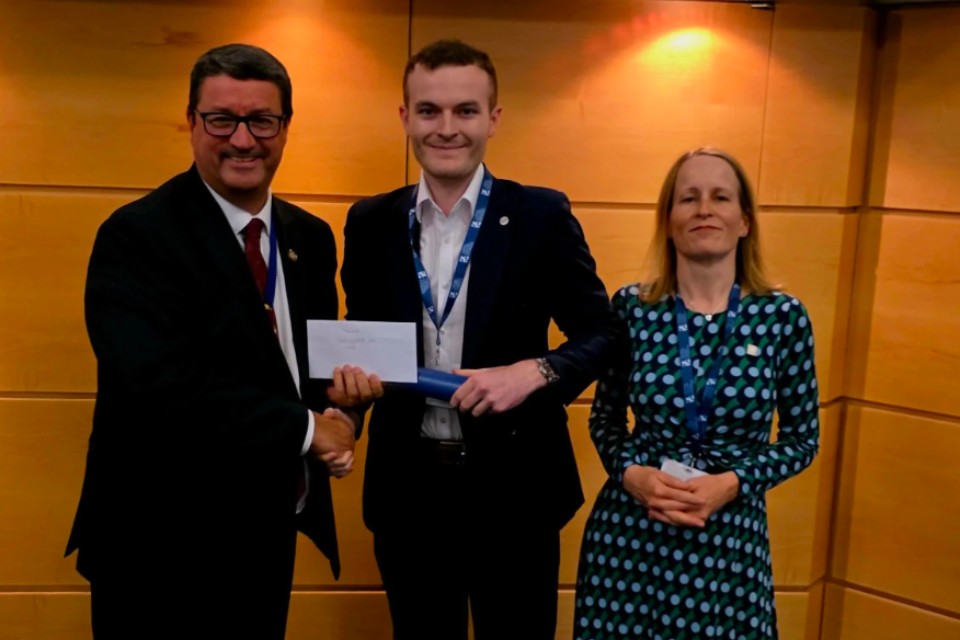
Third year medical student Jack Carter has beaten more than 2,000 other candidates to win a research award at an international conference.
After submitting an abstract of his research into neural tissue engineering in a bid to present at Liverpool University’s annual research conference, a professor from the University mentioned that the Royal College of Surgeons Edinburgh was accepting abstracts exploring the future of surgery for its next triennial conference, and encouraged Jack to apply.
Competing alongside consultant doctors from around the world, including China, India, and the USA, Jack made it through to the final 10 candidates and was invited to present his research at the Triennial international conference of the Royal College of Surgeons Edinburgh; one of the largest and most prestigious surgical colleges in the world. Following presentations from the shortlisted candidates which were scored by a panel of judges, Jack was declared the winner of the RCSEd Triennial Oral Presentations.
Jack said, “My research is in the field of tissue engineering, a discipline of biomedical engineering aiming to restore and replace various human tissues after damage caused by disease or trauma. I explored the use of electrical stimulation on stem cells (cells which can turn into any type found in the body) to accelerate the healing of the brain and spinal cord.”
Jack undertook his research, ‘Bioengineering in Regenerative Neurology: Electrically Stimulating Neural Stem Cells’, as part of the ASPIRE project organised by the School of Medicine. The annual programme provides students with a taster of lab-based research over the summer and can vary from anatomy surveys to projects examining cancer. Jack spent eight weeks in Keele’s Neural Tissue Engineering Lab (NTEK) where he cultured stem cells and found that electrical stimulation made them perform better. Early data indicated that if stem cells transplanted into a damaged brain appeared not to work, stimulating them could overcome this.
Jack said, “This research project could be revolutionary in treating various neurological diseases notorious for causing life-long disability. In the future, it could give patients with brain and spinal injuries the ability to walk, talk, and live life as they did before. It could even be expanded to develop treatments for patients who’ve had a stroke, an infection in the brain, or even degenerative conditions like dementia or motor neurone disease.”
He continued, “I would not have had this opportunity without the School of Medicine’s ASPIRE programme and the NTEK lab in the School of Life Sciences volunteering to have me. The ASPIRE project opened up the opportunity to explore lab research, which is very different to the clinical environments we usually train in to become doctors. It gave me the motivation and confidence to explore other fields of science research, something which I’d never considered before. Additionally, the staff in the NTEK lab were extremely supportive and encouraging during my research, especially my main supervisor, Dr Chris Adams.”
Alongside his studies at Keele, Jack is also working to improve patient care. He founded the Keele MedTech society and collaborated with Cardiff and St. Georges University on a range of medical AI research, such as measuring the success of an AI model built to interpret electrocardiograms (ECGs) and analysing how ChatGPT and Google Gemini performed in knowledge tests that medical students and doctors take. This was when Jack learnt about the risks of healthcare professionals using AI in their daily work, and he went on to co-found the UK AI Health Council. The group has since developed a medical AI for healthcare professionals using data taken from national and local authenticated guidelines to provide specific and trusted information in seconds, alongside promoting the safe use of AI in medicine.
Most recently, Jack has been involved in Royal Shrewsbury Hospital’s largest research project to date, the TRIOMIC study, which hopes to revolutionise colorectal cancer diagnosis. The large-scale study is trialling a new, non-invasive device which could potentially diagnose or provide the ‘all clear’ on bowel cancer within a week of a referral from a GP. Jack’s role in the study is to analyse the new diagnosis pathway and examine how to maximise speed while maintaining patient safety and quality of care.
Wanting to create more opportunities for his peers to share their research and academic passions, Jack also launched ‘TEDx Keele University’ earlier this year, which was a sell-out event. He said, “Being a student at Keele has allowed me opportunities I wouldn’t have had elsewhere. Having the ability to support potentially life-changing research has created newfound interests and a great sense of pride. I chose Keele because of its well-established medicine course, its ties to Royal Stoke hospital (one of the busiest major trauma centres nationally), and its intimate campus community with a very green and scenic backdrop.”
Following his graduation in two years, Jack aims to become a Trauma and Orthopaedic surgeon, while maintaining his interest in research and MedTech.