

Keele astrophysicists contribute to NASA-supported research discovering building blocks of life in neighbouring galaxy
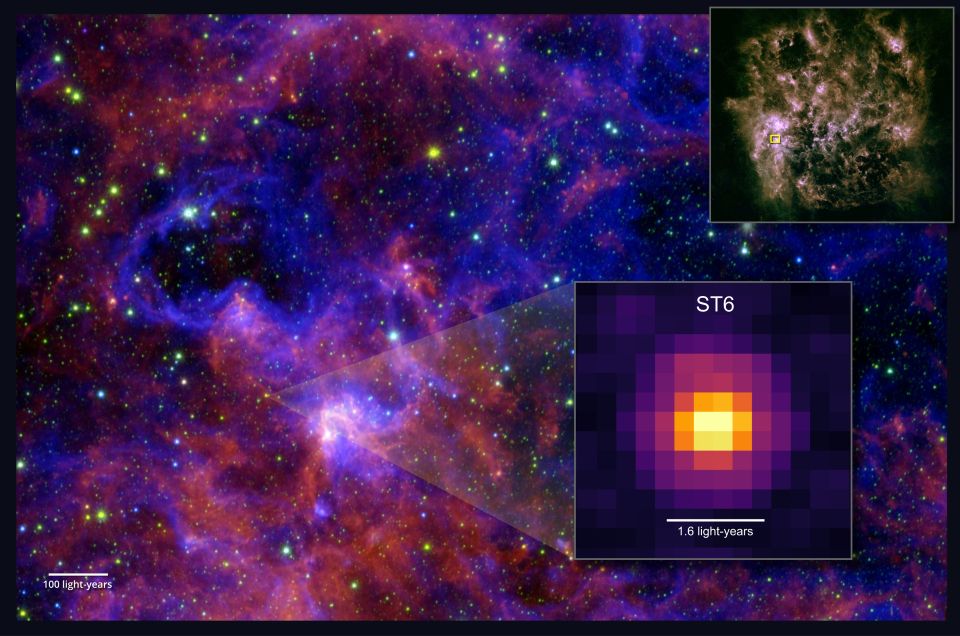
Astrophysicists from Keele University, alongside an international research team supported by NASA, detected large complex organic molecules in ices outside of the Milky Way for the first time - offering a glimpse into the chemistry of the early universe.
In a discovery that could reshape our understanding of how the chemical ingredients for life spread throughout the cosmos, astronomers detected organic molecules with more than six atoms frozen in ice around a young star called ST6 forming in a galaxy outside of the Milky Way.
Using the James Webb Space Telescope's (JWST) Mid-Infrared Instrument (MIRI), the researchers discovered five different carbon-based compounds in the Large Magellanic Cloud - our nearest galactic neighbour.
The team identified five complex organic molecules (COMs) in the ice surrounding the young protostar, many of which can be found right here on Earth: methanol and ethanol (common types of alcohol), methyl formate and acetaldehyde (primarily used as industrial chemicals on Earth) and acetic acid (the main component of vinegar). One of the molecules -acetic acid - has never been conclusively detected before in space ice, while ethanol, methyl formate and acetaldehyde represent the first detections of these COMs in ices outside the Milky Way galaxy. In addition, the team also observed spectral features that resemble another ice COM - glycolaldehyde, a sugar-related molecule and precursor of more complex biomolecules, such as components of RNA; however, further investigation is needed to confirm its detection.
Led by University of Maryland and NASA research scientist Marta Sewilo, the team included Keele University astrophysicists Dr Joana Oliveira and Dr Jacco van Loon. The team detailed its findings in a paper published in the Astrophysical Journal Letters.
Dr van Loon said: "We have used the James Webb Space Telescope to, for the first time, find precursors of biotic material in a nearby galaxy. Acetic acid, methyl formate and possibly glycolaldehyde all are associated with the creation of the first sugars, which form the basis of RNA and DNA - the foundations of life.
"To find these also in the more pristine environment of the Large Magellanic Cloud galaxy suggests life might have started elsewhere much earlier than it has on Earth."