

Scientists “resurrect” 1960s data to learn more about how continents break apart
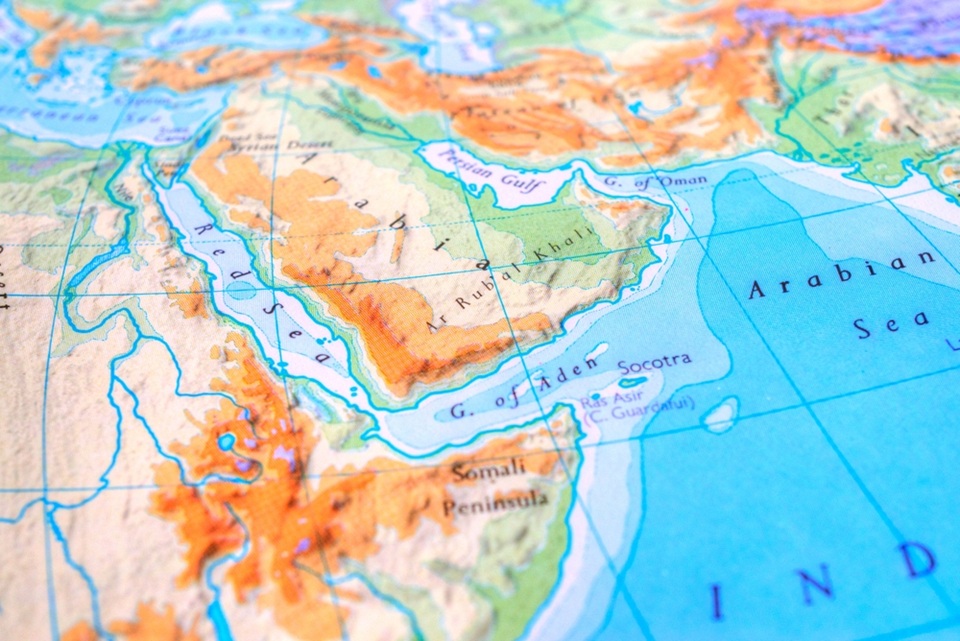
Magnetic data collected in the late 1960s has been brought back to life by a research team including a Keele scientist, who have used it to learn more about how the continent of Africa is stretching and splitting apart.
The high-resolution aeromagnetic survey, conducted over the Afar region of Ethiopia, what is now Eritrea, was conducted around 1968/69 in one of the most climatically inhospitable regions on Earth.
The data has remained completely forgotten since the 1970s, but now a research team including Keele’s Emeritus Professor Peter Styles, has digitised this old data and integrated it with additional “vintage” magnetic data from the nearby Red Sea and Gulf of Aden regions.
By combining these vintage datasets and using modern technology to analyse them, the researchers have revealed new insights about the magnetic crustal structure in the area, which is telling them more about how the African continent is shifting, stretching, and splitting apart, a process known as “rifting”.
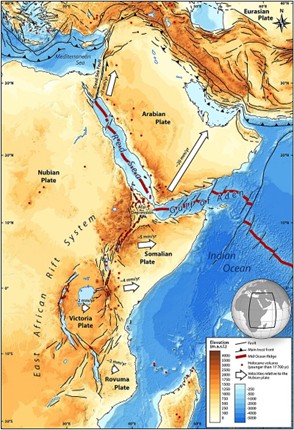 We can see from the jigsaw-like fit of some of the continent's edges that they were once joined, but the exact way that they split apart is uncertain. The best place to look at the early stages of continental rifting is the East Africa Rift located near the Red Sea and Gulf of Aden.
Scientists believe we are seeing the earliest stages of this process in this area, and it has long been considered that this is occurring, or has already occurred, around the low-lying Afar Depression area of Ethiopia, where there is thought to be a triple junction; a boundary where three tectonic plates meet.
The theory of plate tectonics tells us that the present configuration of the continents has been very different over geological time and that millions or perhaps billions of years ago, much larger granitic continental crustal masses (known as plates) fragmented and moved apart, creating new oceanic crust in that process and the oceans we now recognise, in a process called seafloor spreading.
During this process, newer and denser basaltic rocks are created in linear structures lying mostly below or close to sea-level. As these basaltic magnetic rocks cool, they record the signature of the Earth’s magnetic field at that time and latitude, but through relatively short periods of geological time the geomagnetic field reverses, giving alternating positive and negative magnetic stripes recorded in the rock which can be read like a supermarket barcode.
If the presumed model of triple junction rifting is correct, we would expect a triangular pattern of these magnetic lineations radiating out from the centre of the Afar Depression.
However, the researchers’ analysis of the modern data compilation showed that the magnetic lineations (seafloor spreading stripes) lines run from east in the Gulf of Aden, westwards across and down into the Afar Depression, but then turn and run North-South following the Red Sea orientation, showing little or no indication of the trend they expected to see in the East African Rift and which can only be recognised in the most recent faulting.
Instead, they suggest that the magnetic signature which is strongly expressed in this area appears to be a manifestation of continental rifting occurring as Africa and Arabia first tore themselves apart following a single fracture following the Gulf of Aden and Red Sea rifts. Their findings have been published in the Journal of African Earth Sciences.
Professor Peter Styles, Emeritus Professor in Applied and Environmental Geophysics at Keele, said: “These findings give a unique perspective on how our planet is constantly changing and shifting right beneath our feet. It’s also a great example of the benefits of looking at all of the available data, even historical data, when testing new models and theories. Models come and go, but well-measured data lasts forever.”