

Free public event at Keele Observatory for partial solar eclipse
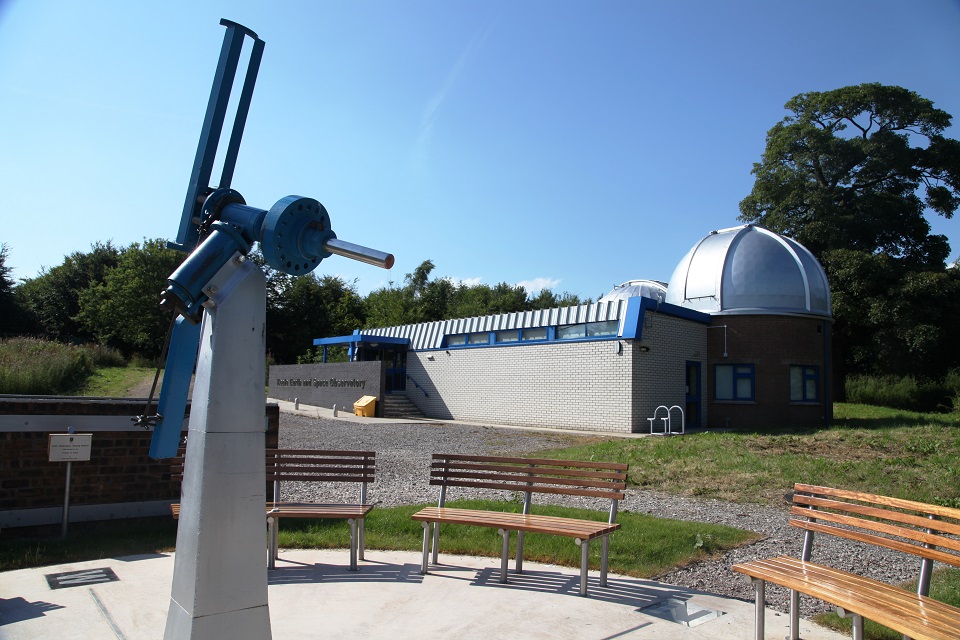
Keele Observatory is hosting a free public event for the partial solar eclipse at the end of the month.
The eclipse, which will see up to 39% of the sun's rays obscured by the moon at its peak, will take place on Saturday, March 29th.
The family-friendly event will get under way at 10am, with the partial eclipse beginning at 10.06am and maximum coverage occurring at 11.04am, before the spectacle ends at 12.03pm.
The observatory is based at Keele University and parking will be free in all car parks, with regular bus services also connecting the campus to Newcastle-under-Lyme and Stoke-on-Trent. A similar event held at the observatory for the solar eclipse in 2015 was attended by hundreds of people.
Dr Jacco van Loon, a Reader in Astrophysics at Keele University and Director of Keele Observatory, said: "We will have solar telescopes set up for people to safely watch the sun in detail. As well as the spectacle of the eclipse, people will also be able to see sunspots and eruptions taking place. We also have some eclipse glasses that we can share but it would be great if visitors could bring their own if possible.
"Hopefully we get lucky with the weather on the day but if we don’t, we will aim to stream the eclipse inside the Observatory, where we can explain and talk about what is happening. Visitors will be welcome to stay afterwards and explore the Observatory and have conversations about all things to do with space and the Universe.”
Similar to a total solar eclipse, during a partial solar eclipse the moon passes between the sun and the Earth. But unlike a total eclipse, the three celestial bodies are not completely lined up, and thus the moon will only block parts of the sun to viewers on Earth. To those in the eclipse's path, the sun appears somewhat like a crescent."
Dr van Loon added: "Although eclipses no longer herald doom or strengthen royal power, and their mysteries have long been removed by scientific understanding, it still is an unfamiliar and remarkable sight. And while we won't see a total eclipse, it is still amazing that the sun and the moon look almost the same size on the sky to us, despite the sun being so much larger and more distant than the moon."
For more information on the Observatory and directions, visit https://www.keele.ac.uk/observatory/