

Keele psychology expert advises U.S. police on protest management
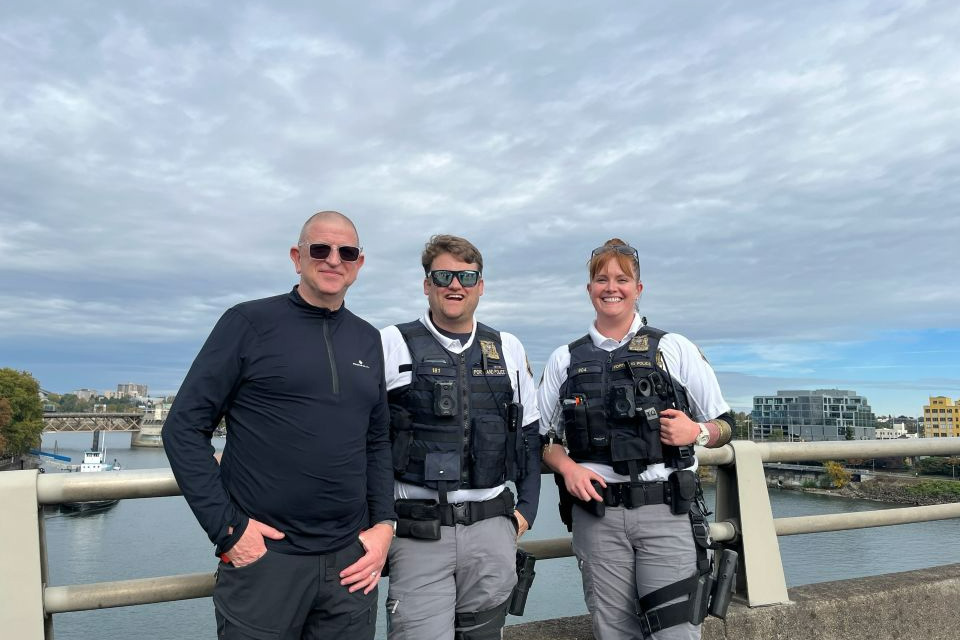
A world-leading expert in crowd psychology and public order policing at Keele University is advising police in the United States on managing large gatherings, including protests linked to immigration enforcement operations.
Professor Clifford Stott MBE, from Keele's School of Psychology, is guiding the response of police in Portland, the largest city in the state of Oregon, and helping them to advance and develop their policing model around the management of protests.
The Portland Police Bureau began to rethink its crowd management strategies after social justice protests in 2020 escalated into months of civil unrest, when officers used force on protesters over 6,000 times but ultimately paid out millions in injury claims and lawsuits. In June this year, ongoing protests began in the city, in response to the Immigration and Customs Enforcement (ICE) operations and presence in the city and surrounding area. The protests gained national attention after President Donald Trump referred to the city as "a war zone" during a press conference.
While observing a peaceful demonstration in Portland in October this year, Professor Stott was exposed to tear gas deployed by federal agents, along with the surrounding demonstrators. But through his work with city police chiefs, crowd science and dialogue-driven policing are redefining public-order management in Portland, making it safer and more democratic.
Professor Stott said: "One of the most important things to recognise is the city has become a site of national contestation and the frontline of the disputes that are emerging between the Federal administration and local governance in the country. I have been working with the city authorities to help manage the consequences.
"Our work occupies a delicate middle ground that both protesters and police tend to value because it helps protect fundamental rights, supports non-violent behaviour, and strengthens local policing legitimacy. Despite some ongoing scepticism within law enforcement, many officers, city leaders and activist groups are increasingly supportive, and the model is gaining momentum.
"With the protests that have taken place, it has presented an opportunity to really test the research-led policing model that we have been working on, that is dialogue-led and facilitation focused, and I think it’s going extremely well overall.
"We're now in a position where at recent protests, the local police force has not acted in amplificatory ways, and it has been able to manage the tensions outside the ICE facility in a way that has not seen those confrontations escalate as they did in 2020. The policing model has played a powerful role in helping to deescalate tensions and avoid the spread of confrontation beyond a very isolated area in the city itself."
Previously, Professor Stott was commissioned by the City of Seattle Office of Inspector General (OIG), a watchdog agency that monitors Seattle Police Department operations, to analyse the policing of Black Lives Matters protests in the city in 2020. That work led to a further project with the Columbus Division of Police (CPD), in Ohio, and a secondment to Ohio State University for 18 months as a visiting professor.
Professor Stott, a world-renowned expert in crowd psychology, riots, policing and public order, whose research is frequently drawn upon by Government, police forces and organisations in the world of football, said: "To find myself in a situation where I can sit down with the mayor, with the Chief of Police, with assistant chiefs, and other senior commanders to think through the problems that they're facing and help them orient strategically and constructive ways to meet those challenges has been incredibly rewarding.
"And to find myself at the top table, having the opportunity to bring Keele research to bear on these critically important decisions at a pivotal time in American democracy, has been some of the most rewarding experiences in my professional career. To see history playing out and be part of that conversation is exciting and meaningful. Universities are here to meet these challenges in our societies and to be invited to participate in this way really does hammer home the significance of the research we have been doing here at Keele."