

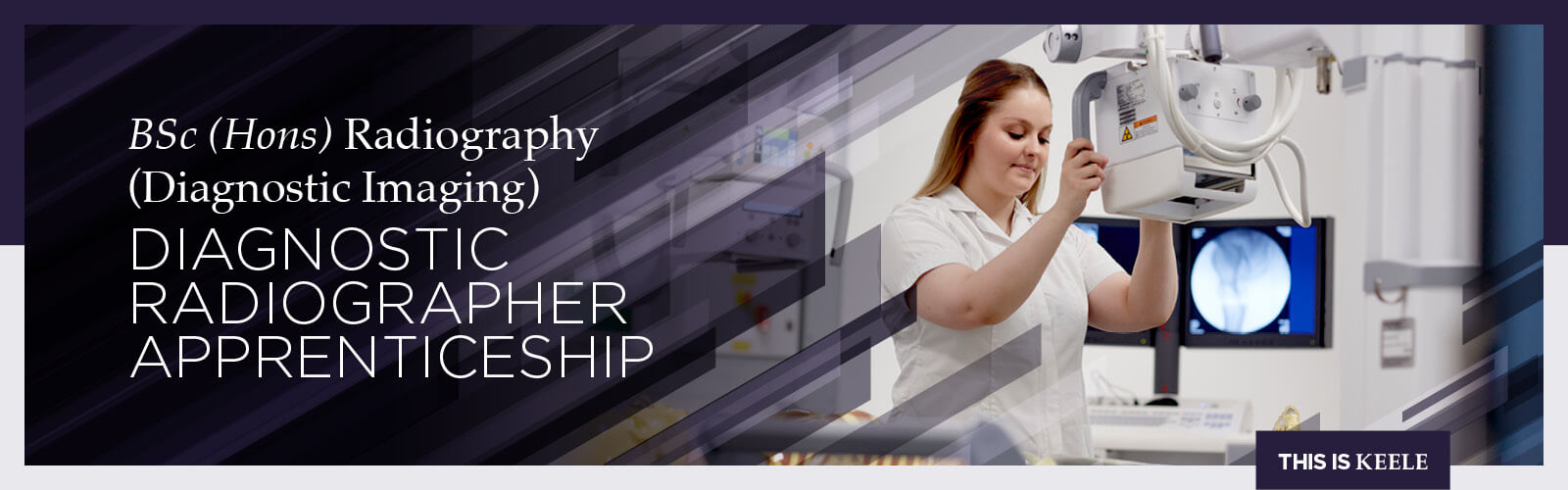
Diagnostic Radiographer Apprenticeship
The Diagnostic Radiographer Apprenticeship at Keele University prepares learners to achieve a Practitioner- level qualification, enabling them to develop and demonstrate the knowledge, skills and behaviours required for registration with the Health and Care Professions Council (HCPC).
The apprenticeship has a contemporary focus, aiming to develop compassionate radiographers with emotional intelligence to thinking critically and apply clinical reasoning within an evidence-based framework. It supports learners in acquiring a broad scope of practice and the ability to undertake a wide range of diagnostic examinations.
Apprentices are trained to become autonomous, accountable practitioners, capable of applying theory to their own practice. They develop the confidence to manage uncertainty, solves problems, and respond proactively to change, while delivering consistently high-quality patient – centred care.
Duration: 3 years.
Qualification: BSc (Hons) Radiography (Diagnostic Imaging).
Application: We typically require applications 8 weeks before programme starts.
Ofsted: 'Good' Ofsted rating for Apprenticeships at Keele University in Full Inspection, June 2023.
The UK healthcare sector has a significant shortage of Diagnostic Radiographers and rising demand from employers for highly skilled, qualified professionals.
The Diagnostic Radiographer apprenticeship at Keele University is an alternative route into the radiography profession and offers the opportunity to train and upskill the future healthcare workforce.
- We work in close partnership with learners and employers to deliver supportive, practice-focused training—combining tailored academic support with strong clinical mentorship to develop confident, work-ready professionals who meet service needs.
- The apprenticeship offers a blended approach to learning, combining on-the-job training, online teaching and an on-campus study day every six weeks at our specialised Radiography Suite and Image Analysis Digital Health Hub on campus at Keele University.
- The programme offers the opportunity to upskill existing Assistant Practitioners, providing a clear progression route to practitioner-level practice. It builds on current experience to develop advanced knowledge, clinical confidence, and the capability to undertake a broader range of diagnostic examinations.
The apprenticeship is focused on applying the subject theory into applicants own clinical practice. Apprentices will develop the ability to reflect on and respond proactively to change, undertaking a range of diagnostic imaging tests whilst maintaining excellent patient and client care.
The learning is a hybrid model of synchronous and asynchronous teaching, with support from lecturers and in-situ days (approximately five a year) on campus at Keele University.
Indicative modules include.
- Axial and Appendicular Anatomy, Image Evaluation and Radiographic Practice.
- Foundations of Research and Radiographic Science.
- Histology and Pathology.
- Imaging Technologies.
- Principles and Research.
- Radiographic Skills and Image Interpretation 2.
- Initial Image Commenting.
- Evidence-based Project.
- Patient Pathways.
- Leadership, Management and Organisation.
- Dedicated Practice Experience modules across all levels of study.
To complete an apprenticeship, you must be employed in an organisation with your employer's support. We typically require apprentice applications 8 weeks before programme starts and by undertaking an apprenticeship, you commit to completing the End Point Assessment (EPA).
The Diagnostic Radiographer Apprenticeship typically requires.
-
A Levels BBC or equivalent - ideally with one science, but applicants with other qualifications will be considered on an individual basis.
- GCSE Maths and English, Grade C (4) or equivalent.
We will work in partnership with you to ensure you are supported throughout the apprenticeship process.
- Our Business Engagement Manager will provide tailored support and offer guidance on applying for an apprenticeship at Keele University, direction on eligibility and contracting, or any other questions you may have.
- This relationship does not stop once you start an apprenticeship at Keele University. We offer a personalised approach to apprentices, ensuring you have the assistance you need from Keele University as your Training Provider, every step of the way.
Apprenticeships are paid for by employers, not apprentices.
- Employers with a payroll of more than £3 million can typically use their apprenticeship levy contributions to pay for places on apprenticeship programmes.
- Any business with a payroll below £3 million is usually eligible for government funding that will cover at least 95% of the cost of an apprenticeship course.
Additional incentives are also available to employers based on differing circumstances.
Contact us to find out more...
You make an application to study an apprenticeship through your employer with their support.
Applicants must meet several key criteria:
- Employment in a relevant role: Applicants must be currently employed in a position relevant to the apprenticeship or be recruited into a new role that aligns with the apprenticeship focus.
- If you are seeking a new role with apprenticeship training: Employers will typically advertise apprenticeship vacancies through their own recruitment sites and browse apprenticeships before you apply.
- Meet entry requirements: You must satisfy the specific entry requirements for the apprenticeship, including necessary educational qualifications and/or relevant professional experience.
- Employer support for upskilling: Existing employees are encouraged to discuss with their employers the potential for support in upskilling through the apprenticeship, which can enhance their professional development and benefit the organisation.
Why Keele University?
Keele University is proud to offer a variety of apprenticeships across different sectors and specialisms. We provide a personalised approach to apprenticeships and have an evolving programme portfolio, based on employer needs through consultation.