


Counselling and Psychotherapy - MSc
Make a difference to the lives of others by gaining the knowledge skills and experience to practice as a professional counsellor. Our British Association for Counselling and Psychotherapy (BACP) accredited MSc combines academic study with counselling skills practice, facilitating your personal and professional development as well as offering you a grounding in research methodology.
Please note the equal consideration date is 1 March 2027.
We encourage you to apply by this date to ensure your application receives full consideration. While we may still review applications submitted after this point, priority will be given to those received by the deadline — unless places remain available or further review is needed.
Please note that this course is not open to international applicants who require a visa to study in the UK.
Month of entry
- September
Mode of study
- Part time
Fees for 2026/27 academic year
- UK - Full time £13,100 per year. Part time £7,200 per year.
Fees
Duration of study
- Part time: 2 years
This course is no longer accepting applications from international students for the 2026/27 academic year.
Why study Counselling and Psychotherapy at Keele University?

About the course
Our MSc in Counselling and Psychotherapy incorporates incorporates four interwoven strands of counselling training: counselling theory, counselling practice, personal development, and positionality.
The philosophy of the programme is humanistic, with a focus on person-centred practice. The core theoretical model is grounded in Carl Rogers’ belief in the self-therapeutic capacity and wisdom of clients (1967). The philosophical traditions of existentialism and phenomenology illuminate our understanding of humanistic practice, explored through lectures and small group work.
You will be encouraged to examine and question your own beliefs, assumptions, and lived experiences to develop a personal, integrated theory of human development. This process is rooted in humanistic and phenomenological principles and supports a deepening awareness of how identity, power, and privilege shape therapeutic presence and practice.
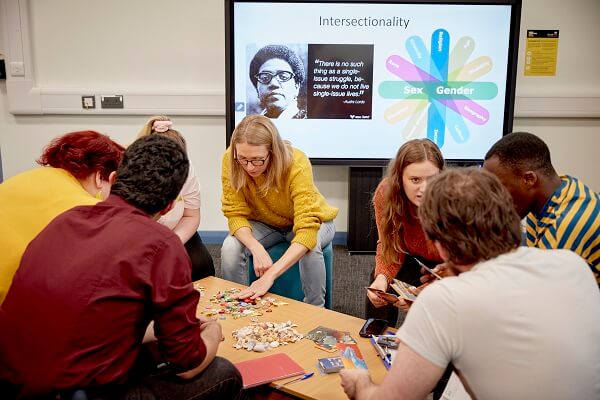
Positionality is a major strand of the programme, threaded throughout all aspects of training. You will be invited to reflect on your social location, including dimensions such as race, gender, class, sexuality, ability, and culture, and consider how these intersect with power and privilege in therapeutic relationships. This includes engaging with difference, marginalisation, and the ethical implications of working across diverse contexts. We view this reflective work as essential to developing relational depth, cultural humility, and ethical integrity.
To enable you to build and maintain strong therapeutic alliances, we aim to facilitate your ability to co-create relationships at depth, including an understanding of the barriers that may prevent or impact such relationships. Concepts such as presence, empathic understanding, resonance, acceptance, and challenge will underpin your personal way of being and professional practice, supporting your capacity to meet clients with authenticity and depth.
Knowledge and skills
This programme supports the development of a therapeutic way of being, grounded in person-centred values such as presence, empathic understanding, acceptance, and congruence. Rather than learning techniques, students are invited to engage deeply with their own processes in order to meet clients in what Carl Rogers described as a real relationship — one that is authentic, mutual, and emotionally resonant.
Through experiential, academic, and reflective learning, you will:
- Apply contemporary theory and research to therapeutic practice in ways that are responsive to the lived realities of clients.
- Develop the capacity to make thoughtful, ethically grounded decisions in complex and uncertain situations.
- Engage critically with current scholarship in counselling, including the evaluation of research methodologies and their relevance to practice.
- Undertake independent research that reflects your interests and contributes meaningfully to the field.
- Expand your relationality — your capacity to engage with clients across diverse experiences, identities, and emotional landscapes, with authenticity and depth.
This course includes 100 hours of supervised counselling practice, which may extend beyond the formal duration of the programme. Please take this into consideration when applying.
Students will be required to attend a period of two week in-person teaching as part of the programme.
Indicative dates for 2027 (subject to change) Monday–Friday, 9am–5pm:
- 13–17 September 2027
- 20 –25 September 2027
Accreditation and professional recognition
The part time Counselling and Psychotherapy MSc is accredited by the British Association for Counselling and Psychotherapy (BACP).
This means that students who successfully complete the programme gain automatic entry onto the BACP register.


Course structure
The MSc in Counselling and Psychotherapy comprises of eight compulsory modules which must all be passed to achieve the MSc award.
What you will study
The module details given below are indicative, they are intended to provide you with an idea of the range of subjects that are taught to our current students. The modules that will be available for you to study in future years are prone to change as we regularly review our teaching to ensure that it is up-to-date and informed by the latest research and teaching methods, as well as student voice. The information presented is therefore not intended to be construed and/or relied upon as a definitive list of the modules available in any given year.
Compulsory modules
Peer Practice and Reflective Learning Part 1 (15 credits)
Peer Practice and Reflective Learning Part 2 (15 credits)
These modules focus on developing your therapeutic way of being through peer practice, reflective inquiry, and supervision. Each module includes 10 hours of personal therapy, supporting your self-awareness and emotional resilience as a practitioner. You will engage in structured opportunities to deepen your self-awareness, explore practice issues, and integrate theory with lived experience.
Supervised Counselling Placement (Part-time, 0 credits)
These modules hold the core requirements for qualification, including 100 hours of supervised counselling practice. You are encouraged to identify and apply for a placement that aligns with your career aspirations. Keele students undertake placements in a wide range of settings and with diverse client groups.
While securing a suitable placement is your responsibility, our dedicated Placement Officer will offer support and guidance throughout the process.
Please note: The 100 hours of counselling practice may extend beyond the formal duration of the programme. You will also need to fund your own personal therapy and counselling supervision, so please consider the time and financial commitments involved when applying.
Exploration in Counselling (15 credits)
This module provides you with opportunities to establish a foundational understanding of person-centred practice, the theory and philosophy that underpin such practice, and an in-depth understanding of how the BACP Ethical Framework for the Counselling Professions will apply to your training as a person-centred practitioner. Through this module, you will be invited to engage with lectures, small-group discussions, and critical evaluation exercises which are aimed at enabling you to consider your relationship with person-centred theory and how you might train as a therapist. You will be able to demonstrate your knowledge of the BACP Ethical Framework for the Counselling Professions and how this applies to professional contexts, thereby strengthening your foundation as you begin your training.
Understanding in Counselling (30 credits)
This module explores how identity, difference, power, and culture shape the counselling process. You will reflect on your own positionality — including how your social location, values, and lived experience shape your understanding of others and your approach to counselling. The module situates counselling within broader social and cultural contexts, examining how marginalisation, privilege, and intersectionality influence both client experience and therapeutic practice.
Integration in Counselling (15 credits)
This module provides a foundation for exploring a range of therapeutic and practice-related issues alongside person-centred counselling. You will have the opportunity to investigate an area of counselling that aligns with your interests, integrating your learning across theory, practice, and personal development.
Research Methods (15 credits)
This module introduces you to a range of qualitative research methodologies that are particularly suited to exploring lived experience in counselling and psychotherapy. You will engage with approaches such as Interpretive Phenomenological Analysis, Autoethnography, Heuristic Inquiry, Narrative Inquiry, and Reflective Thematic Analysis — each offering unique ways to investigate meaning, identity, and relational depth within therapeutic contexts. The module encourages you to consider how research can be both rigorous and personally resonant, and how it can inform and enrich your practice.
Personal and Professional Development and Reflexivity (15 credits)
This module fosters personal and professional growth in line with BACP standards through experiential learning, reflective practice, and peer engagement. You’ll explore your therapeutic identity via interactive workshops, creative exercises, and group dialogue. A key feature is attendance at our annual counselling conference, offering exposure to diverse perspectives and current issues in the field. Reflexivity is developed throughout via structured reflection and activities that deepen self-awareness and ethical understanding.
Counselling Dissertation (60 credits)
This module offers you the opportunity to undertake an independent research project on a counselling topic of personal and professional significance. Grounded in person-centred practice, the dissertation invites you to explore questions that matter to you — whether through self-study, qualitative inquiry, or reflective engagement with lived experience. Many students find this process not only academically enriching but personally transformative, deepening their understanding of themselves and their approach to therapeutic work. The final dissertation (15,000 words) represents a meaningful contribution to the field of counselling and psychotherapy.

"This programme encourages students to think critically, challenge their beliefs, and develop personally in order to make well rounded counsellors."

Entry requirements
The following section details our typical entry requirements for this course for a range of UK and international qualifications. If you don't see your qualifications listed, please contact us to find out if we can accept your qualifications.
Typical offer
Please ensure that you read the full entry requirements by selecting your qualifications from the dropdown menu below. This will include any subject specific, GCSE/Level 2 Maths, and English language requirements you may need.
Please select your country from the drop-down list below for the full entry requirement information
UK
2:2 degree in any subject
or
Keele Graduate Certificate in Counselling, with 60% in one assignment and a Progression Report from an academic mentor
You will also need: an English language qualification (see below)
Algeria
This course is part time and only available for students who do not require a visa. If you are unsure if this applies to you, please contact our admissions team at enquiries@keele.ac.uk
Bahrain
This course is part time and only available for students who do not require a visa. If you are unsure if this applies to you, please contact our admissions team at enquiries@keele.ac.uk
Bangladesh
This course is part time and only available for students who do not require a visa. If you are unsure if this applies to you, please contact our admissions team at enquiries@keele.ac.uk
Canada
This course is part time and only available for students who do not require a visa. If you are unsure if this applies to you, please contact our admissions team at enquiries@keele.ac.uk
China
This course is part time and only available for students who do not require a visa. If you are unsure if this applies to you, please contact our admissions team at enquiries@keele.ac.uk
Egypt
This course is part time and only available for students who do not require a visa. If you are unsure if this applies to you, please contact our admissions team at enquiries@keele.ac.uk
Ghana
This course is part time and only available for students who do not require a visa. If you are unsure if this applies to you, please contact our admissions team at enquiries@keele.ac.uk
Hong Kong
This course is part time and only available for students who do not require a visa. If you are unsure if this applies to you, please contact our admissions team at enquiries@keele.ac.uk
India
This course is part time and only available for students who do not require a visa. If you are unsure if this applies to you, please contact our admissions team at enquiries@keele.ac.uk
Kenya
This course is part time and only available for students who do not require a visa. If you are unsure if this applies to you, please contact our admissions team at enquiries@keele.ac.uk
Kuwait
This course is part time and only available for students who do not require a visa. If you are unsure if this applies to you, please contact our admissions team at enquiries@keele.ac.uk
Nepal
This course is part time and only available for students who do not require a visa. If you are unsure if this applies to you, please contact our admissions team at enquiries@keele.ac.uk
Nigeria
This course is part time and only available for students who do not require a visa. If you are unsure if this applies to you, please contact our admissions team at enquiries@keele.ac.uk
Oman
This course is part time and only available for students who do not require a visa. If you are unsure if this applies to you, please contact our admissions team at enquiries@keele.ac.uk
Pakistan
This course is part time and only available for students who do not require a visa. If you are unsure if this applies to you, please contact our admissions team at enquiries@keele.ac.uk
Qatar
This course is part time and only available for students who do not require a visa. If you are unsure if this applies to you, please contact our admissions team at enquiries@keele.ac.uk
South Africa
This course is part time and only available for students who do not require a visa. If you are unsure if this applies to you, please contact our admissions team at enquiries@keele.ac.uk
Sri Lanka
This course is part time and only available for students who do not require a visa. If you are unsure if this applies to you, please contact our admissions team at enquiries@keele.ac.uk
Turkey
This course is part time and only available for students who do not require a visa. If you are unsure if this applies to you, please contact our admissions team at enquiries@keele.ac.uk
UAE
This course is part time and only available for students who do not require a visa. If you are unsure if this applies to you, please contact our admissions team at enquiries@keele.ac.uk
Uganda
This course is part time and only available for students who do not require a visa. If you are unsure if this applies to you, please contact our admissions team at enquiries@keele.ac.uk
USA
This course is part time and only available for students who do not require a visa. If you are unsure if this applies to you, please contact our admissions team at enquiries@keele.ac.uk
Zimbabwe
This course is part time and only available for students who do not require a visa. If you are unsure if this applies to you, please contact our admissions team at enquiries@keele.ac.uk
Applicants will not be invited to interview until after the equal consideration deadline of the 1 March 2027 has passed. Interviews will take place after this date.
In line with the requirements of BACP, you will also need to demonstrate the following attributes:
- Self-awareness, maturity and stability
- Ability to make use of and reflect upon life experience
- Capacity to cope with the emotional demands of the course
- Ability to cope with the intellectual and academic requirements
- Ability to form a helping relationship
- Ability to be self-critical and reflect and act on developmental feedback
- Awareness of the nature of prejudice and oppression
- Cultural understanding and awareness, including:
- the nature of prejudice and oppressions
- power and privelege
- awareness of own bias, attitudes and beliefs
- self-awareness of own identity/identity characteristics
- Ability to recognise the need for personal and professional support
- Competence in or the aptitude to develop generic personal skills, including: literacy, numeracy, information technology, administrative skills, self-managements skills, communication and interpersonal skills.
- Adequate private space and IT equipment to take part in online taught sessions.
You will also need to address the requirements outlined above in your personal statement, in the application form and in response to the Interview Questionnaire for MSc in Counselling and Psychotherapy 2027 to be completed as part of the application process.
Additional entry requirements
As part of the application process, you will be required to do a group interview.
Recognition of prior learning
Due to the requirements of BACP accredited courses, Recognition of Prior Learning (RPL) is not permitted for entry onto or credit within the accredited MSc Counselling and Psychotherapy programme. All students must complete the full programme as validated to meet professional training standards.
English language requirements
All of our courses require an English language qualification or test. For most students, this requirement can be met with a 4 or C in GCSE English. Please see our English Language guidance pages for further details, including English language test information for international students. For those students who require an English language test, this course requires a test from Group D.
References
Normally, you will need to provide at least one academic reference to support your application unless you have been out of study longer than two years. If it has been more than two years since you last studied on a degree-level programme, you will normally need to provide an employment reference instead. For more information about Academic References, please see our Postgraduate how to apply web pages.
Personal Statement/Statement of Purpose
Please see our Postgraduate how to apply web pages for guidance on what to include in your personal statement.
Recognition of Prior Learning
The Recognition of Prior Learning (RPL) is a process which enables applicants to receive recognition and formal credit for learning acquired in the past through formal study or work and life experiences.
RPL can also be requested for admission onto the start of a programme in lieu of the admission requirements. For more information, see our Recognition of Prior Learning web pages.
General information
The entry grades outlined in this section indicate the typical offer which would be made to candidates, along with any subject specific requirements. This is for general information only. Keele University reserves the right to vary offer conditions depending upon a candidate's application. For international students, find out how we work with approved agents as part of our admissions process.
Our expertise
There is a wealth of therapeutic experience and knowledge amongst our core team. You will be taught by qualified counsellors who have undertaken training in person-centred/humanistic counselling and have experience of working in a variety of therapeutic settings including the NHS, the voluntary sector, private practice and in education.

Postgraduate funding and scholarshipsFees, funding and scholarships
Fees
2027/28 academic year
For start dates between September 2027 and July 2028.
| Type of study | Fees (per year) |
|---|---|
| UK - part time | £6,800 |
For continuing students, fees will increase annually by RPIX, with a maximum cap of 5% per year.
Funding
Whether you're continuing from undergraduate study or returning to education, our dedicated financial support team is here to help.
Please note, if your course offers a January start date, the January 2026 start date falls in the 2025/26 academic year. Please see the tuition fees archive for the 2025/26 fees.
Planning your funding
It's important to plan carefully for your funding before you start your course. Please be aware that not all postgraduate courses and not all students are eligible for the UK government postgraduate loans and, in some cases, you would be expected to source alternative funding yourself. If you need support researching your funding options, please contact our financial support team.
For continuing students, fees will increase annually by RPIX, with a maximum cap of 5% per year.
Scholarships
We know that understanding what support is available for postgraduate students is an important step in planning your future and we are committed to rewarding excellence and potential.
Visit our scholarships and bursaries webpage to find out more about our scholarships, including:
- Keele Global Scholarship – up to £5000 tuition fee discount for international students (2027/28)
- Keele Graduate Scholarship – up to £3000 tuition fee discount for home students (2027/28)
Terms and conditions apply.
Additional costs
Mandatory costs
You can expect some additional costs as a student on this course, which may support learning activities, specialist equipment, fieldwork, placements, or other course-related requirements. Details of these mandatory costs are outlined below to help you plan accordingly. Students may also incur general expenses related to university study, such as for printing, textbooks and other materials. Students who undertake a placement may be responsible for additional costs, such as travel, accommodation, and subsistence costs. For further information, please refer to the additional costs information.
- 20 supervision sessions at circa £70 per session
- 20 Personal Therapy Sessions: circa £60 per session (however, if you need more therapy or take longer to do placement hours these will increase)
- Enhanced DBS check with digital ID check: £60.70
- Registration to the DBS Update Service: £16 per year.This price is not set by the University and is liable to increase.
Supporting you throughout your studies
Throughout the programme you will have access to a robust support system including an academic mentor, tutor groups, personal development/process groups, a dissertation supervisor, an independent supervisor during placement, an independent personal therapist, counselling placement officer, Student Services, disability and inclusion support, counselling and mental health support.

Teaching, learning and assessment
Teaching
The MSc Counselling and Psychotherapy programme is grounded in person-centred and humanistic principles. It offers a rich and varied learning experience designed to support both personal and professional development. Teaching methods include:
- Lectures – providing theoretical foundations and critical perspectives
- Experiential workshops – exploring counselling issues and practice through the lens of self and others
- Skills groups – focused on developing core counselling competencies
- Formative recorded practice observation days – offering structured feedback and reflective learning
- One-to-one tutorials – personalised support from your academic mentor
- Presentations – opportunities to share and develop ideas collaboratively
- Dissertation supervision groups – supporting your research journey and academic writing
Assessment
Assessment methods within the programme are designed to reflect the diverse range of knowledge, skills and attributes developed throughout your training. These methods support both formative and summative evaluation and may include:
- Multiple-choice classroom tests – assessing theoretical understanding
- Research presentations – communicating research findings and critical analysis
- Dissertation – an extended piece of independent research
- Recorded counselling sessions with peers – assessed both formatively and summatively
- Evaluation of own counselling practice – fostering self-awareness and professional growth
- Individual and group presentations – developing confidence and communication skills
- Completion of 20 hours of personal therapy – integrated across modules to support personal development
Key programme expectations
Before applying, it is important to understand the core physical and psychological demands of training for a career in this field. To help you make an informed choice, our programme aligns with fitness to train standards detailed by the Higher Education Occupational Practitioners (HEOPS) group. We encourage all prospective students to review these core capabilities to ensure they feel confident meeting the day-to-day expectations of both the academic study and clinical placements.

Emotional readiness and capacity for training
Training as a counsellor and psychotherapist involves sustained emotional engagement and self-reflection. The programme includes work with material related to trauma, loss, abuse and emotional distress. Students are therefore expected to have the emotional readiness and reflective capacity to engage safely with potentially distressing material and to take appropriate responsibility for their own wellbeing throughout the course.

Personal therapy (mandatory)
Personal therapy is a compulsory and central component of the programme. Students are expected to begin personal therapy as soon as possible after starting the course and to maintain therapy over the course of study. Students are responsible for locating and funding their own therapist, who must be appropriately qualified and independent of the programme. The cost of therapy is typically in the region of £30–£60 per session and should be considered when planning for the course.

Supervised clinical practice and placement requirements
All students are required to complete a minimum of 100 hours of supervised client work as a core and non-optional component of the programme. Students are responsible for securing their own suitable placement, with guidance from the placement lead. Also locating a supervisor and again this will involve a cost of between £35-70 per hour. Placements may involve travel, time commitment and flexibility, alongside academic and personal responsibilities.

Professional conduct and fitness to practise
Students are expected to behave in a professional, ethical and responsible manner throughout the programme. This includes maintaining appropriate boundaries, confidentiality and accountability, and engaging constructively with feedback. Concerns relating to professional conduct, wellbeing or suitability for training may be addressed through the University’s Fitness to Practise procedures.
.png)
Engagement in experiential and skills-based learning
The programme includes experiential learning, counselling skills practice and participation in group processes. Students are expected to engage actively, respectfully and responsibly in these activities, recognising their central role in developing safe and effective counselling practice. There is an expectation for being fully present in all sessions.

Commitment, independent study and academic responsibility
As a Master’s-level programme, the MSc requires substantial study and reflective work outside taught sessions. This includes reading course materials, revisiting teaching sessions where appropriate, reflective writing, skills practice, and preparation for placement and supervision. Students are expected to manage their time effectively in order to meet these requirements.