


Year of entry
- 2027
UCAS code
- B230
Duration of study
- 4 years
Pharmacy - MPharm
Course summary
Our four-year evidence-based, patient-centred programme combines innovative learning experiences such as augmented reality with increased opportunities to practise your clinical skills. On successful completion of the course you will have exciting career opportunities in primary care, secondary care, community pharmacies and many other areas of practice.
Why study Pharmacy at Keele University?
 Pharmacy ranked Top 5 in England (NSS 2025, broad-based universities)*
Top 10 in England for Pharmacy and Pharmacology (Guardian University Guide, 2026)
No.1 in the West Midlands for Pharmacy and Pharmacology (Times and Sunday Times Good University Guide, 2027)
Top 10 in England for Pharmacy (Complete University Guide, 2027)
Top 10 in the UK for Pharmacy (Daily Mail University Guide, 2027)
Pharmacy ranked Top 5 in England (NSS 2025, broad-based universities)*
Top 10 in England for Pharmacy and Pharmacology (Guardian University Guide, 2026)
No.1 in the West Midlands for Pharmacy and Pharmacology (Times and Sunday Times Good University Guide, 2027)
Top 10 in England for Pharmacy (Complete University Guide, 2027)
Top 10 in the UK for Pharmacy (Daily Mail University Guide, 2027)

Course overview
Pharmacy at Keele enables you to develop the values and attitudes required of a pharmacist. Pharmacists play a key role in the different aspects of medicine design, development and delivery, ensuring the safe and appropriate supply and administration of medicines.
Key pharmacy skills
How medicines treat medical conditions and discovering how the body works are just some of the features of our Pharmacy programme. Prescribing and clinical skills are a key component of the course alongside developing important communication skills so you can confidently engage with patients and work effectively as part of a multi-disciplinary team.
You will develop a solid foundation in areas such as biology and chemistry and build on these progressively throughout each academic year. You will explore key themes such as pharmacology where you will learn how drugs work within the body, and you'll also cover pharmaceutics where you will focus on formulating drugs in ways that can be administered to a patient. You will explore therapeutic areas which concentrate on medical conditions, how they are diagnosed and monitored and what treatments should be used to effectively manage them.
You will study the current legal framework for pharmacy and develop your ethical reasoning to enable you to act in the best interests of patients such as the emergency supply of medicines.
Engaging with patients
A successful pharmacist engages with patients skilfully through careful listening and provision of evidence based advice. The role of the pharmacist is multi-faceted, you will need to confidently provide advice, deal with sensitive subject areas, signpost people to additional services and provide guidance on how patients should administer their medication. You will also interact with carers, other service users and a wide range of healthcare professionals.
As a healthcare professional you will also seek to promote healthy lifestyles with individuals which may involve initiating challenging conversations about health issues in society like weight management or alcohol consumption. We nurture you to develop those pivotal communication skills so you can manage these discussions in a confident, sensitive and effective manner.
Strengthening your employability
Placements
You will be able to experience the role of a pharmacist in a wide range of settings over the four years of the MPharm. This will include approximately 30 weeks of placements (higher than the sector average) in the community, primary care and hospital settings. Placement learning will be integrated with your theoretical studies on campus to enable you to achieve all of your learning outcomes and make informed decisions about your future career aspirations. Your placements will form an increasingly large component of your studies over the duration of your four years at Keele.
Student support
We provide you with a supportive educational environment and at the beginning of the programme, you will be allocated an academic mentor who will provide academic advice and guidance.
During your first and second year you are assigned a professional portfolio supervisor to encourage your professional development. Your professional portfolio supervisor will be a registered pharmacist. You will also benefit from peer support from a current student who is currently in year three or four.
Our Faculty Student Experience and Support team offer guidance and advice and gives one to one support to students within the School of Allied Health Professions and Pharmacy.
Additional help is available from the School's Disability Liaison Officer who provides an extra layer of assistance for all students, particularly for those who have additional support requirements.
You can also access plenty of student advice and support services at Keele including;
- Learning Support and Academic Guidance
- Disability Support and Inclusion
- English Language Unit
- Student Advice at Keele (ASK)
- Student Support Services
- Occupational Health Department
*We have compared the positivity ratings of all participating UK institutions using the NSS 2025 sector data to determine Keele's position relative to other broad-based universities (i.e. excluding specialist institutions and further education colleges).
Specialist facilities
We use a range of innovative methods and 21st century technology to give you the best opportunities to learn authentic pharmacist skills. Our facilities include a 3D lecture theatre, virtual and augmented reality facilities, and a clinical skills suite to aid development of your hard and soft skills.
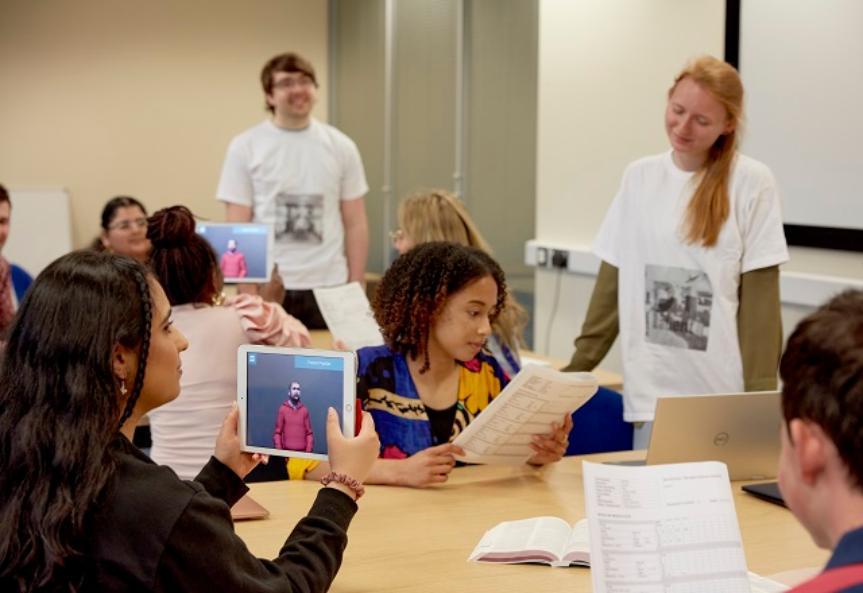
Augmented reality software
We use a range of innovative methods of teaching and 21st century technology to give you the best opportunities to learn authentic pharmacist skills, including our Keele Augmented Reality Environment (KARE). This innovative tool will enable you to explore virtual patient cases, including the prescribing of medicines, in a safe environment. Through KARE, you can practice pivotal communication skills and learn how to manage patient scenarios effectively. It’s a valuable resource that bridges theory and practice, arming you with the clinical skills you will require during your career as a pharmacist..
Clinical Skills Suite
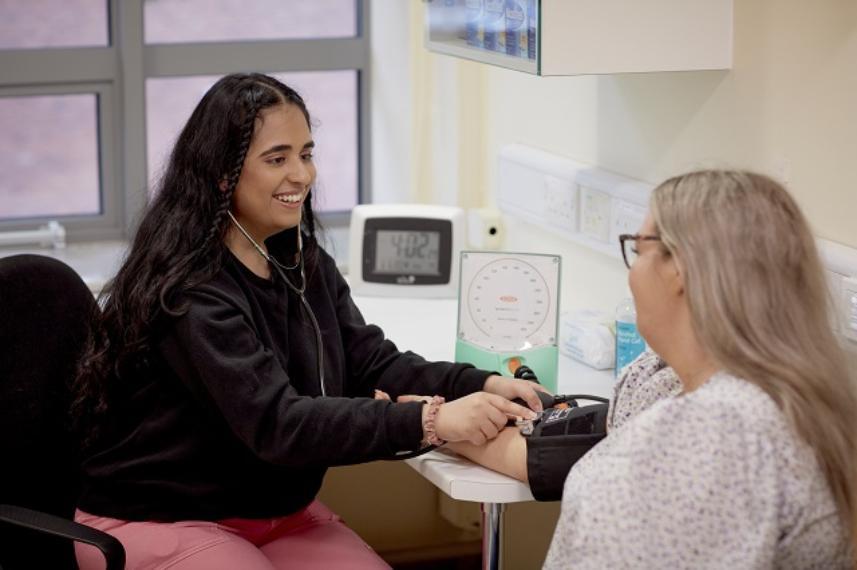
In our Clinical Skills Suite, we have a mock dispensary and six consultation rooms enabling you to develop essential pharmacist competencies such as labelling and selecting medication correctly. You will use the consultation rooms to facilitate expanding your expertise and increasing your confidence in communicating with patients.
Central Science Laboratories
Our state-of-the-art laboratories are equipped with industrial research grade analytical and laboratory equipment that you will use in some of your teaching.

Course structure
Modules for Pharmacy
Our courses are designed to develop the skills, experience and expertise you'll need to succeed in your chosen career, informed by the latest research, teaching methods, student feedback, and employer insights. Module details are representative of what we intend to deliver on the course, but may change to reflect best practice and academic development. This information should therefore not be considered a definitive list of available modules.
MPharm Programme Stage 1
The Stage 1 programme provides an integrated and fully contextualised introduction to the Keele MPharm degree.
Based on a single 120-credit module that comprises of two cycles of learning, assessment and reflection, all topics progress logically and coherently with patient-oriented themes. The principal aim is to develop knowledge and skills in a wide variety of disciplines by demonstrating the linkages between seemingly disparate topics in science and practice that underpin all subsequent learning.
Rather than packaging material into small, discrete modules, you will develop a deeper understanding of the topics covered: for example, examination of the structure and function of DNA and mRNA is preceded by studies in the basic chemistry which governs chemical bonding and molecular structure, and is followed by analyses of genetics and patient care. Studies in metabolism are underpinned by the principles of structure and bonding, and are delivered alongside topics in bioenergetics and reaction kinetics. Studies in pharmacy practice are supported throughout the programme by practical pharmacy skills classes and developing topics in the essential and pharmaceutical sciences. In this way, the linkages between all strands of the programme are made clear and you will be equipped to study the later levels of the course. Dedicated placement learning hours will further support and enrich your learning experience.
MPharm Programme Stage 2
In an identical manner to the Stage 1 programme, the Stage 2 programme is based on a single 120-credit module that comprises cycles of learning, assessment and reflection, and all topics progress logically and coherently with
patient-oriented themes. The principal aim of the module is to further develop your knowledge and skills in a wide variety of disciplines, by demonstrating the linkages between applied topics in science, therapeutics and practice that underpin all subsequent learning.
During the module you will develop a deeper understanding of the topics covered at Stage 1 and understand how they are applied in the pharmaceutical sciences and pharmacy practice. Topics are sometimes highlighted with overt links to Stage 1; for example, aspects of physical chemistry and the analysis of small organic molecules is fundamental to an appreciation of the Pharmaceutical Science and Formulation theme. Fundamental studies of metabolism lead to a deeper understanding of metabolic interrelationships and the metabolism of xenobiotics in the Pharmacology and Drug Action theme.
Therapeutic material with a patient focus will be introduced in order to further contextualise your learning in the physical, formulation and pharmacological sciences. Dedicated placement learning hours will support and enrich your learning experience.
MPharm Programme Stage 3
Stage 3 of the MPharm programme is based on one single 120-credit module, enabling a continuum of learning that is centred upon the development of key clinical and therapeutic skills. Teaching of therapeutic areas will be fully integrated by inclusion of key pharmacological, chemical and pharmaceutical information related to the subject areas being studied. By the end of Stage 3, MPharm, you should be prepared as fully as possible to undertake any summer vacation placements and interviews for foundation training placements.
MPharm Programme Stage 4
Stage 4 of the MPharm programme is based on one single credit module, which aims to further develop your core skills in relation to the practice and science of pharmacy in the context of clinical care of patients. The module completes the implementation of the plan to create a modern, integrated and fully contextualised MPharm course, continuing a course structure that will be familiar to you progressing from previous years.
The structure allows material to be delivered in a coherent and logical order, and enables effective monitoring and feedback mechanisms. You will also have the opportunity to gain the necessary theoretical background to becoming an independent pharmacist prescriber, and explore specialisms within pharmacy, including research and sector-specific practice.
On completion of this module, you will be fully prepared to enter your foundation training year.
You can view the Programme Specification for this course by visiting the Programme Specifications webpage. (opens in new tab)

"My journey at Keele has been an incredible experience, with the School being very supportive and attentive to myself and my peers on the MPharm course. From lectures to clinical placements, it was easy to feel integrated and immersed into the different aspects of pharmacy, allowing me to develop my analytical and interpersonal skills, alongside acquiring a great deal of clinical knowledge. Moving forward, I feel proficient in entering the pharmacy profession, knowing I will be able to impact patients’ lives beneficially through the knowledge and acumen the School have instilled in me."
Double Gold in the Teaching Excellence Framework
Keele is one of only 15 broad-based universities in England - out of over 100 - to have been awarded Gold in both the 2017 and 2023 Teaching Excellence Framework (TEF) exercises, demonstrating our consistent teaching excellence.
Additional opportunities

There are a range of additional opportunities for this course.
Please note that undertaking one may impact the availability of another.

Entry requirements
These are the typical entry requirements for this course for a range of UK and international qualifications. If your qualifications aren't listed, please contact us to check if we can accept them. If you don't think you'll meet the stated requirements, you may be able to access this course via a Foundation Year.
Typical offer
Please ensure you read the full entry requirements by selecting your qualifications from the menu below. This will include any subject specific, GCSE/Level 2 Maths, and/or English language requirements.
Please select your qualification from the drop-down list below for the full entry requirement information
A Level
ABB in three A Levels including B in Biology or Chemistry.
Contextual Offer: BBB in three A Levels including B in Biology or Chemistry.
You will also need: 6 / B in GCSE Maths or Level 3 Functional Skills Maths, plus an English language qualification (see below).
Access to HE Diploma
128 UCAS points in an Access to HE Diploma with Biology or Chemistry related content, including Distinction in at least 30 Level 3 credits and Merit in at least 15 Level 3 credits. Please contact the University Admissions Team for advice on whether your chosen course would qualify.
6 / B in GCSE Maths or Level 3 Functional Skills Maths, plus an English language qualification (see below).
Algeria
The Baccalauréat de l’Enseignement Secondaire with an overall grade of 17/20 to include 16/20 in Biology or Chemistry
OR
Brevet de Technicien Supérieur with an overall grade of 13/20 to include 13/20 in Biology or Chemistry
You will also need: an English language qualification (see below)
Bangladesh
2 year undergraduate degree at 60% or above and 60% in Biology or Chemistry.
We will also consider applications on an individual basis for those who have completed the Higher Secondary Certificate a CGPA of 5.0 and 5.0 in Biology or Chemistry.
BTEC Extended Diploma / National Extended Diploma
DDM in any of the following BTEC Extended Diplomas / National Extended Diplomas: Applied Science.
Contextual Offer: BTEC Extended Diploma not included.
You will also need: 6 / B in GCSE Maths or Level 3 Functional Skills Maths, plus an English language qualification (see below).
BTEC National Diploma / Diploma
Distinction and Merit in any BTEC National Diploma / Diploma and B in Biology or Chemistry A Level, or Distinction and Merit in Applied Science BTEC National Diploma / Diploma and A in any A Level.
You will also need: 6 / B in GCSE Maths or Level 3 Functional Skills Maths, plus an English language qualification (see below).
BTEC National Extended Certificate / Subsidiary Diploma
Distinction in any BTEC National Extended Certificate / Subsidiary Diploma and BB in two A Levels including B in Biology or Chemistry, or Distinction in Applied Human Biology, Applied Science, Health and Social Care, Sport, or Sport and Exercise Science BTEC National Extended Certificate / Subsidiary Diploma and BB in two A Levels.
You will also need: 6 / B in GCSE Maths or Level 3 Functional Skills Maths, plus an English language qualification (see below).
Canada - Diploma
70% / BBBBC in five courses in the Grade 12 Diploma including 70% in Biology or Chemistry.
60% in Grade 11 Maths, plus an English language qualification (see below).
China - Gaokao
72% in the Gaokao including 69% in Biology or Chemistry.
65% in Senior Secondary School or Gaokao Maths, plus an English language qualification (see below).
Core Maths
If you have B or higher in Core Maths and are studying A Levels, BTEC, the International Baccalaureate, or an Access to HE Diploma, you will typically receive an alternative offer which will be lower than the standard offer. Please see 'Alternative and contextual offers' below.
Cyprus - Apolytirion
18.5 / 88% in the Apolytirion including 18 in Biology or Chemistry.
15 in Maths in the Apolytirion, plus an English language qualification (see below).
Egypt
Diploma from Technical, Commercial, Industrial or Health Institutes with a minimum of 65% overall and no subject below 55%, including 60% in Biology or Chemistry
Please contact Admissions for further information if you hold:
Diploma of Industrial Technical Secondary School
Al-Azhar Training Diploma
European Baccalaureate
75% overall with 7 in Chemistry or Biology (4 period).
You will also need: 6.5 in European Baccalaureate Maths, plus an English language qualification (see below).
Extended Project Qualification (EPQ)
If you have B or higher in the EPQ and are studying A Levels, BTEC, the International Baccalaureate Diploma, or an Access to HE Diploma, you will typically receive an alternative offer which will be lower than the standard offer. Please see 'Alternative and contextual offers' below.
France - Baccalaureate
14 in the French Baccalaureate / International Option Baccalaureate including 14 in Chemistry / Physics or Biology, or 13 in the Baccalauréat Français International including 13 in Chemistry / Physics or Biology.
11 in Maths in the Baccalaureate, plus an English language qualification (see below).
Germany - Abitur
2.0 overall average in the Abitur including 12 in Biology or Chemistry.
11 in Maths in the Abitur, plus an English language qualification (see below).
Ghana
We do not accept the West African Senior School Certificate Examination for direct entry. However, you can apply to study an International Foundation Year at Keele University International College. On successful completion, you can progress to an undergraduate degree at Keele.
Hong Kong - Diploma
544 from two electives and one core subject in the HKDSE including 4 in Biology or Chemistry.
You will also need: 3 in HKDSE Maths (Core), plus an English language qualification (see below).
India - Standard XII
Average of 75% from four subjects including 70% in Chemistry or Biology in the ICSE, CBSE or Western Bengal Standard XII, or average of 80% from four subjects including 75% in Chemistry or Biology in any other Standard XII.
You will also need: 7 or C1 in Secondary School Examination Maths, or Pass in Standard XII Maths, plus an English language qualification (see below).
International Baccalaureate Career-Related Programme
We encourage applications with the IBCP but recognise that your combination of qualifications may differ depending on where you are studying.
If you are taking a BTEC National Diploma / Diploma with one or more Higher Levels, your offer will be similar to our BTEC + A Level offer (see 'BTEC National Diploma / Diploma') but with an HL requirement of 6 for A, 5 for B, or 4 for C.
For any other combination, please contact the University Admissions Team for advice.
International Baccalaureate Diploma
655 in three Higher Levels including 5 in Biology or Chemistry, or 32 points including 5 in Higher Level Biology or Chemistry.
Contextual Offer: 555 in three Higher Levels including 5 in Biology or Chemistry, or 31 points including 5 in Higher Level Biology or Chemistry.
You will also need: 6 / B in GCSE Maths or Level 3 Functional Skills Maths, or 5 in IB Middle Years Maths, or 4 in IB Diploma Standard Level Maths (any), plus an English language qualification (see below).
Ireland - Leaving Certificate
H3, H3, H3, H4, H4, H4 in the Irish Leaving Certificate including H4 in Biology, Chemistry, or Physics and Chemistry (combined).
O3 / H6 in Maths, plus an English language qualification (see below).
Italy - Diploma di Esame di Stato
85% in the Esame di Stato including 8 in Biology, Chemistry or Natural Science.
You will also need: 6 in Maths in the Diploma, plus an English language qualification (see below).
Kenya - KCSE / Diploma
We do not accept the Kenya Certificate of Secondary Education for direct entry. However, you can apply to study an International Foundation Year at Keele University International College. On successful completion, you can progress to an undergraduate degree at Keele.
We may accept a two year Diploma. Please contact the University Admissions Team for advice.
Malaysia - STPM
ABB in three Principal Level subjects in the STPM including B in Biology or Chemistry.
You will also need: B in SPM Maths, plus an English language qualification (see below).
NCUK
Pass NCUK Foundation Year with ABB including B in Chemistry or Biology.
Grade A in EAP English Language module.
You will also need: 6 / B in GCSE Maths or international equivalent.
Nepal
80% in the Higher Secondary Certificate (HSSC) (from 2018 onwards) including 75% in Biology or Chemistry
Nigeria - Senior School Certificate / OND
We do not accept the Senior School Certificate (WAEC or NECO) for direct entry. However, you can apply to study an International Foundation Year at Keele University International College. On successful completion, you can progress to an undergraduate degree at Keele.
We may accept an Ordinary National Diploma with GPA of 2.5 or a Merit / Lower Credit. Please contact the University Admissions Team for advice.
Pakistan - Secondary School Certificate
We do not accept the Secondary School Certificate for direct entry. However, you can apply to study an International Foundation Year at Keele University International College. On successful completion, you can progress to an undergraduate degree at Keele.
Portugal
Overall average of 16 in a Secondary Certificate including 16 in Biology or Chemistry.
11 in Secondary Certificate Maths, plus an English language qualification (see below).
Scotland - Highers and Advanced Highers
BBBBC in five Highers including Chemistry or Biology Higher, or BC in two Advanced Highers and CC in two Highers including Chemistry or Biology Higher or Advanced Higher, or BCC in three Advanced Highers including Chemistry or Biology Advanced Higher.
B in National 5 Maths, or C in Higher Maths (including as one of the Highers taken as part of your offer), or 6 / B in GCSE Maths or Level 3 Functional Skills Maths, plus an English language qualification (see below).
Singapore - A Levels (H2)
ABB in three H2 levels including B in Biology or Chemistry.
You will also need: B in O-level Maths, plus an English language qualification (see below).
South Africa - Matric (NSC and IEB)
76666 in five subjects including 6 in Life Science or Physical Science.
You will also need: 5 in NSC Maths, plus an English language qualification (see below).
Spain - Bachillerato
Overall average of 7.8 in the Título de Bachillerato including 8 in Biology or Chemistry.
You will also need: 6 in Graduado en Educación Secundaria (GES) Maths or 6.5 in Título de Bachiller Maths, plus an English language qualification (see below).
Sri Lanka - Advanced Level
ABB in three Advanced Levels including B in Biology or Chemistry.
You will also need: B in O-Level Maths, plus an English language qualification (see below).
T Level
Distinction in any of the following T Levels: Health, Healthcare Science, Science.
You will also need: 6 / B in GCSE Maths or Level 3 Functional Skills Maths, plus an English language qualification (see below).
Turkey
75% in the Lise Diplomasi/Meslek & Teknik Lisesi Diplomasi to include 70% in Biology or Chemistry
OR
a CGPA of 2.6 or 60% in the Lisans Diplomasi to include 60% in Biology or Chemistry
Uganda - Advanced Certificate of Education
ABB in three Principal Level subjects in the Advanced Certificate of Education including B in Biology or Chemistry.
You will also need: 4 in UACE or UCE Maths, plus an English language qualification (see below).
USA - Advanced Placement
ABB = three AP test scores of 544 OR
2 AP test scores PLUS on of the following:
SAT I: 1290 (min 650 RW, 620 M)
ACT: 28
Honours course at B+
One year long equivalent Dual Enrolment/College course at A.
We can accept:
An AP score of 4 in Biology or Chemistry
An ACT score of 27 in Biology or Chemistry
You will also need: an English language qualification (see below)
USA Non-AP Curriculum
ABB = Achieved overall GPA of 3.7 with three honours at B+,B+,B+
OR
2 honours course and overall GPA of 3.7 PLUS one additional qualification:
SAT I: 1390 (min 720 RW, 650 M)
ACT: 30
One year-long equivalent Dual Enrolment/College course at A.
We can accept:
An ACT score of 27 in Biology or Chemistry
Dual Enrolment/College course at A in Biology or Chemistry
You will also need: an English language qualification (see below)
Welsh Baccalaureate / Bagloriaeth Cymru
The Advanced Skills Baccalaureate Wales is equivalent to one full A Level at the same grade and can be included alongside 2 other A Levels in a standard A Level offer for this course (see A Level). All subject specific requirements will still need to be met.
Zimbabwe - ZIMSEC A level
ABB in three ZIMSEC A Level subjects including B in Biology or Chemistry.
You will also need: 6 / B in GCSE Maths or Level 3 Functional Skills Maths, plus an English language qualification (see below).
Additional information
Health checks and DBS Clearance
Offers are subject to Occupational Health clearances and an Enhanced Disclosure and Barring Service (DBS) clearance. The University follows the DBS Code of Practice in these issues and can provide a copy of the Code on request.
Interview
Shortlisted candidates will be invited to attend an interview.
For this course, the University uses a “gathered field” approach to admissions. This means that when there are more strong applicants than available places, all applications are reviewed together after the deadline. This helps ensure a fair process by comparing candidates at the same time, based on their quality and interest in the course.
English language requirements
All our courses require an English language qualification or test. Most students meet this through a 4 or C in GCSE English. Please visit our English Language pages for details, including test information for international students. For students who require a test, this course requires a result from Group D.
Alternative and contextual offers
We're committed to ensuring equality of opportunity for applicants with the potential and motivation to succeed, regardless of background. We offer alternative offer schemes with clear eligibility criteria, including contextual offers, offers for those studying in the Keele region, and recognition of a range of additional qualifications.
General information
The entry grades outlined indicate the typical offer, along with any subject specific requirements. This is for general information only. Keele University reserves the right to vary conditions based upon a candidate's application. For international students, find out how we work with approved agents as part of our admissions process.
Social life, societies and sports
Find out moreAccommodation
Find out moreLocal area and travel
Find out moreBoost your employability
Find out more
"I would 100% recommend Keele for anyone interested in pharmacy. You'll get a very varied pharmacy course at Keele, much different to other universities. You'll also get many new and exciting placements, not available to everyone (the tutors work really hard to organise these), and the teaching style or tutorials, lectures and group projects makes for a very fun and productive 4 years."

Fees and funding
Tuition fees for 2027/28 2026/27 academic year
- The tuition fee for UK Home students starting in 2027/282026/27 is set by the UK Government and will be £10,050£9,790.
- International: Band 5, £25,600 for the 2026/27 academic year
International fees for 2027/28 entry have not yet been confirmed. We review all tuition fees annually and will update this page once they are finalised.
In subsequent years of your course, UK Home fees may change in line with government policy or legislative requirements. For continuing international students, fees will increase each year in line with RPI, capped at a maximum of 5% per year.
For details of our international fee bands visit our Undergraduate tuition fees page.
Financial support
Going to university can be daunting as well as exciting. It's important to understand the costs and financial support available.
Our Student Financial Support team offers confidential advice and guidance to help you manage your money, resolve issues with Student Finance, create a budget, explore your options if you're facing financial hardship, and access any funding you are eligible for, such as bursaries and scholarships.
For more information visit our undergraduate fees and funding pages.
Additional costs
The additional costs listed below apply to the 2026/27 academic year. Costs for 2027/28 entry will be confirmed closer to the time, so the information below should be used as a guide only.
Mandatory costs
You can expect some additional costs as a student on this course, which may support learning activities, specialist equipment, fieldwork, placements, or other course-related requirements. Details of these mandatory costs are outlined below to help you plan accordingly.
Optional costs
In addition to the mandatory costs listed below, there may be optional costs that students can choose to incur to enhance their learning experience. These are not required to complete the course. Details of these optional costs are outlined below to help you plan accordingly.
Students may also incur general expenses related to university study, such as for printing, textbooks and other materials. Students who undertake a placement may be responsible for additional costs, such as travel, accommodation, and subsistence costs. For further information, please refer to the additional costs information.
Mandatory:
- Lab coat and specs: £25
- Pharmacy logoed convoy grey scrub top: £23.54
- Pharmacy convoy grey scrub trousers: £11.73
- Vaccinations: Various vaccinations must be completed before you undertake your first placement. These are required to protect you, your family and your patients from infections and/or diseases that you may be exposed to whilst working as a student health professional. Obtaining these vaccinations and evidence of their completion is your responsibility and may be completed by your GP who will charge for these services.
- Travel to Placements: Students are responsible for reasonable costs incurred in travelling to local placements and making travel arrangements - in the same way as for travel to and from the University generally. However, students are able to apply for the NHS Learning Support Fund to support travel to and from placement locations (eligibility criteria apply). Students may also be eligible for support towards expenses through NHS Learning Support Fund Travel and Dual Accommodation Expenses application.
- Enhanced DBS check with digital ID check: £60.70
- Registration to the DBS Update Service: £16 per year. This price is not set by the University and is liable to increase.
- Student groups are allowed to spend £40 on materials for their health promotion campaign in year 3. Students pay this themselves initially and can then claim to be reimbursed.
Optional:
- Replacement name badge: £5


Your future career
Upon graduation from this course you will be required to complete a statutory one year Foundation training year and the General Pharmaceutical Council’s registration assessment to be able to qualify to practice as a pharmacist and an independent prescriber.
You will graduate with a portfolio of skills that will enable you to work in a wide range of careers in the industry. You could progress to careers as a;
- Hospital Pharmacist
- Community Pharmacist
- GP Practice Pharmacist
- Research Scientist
- Clinical Research Associate
- Higher Education Lecturer
- Regulatory Affairs Officer
- Product Development
- Science Writer
- Industrial Pharmacist
Find out more about our careers and employability services, including career planning, alumni mentoring, jobs, internships, starting your own business and much more.

Teaching, learning and assessment
A variety of teaching methods are used on the programme including large group teaching sessions, lectures, seminars, and and tutorials. Practical classes support the improvement of your scientific, and professional skills. Teaching is complemented by an extensive programme of one-to-one mentoring by healthcare professionals, clinical placements, and opportunities to interactive with simulated patients.
During the programme you will sometimes be expected to role play and engage in simulated clinical scenarios with other students, such as the practice and observation of practical skills in physical contact with other students. For some specific practices, this may necessitate modification of dress - e.g., to shorts and t-shirt. These activities will be conducted in a professional, safe, respectful and culturally sensitive way, under the supervision of academic staff, according to a defined protocol.
Assessment methods
A wide variety of assessment methods are used during the course. During each academic year you will experience a range of assessment types from formal examinations to laboratory practicals and coursework, and skills-based assignments. You will also complete a professional development portfolio and there are competency based assessments to assess areas including how you counsel patients and checking your clinical abilities.
Key programme expectations
Before applying, it is important to understand the core physical and psychological demands of training for a career in this field. To help you make an informed choice, our programme aligns with fitness to train standards detailed by the Higher Education Occupational Practitioners (HEOPS) group. We encourage all prospective students to review these core capabilities to ensure they feel confident meeting the day-to-day expectations of both the academic study and clinical placements.

Medical fitness to train and work
Pharmacy students must meet essential medical fitness standards to ensure they can safely train and practise. This includes immunity screening, infectious disease precautions, and meeting functional health requirements. Examples of functional health requirements include the ability to perform essential skills for safe and effective interventions, moving, handling and storage of medications and operating equipment.

Vision and hearing
Pharmacy students need to have good enough eyesight to safely carry out their work. This includes being able to read small text, notice small movements, and read information on a computer screen from a normal distance, using glasses or contact lenses if needed. Students need to be able to hear well enough to communicate clearly with others. This includes being able to follow conversations face‑to‑face and over the telephone, even in noisy environments, using hearing aids if required. Relying only on lip‑reading is not sufficient in some situations.

Communication requirements
Pharmacy students must be able to meet GPhC proficiency standards in relation to spoken, written and electronic communication with patients, colleagues, and carers, including in environments where there is background noise.

Honesty and self-awareness
As per GPhC guidance, pharmacy students must be open and honest about any health issues which may affect their ability to provide safe and effective care and should have a full awareness of their own mental health, when to seek help and from whom.

Cognitive requirements
Pharmacy students must have the cognitive ability, memory, and awareness to understand and apply their knowledge base in a practical environment, including to be able to gather, analyse and evaluate information and create and follow appropriate patient care plans.

Placements and travel requirements
Pharmacy students complete a number of mandatory practice-based learning placements in a variety of settings. Placements are a core requirement of the programme and are not optional. Students must be prepared to travel to placement locations across a wide geographical area and, where necessary, adjust their living arrangements.

Academic expertise
The teaching team at the School of Life Sciences are active researchers in core areas such as biosciences, geosciences, environmental sciences, geography and bioengineering. Their academic expertise informs your learning, incorporating current practices, theories and contemporary themes that encourage discussion within your subject area.
The teaching team consists of professors, readers, senior lecturers, lecturers, demonstrators, and teaching fellows.
Professional support staff are also available to assist with any queries you may have during your undergraduate studies at Keele.
The teaching team at the School of Engineering and Physical Sciences perform research across the school with particular strengths in materials science, synthetic, forensic and analytical chemistry. Their academic expertise informs your learning, incorporating current practices, theories and contemporary themes that encourage discussion within your subject area.
Professional support staff are also available to assist with any queries you may have during your undergraduate studies at Keele.
The teaching team consists of professors, senior lecturers, and lecturers within the School of Engineering and Physical Sciences. They are fellows or senior fellows of the Higher Education Academy, the professional body for teachers in higher education. Fellowship provides individuals with recognition of their practice, impact and leadership of teaching and learning. A number of our academic staff have also achieved national recognition for their excellence and innovation in teaching and hold awards from a variety of institutions, including the Royal Society of Chemistry and AdvanceHE.
The teaching team in the School of Humanities and Social Sciences are active researchers in core areas of Criminology and Sociology such as fields of crime, globalisation and urban spaces and cultures. Their academic expertise informs your learning, incorporating current practices, theories and contemporary themes that encourage discussion within your subject area.
Professional support staff are also available to assist with any queries you may have during your undergraduate studies at Keele.
The teaching team consists of professors, senior lecturers, lecturers and graduate teaching assistants.
The teaching team in the School of Humanities and Social Sciences are active researchers in core areas of Education such as critical social policy and feminism. Their academic expertise informs your learning, incorporating current practices, theories and contemporary themes that encourage discussion within your subject area.
Professional support staff are also available to assist with any queries you may have during your undergraduate studies at Keele.
The teaching team consists of senior lecturers and lecturers.
The teaching team in the School of Engineering and Physical Sciences are active researchers in core areas such as materials, sustainability, and energy. Their academic expertise informs your learning by incorporating current practices, theories, and contemporary themes that encourage discussion within your subject area.
Professional support staff are also available to assist with any queries you may have during your undergraduate studies at Keele University.
The teaching team consists of professors, senior lecturers and lecturers.
The teaching team in the School of Humanities and Social Sciences are active researchers in core areas of English and Creative Writing. Their academic expertise informs your learning, incorporating current practices, theories and contemporary themes that encourage discussion within your subject area.
Professional support staff are also available to assist with any queries you may have during your undergraduate studies at Keele.
The teaching team consists of professors, readers, senior lecturers, lecturers, and graduate teaching assistants.
The teaching team in the School of Humanities and Social Sciences are active researchers in core areas such as twentieth century and contemporary music, cultural politics, social movements and representation. Their academic expertise informs your learning, incorporating current practices, theories and contemporary themes that encourage discussion within your subject area.
Professional support staff are also available to assist with any queries you may have during your undergraduate studies at Keele.
The teaching team consists of professors, readers, senior lecturers, and lecturers.
The teaching team at the School of Engineering and Physical Sciences provide research-led quality teaching, particularly in the fields of forensic chemistry, forensic biology, crime investigations, forensic search and forensic anthropology, taphonomy and archaeology.
Professional support staff are also available to assist with any queries you may have during your undergraduate studies at Keele.
Our teaching team consists of professors, senior lecturers, lecturers, demonstrators and PhD students.
The teaching team at the School of Life Sciences are active researchers in core areas such as biosciences, geosciences, environmental sciences, geography and bioengineering. Their academic expertise informs your learning, incorporating current practices, theories and contemporary themes that encourage discussion within your subject area.
The teaching team consists of professors, readers, senior lecturers, lecturers, demonstrators, and teaching fellows.
Professional support staff are also available to assist with any queries you may have during your undergraduate studies at Keele.
The teaching team in the School of Humanities and Social Sciences are active researchers in core areas of medieval, early modern, and modern history including expertise in historical inequality, democratisation and civil society. Their academic expertise informs your learning, incorporating current practices, theories and contemporary themes that encourage discussion within your subject area.
Professional support staff are also available to assist with any queries you may have during your undergraduate studies at Keele.
The teaching team consists of professors, readers, senior lecturers, lecturers and graduate teaching assistants.
The teaching team at the School of Medicine are either active researchers in core areas such as musculoskeletal health, mental health and well-being, biomedical science, prognosis and big data, or actively engaged with a diverse range of scholarly activities to enhance their roles as educators.
The teaching team consists of professors, readers, senior lecturers, lecturers, senior teaching fellows, teaching fellows, senior research fellows, research fellows, research associates, research assistants, anatomy technicians and PhD students. The School of Medicine teaching team also includes a wide range of health professionals who are actively engaged in clinical research and quality improvement including those based in hospitals and community-based services.
The academic team at the School of Nursing and Midwifery are active researchers in core areas such as loss, bereavement and end of life care; primary, community and district nursing; and women's health. Their academic expertise informs your learning, incorporating current practices, theories and contemporary themes that encourage discussion within your subject area.
Professional support staff are also available to assist with any queries you may have during your undergraduate studies at Keele.
The teaching team consists of readers, senior lecturers, lecturers, research associates and teaching fellows.
The teaching team at the School of Engineering and Physical Sciences perform research across the school with particular strengths in astrophysics, materials science, renewable energy and sustainability. Their academic expertise informs your learning, incorporating current practices, theories and contemporary themes that encourage discussion within your subject area.
Professional support staff are also available to assist with any queries you may have during your undergraduate studies at Keele.
Our teaching team consists of professors, senior lecturers, lecturers, readers, and PhD students.
The teaching team in the School of Humanities and Social Sciences are active researchers in areas including democracy, governance, public policy and idealism. Their academic expertise informs your learning, incorporating current practices, theories and contemporary themes that encourage discussion within your subject area.
Professional support staff are also available to assist with any queries you may have during your undergraduate studies at Keele.
The teaching team consists of professors, senior lecturers, lecturers and graduate teaching assistants in the School of Humanities and Social Sciences.
The teaching team within the Institute of Sport brings together expertise across sport, exercise, health and rehabilitation, reflecting the continuum of human performance and wellbeing across the lifespan. Our staff are actively engaged in research and applied practice spanning physical activity, performance, health and recovery, ensuring that teaching is informed by both scientific evidence and real-world application. As a CASES-accredited partner institution, and with staff holding individual CASES accreditation, the programme is underpinned by recognised professional standards in sport and exercise science.
Staff operate within an interdisciplinary environment, working alongside colleagues from across the Allied Health Professions within the School. This collaboration informs teaching and supports a broader, integrated understanding of health, physical activity and rehabilitation across diverse populations and contexts.
Collectively, this breadth of expertise shapes your learning experience, incorporating current practices, theories and contemporary themes that encourage discussion within your subject area.
Professional support staff are also available to assist with any queries you may have during your undergraduate studies at Keele. The School's teaching team consists of professors, senior lecturers and lecturers.
The teaching team at Keele Business School are active researchers in core areas such as accounting, finance, economics, human resource management, marketing, and management. Their academic expertise informs your learning, incorporating current practices, theories and contemporary themes that encourage discussion within your subject area.
Professional support staff are also available to assist with any queries you may have during your undergraduate studies at Keele.
Our teaching team consists of professors, senior lecturers, and lecturers within Keele Business School. The team is multicultural and multinational, bringing an international dimension to the school's teaching, research, and business engagement.
The teaching team within the School of Allied Health Professions and Pharmacy brings together a diverse community of academics and clinicians working across four interrelated themes: Pharmacy and Pharmaceutical Science, Medical Technologies, Allied Health Therapies, and Active Living and Sport.
Our staff include experts in the biological and clinical sciences, statistics, engineering, and professional practice, who contribute to both research and scholarly activity aligned to their disciplines. This breadth of expertise ensures that teaching is informed by current evidence, practice, and innovation, enabling you to engage with contemporary issues relevant to your chosen field.
The teaching team consists of professors, senior lecturers, lecturers, readers, visiting clinicians, and research fellows.
Our programmes are supported by experienced professional staff who help to ensure a high-quality student experience throughout your studies.
The teaching team at Keele Business School are active researchers in core areas such as accounting, finance, economics, human resource management, marketing, and management. Their academic expertise informs your learning, incorporating current practices, theories and contemporary themes that encourage discussion within your subject area.
Professional support staff are also available to assist with any queries you may have during your undergraduate studies at Keele.
Our teaching team consists of professors, senior lecturers, and lecturers within Keele Business School. The team is multicultural and multinational, bringing an international dimension to the school's teaching, research, and business engagement.
The School of Computer Science and Mathematics is home to active researchers working across a rich range of topics, from artificial intelligence, cyber security and human-centred computing to fluid and solid dynamics, biomechanics and pure mathematics. Whether developing responsible AI, designing smart health technologies, or advancing mathematical methods for waves, materials and structures, our research is wide-ranging and internationally recognised.
This will directly shape your learning. You'll encounter current ideas in AI and its ethical implications, cloud computing, evolutionary systems, usable security, mathematical modelling of materials and discrete mathematics, taught by the people actively advancing these fields.
The teaching team consists of professors, senior lecturers, lecturers, readers and visiting research fellows.
Alongside your teaching team, dedicated professional staff will be on hand to support you throughout your time at Keele.
Our teaching team includes readers, senior lecturers, lecturers, research associates and teaching fellows who are active researchers and educators with expertise across a wide range of health and social care disciplines.
Their research and scholarship span areas including musculoskeletal health, mental health and wellbeing, community nursing, women's health, biomedical science, prognosis and big data, contemporary issues in child and family social work, end-of-life care, and international social work practice. Staff also undertake pedagogic research to advance teaching and learning within health and social care education.
This academic expertise informs your learning by incorporating current practices, theories and contemporary themes that encourage discussion and critical thinking within your subject area.
Professional support staff are also available throughout your undergraduate studies at Keele to provide guidance and answer any queries you may have.
The teaching team in the School of Law consists of professors, senior lecturers, lecturers and solicitors. They are all either active researchers (in fields including social justice and human rights; public and European law; ethics, health and social care; and legal education) or experienced legal practitioners. Their academic and professional expertise informs your learning, incorporating current practices, theories, and contemporary themes that encourage discussion within your subject area.
Professional support staff are also available to assist with any queries you may have during your undergraduate studies at Keele.
The teaching team at the School of Psychology have expertise spanning cognition and neuroscience, health and wellbeing, social identity and change, and justice and security.
Staff research and scholarship expertise inform your learning, incorporating current practices, theories and contemporary themes that encourage active learning and discussion within your subject area.
Professional support staff are also available to assist with any queries you may have during your undergraduate studies at Keele.
The teaching team consists of professors, senior lecturers, lecturers and teaching fellows within the School of Psychology.
The teaching team at the Harper and Keele Veterinary School includes active researchers in areas such as animal health and wellbeing, animal welfare and farming technologies. Many are currently practising veterinary surgeons and allied professionals, and the course draws on a wide range of expertise across many disciplines through contributions by external lecturers. Their academic expertise informs your learning, incorporating current practices, theories and contemporary themes that encourage discussion within your subject area.
Professional support staff are also available to assist with any queries you may have during your undergraduate studies at Keele.
Our teaching team consists of readers, professors, senior lecturers, lecturers and teaching fellows.
The academic expertise in the School of Humanities and Social Sciences informs your learning, incorporating current practices, theories and contemporary themes that encourage discussion within your subject area.
Professional support staff are also available to assist with any queries you may have during your undergraduate studies at Keele.
Our teaching team consists of professors, readers, senior lecturers, and lecturers.

Foundation year
Our Foundation Year provides an excellent alternative route to Keele, offering preparation for your chosen degree with guaranteed entry onto your undergraduate course once you successfully complete.
This extra year of study can improve your academic skills, expand your subject knowledge, build your confidence, and provide a better understanding of higher education.
On our Foundation Year, you'll join our undergraduate community from the outset, with access to all the facilities and support you'd get as an undergraduate student at Keele.
The information in this Foundation Year section is for UK/Home applicants. Where an international Foundation Year is available, please see the 'Information for international students' tab.
Course content
Our Foundation Year allows you to develop your critical thinking, academic reading, writing, and communication study skills along with subject-specific knowledge and skills. Upon meeting the progression criteria and successfully completing our Foundation Year, you will automatically progress into your Keele undergraduate degree with the confidence that you have the skills, and knowledge needed to successfully complete your course.
This Foundation Year is a two semester programme which provides a tailored pre-degree programme of study to better prepare you for the MPharm Pharmacy course. For example, in the Academic and Professional Development for Health module you will begin to develop an awareness of professional standards that you will be working to in your degree and professional career. Course content has been developed in collaboration with degree teaching teams, so that by the time you begin Year 1, you will be ready to excel at your studies, as the majority of our Foundation Year students do.
On this Foundation Year, we will advance your knowledge of human biology and chemistry, giving you a solid grasp of body systems, science and lab work. You'll develop safe, professional laboratory skills and get to know the mathematical techniques and quantitative methods used across health science-related and social care programmes. You will also be introduced to concepts relating to organic, inorganic, physical and analytical chemistry.
Throughout the programme, you will develop subject-specific and broad based skills that will be invaluable in your academic career and beyond. You can find out more about our Foundation Year, Including Information on learning, teaching and assessment methods and further opportunities available to you by visiting our homepage.
Course structure
The module details given below are indicative and will give you a good idea of the range of subjects that we teach. We regularly review our teaching to ensure that the modules we offer are up-to-date; therefore, the modules available to study are liable to change.
Semester one modules
| FYO-00237 | Foundations of Human Biology for Health | 15 credits |
| FYO-00241 | Foundations of Chemistry for Health | 15 credits |
| FYO-00213 | Foundations of Numerical and Quantitative Methods for Health Science | 15 credits |
Semester two modules
| FYO-00239 | Advancing Human Biology for Health | 30 credits |
| FYO-00243 | Advancing Chemistry for Health | 15 credits |
Year long modules (semesters one and two)
| FYO-00181 | Academic and Professional Development for Health | 30 credits |
Entry requirements
The entry grades outlined in this section indicate the likely offer or range of offers which would be made to candidates along with any subject specific requirements. This is for general information only. Keele University reserves the right to vary offer conditions depending upon a candidate’s application. Read more about our undergraduate entry requirements.
- 112 UCAS points including at least one Level 3 qualification (such as an A level, BTEC, Access Course, or T level), or 104 UCAS points including A level / Scottish Higher / IB Diploma Physics, Chemistry or Biology, T Level Health, Healthcare Science or Science, or BTEC Applied Human Biology or Applied Science (any level).
- Plus C in GCSE English / Level 2 Functional Skills English and C in GCSE Maths / Level 2 Functional Skills Maths.
- Shortlisted candidates will be invited to interview.
Criminal records declaration (DBS/Disclosure Scotland)
A satisfactory Disclosure and Barring Service check (Enhanced plus Barring Lists) will be required for successful candidates.
Health checks
A satisfactory health check will be required for successful candidates.
Progression requirements
Find out more about Foundation Year progression requirements and routes.
How to apply
UCAS Applications
Visit UCAS for applications. You should apply for MPharm (H) Pharmacy with Foundation Year, UCAS code: B231.
Direct entry students
If you are a UK or EU student, already have your qualifications, are not expecting any further results and only wish to apply to Keele, please contact the Admissions Office directly.
The information in this Foundation Year section is for UK/Home applicants. Where an international Foundation Year is available, please see the 'Information for international students' tab.
We also offer a January start for some of our Foundation Year courses. Adopting a blended learning approach, the January start is particularly useful for students wishing to return to education following time out of studying, or who are seeking a flexible approach to their Foundation Year studies. Our January start is available across most of our Science, Humanities, Social Science, Health and Business courses.
Whilst still being a full-time course, our blended delivery model combines live teaching sessions - both online and on-campus - with self-directed study, enabling you to predominantly study at a time that suits your lifestyle. You will benefit from weekly online taught sessions which encourage you to engage with your teachers and peers.
In addition to online study there will be a series of full study days that you will be required to attend throughout each semester. These sessions may include lab-based activities, group work, review of course and assessment materials studied online. They will emphasise opportunities for you to deepen your knowledge and understanding of your chosen route.
Please refer to the September start tab for more information about the entry requirements and what you will study. The modules that you will take on a January start Foundation Year will be similar to those for the September start, but on a compressed timescale and tailored to a blended learning approach (with the majority of learning taking place online).
For more information, including fees, the UCAS code for this course, how to apply, and how you will be taught, please visit our January Start Foundation Year webpage.
Our International Foundation Year is delivered on campus through Keele University International College (KUIC). Find out more about the International Foundation Year options on the KUIC website.
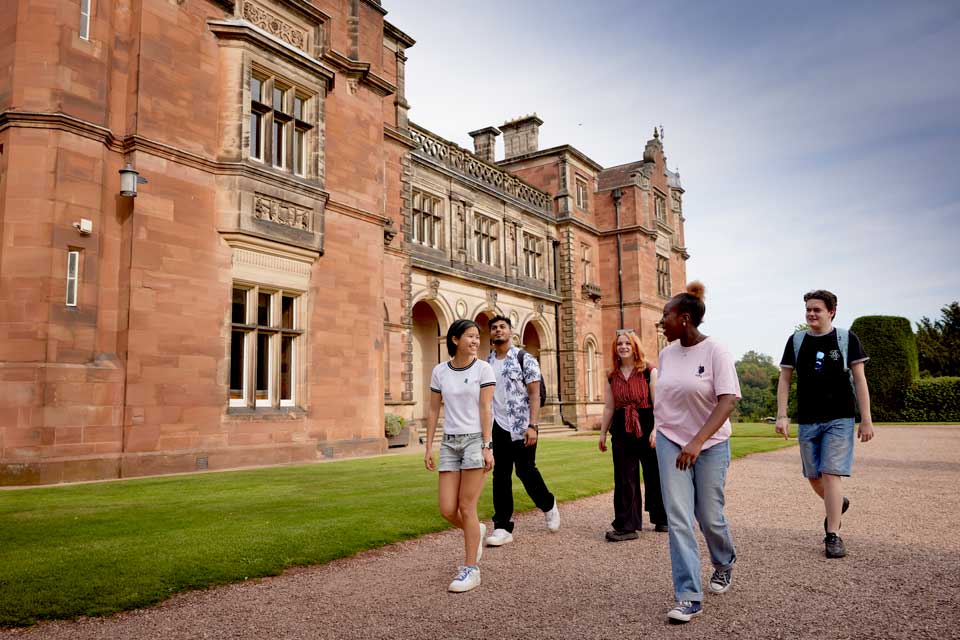
Student life at Keele is vibrant, diverse, and packed with opportunities to make the most of your time at university.

We help students manage their money and ensure that they receive any funding for which they may be eligible.

Make yourself more employable after graduation by taking advantage of the whole host of additional opportunities.