


English Literatures - MA
Keele has a long, distinguished history of teaching and research excellence in English and American Literatures. Our broad, comprehensive expertise in fiction, poetry, drama, life writing, literary theory, creative writing, film and media, gives you the freedom to tailor your study through tuition and one-to-one supervision from leading specialists. In a structured learning environment, you’ll gain an extensive grounding in literary theory and research, extending your knowledge of literary works and the conceptual frameworks used to approach them. Developing as a researcher and communicator, you'll enjoy lively debates within a passionate community which shares your love of literature.
Month of entry
- September
Mode of study
- Full time, Part time
Fees for 2026/27 academic year
- UK - Full time £9,400 per year. Part time £5,200 per year.
International - £17,100 per year.
Fees
Duration of study
- Full time - 1 year, Part time - 2 years, Modular - Up to 5 years
This course is no longer accepting applications from international students for the 2026/27 academic year.
Why study English Literatures at Keele University?

Course summary
Whatever your motivation – the chance to pursue your passion for literature or to develop analytical, writing and research skills – our MA can help you achieve this and more, with opportunities to enjoy readings from an exciting range of published poets, novelists and peers within an intellectually stimulating, collegiate environment.
You’ll be supported throughout by our leading academics in the field of literary studies, whose research across a broad spectrum of literary periods and genres feeds directly into teaching and research supervision, giving you significant scope when choosing your dissertation topic.
Core modules are designed to deepen your understanding of methodologies appropriate to the study of literature from the Renaissance to the present. You will approach texts from different theoretical perspectives, enhancing your understanding of a wide range of cultures, values, experiences and intellectual traditions.
The wide choice of optional modules from across the disciplines of English or American Literature, Creative Writing or Film, enables you to tailor your studies to your interests. You can deep dive into classic texts from Lord Byron, Austen or Shakespeare, for example, or explore the weird and wonderful cinematography of directors like Lilly and Lana Wachowski and David Lynch.
Alternatively, using our contacts or through your own networks, you can opt for a work placement, applying your knowledge in a work setting, gaining valuable experience and enhancing your CV. Recent English Literatures students, for example, have worked at the Samuel Johnson Museum, Staffordshire Archives and Heritage, and the New Vic Theatre.
You’ll graduate with knowledge of research design, methods and processes, together with the creative, critical, reflexive, and analytical mindset that employers desire, and the ability to think critically about complex topics from different perspectives.
You’ll also be studying at a University where you can immerse yourself in a wide range of creative and cultural events and societies, courtesy of ArtsKeele, giving you access to valuable networks of professional contacts. The fortnightly Keele Hall Readings, for instance, recently featured acclaimed writer Okechukwu Nzelu, whose first book won a Betty Trask Award, and Caleb Parkin, self-proclaimed 'day-glo queero techno eco poet and facilitator'.
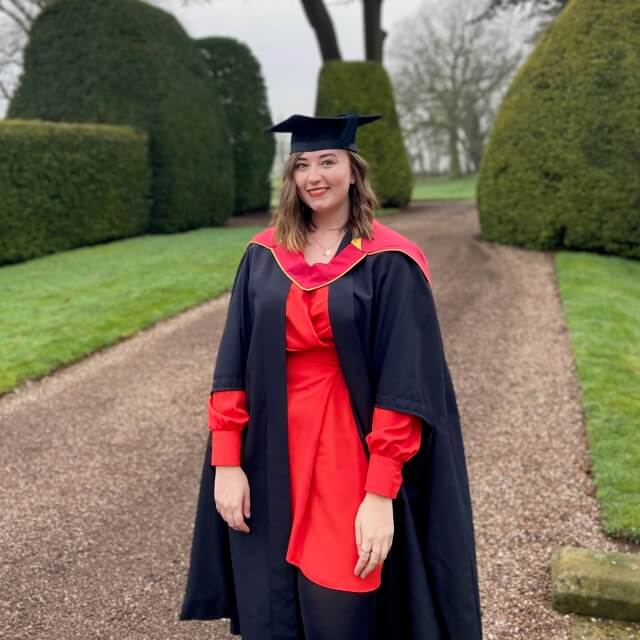
"There were plenty of opportunities to get involved in organising and attending conferences and research events, which helped to give a well-rounded experience of academia. The best thing about English at Keele though, undoubtedly, is the staff. Every member of the English department was welcoming, enthusiastic, and, most importantly, supportive. Thanks to the staff, I have learnt so much in my whirlwind year at Keele, not only in terms of developing my knowledge about English literature but also in terms of justifying the importance of my own research, and the Humanities in general."

Course structure
Studying English literature, language and creative writing can be both inspiring and rewarding, offering new insight into the ways in which stories, poems, novels, plays and their authors creatively interpret the world in which we live.
This course is taught through a combination of five core modules and optional modules you will select from a choice which reflects the variety in cross-period and thematic spread of English as a subject.
To graduate with a Master’s qualification, you must complete 180 credits, including the production of a 15,000-word dissertation (60 credits) on a topic of your choice, negotiated with and supervised by one of our experienced researchers. You will begin your dissertation early in the course and continue working on it throughout the duration of your studies.
In preparation, you will undertake a full research training programme, which includes sessions on academic writing, ethics, archives and databases, writing a research proposal, and an introduction to a range of methodological approaches from across the Humanities. These sessions are also designed to develop the necessary skills for doctoral research. You’ll be given advice on how to construct, develop and write an extended dissertation, based on independent research.
The MA English Literatures can be studied as either a one-year full-time or two-year part-time course, with a September start date. It is also possible to study more flexibly part-time on a modular basis, accumulating degree credits by taking individual modules over a maximum period of five years.
Modules
The module details given below are indicative, they are intended to provide you with an idea of the range of subjects that are taught to our current students. The modules that will be available for you to study in future years are prone to change as we regularly review our teaching to ensure that it is up-to-date and informed by the latest research and teaching methods, as well as student voice. The information presented is therefore not intended to be construed and/or relied upon as a definitive list of the modules available in any given year.
Core Taught Modules
Research Methods in the Humanities, Media, and Creative Arts (15 credits), Semester 1
You will receive training in the practical and technical skills necessary for postgraduate research in the humanities, so you will be able to plan, then find and use the necessary resources for your research and writing. This includes: relevant University regulations; procedures for managing a research degree; the differences between popular press dissemination of research and academic forms; how to identify issues of research ethics affecting your work; plus how to use real-world and digital archives and be creative in looking for primary research sources, such as film archives, digitised magazines and pamphlets, and first editions of out-of-print literature. You will also develop essential personal and professional skills in time, stress and project management.
Reflective Practice in the Humanities, Media, and Creative Arts (15 credits), Semester 2
Reflective practice describes a systematic approach to reflection that involves creating a habit, structure and routine around reflecting on our experiences and engaging in continuous learning. Whether you choose to learn from experience as an individual or with others, there are many benefits to be gained from sharing ideas, experiences and considering how you can change or improve your creative practice. Throughout this module, you will be asked to explore the intellectual connections between your research area and wider fields of study. We look at ‘big ideas’ relevant to contemporary society, such as the concept of ‘post truth’, ‘big data’ and the pulling down of statues, and we work to understand them from the perspective of our disciplines.
Criticism, Analysis, Theory in Literary Studies (30 credits), Semester 1
You will develop your analytical abilities through the study of a selection of key theoretical and critical issues and approaches in contemporary literary and cultural analysis. You’ll be introduced to the variety of interpretive methods currently used within the discipline of English. Collective weekly discussions about selected text examples build your confidence in selecting and applying such theory to a range of literary texts. In your assessments, you can choose to develop a project focusing on literary and filmic texts studied on the course or of your own choice.
Canon, Anti-Canon, Context (30 credits) Semester 2
You will explore key questions of literary value and function, developing high-level skills in cross-period, comparative reading and the evaluation of literature across a variety of literary periods, national and international contexts, genres and movements. The module asks questions such as: what is a ‘literary’ text, and in what ways is it different from non-literary texts, or from filmic ones? How does a text become ‘canonical’? What prevents other texts from being classified as ‘canonical’? How do canonical and non-canonical texts construct and communicate different constructions of identity? How do these texts and identities come to be recovered, and perhaps evaluated differently in different social and intellectual contexts?
Dissertation – English (60 credits), Semesters 1, 2 & 3
Guided by extensive one-to-one supervision from an internationally-renowned expert in the field of English Studies, you will research, plan and write a substantial piece of original work, locating your specific topic within the context of relevant debates within the discipline of English literature and the humanities more generally. The final dissertation is 15,000 words, excluding footnotes, bibliography and annexes. Capitalising on expertise across the School of Humanities, you have considerable flexibility when choosing your specialist subject, not just in literature, but also other media, including film studies and television. In the past, student dissertations have ranged from a review of identity and disability in coming-of-age literature, to a focus on modern Japanese literature, to the study of selfhood in post-modernist literature and film.
Optional Modules
You will choose either the 30-credit Work Placement module or two 15-credit option modules from the list below. Please note that optional modules are based on individual staff specialisms and subject to change each year. This is an indicative list:
The Alcohol Question
From celebrations of friendship and sociability to cautionary tales of inebriety and debauchery, from the euphoria of intoxication to the misery of the hangover, from the public house to the home, the stage to the pulpit, literature and the arts have a long and ambivalent relationship with alcohol. This module presents some of the key representations of alcohol and drinking culture from the Renaissance to the present day. You will examine the social and cultural function of different types of alcohol, look at the economic factors that have affected the consumption and licensing of drink, interrogate some of the common myths and discourses which surround alcohol, explore changing medical understanding of subjects such as alcoholism and addiction, and explore the associations that literature often makes between sexuality, class and alcohol. The module covers a comprehensive series of texts – ranging from poetry to prose, film to the fine arts – that each represent a different aspect of what has become known as The Alcohol Question. It invites you to reflect upon the reasons why alcohol is such a pervasive, but divisive, topic and why so many creative minds have felt the need to address its importance to the human condition in such a variety of different ways.
Postmodernism: Fiction, Film, and Theory
Postmodernism represents an important body of critical theory that developed in the second half of the 20th century, and continues to have relevance in the 21st. It crosses a range of disciplines, but emphasises an interrogative, reflexive and eclectic challenge to many philosophical and aesthetic values and practices. On this module, you will explore the relevance and meaning of some of the ideas associated with postmodernism with respect to selected novels and films. You will assess the influence of key ideas on writers and directors and study the main themes and techniques used in postmodern fiction and film. The module also encourages a critically-informed assessment of the implications of postmodern thinking for contemporary notions of history, identity, sexuality, politics and consumer society. Fiction and film likely to be studied on the module include Julian Barnes, A History of the World in 10 Chapters; Jeanette Winterson, Oranges Are Not The Only Fruit; Martin Amis, Other People; Ali Smith, How To Be Both; The Hours (dir. Stephen Daldry); The Company of Wolves (dir. Neil Jordan); The Matrix (dir. the Wachowskis); and Mulholland Drive (dir. David Lynch).
Writingscapes
How do you see the world around you? Imaginary geographies play an important role in understanding the spaces and places we encounter in our lives. During this module, you will read a range of critical material on relationships between humans and natural (other-/more-than-human) and social environments. You will draw on this reading to produce your own creative writing (poetry and/or fiction and/or creative nonfiction). You will also learn how to give and take constructive critique on your work from your peers, which will help you shape your writing through revision.
Work Placement for Humanities Postgraduates
This module is designed to give you an opportunity to contribute to the world beyond the University, in any workplace where the research, analytical, and communication skills developed as part of a postgraduate Humanities degree can be used. The chosen workplace may be, for example, a local museum, theatre, charity, library, school or education provider, marketing company, PR firm, local newspaper, local radio, or another suitable opportunity identified by you and approved by the module leader. While on the placement, you will produce a theoretically informed portfolio critically reflecting on and giving evidence of the activities/outputs completed at your chosen workplace. These may include, for example, researching and producing materials advertising or supporting current or proposed exhibits or performances, researching and producing written or audio pieces, and/or planning small group educational activities on Humanities-related topics. Advice will be given on identifying and contacting placements and composing a CV in Semester 1, and support will be provided throughout the placement, which will usually take place in Semester 2.
Words and Pictures: The Contemporary American Graphic Novel
The graphic novel is becoming an increasingly important form and is proving itself worthy of scholarly attention. For many readers coming to graphic novels for the first time, the form poses specific challenges in the sense that it requires new modes of attention, new ways of reading. One of the exciting aspects of this module is that it offers students guidance in those new ways. Time is taken with each primary text, reflecting both the scope and ambition of the texts themselves, and also the need for reflection throughout the module on the reading process itself. Content is not neglected, however, and students will have the opportunity to explore the startling variety of themes, ideas and issues tackled in graphic novels, from racial identity to sexual politics, teenage angst and 9/11. The module is particularly suitable for students with at least a literature background.
Thresholds: Young Adult Fiction
Why do young adults love Young Adult Fiction? Why do we still love those books we read at that age, even when older? Young Adult Fiction, mindful of its borderline status between children's fiction and adult fiction, often focuses on moments of crisis, its characters caught between innocence and ruin, naivety and understanding, or sometimes literally between two worlds. What is it about young adulthood that invites these creative explorations of the threshold, the liminal, or the disastrous? How can we read 'growing up', through these fictions, as not merely gradual development but as a series of shocks? This module will look at a selection of YA Fiction, from the twentieth century to the present day, through the lens of liminality and crisis. Students will suggest, and then vote on, the final text of the year: what do you want to read and discuss?
Shakespeare on Film: Adaptation and Appropriation
How have Shakespeare's works been adapted by the film industry, and why do screenwriters and directors make the creative decisions they make? In 'Shakespeare on Film' you will explore a range of Shakespeare plays adapted for film, and develop your understanding both of the original works and of the possibilities they offer for reinterpretation and adaptation. You can practise film adaptation yourself, as you explore possibilities for cutting and modernising Shakespeare’s text for the screen.
Gender and Power in Restoration Literature
In 1660, Charles II was restored to the throne following a particularly tumultuous time in English history where, for just over a decade, England was ruled as a republic. Charles’s return and the decadence of his newly-restored court brought about a new literary engagement with sexual and social freedom: writings produced in this period frequently engage with erotic as well as political and philosophical subjects, revealing scepticism about received moral and social codes of behaviour, and still have the ability to shock and surprise readers today. During the module we will consider a variety of literary works from the period 1660-89 that are concerned with power relations and courtship, including poems, plays, and prose narratives, and explore how these texts engage with the larger social and political concerns of the period. A particular focus of the module will be engaging in comparisons between the approaches of male writers towards issues of power and gender, and the approaches of women writers, including the most prolific and successful playwright of the period, Aphra Behn. Behn’s writings, in particular, offer exciting criticisms of male authority and the constraints placed on women’s behaviour, and highlight the contradiction between these constraints and the period’s more general fascination with liberty and sexual freedom. Writers studied on the module may include Aphra Behn, John Dryden, Sarah Fyge Egerton, Margaret Cavendish, the Earl of Rochester, and William Wycherley.
Working-Class Fictions
This module introduces you to the practices of working-class fiction, a genre grounded in matters of identity and social realism. You will explore literary traditions through a series of set texts (e.g. Angry Young Men of the 60s, Shuggie Bain), film adaptations, and protest songs to inspire your own practice. You will be alerted to debates and propaganda that continue to influence whilst exploring how to experiment with media to best represent the class-subject past and present.

"The work placement module gave me the opportunity to work in the education sector whilst conducting my studies. This module helped my confidence to grow, and the support of the lecturers and informative seminars firmly confirmed the decision that teaching is the right career path for me. I have since been accepted onto the Teach First programme. "

Entry requirements
The following section details our typical entry requirements for this course for a range of UK and international qualifications. If you don't see your qualifications listed, please contact us to find out if we can accept your qualifications.
Typical offer
Please ensure that you read the full entry requirements by selecting your qualifications from the dropdown menu below. This will include any subject specific, GCSE/Level 2 Maths, and English language requirements you may need.
Please select your country from the drop-down list below for the full entry requirement information
UK
2:2 degree in any humanities or social science subject
or
demonstrated professional or relevant qualifications or experience
You will also need: an English language qualification (see below)
Bangladesh
60% in a 4-year degree or 3-year degree with a 2-year Master's in any humanities or social science subject from a public university
or
CGPA 2.8 in a 4-year degree or 3-year degree with a 2-year Master's in any humanities or social science subject from a private university
or
demonstrated professional or relevant qualifications or experience
We don’t accept degrees from certain universities, please see our Bangladesh Country Page for more information
You will also need: an English language qualification (see below)
Canada
70% or C or a GPA of 2.5 in a degree (Ordinary or Honours) in any humanities or social science subject
or
demonstrated relevant professional qualifications or experience
You will also need: an English language qualification (see below)
China
70% in a degree in any humanities or social science subject or 65% in a degree in any humanities or social science subject from a '211' university
or
demonstrated professional or relevant qualifications or experience
You will also need: an English language qualification (see below)
Ghana
Second class degree in any humanities or social science subject
or
demonstrated professional or relevant qualifications or experience
You will also need: an English language qualification (see below)
India
55% or CGPA 6/10 in a degree of at least 3 years in any Humanities, or Social Science subject
or
demonstrated professional or relevant qualifications or experience
You will also need: an English language qualification (see below)
Kenya
Second class degree in any humanities or social science subject
or
demonstrated professional or relevant qualifications or experience
You will also need: an English language qualification (see below)
Nepal
60% / 2.4 in a 4-year Bachelor's degree in any humanities or social science subject
or
65% / CGPA 2.8 in a 3-year Bachelor's degree in any humanities or social science subject
or
demonstrated professional or relevant qualifications or experience
You will also need: an English language qualification (see below)
Nigeria
Second class degree in any humanities or social science subject
or
demonstrated professional or relevant qualifications or experience
You will also need: an English language qualification (see below)
Pakistan
We accept a range of qualifications from Pakistan. Please visit our Pakistan Country Page for more information or we will consider demonstrated relevant professional qualifications or experience.
You will also need an English language qualification (see below)
South Africa
Second class division 2 / 60% in a Bachelor's degree with Honours in any humanities or social science subject
or
Second class division 1 / 70% in an Ordinary Bachelor's degree in any humanities or social science subject
or
demonstrated professional or relevant qualifications or experience
You will also need: an English language qualification (see below)
Sri Lanka
55% in a Special Bachelor's degree in any humanities or social science subject
or
demonstrated professional or relevant qualifications or experience
You will also need: an English language qualification (see below)
Uganda
Second class degree in any humanities or social science subject
or
demonstrated professional or relevant qualifications or experience
You will also need: an English language qualification (see below)
Zimbabwe
Second class degree in any humanities or social science subject
or
demonstrated professional or relevant qualifications or experience
You will also need: an English language qualification (see below)
English language requirements
All of our courses require an English language qualification or test. For most students, this requirement can be met with a 4 or C in GCSE English. Please see our English Language guidance pages for further details, including English language test information for international students. For those students who require an English language test, this course requires a test from Group C.
References
Normally, you will need to provide at least one academic reference to support your application unless you have been out of study longer than two years. If it has been more than two years since you last studied on a degree-level programme, you will normally need to provide an employment reference instead. For more information about Academic References, please see our Postgraduate how to apply web pages.
Personal Statement/Statement of Purpose
Please see our Postgraduate how to apply web pages for guidance on what to include in your personal statement.
Recognition of Prior Learning
The Recognition of Prior Learning (RPL) is a process which enables applicants to receive recognition and formal credit for learning acquired in the past through formal study or work and life experiences.
RPL can also be requested for admission onto the start of a programme in lieu of the admission requirements. For more information, see our Recognition of Prior Learning web pages.
Professional qualifications and work experience
The majority of our courses will consider relevant work experience and/or professional qualifications at the appropriate level, as an alternative to an undergraduate degree for entry. The work experience should be for a sustained period and at a suitable level, based within a relevant sector to your chosen course.
Admissions staff will review your work experience and/or professional qualifications during the assessment of your application to ensure suitability in terms of relevancy, level and appropriate learning outcomes.
General information
The entry grades outlined in this section indicate the typical offer which would be made to candidates, along with any subject specific requirements. This is for general information only. Keele University reserves the right to vary offer conditions depending upon a candidate's application. For international students, find out how we work with approved agents as part of our admissions process.
Social life, societies and sports
Find out moreAccommodation
Find out moreLocal area and travel
Find out moreBoost your employability
Find out more
Postgraduate funding and scholarshipsFees, funding and scholarships
Fees
For continuing students, fees will increase annually by RPIX, with a maximum cap of 5% per year.
Funding
Whether you're continuing from undergraduate study or returning to education, our dedicated financial support team is here to help.
Some travel costs may be incurred if an external project or placement is undertaken; any such costs will be discussed with the student before the project is confirmed. It will be possible for you to select an internal project and that would not incur any additional travel costs. There may be additional costs for textbooks and inter-library loans.
Living costs
Keele University is located on a beautiful campus and has all the facilities of a small town. Student accommodation, shops, restaurants and cafes are all within walking distance of the teaching buildings. This is a very cost-effective way to live and to reduce your living costs.
Please note, if your course offers a January start date, the January 2026 start date falls in the 2025/26 academic year. Please see the tuition fees archive for the 2025/26 fees.
Planning your funding
It's important to plan carefully for your funding before you start your course. Please be aware that not all postgraduate courses and not all students are eligible for the UK government postgraduate loans and, in some cases, you would be expected to source alternative funding yourself. If you need support researching your funding options, please contact our financial support team.
Scholarships
We are committed to rewarding excellence and potential. Please visit our bursaries and scholarships webpage for more information.
For continuing students, fees will increase annually by RPIX, with a maximum cap of 5% per year.
Scholarships
We know that understanding what support is available for postgraduate students is an important step in planning your future and we are committed to rewarding excellence and potential.
Visit our scholarships and bursaries webpage to find out more about our scholarships, including:
- Keele Global Scholarship – up to £5000 tuition fee discount for international students (2027/28)
- Keele Graduate Scholarship – up to £3000 tuition fee discount for home students (2027/28)
Terms and conditions apply.
Additional costs
You do not need to budget for additional mandatory or optional costs beyond standard study expenses. For general information, see the university's additional costs information.

Teaching, learning and assessment
How you'll be taught
English is a wide-ranging discipline which allows you to develop skills in critical argument and engage imaginatively with literary texts both past and present.
You will explore the ways in which the formal characteristics of literature have developed over time and across diverse cultures within the Anglophone world, as well as the socio-political, ethnic, and gender contexts that inform and impact them.
Typically, the taught elements of the course includes a combination of taught classes, seminars, large and small group work, guided independent study and one-to-one supervision. With smaller-sized classes, our ethos is very much about learning co-operatively and supportively in a friendly, nurturing environment, sharing your ideas with tutors and peers and vice versa.
The programme benefits from being situated within the broader School of Humanities and Social Sciences which allows us to offer interdisciplinary research training and supervision.
You will be encouraged to attend and participate in our programme of academic research seminars and conferences and become involved in Work in Progress seminars specifically tailored to doctoral and MA students’ presentations. Many of our postgraduates get involved in organising and attending conferences and research events, which gives you a well-rounded experience of academia for those considering this career.
You’ll also be encouraged to take advantage of ArtsKeele, the University’s vibrant arts programme, comprising art, music, live poetry readings, performances, public lectures and other cultural treats. For example, Keele Creative Writing Anthology provides opportunities to hear live readings from published award-winning poets and novelists, previously featuring Helen Mort, Jenna Clarke and Caleb Parkin. While Keele Concerts Society organises a mixed programme of internationally acclaimed music on campus and at the New Vic Theatre. Recent performances included a trio of folk singers and one of the world’s finest classical guitarists.
How you’ll be assessed
Assessment on the course is designed to develop the research and communication skills necessary to complete a substantial dissertation. Conducted through coursework and (in some cases) individual presentations, this is achieved through a variety of different methods: short and long essays; annotated bibliographies; project outlines; reflective study diaries; and the dissertation.
You’ll be encouraged to attend dissertation workshops to develop writing skills, write reports of any research seminars you attend, and present your research proposals within your discipline cohort and to the wider Humanities community in our annual research symposia.