

Mason's history
This ceramic collection traces the involvement of Miles Mason, the founder of Mason's Ironstone China, and his successors, in the production of ceramics in Staffordshire.
Miles Mason (1752-1822) married an heiress; the daughter of Richard Farrar who had established a successful retail business selling imported Oriental porcelain at 131, Fenchurch St. London. Mason continued this business, but after 1791, when the East India Company ceased the bulk importation of Oriental porcelain, he began to manufacture his own wares.
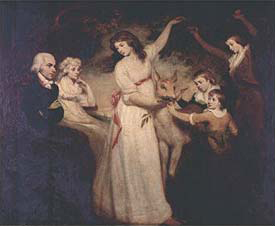
Private collection.
Copyright © 2005 Keele University.
All rights reserved.
Three short-lived partnerships followed, firstly around 1796-7 retailing ceramics with Green & Limpus in London, secondly manufacturing porcelain with Wolfe & Lucock in Liverpool and finally with Wolfe's brother George making pottery at Lane Delph (Fenton) in Staffordshire. The ceramic ventures were terminated in 1800 and by 1802 Mason had relinquished his retail business.
About 1800 Miles Mason began porcelain production on his own account at works in Lane Delph. A greyish hybrid hard-paste porcelain body was produced emulating the Oriental ceramics, which he had originally retailed so successfully. Miles Mason also utilised the newly discovered white bone china as his standard body during the early 1800's.
Mason focused porcelain production on tea, coffee and dessert services in these early years. Many services were transfer printed in underglaze blue with patterns in the Oriental style such as 'Broseley Willow' which was enhanced with a variety of gilded patterns. Overglaze enamel bat printing was also popular.
Some fashionable shapes were based on contemporary silver. Mason rivaled his competitors by producing finely potted wares with elegantly hand-enameled designs.
You can view the factory mark of Miles Mason on the Mason's marks page.
In 1806 Miles Mason entered into a partnership with his eldest son William at the larger Minerva Works. Further expansion took place in 1811 when they took on Sampson Bagnall's factory which was also at Lane End.
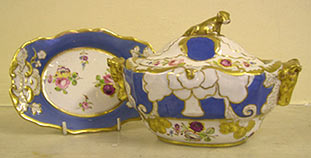
A fine Mason's Dessert tureen, cover and stand, Patent Ironstone China tureen 15.87cm high c. 1825-35. The Raven Mason Collection
Copyright © 2005 Keele University. All rights reserved.
Over a number of years many experiments must have taken place with earthenware and prototype ironstone bodies. It is highly likely that Miles Mason was the driving force behind these developments, but it was his youngest son Charles James Mason who registered the famous patent 'for the improvement in manufacture of English porcelain'. The patent was taken out in 1813, the same year that Miles was to retire from the business.
Mason's patent ironstone china was extremely durable and could be produced at very competitive prices.
The changing dining habits of the early nineteenth century revolutionized the ceramic industry. A greater variety of items were required and ironstone was eminently suited to the manufacture of large items, especially dinner services.
The manufacture of porcelain was costly; the less expensive ironstone body could be afforded by a greater percentage of the population. It was much more resilient to daily household use and relatively inexpensive to replace.
You can view the factory marks of Mason's patent ironstone china on the Mason's marks page.
...the durability of the composition is beyond any other yet produced, and not being so liable to chip or break...will prove a recommendation for its general utility
'The Times' December 1813
Japanese porcelain was mainly manufactured in Arita; it was highly prized and exported through the Port of Imari in the Province of Hizen. Designs were often based on textile patterns, especially sumptuous brocades; the result when transferred to ceramics was a bold, decorative scheme.
The Prince Regent (late George IV) placed orders with several English manufacturers for ceramics in the Japan style. Fashionable society followed his lead and anglicised versions of Japanese decoration developed during the first quarter of the nineteenth century.
In 1813 Miles Mason's sons, Charles James and George Miles took over the business and for the first time dinner services became a principal product, they also introduced Japan patterns onto the new patent ironstone body.
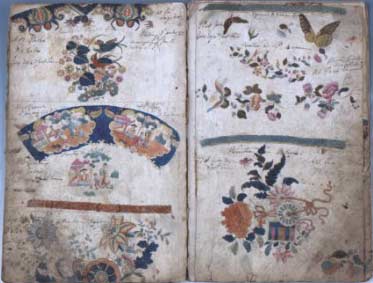
Design from the C.J. Mason pattern book. Circa 1840. By courtesy of The Wedgwood Museum, Barlaston, Staffordshire. Copyright © 2005 Keele University. All rights reserved.
This was a huge success; the greyish-blue ironstone body was the perfect canvas for Japanese style decoration. The blue was applied under the glaze either by hand painting or printing. After glazing, the ware was enamelled with colours and the edge lined with apricot lustre or gold. A variety of Japan patterns decorated virtually every shape the company produced and ornamental pieces such as vases and inkstands were sometimes more intricately decorated and gilded.
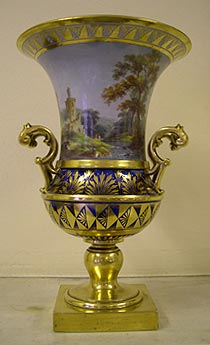
29.21cm high c.1815-25 The Raven Mason Collection. Copyright © 2005 Keele University. All rights reserved.
The sheer strength of the ironstone body enabled the Mason's factory to produce ornamental objects of considerable size.
Magnificent vases in the Italianate style, such as Neapolitan Ewers, were extremely costly. Large items were produced to decorate the hall and principal rooms of mansions. The range of ornamental pieces must have been legion; frequently they were often elaborately embossed and moulded.
Sadly, very little is known about the work people employed by Miles Mason and his successors. Probably the best recorded artist was Samuel Bourne (ca.1789-1865) reputed to have been apprenticed to Enoch Wood where he learnt the art of enamel painting.
It is possible that Bourne painted some of the landscapes known on Mason's wares. He was probably employed from about 1809. Regrettably his work is unsigned. Bourne continued to work for the Mason factory until approximately 1828 when he moved to Minton where he became chief designer and artist until 1863.
An auction catalogue for a sale held by Phillips at 11, Albermarle Street London, in June 1822 records:
"A noble vase, formed from the antique, beautifully painted in landscapes and figures by Bourne, and sumptuously gilt"
The vase had a reserve of £20 guineas (£21)
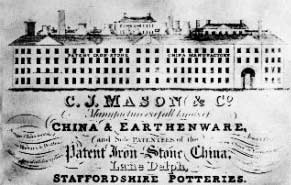
Copyright (c) 2005 Keele University. All Rights reserved.
When George Miles Mason retired from the partnership in 1826, his younger brother Charles James continued the firm under the name of C.J.Mason and Co.
The period of the 1820's and 1830's was one of considerable prosperity for the company and a range of markets were developed. Charles James appears initially to have championed the need for improvements in working conditions and wages, whilst pioneering technological change.
The introduction to the ceramic industry of George Wall's patented flatware machine caused such an outcry, that it was subsequently withdrawn. C.J. Mason's policy of selling by auction forced down the retails prices of his wares and the subsequent reduction in the wages of his workers made him extremely unpopular.
From 1813 to 1848 the very large production of their Patent Ironstone wares inevitably resulted in the market becoming saturated. The novelty and desirability of Mason's products had waned in the eyes of the consumer and the constant re-use of Oriental designs was considered outmoded by the general public.
Charles James Mason was declared bankrupt in February 1848. By the time of the Great Exhibition of 1851 he had re-established himself at the Daisy Bank Works, Lane End, Longton. His workforce of 75 people, of whom 35 were children, were producing heavily decorated earthenwares, such as 'Bandana' style pieces.
It seems probably that C.J. Mason failed for a second time, after little more than two years. His wares did not bear comparison with his competitors and their heavy decoration proved unpopular.
Charles James Mason died on 5th February 1856, having witnessed the decline and final failure of the pottery business to which he had devoted his entire life.
You can view the factory mark of C.J. Mason and Co on the Mason's marks page.
In 1848 Francis Morley purchased the majority of the moulds, engravings and equipment at the sale of C.J Mason's goods and effects and immediately transferred them to his pottery in Broad Street, Hanley.
In the Paris Exhibition of 1855 Morley was awarded a first prize for a selection of traditional Mason's patterns. In 1858 Morley formed a partnership with his son in law Taylor Ashworth and by 1862 he had retired passing on the Mason's printing plates and other equipment to Taylor and his father George L. Ashworth.
"Messrs Ashworth Bros. continue to the fullest extent, the manufacture of the 'Patent Ironstone China'...and produce all Mason's best patterns in services, etc. from the original moulds...These they produce in immense quantities, both for the home and foreign markets, about one third of their whole production being exported...The 'Ironstone China', from its extreme hardness and durability...is especially adapted, in its simpler styles of decoration, for services used in large steamship companies, hotels, clubs, colleges, and other places where hard usage has to be undergone; while in its more elaborate and rich style - and it is capable of the highest degree of finish - it is eminently fitted for families of the highest ranks. It is much used in the houses of the nobility and higher classes. No climate affects this ware..."
'The Art Journal' 1867
The company continued to trade as 'George L. Ashworth' when it changed hands yet again in 1883 and was purchased by John Shaw Goddard, who was succeeded by his son John Vivian in 1919. The Ashworth name continued in use until March 1968 when it reverted tot he original factory name, mason's Ironstone China Ltd. The company became part of the Wedgwood Group in 1973.
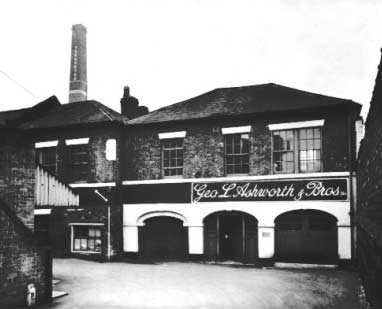 Front of the Broad Street factory of George L. Ashworth and Brothers. Circa 1950.
By courtesy of The Wedgwood Museum, Barlaston, Staffordshire.
Copyright (c) 2005 Keele University. All rights reserved.
You can view the factory marks of George L. Ashworth on the Mason's marks page.