

History in Keele buildings
The names of our buildings carry great significance for Keele. Some facilities are named after benefactors and donors but our buildings are named after people who have a special association with the founding or evolution of Keele, or of the Keele estate.
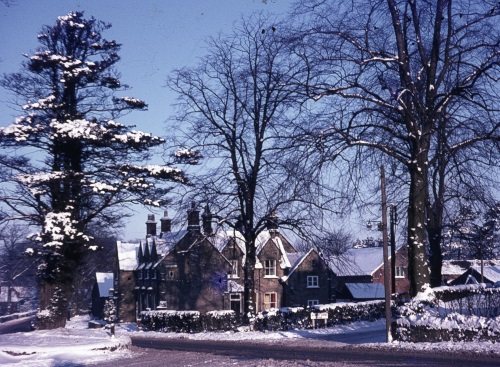 One possibility is that the village name derives from the Celtic word for a 'cell' (a small church or hermit's residence). Many Irish and Scottish place names have variants of Kyle, Kil, Keele and other similar variants arising from this origin. However, scholars consider Keele to derive from the Old English 'kye-hil' , meaning 'cows' hill' or 'cattle hill'. Michael Paffard investigates the origins of the village name of Keele and many local place names in his outstanding booklet, "Keele: An Introduction to the Parish and the University thoroughly".
Photo right: A snowy Keele village in the 1960s by Malcolm Payne (1969)
Keele lies on the same latitude as Boston (Lincolnshire, Bremen (Germany), the Aleutian islands (Alaska), Wicklow (Ireland), Labrador and Edmonton (Canada). Its longitude is shared with Guernsey (Channel Islands), Guernica, Almeria (Spain) and Accra (Ghana).
Professor Stanley Beaver, the first professor of Geography (1950-1974) claimed that "keel" is a Norse word meaning the bottom of a boat. Norsemen used to turn over their boats to sleep under them so "keel" also came to mean a roof-ridge and, by association, a watershed. Keele is on the Trent and Mersey watershed of England so one might argue - very weakly - that Keele is actually an upturned Viking ship.
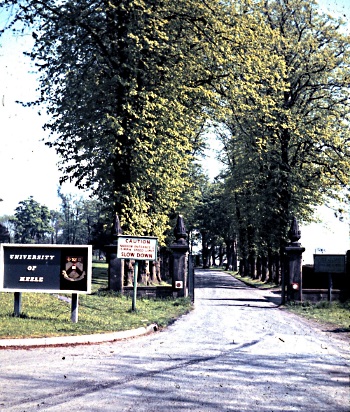 The original higher education institution on the Keele estate was known as the University College of North Staffordshire. The College opened in 1950 with 157 students. After the receipt of its Royal Charter, it was renamed The University of Keele in 1962. This remains the formal and legal name, but the term "Keele University " is preferred in day-to-day usage. There was much speculation about the name when the Charter was granted, not least because there was so little 'name recognition' for Keele. Keele University was proposed because of its brevity and precision and to reflect the historic place which hosts the university. Keele would just have to live with being the only UK university named after a village - and consequently the frequent question: "Where is Keele?"
Alternative names which were considered include The University of Stoke or Stoke-on-Trent but this was rejected because the university does not lie within the city but within the Borough of Newcastle-under-Lyme). The University of North Staffordshire, the University of Staffordshire or Staffordshire University (a name now taken by a neighbouring institution) were also suggested.
Photo left: The gate from the village into Keele University - by Graham Fisher (Golden Class of 1964)
After the near-simultaneous opening of the M6 motorway, Keele very quickly became synonymous with the Keele Motorway Services area adjacent to the campus. There is a five second opportunity to see Keele Hall from the M6 just south of the services. There has also much confusion with the city of Kiel in North Germany - Kiel has a gigantic ship canal while Keele has eight small and very attractive lakes. Kiel University dates back to 1665. For Classical scholars, the Public Orator of Oxford University suggested the Latin name of "Collegium Universitatis in Staffordia Boreali Collocatum" and this is approved as another approved name.
You can track the evolution of the campus in our feature about Maps and plans of Keele over the years.
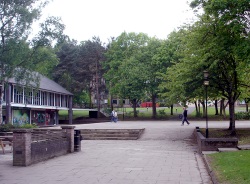 The central and unchanging core of campus has always been the open space between the Chapel (1965), the Library (1962) and the Students' Union Building (1962). Even before these buildings were erected, this open area in front of two large wartime Nissen Huts at that location was at the heart of campus life. The area later became known as the Concourse and at times it is called Union Square. For the imaginative, the Union Building, Library and Chapel might be visualised as a trinity serving respectively, "Body, Mind and Spirit".
Photo right: The Concourse in 2011 before the installation of the Forest of Light and landscaping outside the Union Building.
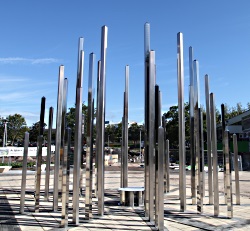 For many years it was centred by a traffic roundabout approximately where the Forest of Light sculpture now stands. When the new ring road around campus was built in the early 1970s, the area was pedestrianised, leaving only one road leading uphill past the Chapel towards Lindsay; the road to Keele Hall became an access route and was no longer a thoroughfare. The Concourse was paved, with steps leading down to the new Union extension; most would describe it as functional rather than attractive. In 2012 the area was completely renovated - providing appealing and accessible landscaped slopes and steps, trees and gardens between the three major buildings. The up-lit Forest of Light sculpture was installed in 2012 to commemorate the 50th Anniversary of the Royal Charter of the University of Keele. In 2015, a large permanent "Keele shield" was installed on the lawn leading up from the Forest of Light to the Library. The central core of Union, Library and Chapel might prompt one to imagine this is a reflection of "Body, Mind and Spirit".
Photo left: The Forest of Light just completed in 2012
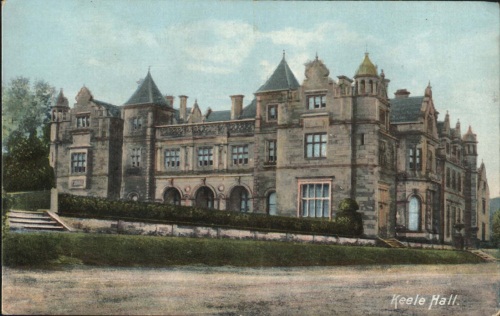 Keele Hall is a 19th-century mansion house and is a Grade II listed building. The manor of Keele was held by the Sneyd family continuously from 1544 to 1948. A large gabled Tudor style house was built on the hill in 1580. In 1651 Colonel Ralph Sneyd fought on the Royalist side in the English Civil War and was killed. The family’s fortunes fluctuated, with a brief heyday in the 18th century when a Sneyd commanded the Royal bodyguard at Buckingham Palace. The family’s history can be partly traced in the heraldic devices on the walls, including one commemorating a battle honour awarded against the French at Poitiers in 1356.
Image right: Keele Hall in a postcard by W Shaw's of Burslem (c. 1905)
In the 19th century, the family prospered as landowners, coal and iron owners and also brick and tile manufacturers. The original house was remodelled several times and finally replaced entirely between 1851 and 1861 with the present Keele Hall. The celebrated Victorian architect Anthony Salvin, who also worked on the renovations at Windsor Castle, Alnwick Castle and the Houses of Parliament, designed an imposing building in mock Jacobean style. It is built of local red sandstone with contrasting Hollington stone dressings. A Latin inscription around the roof frieze may be translated as "In 1860 Ralph Sneyd undertook the reconstruction of this house which had been built by his ancestor Ralph Sneyd in 1580". The three-storeyed castellated entrance front has four octagonal turrets and the other fronts have curved gables. The eastern façade overlooks sweeping lawns down to an ornamental lake, arboretum and extensive woodlands, which were landscaped by William Emes in the 18th century.
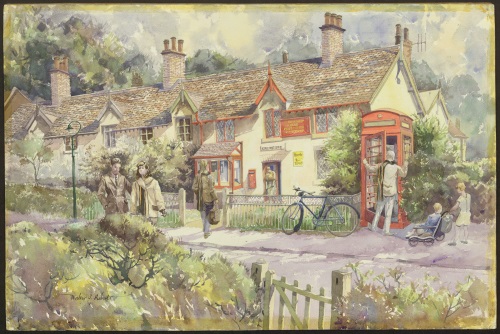 Image left: Keele Post Office and village in 1965 by Walter J Roberts. By permission of the National Archives.
The artist was commissioned by the Post Office to produce paintings to promote the new Post Office Savings Bank. Eagle-eyed Keelites will spot the black, red and yellow Keele scarf. Many a shilling was thrust into the greedy jaws of the public telephone box.
In 1900 Grand Duke Michael Mikhailovich of Russia rented Keele Hall. He had undertaken a morganatic marriage against the will of his cousin, the Tsar Alexander III of Russia, and spent the rest of his life in exile in England, France and Germany. During his ten years at Keele, the Grand Duke adopted the lifestyle of an English country gentleman and on one occasion welcomed King Edward VII, the first ruling monarch to visit Keele. The town council of Newcastle-under-Lyme conferred on Grand Duke Michael the honour of Lord High Steward of the Borough.
Keele Hall was requisitioned by the Army during World War II and was occupied first by British and then by American troops before becoming a camp after the war for Polish soldiers, refugees and others displaced during the war. In 1948 the Keele estate was purchased from Colonel Ralph Sneyd for the establishment of the University College of North Staffordshire, which opened in 1950 and in 1962 became Keele University. At the time of its opening in 1950, Keele Hall was partially roofless and required considerable repair and adaptation. Teaching took place in Keele Hall until 2003 when Philosophy and English finally left for more functional and less Hogwartian surroundings. Teaching returned in 2016 with the founding of the Institute of Liberal Arts and Sciences at Keele.
You can view photos of Keele before the founding of the University on the Sneyd Family Photo Album.
 Walter Moberly (1881-1974) was a British academic who, as Chairman of the University Grants Committee, played a significant role in the creation of Keele University.
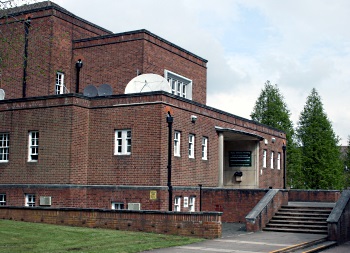
Photo right: The Walter Moberly in 2010 by John Newby (Golden Class of 1963) in 2009; subsequently refurbished again in 2015 as a state-of-the-art teaching building on campus.
Moberly began his academic career as a lecturer in political science at the University of Aberdeen. He then served with distinction in the Great War and joined the University of Birmingham as a Professor of Philosophy. He later became Principal of the University College of the South West of England and Vice-Chancellor of the University of Manchester, before joining the University Grants Committee in 1935. Moberly was hugely supportive of Lord Lindsay’s vision for a new kind of university, enabling Lindsay to found the experimental University College of North Staffordshire in 1950 – which became Keele University in 1962. Walter Moberly Hall Interior
The iconic building was designed by J A Pickavance and intended as the second of four buildings in red brick and neo-Georgian style in the form of a quadrangle. The first building completed was the New Teaching Block (later R H Tawney Building) and this building was the second – and originally named the Conference Hall. The third and fourth of the planned buildings were not built. The Conference Hall opened in 1954. It was an essential feature of the Keele experiment for the entire student body in the Foundation Year to gather here for lectures. It was also vital to the social and cultural activities of the community of scholars, being used for lectures, plays, debates, concerts and other events requiring a large auditorium. It was renamed the Walter Moberly Hll in May 1960.
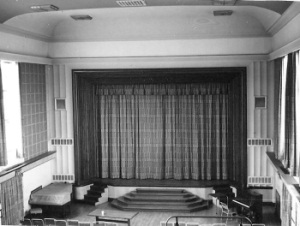 Photo left: Walter Moberly Hall interior by John Gillis (Golden Class of 1962)
Over the years the building has earned the student nickname of "The Wobbly Mobbly". According to John Sutton (Class of 1958): "The "Wobbly Hall" was opened in my time and the first Royal Ball was held in it. It had a very curious acoustic feature which the then Professor of Physics, Arthur Vick, loved to demonstrate. If you stood on a certain spot in the centre of the main hall and clapped your hands, the noise reverberated around the ceiling."
It remained in use as the Walter Moberly Hall until the mid-1980s when it was converted for much-need office space and renamed the Walter Moberly Building. The Walter Moberly Building was restored to use for teaching and learning in 2015 when a multi-million-pound refurbishment replaced the offices with modern flexible spaces throughout.
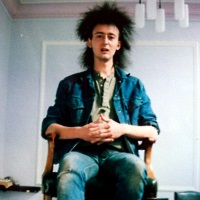 Photo right: The elegance and sophistication of the Senate Room is not evident in this photo but the legendary Keele SU Social Secretary & Speaker of the Union, Mark Ellicott (1985) is.
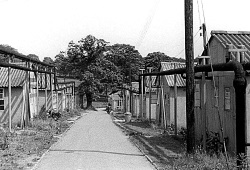 The Keele estate has welcomed many distinguished visitors but during the 1940s most of the occupants of Keele Hall were not here by choice. British troops arrived at Keele Hall during 1940 and an army base was built to house troops evacuated from Dunkirk. They gradually rejoined their units as they re-formed or underwent further training. There was also an anti-aircraft gunnery school. It is believed that battlefield communications by radio were tested between Keele hill and Mow Cop.
The Huts provided memorable and (usually) very comfortable homes for Keele students from the 1950s right into the 1970s. Read about Hut Life.
Photo left: The Huts in 1954 - luxury 1950s style with trendily visible heating pipes.
By 1944 the original and shoddy British huts were supplemented by more substantial temporary buildings to housed American troops waiting to be sent to Normandy after D-Day. By the end of the war, over 120 temporary buildings were scattered across the bare and windswept hilltop while Keele Hall itself took a battering from the army boots of its less-than-careful occupants. Bungalow 2009 After the Second World War, the camp was converted again as accommodation for refugees and displaced persons from war-torn Europe. Among these was a Polish woman who was murdered on her way back to camp from Newcastle - her murder in 1948 was never solved and the perpetrator never identified. This is the only murder known to have occurred within the precincts of the Keele estate.
 In 1950 the new University College of North Staffordshire (from 1962, Keele University) opened and the army huts provided rough-and-ready but remarkably warm and comfortable accommodation for staff and students. More military buildings were adapted for educational use while two large Nissen Huts became the home of the new Students’ Union and Chapel. Another draughty hut, known as the RAF Hut, became a refectory. It was later renamed by a student graffiti artist as the “Frank Godfer Hall”, in imitation of the University motto inherited from the Sneyd family: “Thanke God for All”. Some of the more robust huts continued as student residences into the 1970s while many more remained as offices, workshops and storage well into the 1980s. Gradually all but two were replaced by permanent buildings.
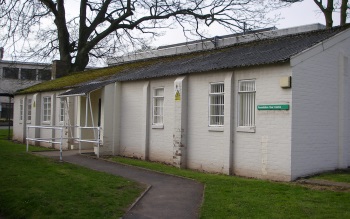
Photo above right: The surviving "Bungalows" in 2009 by Stan Beckensall (Founding Class of 1954)
 The only two survivors are two brick “huts” - now called The Bungalows - which survive as reminders of the pioneering days at Keele. These must have served a hundred different uses over the decades but one is currently used for teacher training and the other is used to teach Foundation Year students.
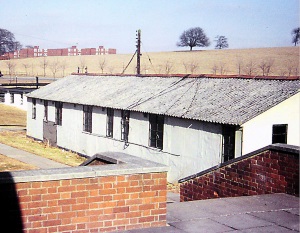
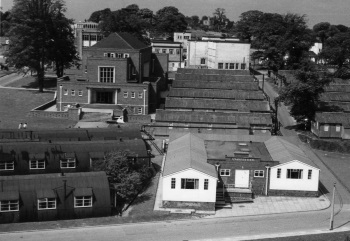
Photo left: The Huts in 1986 from the steps of the Walter Moberly - the former registry, soon to be demolished to make way for what later became Cherry Tree Drive.
Photo right: This fabulous shot of the huts in 1961 was sent in by Sheilah Da Silva (1963). On the left are the two large Nissen Huts which housed the Union and Chapel until the 1960s; to the left rear is the Conference Hall, later Walter Moberly Building. The white huts at the front housed the Registry and administrative offices.
This building is named after not one, but two William Smiths, both of whom were influential in the development of mapping. The first William Smith (1546?-1618) laid the foundations of the conventions of county mapping and of urban cartography. Smith was an antiquarian and Rouge Dragon at the College of Heralds whose work, ‘The Particuler Description of England. With the portratures of certaine of the cheiffest citties and townes’, made an important contribution to cartography of the time.
The second William Smith (1769-1839) is credited with creating the first nationwide geological map. While working as a miner, Smith noted the patterns in strata of rock, leading to a lifelong fascination. He developed a way of displaying the horizontal extent of rocks, which eventually led to his ‘Map that Changed the World’.
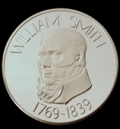 In 2014, Keele Professor Peter Styles was awarded the prestigious William Smith Medal for 2014 by the Geological Society of London for his outstanding research. The Medal is awarded for excellence in applied and economic aspects of geoscience. Peter said: "William Smith developed the concept of the 'Geological Map', which has underpinned our transformation of observed 3-D Geology onto a 2-D surface representation for some two hundred years. We can do nothing in geoscience without them. That is why at the merger of those two Departments at Keele, we named the Geography and Geology building after him. I am therefore both honoured and humbled to receive this medal... it is the high point of my career."
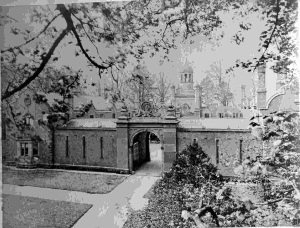 The Clock House is a Grade II listed building. It was built in 1833-1834 to provide stables, carriage stores and residences for the coachman and head gardener. It is built from red and blue bricks in diaper pattern with sandstone dressings. The clock tower arches over the south entrance and has a pyramidal roof, octagonal bell-turret and corner turrets. Pevsner describes it as "Tudor, in a vague way." A new drive led southwest past Keele Park Racecourse opened by Col Ralph Sneyd in 1896. Sneyd converted the block into breeding stables for racehorses until Keele Park folded in 1906. In the 1920s he converted the residences to provide lodgings during his infrequent visits.
On 28th October 1970 about 300 Keele students carried out a bizarre protest at the Clock House. They surrounded and attempted to levitate the building 300 feet into the air by psychic power and the force of their “spiritual unity”. In those heady days, some averred that they managed to raise the building “about six feet, give or take six feet.” Read more here about the Levitation.
The building now houses the Music School and the Vice-Chancellor's residence. A road to the Clock House cuts through a Romantically landscaped Gorge; a bridge spans the Gorge and carries the main footpath from Keele hall to Keele village, following the line of an ancient trackway.
Why not find out why the clock had no hands for forty years here: Clock House.
Photo: The Clock House in a vintage photo
Professor Colin Reeves is a former Head of Computer Science at Keele, who was a prominent figure at the University throughout the 70s and 80s. Colin was Keele’s first Professor of Computer Science, following a career in the chemical industry and a spell as a programmer on one of the first industrial computers. He has a long association with the British Computer Society, rising to become a moderator and then Chairman of the BCS Examinations Board. Through his influential work in curriculum design, he was asked to work with the Universities Grants Commission of Sri Lanka and recommend a plan to introduce computing into the university system. As a result of the Reeves Report, Colin was able to initiate Keele’s longstanding relationship with Sri Lanka.
Donald MacCrimmon MacKay (1922 -1987) was a British physicist and the founding Professor of the Department of Communication and Neuroscience at Keele University. He is known for his pioneering contributions to information theory and the theory of brain organisation. The Keele programme he founded was significant in exploring the new field of cybernetics and artificial intelligence. In the late 1940s, MacKay was among the first members of the Ratio Club. He is remembered for saying,
"In our age, when people look for explanations, the tendency more and more is to conceive of any and every situation that we are trying to understand by analogy with a machine."
Lord Moser was Keele’s second Chancellor, who held the office between 1986 and 2002. Claus Moser is a statistician who has made major contributions in academic life and in the Civil Service. His academic career was spent at the London School of Economics, where he had been a student. He held a variety of posts at LSE and was awarded a Chair in Social Statistics in 1961. In 1967, Harold Wilson appointed him Director of the Central Statistical Office, a post he held until 1978. He was made a Knight Commander of the Bath in 1973 and a Life peer with the title, Baron Moser of Regents Park, in 2001. He has a wide variety of other honours to his name, from Britain, France and his native Germany.
In 2004, Keele University was selected to be part of the £51m initiative by the Department for Education and Skills and the Wellcome Trust to create a national network of Science Learning Centres. The Science Learning Centre West Midlands is one of nine regional centres across the country, providing professional development opportunities to all science educators in the region. The aim is to bring "cutting edge science" from higher education and industry to the classroom and to increase innovation and creativity in ways that will revitalise science education in the West Midlands. The building was officially opened by the Minister of State for Higher Education and Lifelong Learning, Bill Rammell, in October 2005.
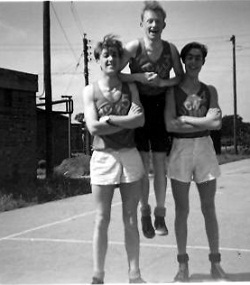 When the University College of North Staffordshire opened in 1950 no sporting facilities existed. The Director of Sport, Hank Haley, was not deterred and demanded that all students must participate in a recognised sport. An Athletic Union was formed and students improvised or borrowed neighbouring facilities. The refectory (now Keele Hall Ballroom) once hosted a major fencing tournament and long corridors in the Chemistry Block were equipped with hurdles to enable a promising athlete to train. Haley’s vision was fulfilled in 1964 when the Sports Centre was opened.
The original building was completed in 1964 to a design by Bridgewater, Shepheard & Epstein of dark brick and concrete.
A new Sports Hall was added in 1994 and improvements and adaptations have occurred continually to provide facilities for many sports, both indoors and on outdoor pitches and playing fields. Many of the fiercest contests between Keele University and Staffordshire University have occurred here during Varsity.
Photo: Keele athletes 1950s-style - no sports building yet but keen pioneer students and athletes Dion Webb (1957), Keith Clement (1956) and Stuart Milner (1957) were not deterred!
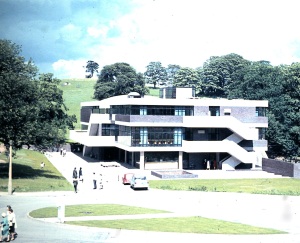 The Students’ Union first occupied a Nissen Hut leftover from the military occupation of Keele during the Second World War. The present building was opened in 1962 by Queen Elizabeth the Queen Mother and Princess Margaret, President and Chancellor of the University (1956-1986) and was completed in 1963.
It revelled in a progressive 1960s architectural style; its wide-open interiors were decked in white pine and an open staircase bisected the building. The exterior was described as resembling a Mississippi steamboat. It was originally intended to be the first of two identical buildings side-by-side “like a catamaran” but the second building never materialised.
Photo left: New Union Building by Graham Fisher (Class of 1965)
The building was designed by Stillman & Eastwick Field and the reinforced concrete structure was described by Pevsner in 1974 as "the best building so far" on campus, adding that the "stairway is dramatic and imposing... (and) ends up rather surprisingly on a non-existent and fake third floor. For all the viewer knows it continues onward into heaven". The extension with a shopping frontage was built in 1974-1975. The interior of the ground floor was re-modelled during 2011-2012 and recaptured some of the open and airy atmosphere of the original design. The cupola over the ballroom was also reinstated.
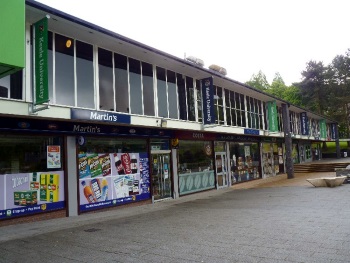 Photo left: Union Shops in 2015. The names and types of shops change but there has always been a newsagent, a bookshop, a "supermarket" and at least one bank. In 2016 there was Martin's newsagent, Costa Coffee, a Waterstones bookshop, the supermarket was called Select & Save then Costcutter, and the bank was run by Santander; in 2016 a Pharmacy opened, staffed in part by Keele students.
The popular "Union Square" pub on the corner existed from the mid-1990s until 2009. After serving previously as a pizza parlour it was given an American theme. The Union Square sign was saved from the rubbish tip by a generous benefactor who bought it at a charity auction.
Photo right: Photo of the original Union Square Bar sign
 The Students' Union Building was briefly the seat of government of the Free Republic of Keele, a sovereign state which unilaterally declared its independence in 1980 - read about Declarations of Independence.
The Keele Postgraduate Association (KPA) was established in 1963, then called the Keele Research Association (KRA), to campaign for on-campus accommodation for postgraduate students. The association continues to represent the interests of postgraduate students and enhance the postgraduate community experience, and Keele is fortunate to be one of only four UK universities to have a separate students union for postgraduates. The KRA was originally located in the former Gun Room in Keele Hall, a cellar space at the corner of the courtyard where the steps lead up to the Italian Gardens.
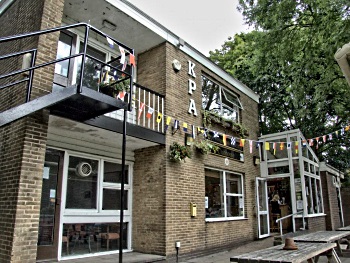 In 1994 it relocated to the old warden's house in Horwood Hall, right next to A Block, where it became known by some at the time as 'The Kipper'. Originally only providing liquid sustenance, in 1997 the Clubhouse expanded to providing food in the form of its famous 'KPA Doorstop Sandwich'. Good ale was always an important part of the Clubhouse and since 2008 the Clubhouse has been featured in the 'CAMRA Good Beer Guide'. The KPA Clubhouse still performs an important role as a social and study space for postgraduate students, as well as providing an important social space for university staff too. You can read a lot more about the KPA's history and traditions at The KPA Oar.
Photo left: The KPA Clubhouse, 2015
The Darwin Building was completed in 1991 to a design by Green Campbell Wainwright and was opened by Sir Roy Griffiths in December 1992. It was the second stage of Keele's Science Park development to be opened after the Stephenson Building. Naturalist Charles Darwin was a frequent visitor to North Staffordshire and married his cousin Emma Wedgwood at St Peter’s Church in nearby Maer on 29 January 1839. His early thoughts on earthworms evolved in the grounds of Emma’s family home Maer Hall and he is said to have spent many hours walking in the surrounding hills. His grandfathers, physician and thinker Erasmus Darwin and potter Josiah Wedgwood, were prominent members of Staffordshire society. Josiah Wedgwood V, the potter’s great-great-great-grandson, was a founder member of the University’s Council and Court of Governors, and is commemorated by an avenue of 20 silver willows close to the Darwin Building.
The Hornbeam building is named after the magnificent hornbeam tree which is outside the building. It is rumoured that the Founding Professor of Geography, Stanley Beaver, had the plans for the building altered to accommodate the tree. The hornbeam is native to the South East of England. It is usually conic in shape but older trees can spread into a high dome. The bark is lead-grey and smooth except for a network of diffuse stripes of paler grey or brown, separated by darker fissures. The branches all tend to be very long, giving the tree the appearance of an old-fashioned broom or besom. Hornbeam is frequently used as hedging. After box, it is the hardest of native woods, and was formerly used for ox-yokes, cog wheels for water and wind mills, and for piano keys.
Jack Ashley (1922-2012) was MP for Stoke-on-Trent South for 26 years, from 1966 to 1992. In December 1967, Ashley lost his hearing as a result of complications from a routine operation to correct a perforated eardrum. He was persuaded to retain his seat in the House of Commons, electing instead to take a crash course in lip reading. He thus became the first totally deaf MP. Ashley was a lifelong campaigner for the disabled, especially the deaf and blind. He led high profile campaigns, including the campaign for improved compensation for victims of thalidomide, vaccine damage and damage done by the arthritis drug, Opren. In 1986, he and his wife founded the charity Defeating Deafness. Following his retirement from Parliament in 1992, Ashley was made Baron Ashley of Stoke.
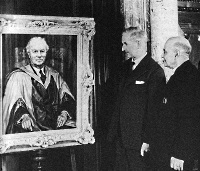 Sir John Lennard-Jones (1894–1954) was a mathematician who some regard as the initiator of modern computational chemistry. Lennard-Jones is well known for his work on molecular structure, valency and intermolecular forces. His theories of liquids and of surface catalysis also remain influential. He was the UK’s first Professor of Theoretical Chemistry, at Cambridge University, having previously been Professor of Theoretical Physics at Bristol University.
Photo left: Key people from the founding years. Lennard-Jones and Horwood view a new portrait of our founder Lord Linsday. This fine painting hangs in the University Common Room of Keele Hall.
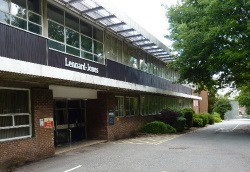 The research school that he founded at Cambridge attracted many of the UK’s leading scientists and mathematicians. The Royal Society of Chemistry awards the Lennard-Jones Medal and hosts the Lennard-Jones lecture each year. The Lennard-Jones potential is also named after him – the description of the potential energy as a function of the separation of atoms. Sir John succeeded Lord Lindsay as the second Principal of the University College of North Staffordshire in 1952 but he passed away only two years later.
Photo right: Entrance to the Lennard-Jones in 2015
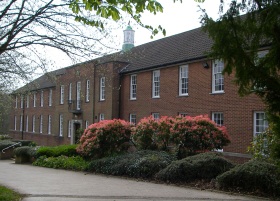 Richard Henry Tawney (1880-1962) was an economic historian, social critic and proponent of adult education, whose writings had a profound influence on Lord Lindsay, the founder of Keele University. Tawney spent much of his early career teaching at the Workers’ Educational Association, combining his work with his pioneering efforts to bring about major social change. From 1905 to 1948, he served on the Workers’ Educational Association Executive, holding the offices of Vice-President (1920-1928; 1944-1948) and President (1928-1944). He also served on the Consultative Committee of the Board of Education (1912-1931), the Education Committee of the London County Council and the University Grants Committee. Lord Lindsay was inspired by Tawney’s writings which led to the creation of the ‘Keele Experiment’, which began life as the University College of North Staffordshire in 1950. The Building was designed by J A Pickavance and was built in 1953 of red brick, in neo-Georgian style with a cupola.
The building was originally styled the New Teaching Block until May 1960 when it was named after R H Tawney. This and the Walter Moberly Building were originally planned as the first two buildings in a quadrangle, emulating the typical design of many American liberal arts colleges. Lindsay drew much of his inspiration for Keele and his educational philosophy from this American model of higher education which was characterised as the search for truth in the company of friends".
Photo: R H Tawney Building in 2009, by Stan Beckensall (Founding Class of 1954)
William Emes (1729?-1803) was a renowned landscape gardener who created the beautiful gardens at Keele Hall. The early details of Emes’ life are not known, but by 1756 he was working on Kedleston Hall, Derbyshire, at the behest of Sir Nathaniel Curzon. Emes quickly developed an excellent reputation as a landscape gardener, his style being similar to that of Lancelot ‘Capability’ Brown. The main features of his designs were trees and water. The gardens at Keele Hall, for example, have eight lakes and tens of thousands of trees. Emes designed gardens all over England and Wales, predominantly in the Midlands. He worked on Keele Hall between 1768 and 1770, bringing his signature parkland style to the Sneyd estate. In later life, he moved to the South of England, working extensively in Hampshire. He died in London in 1803.
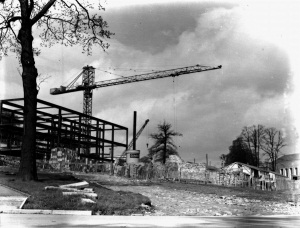 Eminent architect Sir Howard Robertson was engaged to design the Library. It follows no particular style of architecture but was designed to fit in with the overall style of the campus. Pevsner describes it as "a Georgian type of building... made superficially modern by the shapes of the windows and by pretty little motifs of the kind the Swedes used in the twenties." The height was limited by the need for anti-subsidence measures, which also included special foundation work and slip-joints in certain areas. So there is no truth to the myth that the ‘Library is sinking!’ By 1961, the first two phases of the construction were complete. At this point, the Library held around 200,000 volumes and over 300 readers. The building was officially opened in October 1962.
Over the ensuing 50 years, the Library has undergone regular changes and updates in appearance, function and personnel. It has grown along with the University – in 1962, there were an estimated 98,000 visits; in 2012, that figure was well over 700,000. The Library had a number of previous homes, including the Great Hall of Keele Hall in the early years. In 1974 Pevsner described it as "in the style of a Swiss chalet".
An exhibition in 2012 celebrated the 50th Anniversary of the Library.
Photo: Library under construction - Alan Self (Class of 1961)
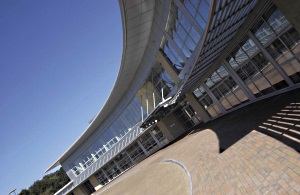 Sir David Weatherall was Chancellor of Keele University, succeeding Lord Claus Moser in 2002 and holding office until 2012. Sir David made a significant contribution to Keele, including presiding over the graduation of the first students to graduate from the School of Medicine – a subject close to his heart. His graduation ceremony anecdotes were invariably memorable and funny. Sir David is one of the outstanding British clinician scientists of his generation - a pioneering researcher in molecular genetics, haematology, pathology and clinical medicine. He was Regius Professor of Medicine at the University of Oxford, 1992-2000.
Photo left: Sir David Weatherall Building in 2006. By 2016 there have been two extensions to this stylish modern building for the School of Medicine and health research units.
In 1989, Sir David founded the Weatherall Institute of Molecular Medicine at Oxford University to foster research in molecular and cell biology with direct application to the study of human disease. Sir David is also co-author of the Oxford Text Book of Medicine.
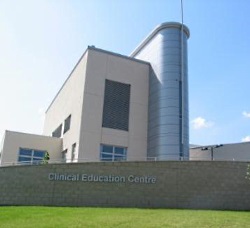 This building is on the site of the main hospital complex for North Staffordshire - it was opened as the main centre for the teaching of nursing and related courses.
Photo right: Clinical Education Centre, about 2008
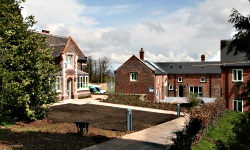 Home Farm was originally built in 1833 during the extensive landscaping works carried out by Ralph Sneyd, shortly after he inherited the estate from his father. Home Farm was a ‘model farm’. The first model farms were built in the 1790s during the reign of George III.
Photo left: Home Farm and Nova Centre (old farmhouse, left) after refurbishment in 2012
The architecture and layout of model farms were designed to enable agricultural experimentation and improvement. In Staffordshire and Cheshire, this included increasing dairy output by feeding cattle higher quality fodder. Home Farm is fairly unusual as it was one of only 20 built in the 1830s and is actually older than the current Keele Hall. It was a fine example of a model farm and its renovation for the Keele Hub for Sustainability preserves many of the original features.
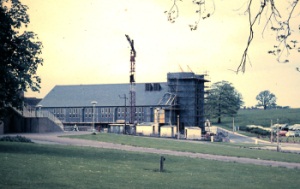 Keele University Chapel is the UK’s first religious building designed specifically to accommodate services by different Christian traditions. It was consecrated jointly by the Anglican, Roman Catholic and Free Churches. Although there were many precedents in terms of shared space and facilities, Keele Chapel is thought to be the first building in the UK to be designed specifically with ecumenical considerations at the forefront. Architect George G Pace was appointed to design the chapel in 1958.
Students at what was then the University College of North Staffordshire originally worshipped in a small chapel in Keele Hall (actually now a toilet area off the lower entrance hall) and then in a large Nissen hut remaining from its wartime role as a military base.
In 1959 representatives from 10 European countries and the USA met at The Ecumenical Institute of the World Council of Churches to consider the architectural implications of closer cooperation between the denominations and churches. They hammered out a 13-point statement which Pace then used when preparing his plans for a multi-denominational chapel at Keele. Pace saw that ecumenical relations could affect the way that places of worship were laid out internally. More than anything he saw the need for buildings capable of keeping options open. He set out to design a building where ‘organic development could take place without the great cost of structural alterations or causing violent disruption to a carefully wrought interior.’ Pevsner described it in 1974 as "a chapel pretending to be a Victorian gaol".
Photo above: Chapel under construction - Graham Fisher (Class of 1965)
The Chapel is used for concerts, Graduation Ceremonies and examinations as well as for other public occasions. The exterior of the Chapel was designed to be 'austere, highly disciplined and timeless.' Originally intended to be faced with sandstone, the generous gift of industrial-style bricks of the University’s choice from the Berry Hill Brick Company resulted in the Chapel’s construction in a striking blue Staffordshire brick. It was built in 1964-1965 with two rounded towers with triangular spirelets at the eastern end. Improvements were made to the access and parterre outside the Chapel in September 2012 to match the new development of Union Square and further interior improvements occurred in 2014.
A famous demonstration resulted in the roof being painted with the words "No Cuts" in huge letters.
"While the chapel was being built we had services in the Walter Moberley Hall (including the one the BBC broadcast that was interrupted by a banned record). And a smaller room in the same building for smaller gatherings and private use."
Mo Waddington (1965)
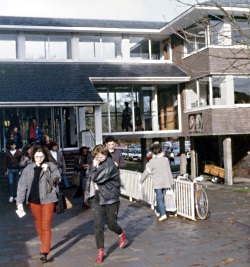 The Chancellor's Building was built in 1962 to a design by Bridgewater, Shepheard & Epstein with dark brick and glass in bands. There have been several subsequent extensions and modifications including the famous "banana" section, built in 1977.
Photo left: Chancellors in 1986 - the original entrance with the footbridge into Building C or the "banana".
The Chancellor at the time of opening was Her Royal Highness Princess Margaret, younger sister of the Queen, who served in that role from 1956 to 1986. The opening in 1962 coincided closely with the award of the Royal Charter which transformed the University College of North Staffordshire into the University of Keele.
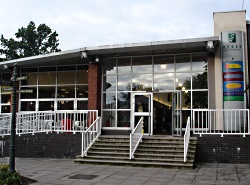 Photo right: Chancellors Building in 2012 - the new entrance into the atrium including the refectory
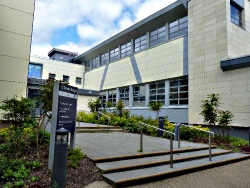 Dorothy Mary Hodgkin, OM, FRS (1910-1994) was a British chemist, credited with the development of protein crystallography. She advanced the technique of X-ray crystallography, a method used to determine the three-dimensional structures of biomolecules. Among her most influential discoveries are the confirmation of the structure of penicillin that Ernst Boris Chain and Edward Abraham had previously surmised, and then the structure of vitamin B12, for which she was awarded the Nobel Prize in Chemistry in 1964. She is regarded as one of the pioneer scientists in the field of X-ray crystallography studies of biomolecules. She was only the third woman to achieve a distinction in Chemistry from the University of Oxford and she taught Prime Minister Margaret Thatcher who installed a portrait of her in Downing Street in the 1980s - even though Professor Hodgkin was an open Labour supporter.
Dorothy Hodgkin Building 2015This building was originally built to house the Department of Physics. After Professor Dorothy Hodgkin had visited Keele on 22 March 1988, the main lecture theatre in the building was named after her. Luke Hodgkin, the eldest son of the late Professor, visited the University in May 2002 with other members of the Hodgkin family to unveil a plaque officially naming the entire Dorothy Hodgkin Building in honour of his mother.
Photo left: After a major refurbishment in 2015 - Dorothy Hodgkin Building
This honour marked a significant change. Physics moved fully into the refurbished Lennard-Jones Laboratory to bring together the School of Chemistry and Physics and Psychology became the sole academic occupant of the Dorothy Hodgkin Building. In addition to her scientific work, Professor Hodgkin was active in the promotion of international peace and understanding. The programme for the official naming ceremony of the building was a key part of that year’s Celebrating Women Series and concluded with a lecture by Professor Helen Haste, University of Bath: ‘Women in Science, Women and Science – Where are we now?’.
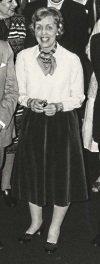 Audrey Newsome came to Keele in 1962 as head of the then Appointments Service (Careers) with a vision for an ‘Appointments and Counselling Service’ at Keele. Vice-Chancellor Harold Taylor described it as “the most exciting thing he’d seen in years” and in 1964 the service began. Audrey had recognised that emotional difficulties were an obstacle to both learning and subsequent employment. Audrey put the service and Keele at the forefront of student support and counselling for over 21 years. In 1974, she and colleagues in the department published ‘Student Counselling in Practice’, the first textbook devoted to student counselling in the UK. In it she talks about the complexities of a world where certainties are gone and students being presented with complex choices. She was a formative member of the Association of Student Counsellors and British Association for Counselling and was awarded an honorary degree by the Open University for services to education and made a Fellow of the British Association for Counselling and Psychotherapy.
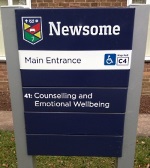 Mark Fudge (Head of Counselling & Mental Health Support) welcomed Audrey to Keele for the naming ceremony in April 2015, saying:
"Naming a building is important - especially as this is only our second named after a woman - and it should be a celebration of her vision. However, perhaps the real legacy is in the individual work undertaken behind closed doors which Audrey, and her team, will be most remembered for. This was the first student counselling service in the UK and 51 years later I’m thankful that you laid down a clear philosophy and pathway which has survived and, I trust, is still helping students become the whole person."
The founding of Keele Observatory dates back to the early 1960s, with the acquisition of the Oxford telescope from the Oxford University Observatory achieved through the enthusiastic work of Keele's first Observatory's Director, Dr Ron Maddison. It was built on an eminence affording excellent views where the Sneyd family had previously built a pavilion in the Seventeenth Century to view their extensive lands. It is said that if you travel due east from Observatory Hill you will not encounter higher ground until you reach the Ural Mountains in Russia. The first main telescope was made by Grubb of Dublin for Oxford University in 1874. There have been continual improvements and extensions - and newer telescopes and equipment have been acquired - but the 1970s saw the first significant expansion when a new dome was built and a 24-inch (0.6 metre) reflecting telescope (the Thornton Telescope).
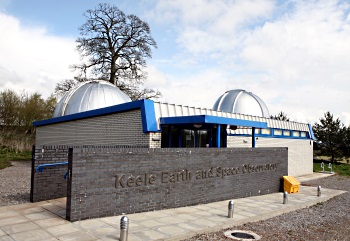 The local engineering firm William Boulton has made a great contribution to the Observatory's development and the current building is named the William Boulton Observatory in appreciation. The official opening was conducted on 1st July 1975 was by HRH Princess Margaret. During the 1990s the gradual increase in light pollution led to discussion of whether to relocate the Observatory but the plan was dropped, mainly because of the Observatory's unique accessibility to students and the public. Careful control of campus lighting (the University supports a 'dark skies' policy) has meant that observations have not been significantly impaired. Major improvements were made in 2009 with a major grant from the Wolfson Foundation and from the Keele Key Fund. A detailed history and historic photographs of the Observatory can be found at Keele's Observatory.
Photo left: Keele Earth and Space Observatory 2012 by Richard Burgess
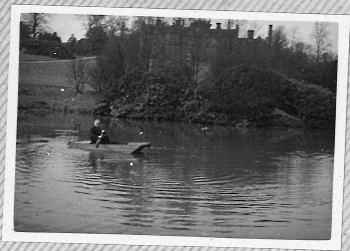 We know the lakes aren't buildings but this page would be incomplete without them. There are eight of them on the Keele campus. Three are naturally occurring and five more were created during the landscaping and drainage efforts of the eighteenth century. Each lake has a slightly different habitat - the one nearest Keele Hall is an ornamental landscaped pond, while the ones further away lie in varied woodland environments.
Photo right: There used to be a boat and a boathouse on the first lake. This photo was taken by Ron Decker (1954), the first American exchange student to Keele from Swarthmore College, Pennsylvania, in 1953-1954.