

Early student publications
The University Library holds an almost complete set of "Cygnet" dating from 1956 to 1982. The only missing issues are now 16 and 19. Other University and student publications held by the Library include copies of "Keele Left", "Keele Newsletter", "Sacred Cow", "University of Keele Bulletin", and "WOOP!" The Keele Oral Project has collected and added many previously absent copies of "Cum Grano", "Scythe", "UNIT", "WOOP!" and some missing issues of "Cygnet" to the stock and we welcome further additions to fill the gaps. "Concourse" is still published by Keele University Students' Union and KUSU maintains its own archive of this newspaper along with its predecessors.
Cygnet (1955-1964)
"When I arrived at Keele in the Autumn of 1954, there was no student newspaper. That didn't seem right, even though there were only about 600 undergraduates and not much news. So I started one, and the first edition came out in the early summer of 1955. I called it The Cygnet to end speculation about whether and when the Keele swans would ever produce offspring. We borrowed the Union Office after they finished work, so we could use the typewriter and duplicating machine: the long-gone sort where you turned a handle ~ one revolution, one page. Susan, later my wife, and a number of good friends helped turn and staple. I had to charge a few pence to cover paper costs, so publication day was a bit fraught, but the queue formed even before we started selling. Somehow or other we managed to gather or invent enough material to fill it each month, and the readers kept buying it. One of the few regular features I recall was "Keele Mots", gems culled from lectures and elsewhere: e.g. Professor X The main difference between children's bones and adult bones is that adult bones are bigger.” After about a year it was well enough established for me to contemplate having it printed properly, so I went to see the Editor of the Staffordshire Times in Newcastle. He was incredibly supportive, gave me a lot of encouragement and advice, and best of all quoted me a printing charge which seemed feasible. I then spent many hours trudging round shops and businesses, mainly in Newcastle, until I achieved the magic number. I remember still the excitement of standing beside the press as the first copy was run off. I was also very happy that the front page of that edition in the Autumn of 1956 carried a large photograph and story celebrating the arrival of Sir George Barnes as Vice-Chancellor, following a distinguished career at the BBC. I edited The Cygnet for another year, again with the indispensable help of friends, including Tony Powell who took over the crucial task of generating advertising revenue, but it involved a lot of work, and I could see a Third looming. I finally managed to persuade someone I trusted, who was also daft enough to take over. I was quite sad when I discovered recently that it is now defunct. I managed to lose all my copies during our many moves over the last 50 years. I don't suppose anyone has kept one or two that a sentimental old fool could share?"
David "Ted" Cawley (1959)
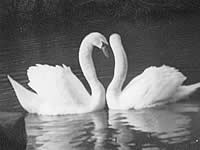 Photo of swans: John D Smith (1957) for Keele Chrismas card 1956
"If recollection be correct, Ted Cawley (1959) and I co-founded, confounded (?), and co-edited the Cygnet circa 1955-1956. Tony Powell made it financially viable. Despite our feeble editorial scribbling the early editions were well received, thanks mainly to the then symbiotic culture, with many faculty fully engaged."
James Howe (1958)
"According to the Editorial of the 8 May 1957 issue, David Edward Cawley, a founding editor of Cygnet in May 1956, relinquished his responsibilities to myself and Bryan Reed who co-edited the newspaper for the next several months. The latest issue I have (March 1958) shows Les Dickinson as Editor and Dave Pownall as Sports Editor."
Hugh "Hoblyn" Oliver (1960)
"The editor from 1956-1957 was Bryan Reed, when I was Assistant Editor. I then edited it from "I am surprised nobody has told you of the origin of The Cygnet. It was started in 1956 or 1957 by David (Ted) Cawley and Brian Reed. Cawley was always complaining about having to cycle to the printers in Stoke on Saturday mornings with copy that Reed was inevitably late in getting together."
Rob Edmunds (1958)
"Cygnet was founded in 1955. I took over from Tony Powell (best man at my first marriage and a really good mate) in early 1957 as Business Manager, first with Bryan Reed as Editor and then David Pownall. We lived on a razor's edge - usually finding a printer who would give us 10 days' credit-just long enough to get out an edition, collect some cash and rush to pay enough to escape! In March 1958 I was on my way to deliver copy when Dave Gledhill and I (on Dave's BSA Bantam) had a horrendous accident on the hill into Newcastle. The copy was eventually delivered!"
Brian "Ned" Lusher (1960)
"I did 1957-1958. I cannot recall who took over from me."
Leslie Dickinson (1959)
"I was editor and deputy editor of Cygnet"
Barry Carter (1961)
"After Leslie Dickinson, Tom Todd (1962) and I took over. We co-edited until March 1960 and then Tom took charge completely while I was off in Berlin to do my term abroad for the German degree. Barry Carter, after being sports and deputy editor, took things in hand for 1960–61. The contents of the paper consisted of a rather random sampling of the tidbits of everyday Keele life: general college news, announcements about the debating society, the call for a boycott to protest against apartheid, rag day, exchanges with other universities, money missing from the union shop, letters to the editor and an ample smattering of humorous (or would-be humorous!) contributions. During the year, it seems to me, there were perhaps three topics of particular importance that came up. First of all, there was the never-ending debate and soul-searching about the 'Keele Spirit' and the success or failure of the Keele Experiment. In one issue, I remember there was a series of three rather anguished articles about the "state of Keele": two critical (by Ray Southall and Brian Tyson / Osiris) and one pro, where I valiantly tried to defend. Mind you, put in context, this 'Keele-bashing' is not really surprising – after all, it was only a couple of years after "Look Back in Anger" which had, to a certain extent, set the tone for the prevailing "Zeitgeist" of disenchantment. Another focal point of controversy was the question of architectural choices and planning. The first more or less contemporary buildings (Horwood Hall, 1959) had just been completed. This, however, only made the architectural bedlam of the campus plainer to see. The plans for the new library had recently been published followed by a public debate held in the Conference Hall (later renamed, "Walter Moberly Building") with the presence of Sir Howard Robertson, the architect. I recall very clearly that the already high levels of friction were only aggravated by Sir Howard's disingenuous remark in defence of the "dovecot" which crowns the edifice that he felt it to be "symbolic of something." However, perhaps the major news item of the year was the announcement that the University Grants Committee was pressing for a massive expansion in student numbers, from about 700 students to 2,400. (With hindsight, we can see all too clearly, that this was the first step in the gradual dismantling of the Keele Experiment.) Most of the students were hostile to the idea of expansion and Cygnet ran a strongly worded editorial. I remember being summoned before the" beak", (i.e. the Principal, Sir George Barnes) and duly submitted to a severe wigging for academic "lèse-majesté". The "crime" was not so much that the paper argued that such an expansion would sabotage one of the fundamental elements of Lindsay's original ideal, but the suggestion that certain members of the Senate might have a professional vested interested in expansion which did not necessarily concord with Lindsay's original ideal. This, it should be remembered was in "the bad old days" before the bastions of the traditional social order defining the norms of undergraduate behaviour and deference had come tumbling down. At the time it was generally accepted (even by a surprisingly high number of students) that it was the University's rightful role to act in "loco parentis".
Jonathan Upjohn (1961)
"I can offer some information about Cygnet. I was the editor/proprietor in about 1964-65, having taken it on from Simon Spencer and eventually passed it on to Sandy Saunders who may well have passed it on to Phil Soar. The origins were already lost in the mists of time even then, because I don't think Simon had been the first proprietor. I know there was an edition produced under Sandy for the first time the New Universities Festival was held at Keele (and nobody bought it and it lost money, but then it was never exactly a licence to print money in the first place!). And it nearly got me thrown out, but that's another story."
Simon Sweetman (1966)
"My recollection is that in my final one or two years (I was 1962-1966), the Editor of Cygnet was a mate of mine, Alun Michael, who went on to be the first First Minister of Wales, had various Westminster ministerial posts including responsibility for getting the fox-hunting ban through Parliament, and is now a backbencher."
Paul Sommerfeld (1966)
"I have retained a number of copies of Cygnet, which were on display at my 60th birthday bash in June, and enjoyed by the ten or so Keele contemporaries who were kind enough to turn up. Some great writing in Cygnet at that time. I think it ceased some time in the 1970s. It was certainly going strong when I arrived in October '64, edited by Simon Sweetman. Among my fond memories of him are his "A thinking man looks at his team" articles about Stoke City in Cygnet and, after he left Keele, playing cricket against the Inland Revenue side which he captained with great enthusiasm. There was the famous edition which had a front page article over-printed so it couldn't be read, following threats to the editorial board from Harold Taylor. I think that article was about contraceptives. I would guess that the sin he referred to by Simon may have been that article (although I wouldn't claim knowledge of all his Keele sins!) What I can't recall is how on earth Harold Taylor found out about it after the paper had been printed but before it had gone on sale, which seems very odd - perhaps Simon can enlighten us."
Malcolm Clarke (1968).
"Martin Huckerby was one of Cygnet's luminaries. A sharp yet erudite and cultured publication, it merged commentary and analysis with other items in artistic style - much out of the general mould of 'That was the Week that Was'. It was also very reliable in its publication - I think fortnightly in term time. It was a good quality yet unpretentious medium to open the eyes and minds of undergraduates (and to give them an outlet for their developing talent)."
Michael Rigby (1968)
"Simon Sweetman was one of the great Keele characters of our day and he remains in our memory for several things. One was playing Winnie the Pooh in Kathy Unsworth's dramatisation of A A Milne. Another was his wonderful Marxist-Leninist football report in Cygnet of a game between Stoke City and Moscow Dynamo."
John Meager (1968) and Alice Meager (Wild)(1969)
"The student magazine "Cygnet" was the more "progressive" one issued alongside "Concourse" in my time. It was "owned" by Phil Soar and lost by him in a late night card game."
David Harris (1970)
"CYGNET passed from Sandy Saunders to me in a rather murky way. I ran into Sandy some years later at a party he was giving in London. Uncharacteristically Sandy asked me to leave…. I cobbled together a few editions. Contributors gradually increased their contribution. Phil Soar provided most of the back page. By the second term I tired of the pre-dawn print run. Once, Phil Soar drove my car back to Keele as I was exhausted. I woke up around half-way. We were racing down a particularly steep hill somewhere near or in the Peak District. Not entirely sure he had a licence, I was terrified. It was time the next generation took over editing and the print run which came with editing. Disposing of ownership was much harder as nobody could see much point in selling advertising and incurring personal debt with the printers. Someone mischievously suggested I might accept £100 and the new editors proposed a game of poker. Ramin Taraz put up his hi-fi system against CYGNET. I would like to say I contrived to lose. Ramin was a very likeable and gifted card player. Witnessed by a small crowd of his friends he won embarrassingly quickly. The following day he and his friends refused to accept their winnings - they had discovered the funding problem. During Sandy's tenure CYGNET had lost its London-based advertising representation. I agreed to continue ownership if they sent out rate cards for 1969/70, which I suppose they must have. They continued to produce amusing editions. At least they told me they were funny. I don't actually recall reading them. It wasn't entirely clear to me who exactly was editing CYGNET now. I merely agreed the number of pages when asked and paid the print bills. One issue unusually contained two photographs, which cost extra then, one of which I contributed. Before leaving Keele I passed over the bank account and paid the last print bill. I had no idea whether CYGNET continued. I made a point of removing comments likely to excessively wound students but not those aimed at staff, although none come to mind. Only one libel action was threatened and disposed of by ridicule. The intending litigant subsequently became a barrister. Every edition sold out instantly although someone did once ask for his money back! A lot of fun was had, often at other people's expense. Not very nice really."
John Walker (1970)
"I was a former Editor of "Cygnet", the unofficial alternative student paper - presumably long since defunct - which was itself a part of the "swan" tradition, as its name obviously indicates. As for the history of Cygnet, ownership passed from Phil Soar to Stu Cresswell and Ric Lewak and friends, then on to me and some co-conspirators including Pete Sykes, with Ed Kubiak as business manager(!). I bequeathed it in about 1972 to the late Danny McGrory and Tom Kelly. I remember Danny from Keele days - he was one of the gang who moved into the 'Cygnet' orbit, so I suppose it had something to do with his becoming a journalist. He was a journalist through and through, with a great instinct for a story and a truly distinguished career. It's a real blow that he has gone. What happened thereafter I know not - maybe others can reveal how much longer Cygnet survived?"
Brian Stewart (1972)
"I was at Keele between 1968 and 1972, and remember Cygnet clearly. Remember the competition to see which female students had the biggest breasts? You'd never get away with that now. One comment I clearly remember was something like: "Keep at it, Sue and Annie, you'll get there on aggregate." I survived Keele and became a novelist in the end."
Carol Birch (1972)
"Brian Stewart approached me to take over Cygnet after reading a piece I wrote for Concourse about creating mixed halls of residence. I asked Danny McGrory (1974) to join me in owning and running Cygnet on the basis of him being business manager and me writing and editing it. We worked on this basis with me at the time writing for both Concourse and Cygnet. I suspect current students would be interested in some of the antics we got up to with Cygnet, especially the ill-fated "streak" through the Foundation Lecture theatre whilst Prof Ingram was giving one of those grandstanding lectures. ”Streaking” had its 15 minutes of fame around this time. Our stunt almost ended up in the redtops and the premature end of one or two student careers. I gave up being owner of Cygnet though I continued to write occasionally for it. Soon after I started to edit Concourse. Danny continued with the help of Alan Warne. Danny and I remained the closest of friends until his death in 2007. Paradoxically, to my knowledge, Danny didn't write for either publication, yet went on to become the most respected foreign correspondent of his generation. I miss him very much."
Tom Kelly (1974)
"All this talk of Swans has made me remember The Cygnet. Do you have old back copies of that home-made magazine? I just have the one in which I got a mention. There must be some around and I think they are an amazing record of the politics - radical, sexual and otherwise - of those heady days in the 70s when I were a lass."
"Fizle" Sagar (1974)
Then a long gap until...
"I worked on Cygnet in about 1981-82 with then editor, Gerry O'Kane. Concourse, the union newspaper, had become rather pretentious at that point and we regarded ourselves as an alternative that was more involved in Keele life. We won that struggle and Cygnet stopped publishing (apart from a special perhaps) when I became Editor of Concourse."
Peter Foley (1985)
Former Chief Executive of Nottingham Forest FC and football supporters' aficionado was once Editor of Cygnet. Peter Foley (1985) Edited Cygnet 1981-82 and Concourse 1982-85. He's now Associate Professor of Religious Studies at the University of Arizona.
"I have a few ancient copies of Scythe dating from the late 50s as I was involved in writing for it and also helping with typing it I think. My roommate Angela Mellersh, now Myers, was also involved. It was probably even more transient than Cygnet. I also had some poems in Cum Grano."
Roberta Buchanan (1960)
"Scythe was a kind of little sister of Cum Grano; it was produced amateurishly, from typescript, from a photocopier, and was a squarish format whereas Cum Grano was near A5, with a full-colour cover."
John Idris Jones (1961)
"I was searching through piles of paper the other day when I came across a copy of Scythe, issue No 2, Dated October 1957, price sixpence. Raymond Southall got it together and edited it. This issue contains poems by HFH Oliver, G Roberts, Angela Mellersh, Bryan Reed, M Brown (I blush to say) I Maddox, Raymond Southall, Zulficar Ghose, J I M (Ted Cawley and I have been wracking our brains to think who that might be, with no success) and G Roberts. I don't know how many editions the publication went through, probably no more than two or three. But it is a little bit of history from those early years. It is surprising that it has lasted so long. The paper is quite thick, and the printing is obviously on a Gestetner."
Michael Brown (1958)
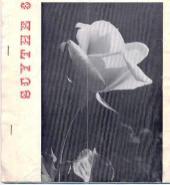
"I have a collection of old copies of Cygnet in a box somewhere in our garage, which also contains an assortment of old copies of Concourse and "Unit" (the Arts magazine), some "Potty" rag mags, and even some of the more memorable lunchtime fliers stencilled out on Mrs Boote's Gestetner in the Union building which we used to distribute around the refectories."
Brian Stewart (1972)
"In my time at Keele, we had three papers and at least one magazine. I was the art editor of Unit, first brought out in 1965 and printed locally at first. For some reason, we later chose a printer in Port Talbot. It was a long train journey. Under Tony Eliott's control, Unit morphed into Time Out."
Marshall Colman (1968)
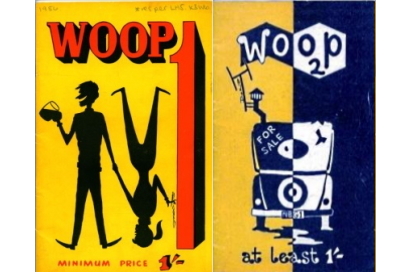
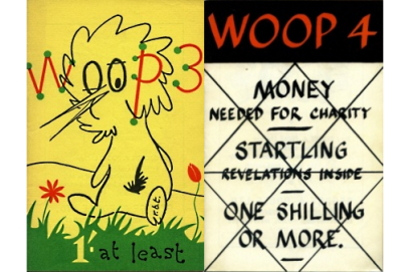
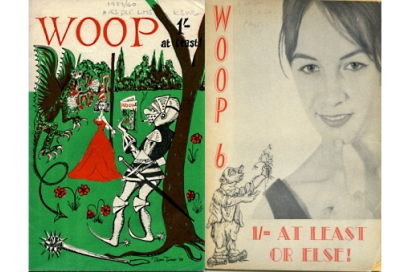
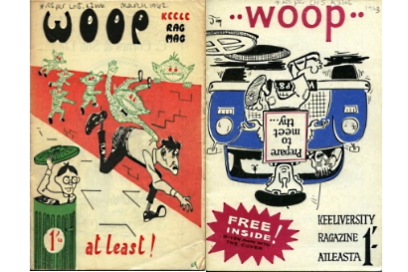
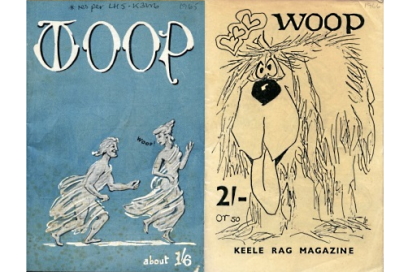
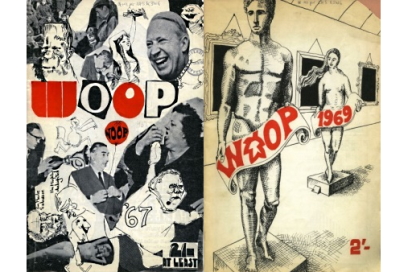
As a representative of WOOP! - the semi-scurrilous and barely humorous Rag Day magazine we'll let Tony Powell (1959) speak for all writers, printers, distributors, sellers and readers with excerpts from his evocative contemporary diary:
Tuesday, February 18th 1958: The Rag is at the forefront of all minds. WOOP 3 magazine is at this very moment being churned out on the Leicester presses, and we'll pick up the first batch tomorrow, by car.… The big day for sales is this Saturday, the 22nd, and the Rag takes place on Saturday, March 1st. I had originally hoped to have sales in Longton, Burslem, Tunstall, half a dozen Training College towns and at several universities, but it looks as though at least the latter will have to be dispensed with, due to transport difficulties (nobody has any vehicles!)
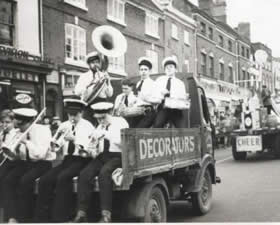 Friday, February 22nd 1958: WOOP came yesterday, that is to say, the first 5,000 copies. Brian Lusher has gone to Manchester to pick up another 14,000, and the remaining thousand will arrive next week. We began sales tonight at dinner in the College Refectory, and disposed of just over 300, whereas I had expected 6 or 700. Nevertheless, the staff are as yet untouched, and I feel we could get rid of another 300 within Keele.
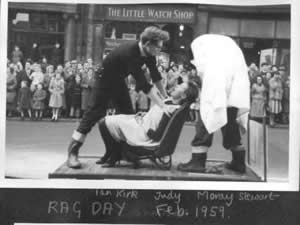 Sunday, March 2nd 1958: As the week dragged on, the weather got worse; snow followed by rain, right up to Rag morning. We got only about a dozen salespeople on Wednesday, when we revisited the outer towns, and raked in about 10. Then on Friday, things began to change, The rain stopped, we hit the shifts at Shelton Iron and Steel, Wedgwood, and Newcastle - sent parties to sell in Hanley, Stoke and Newcastle pubs, cinema and bus-queues in the afternoon and evening, and sold at Trentham Gardens (1 am) in the exodus from Joe Loss's Orchestra, getting rid of approximately 6,000 more…. So we came to Rag Day, with about half the WOOP magazines sold and about 800 from various sources in the kitty. The ground had dried out by eight a.m., and finishing touches were being put all over the grounds to the floats, with hammers and saws creating a riot. After breakfast the lorries began to arrive, and the real flap began. Students selling WOOP and holding out collecting tins - even buckets! - invaded the Towns; stunts began, and the skiffle group was kept hard at work. Tableaux were loaded onto their transports, and a complete melee ensued as they were marshalled into order; the loudspeaker van blared almost continuously, and Ticker Hayhurst, Rag Chairman, got really hot and bothered. … Up to the start of the procession, 5,000 magazines were on the streets, and compliments on layout and content were already flowing in. .... I was on the Committee coach with Dot Pitman (Appeals Officer) dealing with loaded tins, Chas Syms (Treasurer) dealing with the money, helped by Norman Brown (Union Treasurer) and Dave Thorne (Union Secretary) and 2000 WOOPs, the rest being in mobile depots at the front and rear of the procession under the control of Brian Lusher. The floats closed up in Lower Street Newcastle and we inched our way through cheering, laughing crowds along High Street and the Ironmarket.
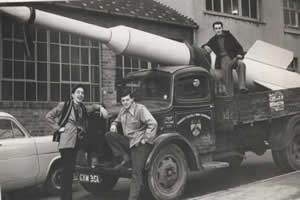 Part-way along, we underwent a minor attack from Nelson Hall Training College and Newcastle Art School, which fizzled out after Diana Hilton broke a bag of flour over the head of an NH girl she knew and didn't get on with. Collectors and salesmen were having a field day of it - the floors of the dustcarts in the procession were ringing with thrown pennies which piled up in heaps. We stopped at the Fire Station in King Street for the walking parties to board coaches, and off we went to Hanley…. The second time into Newcastle was even better than the first. I sold out of WOOPs three times, and practically every living person there was holding a copy. Collections - money was still raining in. We just had to hold out a bucket, and it became the target of the day for small- and not so small - children. The WOOPs we had remaining were Disposed of at any price we could get, some were even given away to kids. And so we wended our weary way back to Keele, jingling as we went…. My own main part in the procession had at first been to hand out bundles of WOOPs and collecting tins to our salespeople, but I soon got tired of this (Dot was very competent) so I rushed about selling and collecting, which I felt was a much more valuable use of time.…
Thursday 6th March 1958: Well, a couple of dozen of us went down to the bank yesterday. The money collection looked like pirate hoards, a mixture of every British coin and a few foreign ones to boot, gathered in two great chests. We tumbled them out onto trestle tables and counted the take for the next four hours. We counted the disappointing sum of 870 collected on the day itself, 900 from WOOP sales, 550 from the competitions, and 530 from advertisements, about 2300 in all. Not bad, I suppose - and what a hell of a good day we'd had.
Tony Powell (1959)
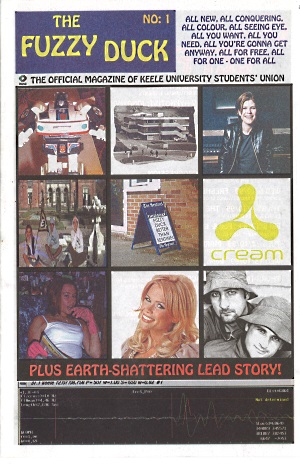
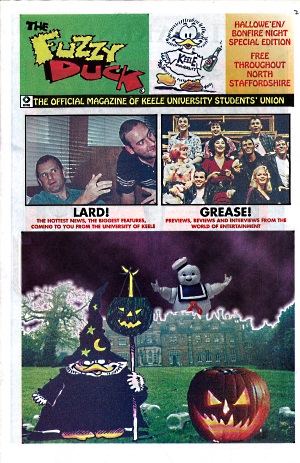
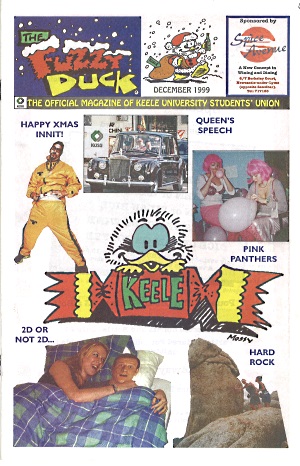
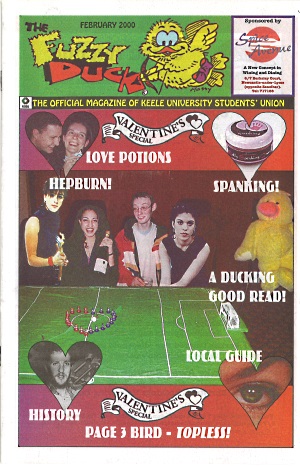
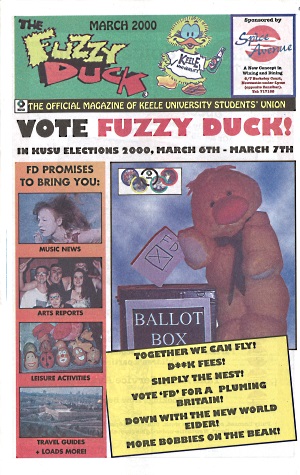
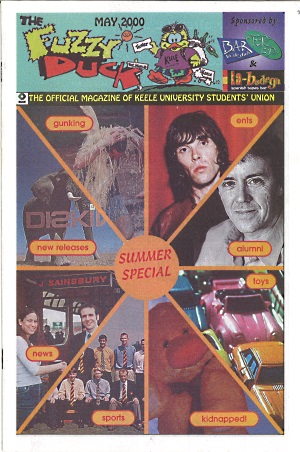
One of the earliest and longest-lasting Keele student publications was "Cygnet". But in 1999-2000 the short-lived but much loved "Fuzzy Duck" burst onto the scene to challenge its ornithological prominence. "Fuzzy Duck" was published by the Students' Union - it looked and felt like, and was the size of the "Beano" or the "Dandy" - a well-tested format! It was re-discovered through Facebook in 2016:
"Just found a mint condition Fuzzy Duck issue 1 from September 1999 if anyone wants it. That month KUSU welcomed Steve Lamaq, Emma B, Bentley Rhythm Ace, LTJ Bukem, Cast and Judge Jules. I have found six issues of the magazine from 1999/2000. I rescued them from my recycling box!"
Matt Allen (2002)
issues were edited variously by Sparky and Ben with Nat helping on one. We know Sparky is Mark Holtz (1993) - but who are Ben and Nat?
Fuzzy Duck issues below - No 1, No 2, Dec 1999, Feb 2000, March 2000 and May 2000
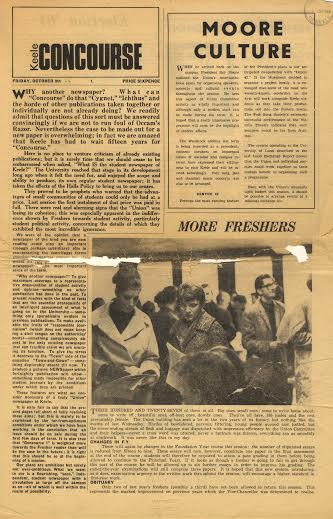
The Student's Union first began to publish "Concourse" in 1964 and it has remained active ever since, celebrating its fiftieth anniversary in 2014. many of the memories below were gathered from predecessor editors by Natalie Ilsley (Editor 2014-1025 for the special 50th Anniversary edition).
Photo: The first-ever Concourse 1964
"I was events editor for Concourse around 1964 The Editor was Norwegian or Swedish beginning with S (Eric Sorensen). I was elected onto the Student Union unopposed - I gathered information from Stoke and Newcastle night entertainment places and events, sorted the information and passed it on to the editorial people. Keele was entirely campus residential at the time. My other Student Union task was to look after the making and sale of chips in the Student Union Building kitchen area about once a week. Everyone seemed happy with life. I had forgotten my Concourse connection until recently"
Gilbert Pleuger (1967)
"I edited Concourse in the summer term of 1974 and still have (somewhere, in my Keele archive box) copies of the three (or was it four?) issues to prove it. I went on to have a career in voluntary and public sector marketing and communications, starting with editing The British Council staff magazine and subsequently managing media relations and internal communications for The National Archives and commissioning intranets and websites for NHS trusts. I consider myself very fortunate in having been able at Keele to develop my writing and subediting skills at Concourse and to have experienced what turned out to be almost the last days of printers using hot metal typesetting."
Bob Smith (1974) Union Secretary 1973-74, Editor, Concourse 1974
"I edited Concourse from December 1969 to February 1971. I was on the team from September 1969 and took over from Nick Pullen when he resigned a couple of editions into his term. For the first two of my editions I was join editor with Andy Fenner. I was re-appointed at the end of the academic year and resigned to concentrate on finals (or so I thought). I handed over to Pete Varden. In those days, the appointing panel was the previous Union Committee after they had left office with the final Union General Meeting of an academic year. Printing was done in Ripley, Derbyshire. This meant that Wednesday afternoon was a frantic time so that some material could catch the post. The printers would set that part in type on the Thursday. Meanwhile, Thursday afternoon, evening and into the night was even more frantic. A before the crack of dawn departure put editor and one or two assistants at the printer's door when they opened - we would hand over the new material, collect the galleys from the earlier dispatch and proof them over breakfast. Back at the printers there was a back and forth of new writing, proofing, re-proofing, page layout etc. The actual printing was always a good feeling to see start - especially on the very rare occasion when we knew that the journey back would not have to be at breakneck speed. Usually we piled into the Union just in time to get the paper into the refectories for the evening trade. I remember the whole period with affection, though one aspect of it did me no good at all. I would start smoking on Wednesday afternoon and probably get through 20 cigs and then between Thursday afternoon and Friday another 60 or so would go. I hardly smoked at all outside those times, but it took me a long time to stop resorting to the weed in times of stress. I had stalwart help from fellow students and good advice from Brian Whalen (Union Permanent Secretary). When I got the job he called me in and said "You'd better read this" as he handed me a thoroughly useful summary of the laws on defamation. I was also pleased that, as time went on, staff became more willing to respond to requests, or even to volunteer, items. During my terms of office there were:
- The "Naked Students" incident outside the Student Union - it happened while, literally (and I do mean that), the press was rolling with the last issue of the term. So Concourse had nothing on that until the next term in October.
- The Edgar Broughton incident and trial - following the extensive "redecoration of the Union Building".
- Great concern about "Secret Files" - including the ransacking of the V-C's office, a sit-in in the SCR, and the flour bombing of the Union Ballroom at the end of a meeting addressed by the Vice-Chancellor and attended by other members of the University's administration.
- The infamous "chip wrapping" edition.
Would that Bob Jones' fantasy "The Bible on Ice" (first draft) had not been lost at the printer's! Of particular interest there might be the first 4 issues of Academic 1970/71) which contained my account "A History of Student Unrest at Keele". At the 1970 NUS Student Journalists Conference, Concourse made the top six of student publications as judged by a panel of professionals. Bob Jones wrote for me and for Pete several times. Other frequent writers of my time were Bernie Martin and Ed Perry. Ed was subsequently Union President for the year 1971/72 that I was Secretary."
John Davnall (1971)
“I began my connection with Concourse writing a humorous diary column. This led to me taking over the ownership of “Cygnet” a satirical publication. On becoming editor of Concourse I handed Cygnet over to Danny McGrory (1974). Danny's story is of more interest than mine. We remained close friends until his death. My chief memories of Concourse are of 4am trips to Derby and the beautiful and extraordinary skills of the printers in those pre-computer days. These were post-Vietnam pre-Thatcher times when students had largely lost interest in anything but themselves, and Keele “the carnivorous flower” was eating itself. I found myself writing at the printers to fill the gaps the typesetters found on printing morning. From Concourse as from Keele itself I mainly learned that doing is more fun than watching."
Tom Kelly (1974), Editor Concourse 1972-1974.
"A full grant of £700; beer at 12p a pint; your own giant telescope to see the stars; a real community of scholars and an annual debate between Professors Flew and Nichol on the existence of God! Keele in the seventies. Sitting on a green hill one glorious summer day at the end of FY [Plato to NATO twice a day], a friend said, ‘You realise we’re living in a socialist paradise and we won’t ever again!’ And on Friday mornings at 6am. We crowded into a little white van and made our way to Ripley printers to produce that week’s Concourse which we sold the same evening at the four refectories. I still have copies. Many of our contributors went on to carve out national journalist careers but we all got jobs: unemployment was 2%! Advent of Thatcher, 1979; end of dream. Discuss."
Martin "Hamish the Red" McArthur (1975) Editor of Concourse 1974
"I started writing for Concourse shortly after arriving at Keele from India in 1972. I became one of the joint editors in 1974-75. Good experience.. and I went on to have a great time during a long career on national newspapers in London."
Pratima Sarwate (1976)
"I was a writer on Concourse in my first year doing mainly film reviews. I was Editor in my second year up till the end of the first term of my final year: Oct 1992-Jan 1994. My deputy editor was John Maslen who studied the same years as me. Andrew Laming 1990-93 was one of our best writers on the magazine. We produced 7 issues I think and had a great time with it. We changed the concept of the magazine so each issue had a theme, dealing with student issues of the time, alcohol, drugs, drinks etc. We had a full time photographer who would take pictures during the main Friday union night (Shag as it was called then!) and we would publish a selection of pics in the middle pages of the magazine! Got us into a bit of trouble when certain people were being naughty and their girlfriends saw their pics - mainly the rugby team"
Nikki Khoroushi (1994)
"It was my sabbatical team 2003-2004 that decided to return the Keele student publication to the name Concourse."
Lauren Nash-Jennings (Nash) (2002) President, 2003-2004.
"Yes, we re-launched Concourse. Toby Micklewright (VP Communications before me) had a glossy in-house publication called Kinetic. It was mostly music based and I think he did it monthly or bi-monthly. Before that a long line of VP Communications had tried different types of magazines each year (which I can't remember the names of) and each new entrant in the role tried to create something enduring. When I got the post I cleared out the office and I found a lot of old boxes full of Concourses dating way back to the 1960s and 1970s. I was fascinated and loved them straight away. I had an idea I wanted to go into journalism and when I went on the NUS training I realised all the big universities in the country have proper newspapers. It felt like such a shame that we once had one which had been allowed to disappear, so I set about resurrecting it for a new generation. The name and the mast head design on the originals still fitted the Keele feel perfectly so I just went for it and took the print job out to Trinity Mirror to get the proper newspaper feel. It won an NUS award that year for best student publication in the West Midlands."
Ciara Hill (2003)
Concourse magazine celebrates 50 years!
"Over the years, Concourse magazine has enabled hundreds or perhaps even thousands of Keelites, to be heard. Concourse was first published in 1964 and whilst other student publications have come and gone over the years, Concourse remains. In 2014 we celebrate a colourful 50 year history and a bright future. Concourse Magazine’s first ever words were ‘Why another newspaper?’ and it has been answering that question for fifty years. When it was launched Concourse aimed to surpass all other student newspapers with its individuality in writing, designing and photography. From tit-bits, gossip and musings to hard-hitting journalism and controversial opinions; Concourse has – and has always had - it all. Concourse gives talented students a chance to articulate and develop their ideas and many alumni have gone on to great careers using the skills first tested on Concourse. I am Esra Gurkan (a 2nd Year English and American Literature student) and I am the current Secretary for Concourse Magazine. I wrote for Concourse in my very first month here and I’ve never looked back. What makes Concourse so special is that it encompasses everything; from Keele chit-chat to world news. I wrote my first article on the topic of Breast Cancer only to discover in the archives that a piece had been written on the same topic and in the very same fashion several years earlier. Our opening lines were spookily similar and as I read it I realised that so many past students have not only experienced the same excitement and challenge of writing, but the same experiences. Putting pen to paper for Concourse enables us to help others and to improve ourselves. Concourse has given us all a voice, past and present. Words are powerful and working alongside some of the energetic minds of my Keele generation is both exciting and humbling. If you wrote for Concourse then I hope, like me, that you value Concourse as one of your great Keele memories. Concourse is for students and run by students and it was run by and for you too. Together we have reached our fiftieth birthday and we are as strong and important as ever. So, here’s to another fifty years of student writing! If you would like to visit our website and continue to read some more of our articles then please visit Concourse online."
Esra Gurkan (2015)
The following memories of alumni editors and writers from "Concourse's First Fifty Years" were published in the 2014 Graduation Special edition of Concourse:
"Concourse was created to introduce some real news coverage about the still small, but expanding university. As Assistant Editor in its third term, and then Editor for its second year, I strove for accurate reporting, informing Keelites on events around their campus. It was perhaps different from now, though: we were independent of the Students Union; we saw our job as reporting, critically if necessary, on their administration (and likewise on the University administration) – which led to the odd controversy. Today, after becoming a reporter and news editor on The Times, and then Foreign News Editor of The Observer, I work mostly in developing countries – training journalists and advising media groups (this year I've been in Sudan and Macedonia). I’m still trying to do what we did on Concourse: help reporters to do honest, independent journalism – providing accurate and balanced information on their societies, and about their often oppressive governments. Hopefully, neither the KUSU nor the University fall into that category!"
Martin Huckerby Concourse Editor 1966 (American Studies & Politics 1967)
"I edited Concourse from September 1969 to February 1971. It was my luck that a lot was happening, both murky and zany, at Keele. After a slightly rocky start, I had no difficulty getting students and staff to write for the paper. Horror? The “Biggest Missed Scoop Ever Award”. An edition was rolling off the press while the “Nude Sunbathing Incident” happened in 1970. Even if the story could have been phoned through, it would have been too late to include. Better was Concourse’s 1970 honourable mention in the competition held as part of the NUS Student Journalists Conference. Professional journalists’ feedback was helpfully to the point – and felt so pointed that an equal 3rd placing was surprising. Personal phones, word processing and computerised layouts were unavailable and hours were long. However, I appreciated a core of assistants who, as well as sharing the effort, seemed to share the fun. I hope they did."
John Davnall Concourse Editor 1971 Keele SU Secretary 1971-1972 (Economics & History 1971)
"I began my connection with Concourse writing a humorous diary column. This led to me taking over the ownership of “Cygnet” a satirical publication. On becoming Editor of Concourse, I handed Cygnet over to Danny McGrory. My chief memories of Concourse are of 4am trips to Derby and the beautiful and extraordinary skills of the printers in those pre-computer days. These were post-Vietnam pre-Thatcher times when students had largely lost interest in anything but themselves, and Keele “the carnivorous flower” was eating itself. I found myself writing at the printers to fill the gaps the typesetters found on printing morning. From Concourse as from Keele itself I mainly learned that doing is more fun than watching."
Tom Kelly Concourse Editor 1974 (American Studies & Sociology 1974)
"I edited Concourse in the summer term of 1974 and still have, somewhere in my Keele archive box, copies of the three issues to prove it.
I went on to have a career in voluntary and public sector marketing and communications, starting with editing The British Council staff magazine and subsequently managing media relations and internal communications for The National Archives and commissioning intranets and websites for NHS trusts. Now in retirement, I am a Wikipedia editor and run the website, Facebook and Twitter account for my local history society. I consider myself very fortunate in having been able at Keele to develop my writing and sub-editing skills at Concourse and to have experienced what turned out to be almost the last days of printers using hot metal typesetting."Bob Smith Concourse Editor 1974 Keele SU Secretary 1972-1973 (English and Politics 1974)
"Both Steve Doughty and I went on to be Daily Mirror Group Graduate Trainees in 1977 - all because of Concourse. Steve, who was one of my co-editors, is now lead writer at the Daily Mail. In fact, at one point there were five ex-Concourse Editors on the two-year Mirror scheme at the same with Steve and I: Terry Ramsey (now with the Evening Standard); Pratima Sawati and Keith Wheatley (who went on to be a freelance sailing correspondent)."
Len Tingle Concourse Editor 1975 (Law & Politics 1977)
"Once when I was Concourse editor, I dropped by the office with a friend. The place was a beehive, and as queen-bee I bobbed from cub-reporter to sub-editor. Afterwards at the bar, my friend was in awe: “When you entered that office you became somebody else. You were suddenly in charge. I’ve never seen you assertive!” To him I was just his dozy flatmate. This was quite an eye-opener for me. Whilst editor, I concentrated on entertaining readers with reviews of Keele events, in particular gigs by: U2, Elvis Costello, The Specials, UB40, The Pretenders, King Crimson, Simple Minds, Alvin Stardust, Robert Plant, Mud, Toyah and Keele’s own brilliant The Man Upstairs. They all played Keele within the space of that amazing 18 months. I went on to be a technical author, retiring 10 years ago & publishing 10 books of my own."
Dave Lee Concourse Editor 1981 (Mathematics and Education 1982)
"Andrew Thacker and I took over the editorship of Concourse after the previous team had blown the entire budget on a fashion shoot for shoes in Manchester. They had wanted to recreate The Face, we wanted to create a Private Eye for Keele - a combination of news stories and humour. On our £100 annual budget we produced four editions of 700 issues each and every one sold out. What I learnt was to work on a shoe string, and also look at commercial possibilities as well as purely journalistic ones. I have been a radio journalist since the early 1990’s and have covered Olympic Games, Ashes test series, FA Cup finals, Wimbledon etc. But now I run my own radio production company, working for clients including the BBC (as an independent producer) Sky News Radio, the FA and the England and Wales cricket board amongst others."
Guy Swindells Concourse Editor 1984 (International Relations 1984)
"Under my editorship, Concourse made enormous technological advances. We moved from a manual typewriter to an electric one, which could perform some elementary word processing. It is remarkable to think that back in those days, cutting and pasting required a Stanley knife and Pritt stick. Furthermore, with almost no budget or resources, my small editorial team had to cobble the whole thing together from news gathering to folding and stapling the print run. It was, therefore, an opportunity to be involved in every stage of publishing and to learn many skills along the way, such as: typesetting, copy writing, editing and team building. Today, I run my own business, Go Jumbo Office Refreshments, but still find the skills learnt on Concourse come in handy."
Quentin Rubens Concourse Editor 1984 Keele SU Secretary 1985-1986 (Economics & Politics 1985)
"I loved my time at Concourse and there are three key reasons in particular. Firstly, it taught me a huge amount about how magazines work. The society was a very small team and we had to learn on the job about everything from advertising to design and printing. This experience, therefore, gave me a clear idea of how all parts of a magazine fit together. Secondly, it was great fun and a really important part of my time at Keele, acting as everything from a hobby to a vocation and even a refuge. There were also some great people there, especially Editor Niki Khoroushi who was a star. Thirdly, my experience at Concourse helped me to secure a bursary from the Scott Trust, owners of the Guardian, to do a post-graduate journalism course at City University in London, which led to a great career. Highlights so far include flying around Britain with Formula One driver Jenson Button in a helicopter and going on a safari in South Africa to test a new car. Concourse started a great career that I am still very much enjoying today!"
John Maslen Concourse Writer 1991-1994 (English and American Studies 1994)
"My experience with Concourse began when I attended a meeting for new students. I then became Music Editor after finding that promotion and record company press departments prefer to deal with editors - not reporters. The contacts I made from 1992-96 allowed me to continue writing music reviews for some years after graduation. In my late 40's, however, I began to feel a little old for the music business. As a result, I changed my focus and for the last 10 years, I have been writing as a freelance working on motorcycling, which has been published regularly in: Motorcycle Sport & Leisure, Staffordshire Life, Good Motoring and The Road.
Ultimately, my writing success began at Concourse thanks to the confidence I gained there. Plus, I have endless stories of the famous (and not so) that I met as a result of my Concourse status!"Dave Owen Concourse Music Editor 1992-96 (English and American Studies 1995)
"By the end of the summer of 1993, myself and Deputy Editor John Maslen, had produced five issues, learning more and more about what students wanted from their SU magazine with each one. We had regular features and writers, and each issue had a focus and theme based on student issues (alcohol, drugs, money and sex).
In our final year, we made the joint decision to carry on our ‘full-time’ jobs for another term, knowing it would affect our final results. We brought out the very first Fresher Issue in October 1993, followed by our bumper Christmas 1993 issue - which is still one of the publications I’m most proud of. Luckily, we both did okay and the following year at my interview for Editorial Assistant for an Encyclopaedia at the Reader’s Digest the questions I asked re: schedule, page count etc clinched me the job - all thanks to Concourse. I loved my degree but my certificate should have said: History, Classics and Journalism! I am now a Marketing Manager and the favourite part of my job is still writing and producing publications."Niki Khoroushi Concourse Editor 1993 (History & Classics 1994)
"We re-launched Concourse in 2004 after being out of print for five years. Why? Well, I came across Concourse when I was working in Communications. Whilst clearing out the office, I found a stack of old boxes full of Concourse dating back to the 60s and 70s. Immediately, I was fascinated and loved them straight away! I had the idea that I wanted to go into journalism and with the understanding that other universities around the country had newspapers, I wanted to bring Concourse back. It, furthermore, was a great shame that Keele had once produced such a great newspaper and had allowed it to disappear. Under my editorship, Concourse won an NUS award for best student publication in the West Midlands."
Ciara Hill Concourse Editor 2004-2005 Keele SU Vice-President 2003-2004 (Criminology & Psychology 2003)
Keep In Touch 1989-1992
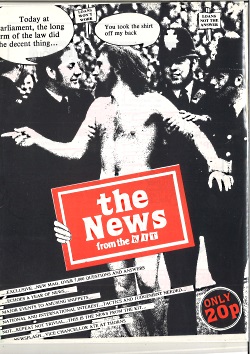
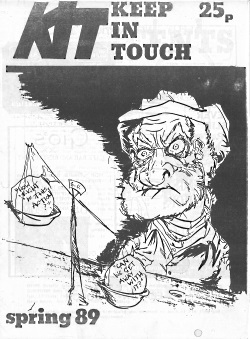
We thought we had a gap in the run of "Concourse" between 1989 and 1992. But we don't - the name "Concourse" was discontinued and replaced by "Keep in Touch", which was described as the Students' Union's official magazine. Apart from the new format, it also featured some excellent front cover cartoons and artwork by Danny Robbins (1995), among others. Among the later editors were Michelle Dalton (1990) and Sally Ray (1992). Another format was launched in December 1989 by editors Karen Millington (1992), Josephine Cussen (1991) and Amanda Davies (1991). In 1992, the name of Concourse was reinstated.
Keep in Touch Front covers below from 1989, Autumn 1989 and Spring 1989.
Known Concourse magazine editors since 1964
1964:Roy Dyche 1965: Liz Allen 1966: Martin Huckerby 1967: Dave Whitworth 1968: Jon Utting 1969: John Hartoch 1970: Nick Pullen 1971: John Davnall, Sheilagh Matheson 1972: Pete Varden 1973: Roddy Simpson, Dave Hadfield, Paul Bream, Tm Kelly 1974: Martin Jenkins, Tom Kelly, Martin "Hamish" McArthur 1975: Steve Doughty, Terry Ramsey, Len Tingle 1976: Pete Coulson, Helen Kyriacou 1977: unknown 1978: unknown 1979: unknown1980: Paula Higginson, Declan Kerr, Hugh Peart 1981: Dave Lee 1982: Owen Gavin, Gerry Guinan 1983: Pete Fowley 1984: Andrew Thacker, Guy Swindells, 1985: Quentin Rubens, February 1985 - February 1986: Krista Cowman, 1986: Richard Bettsworth 1987: Anita Brown, Dave Betts 1988: 1989-1992 Concourse was renamed Keeep in Touch: Sally Ray, Michelle Dalton; Clare Alverson, Rick Crownshaw, Ed Pentin 1993: Niki Khoroushi 1994: Katie Dunn/Claire Jones 1995: Mark Holtz 1996: unknown 1997: Ed Inglett 1998: Mark Fell 1999: unknown 2000: unknown 2001: unknown 2002: unknown 2003: unknown 2004: Ciara Hill 2005: Katherine Vine 2006: John Hutchinson 2007: Matt Alexander 2008: Rich Hill 2009: Nick Heath 2010: Fadi Dada 2011: Freddy Dammé 2012: Victoria Taylor 2013: Amy Tunstall 2014: Natalie Ilsley 2015; Carrie Hodgkins 2016
Compiled from Library archives by Esra Gurkan (2015) for the 50th anniversary of Concourse.
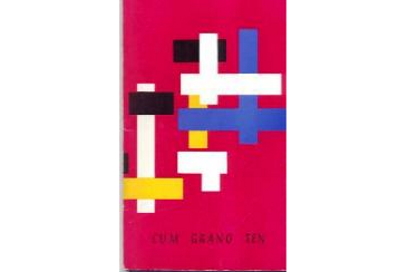
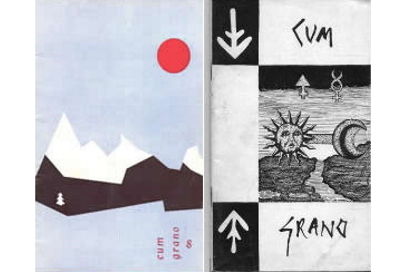
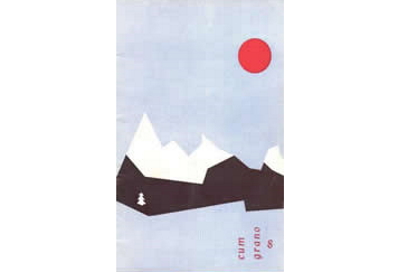
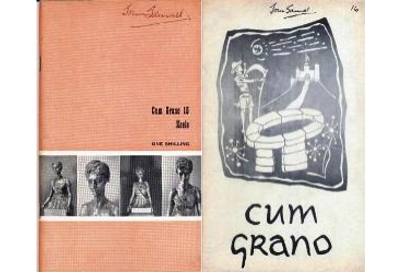
"Cum Grano was an early literary style publication during my time at Keele.. I have vague memories of being on the Editorial Board but the product never really gained momentum."
Bill Lighton (1954)
"Cum Grano was already in existence in 1956. Zulfikar Ghose was editor for at least two years and I'm happy to say he published me. I came second to David Pownall in a short story competition in 1957 or 1958 - I still have that Cum Grano if only I knew in which box in the attic. I have a number of copies of Cum Grano because Keele was THE formative experience of my life."
Brian “Ned” Lusher (1960)
"In the 1950's Cygnet was a newsletter of what was happening on campus. The magazine we all read then was Cum Grano with, especially, poems by Zulfikar Ghose who became a published writer."
Alex Wotherspoon (1962)
"For the literary minded, Cum Grano enabled people like Bryan Read, Zulfikar Ghose and Bryan Tyson to show off there talents; and the newspaper Cygnet, the best part of which was a regular Swiftian satire on Keele in the mould of Gulliver’s Travels written by Hugh Oliver called ‘Hoblyn’s Tour of Leek’. I had developed no literary bent at that time, but was Business Manager of Cygnet for a while following after Tony Powell."
Brian Vale (1960)
"I have a copy of Cum Grano edition published around September 1955. The Editors were then Harry Law and John Barker. It is around A5 in size and has over 100 pages including photographs, sketches, and advertisements from a fascinating and large number (about 100) of organisations and firms throughout the Potteries and beyond, which is almost a trades directory of the period A scrap metal merchant based in Stoke is also described as a rabbit skin merchant! A "literary style magazine" is a good way of describing the edition I have. It contains much readable prose and poetry and is not at all parochial. Contributors included John Blake, Peter Whelan and Frangcon Price, Bernard Gilhooly, Geoffrey Williams, John Periton and many others among the "literati" of Keele at the time. It was published by Batiste Publications Ltd, 20 Bedford Street, London WC2. It also contains an interesting Supplement "intended primarily as an introduction to the organisation and workings of the Students' Union". This lists all of the Union Societies existing at the time and the names of their officers. It shows that there was just one telephone in the Union at the time (Keele Park 232) and that one could buy one of two designs of scarf for 24 Shillings and Sixpence from the College Outfitters in Newcastle, namely Henry White's Ltd. Ties could be bought for between 9 and 15 shillings."
John Groom (1956)
"Cum Grano was a publication of the Students' Union. It was 'professionally' printed, by a printer in the Potteries. W hen I edited CG, we had a very amicable relationship with Audley Printers. I recall visiting their workshop, seeing the silvery metal in pots, the fresh metal letters and inhaling the smell of printing ink. It helped to set me off on a lifetime's fascination with printing and publishing. Offset litho and digital have none of those tactile pleasures! I was editor taking over from Edward Lambton probably around 1959. Audley Printers used to give us so many days credit for printing CG. We would go there in the car, dump them in the back seat, get them to the campus and sell them as soon as possible! The next visit to the printers saw us with pockets-full of cash, to hand over to the relieved printers. It was an early lesson in how to succeed in business without capital!"
John Idris Jones (1961)
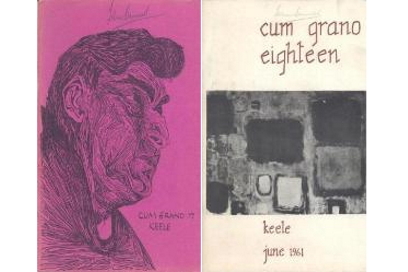
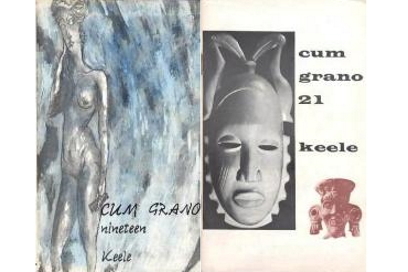
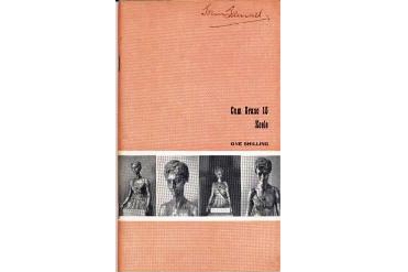
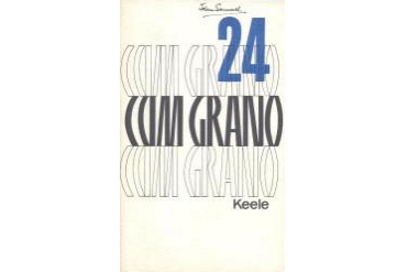
Lots of other student publications have waxed and waned over the decades, including:
Universities' poetry
Amongst Keele Publications some mention should also be made of "Universities' Poetry" which was launched in 1958 at Keele by Bryan Reed and Bryan Tyson. Zulfikar Ghose took over for "Universities' Poetry Two", producing a much more professional issue with an editorial board from other universities including Anthony Smith (Cambridge), John Fuller (Oxford) and Bryan Johnson (London), with Idris Jones (1961) as sub-editor. (Idris roped me in as business editor). The magazine was to run for several years with a national circulation, with Zulfi managing the editorial board after he went down until at least N° 4 (up to that date the magazine was still published at the "University of Keele Press").
Jonathan Upjohn (1961)
Keele left
"In the late 60's and early 70's we had Cygnet of course, plus Keele Left, New Penny Red and UNIT. Any others?"
Geof Branch (1971)
Keele Left, like most small, undergraduate, political publications had a somewhat chaotic career, with sporadic appearances and all too frequent needs for resuscitation. When I knew it (1960), it had just been brought back to life by Tom Simpson (1961). (It was founded by Roy Atkins (1959) and Zulfikar Ghose (1959) in 1958). It goes without saying that it was chronically in the red and with a tiny circulation. (a little under 200 - although, all things considered, this is not too bad for a student population of only just over 700). Aesthetically, it was, I must confess, rather amateur and scruffy in appearance as the cost of printing was prohibitive. This meant that texts had to be retyped onto stencils with a manual typewriter (entailing inevitable copy errors), and then the temperamental mimeograph machine had to be cranked round and round, the pages squared and stapled as neatly as possible. One incident I remember is setting off to Manchester on a Lambretta scooter with Stuart Scott perched on the pillion clutching a tape recorder (in those days a pretty large and cumbersome bit of machinery) to interview Alisdair MacIntyre. For the 1960 edition, the editorial board consisted of Tom Simpson, Stuart Scott, Colin Thomas (1962) and myself. The articles offer a fairly reasonable reflection of the preoccupations of the time. Ray Southall (1959) (the only student contributor) wrote on the threat that the profit motive in a capitalist society posed for education founded on liberal humanism. Alisdair MacIntyre (a Marxist philosopher of the New Left Review) discussed the future of the left, there was an appreciation of the contemporary London theatre scene: ('Roots', 'A Taste of Honey', 'Five-finger Exercise') by Gabriel Pearson (newly appointed as lecturer in the English department), while Rose-Marie Galy, recently back from a visit to Algeria, gave a report on the war and colonial mentality. For the next issue, in 1961, the editorial board was made up of John Borland (196), Christopher Cuthbertson (1963) and David Nightingale (1963) and there was a change in policy as, except for the case of John Bonner, (Economics department) who wrote on Nationalisation, all the contributions came from students. There were articles on the House of Lords, (Carolyn Crawshaw (1964)), a reflection on the role of the Cabinet by Derek Unwin, two opposing viewpoints on Unilateral Disarmament (one by Tom Clitheroe and John Garrad and the other by myself) and a review of the freshly published Listen Yankee (C. Wright Mills) by Sarah Carter (1964). Keele Left was, apparently, still going strong in the 1970s. However, it would appear that by then, that the editorial board had become somewhat more radical, with one issue devoted to instructions on how to make petrol bombs!"
Jonathan Upjohn (1961)
"Don't forget Subversity, the short-lived rival to Keele Left produced by the International Socialists."
Jason Hill (1971)
"I still have a few copies of Dagger Dagger from the mid to late 1970's, a sort of arts/politics/music/current affairs/science fiction magazine - i.e. usual student magazine stuff!"
Chris Parkins (1981)
"Not forgetting the Fuzzy Duck, which was going strong in the late 90s"
Laura Stamps (2001)
"'Green Monster' was as far as I remember an unofficial publication in the 1990s. I have a vague memory of it being banned for publishing what it claimed to be the most offensive joke in the world."
Joline De Ste Croix (1999)
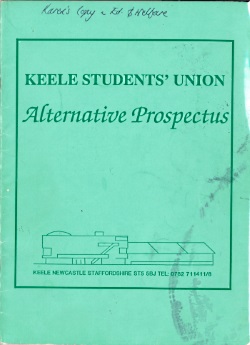 The alternative prospectus
Keele University Students' Union has frequently produced an alternative prospectus, giving a students' perspective to complement that of the official University prospectus. These were typically very informative, honest and practical and often humorous. The version pictured was edited by Kriss Fearon (1991) for 1990-1991 when she was Vice-President of Education and Welfare. Kriss filled many roles at Keele over many years.
And finally:
"The early days at Keele were very special , the relationships between staff and students were exceptionally close; the sports teams were remarkably good , drama, debate and academically related societies had high standards. At the end of the first four years there were also some pretty good degrees, but I do not recall a particularly left wing emphasis. Lord Lindsay's politics were well known and the new institution was certainly known as the Little Kremlin in the Potteries but to most students this was not an issue."
David Jeakins (1954)
Update January 2011
"The University Library holds an incomplete set of "Cygnet" dating from 1956 to 1982 (as it was published irregularly and without issue numbers, it's not always easy to tell which issues are missing). The Keele Oral History Project has supplied many previously absent copies of "Cum Grano", "Scythe", "UNIT", "WOOP!" and "Cygnet" and we welcome further additions to fill the gaps. Thanks to alumni, we now have complete sets of both Cum Grano and UNIT, but there are still gaps in our holdings of WOOP (we need 1959, 1961, 1963, 1964, 1968). Other University and student publications held by the Library include copies of "Keele Left", "Keele Newsletter", "Sacred Cow", "University of Keele Bulletin" and "Concourse". Concourse is still published by Keele University Students' Union which maintains its own archive of this newspaper along with its predecessors."
Helen Burton, Special Collections and Archives Administrator, Keele University Library