
Forever:Keele
Stay in touch with each other and with us
Alumni and Support Keele pages
Alumni
Explore this Section
Early Drama at Keele
Drama has always been important at Keele - and Drama was one of the very first student socieities to be founded by the original pioneer students in 1950. A Shakespeare play followed, and an annual "outdoor Shakespeare" has been performed every year since 1951...
Photo in Keele Hall Courtyard from Henry IV Part I (1952)
The "Annual Shakespeare"
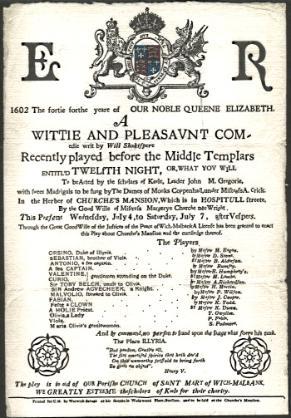
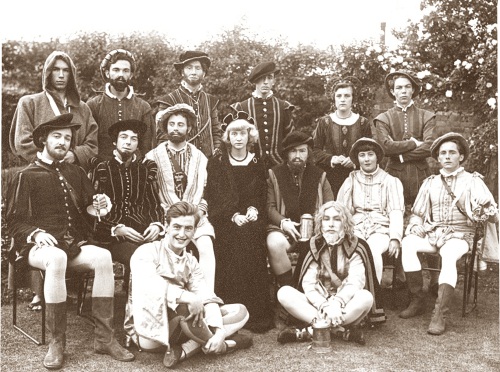
"The first Shakespeare play was Twelfth Night. I have the Elizabethan play bill before me and it was on July 4th - 7th (I presume in 1951) in Churches’ Mansion, Nantwich. This was a beautiful Elizabethan house which only just escaped the Great Fire of Nantwich. We were invited by the owners, Dr and Mrs Myott, the initial Pioneer dramatists performed in the open air using the garden with house as backdrop. They generously took on a motley crowd of undergraduates and a fine production ensued. Proceeds went to the parish church, still regarded as the cathedral of South Cheshire." Bill Lighton (1954)
“The first production was 'Twelfth Night' in the summer of 1951. I watched some of the rehearsals, but the performances were later at Churches Mansion in Nantwich. The thespians included Pat Fable, John (Sweeney) Todd, Thelma and Eric...” June Grocott (Kirkman) (1954)
Photo: the cast of the very first production by Keele Drama Society "Twelfth Night" (Nantwich, 1951)
"I am certain that there was also a production of Twelfth Night performed at the Top Lake of Keele Hall, using the island as a "green room", with a boat coming across the Lake and with Arial. 'The Tempest' was certainly no later than 1953, because Graham Lloyd-Owen (1954) was involved backstage (or rather, at the back of the island) and he left Keele in the summer of 1953. Peter Upton (1955) was Ariel was covered in greenish luminous paint - very effective in the gloaming - and there was a boat on the lake as well. 'King Henry IV Part 1' took place in the Courtyard of Keele Hall, at UCNS in 1952. Peter Whelan (1955) played Hal; Tom Parry (1954) was Falstaff, whilst Hedley Martin (1954) and Ray Garner (1955) were also involved. The performance was in the Courtyard of Keele Hall." Pam Lloyd-Owen (Harris) (1954)
“The first lakeside play was surely “The Tempest”? Peter Upton Ariel and John Gregson as Caliba…? John Barker as Prospero…? I remember selling anti-midge cream to the audience at 3d per small box. I think the very first Shakespeare was “Twelfth Night” - but for some reason not on campus.” Anna Swiatecka (1954)
"The first play to be put on at Keele by students was Shakespeare's Henry IV Part I. In the absence of an assembly hall Henry IV, Part I was played in the courtyard of the main Keele Hall building, presumably in the year 1951-1952. The following three Shakespeare productions were all performed in the open-air, enacted beside the top lake ‘in a natural amphitheatre’ (Sentinel) with tiers of wooden seating for the audience. In 1953 came the Tempest: it was an almost ideal setting for the play, with the background of trees, rhododendron bushes and the waters of the lake." Peter Shenton (1957)
"Peter Shenton (1957) was active in promoting drama in the early days at the University, producing and acting in operettas and plays, the latter making full use of Keele’s sylvan settings. In later life, whilst teaching in the local high school in Zurich he was also a prominent member of the theatrical society of Zurich. He took part, both as producer and as actor - from Gilbert and Sullivan to "A Midsummer Night's Dream," memorably by the upper lake amongst other plays." Stuart Phillips (1956)
"Peter Shenton was such an active participant in Keele dramatic productions of the 1950s (I particularly remember his performance as Créon in Anouilh's "Antigone" in 1956-57) and such a witty and engaging personality" Geoff Matthews (1957)
“There was an the open-air performance of Henry IV part 1 in the courtyard of Keele Hall. Tom Parry was an excellent Falstaff. “Romeo and Juliet” was performed in the same location, for which I arranged the sword-fights. Jim Egan (brother of Michael) made a handsome red-haired Romeo.” Martin Tunnicliffe (1954)
“I have no recollection of "Midsummer Night's Dream" by the lakeside, but I took part in "The Tempest" in that location, as one of a number of "spirits". Stripped-to-the-waist costume was a bit chilly, but I don't suppose the audience would have seen the goose-pimples on the "spirits". I doubt if this was in 1956 and as I was in Paris for 1954-55, it might have been summer 1954. Prospero was played by John (somebody) who, like me, was eventually ordained into the Anglican ministry. The swans made their fortuitous entrance, but decorously, and I forget during which act. They disgraced or delighted themselves and the audience in their impromptu love-scene the following year.” Martin Tunicliffe (1956)
"In 'The Tempest', Liz (?) was pushed across the lake standing in a punt, from the far shore to the large acting sarea, a feat she repeated at least once in a later production. Ffrangcon Price was Miranda, John Barker was Propsero and I was Ferdinand. But who played Ariel - and Caliban?" Peter Shenton (1957)
Lakeside Photo: Hedley Martin (1954) and John Gregory (1954) build a bridge over the lake for "The Tempest" - or was it "The Dream" (1954?)
“Wasn't Liz Pearson in the 'Dream' with her boyfriend James? As she was graduating in 1955 I don't think she was in 'Romeo' but seem to remember that she told us she'd been in "Dream". Liz was the 4th year in my hut in 1955... we usually had a senior student in each Hut.” Dot Bell (Pitman) (1959)
"It was in the 'Dream' when Titania was pulled across the lake on a boat attached to a rope. I know, because I was a stage-hand on the other end of the rope - and got bitten to death by midges." John Sutton (1958)
"I remember being involved in 1955 'Midsummer Night's Dream' by thelLake, the dark highlight of which was the abrupt end of the Saturday matinee when Puck (Peter Shenton) made his entry in heavy rain by leaping from a tree, slipped on the wet grass and dislocated his shoulder. Bit players like me were relieved to get in out of the rain. Peter came on that evening in running spikes, with his dislocated arm strapped to his body. What a trouper! 1956 'Romeo & Juliet' was held in the Clockhouse Courtyard; in 1957 we moved indoors for 'Electra' by Giraudoux. In 1958 'Macbeth' was performed indoors. They were all fine productions, because we were blessed with some very good actors, and also some fine singers and musicians, marshalled by John Groom, who staged some very good Gilbert & Sullivan." Ted Cawley (1958)
"I notice that noone has mentioned Bernie Gibbons (or Bernard Lloyd - stage name ) 1958 who went on to be a professional actor following his exploits at Keele; he was Captain in the production of HMS Pinafore (1956/57) and in Romeo and Juliet playing Mercutio. Professionally he played in the open air Regents Park Shakesperian dramas as well as many other things (maybe at the Globe too). On TV he was in an early court room drama and subsequently as a newsroom journalist as a "baddie" against the popular journalist! Another actor who was in Keele productions was a guy from our year - Peter Brookes who played the postman for many years in the Midlands soap "Crossroads" and I think he was Bottom in the Midsummer Night's Dream. Judy Watson 1959 was involved with costumes." Dot Bell (Pitman) (1959)
Photos Below: "A Midsummer Night’s Dream" (1955)
Glory Years?
Hundreds, maybe even tousands, of plays and performances have been presented at Keele. One memorable occasion was "Lysistrata", produced in 1963
Photo 1 below: "Lysistrata" (1963), Back row left to right - Joey Hickson, Richard, Mary Turner, Geoff White, Lyn Barron, Mike Rowley, Audrey Corkan (now Fogelman), Ken Watson, Hugh Springall. Middle row - Sandra Child, Mike Farmer, Pat Wilson, Al Donaldson. Front Row - Roger Frood, June Marsh, Nick Rowling
Photo 2 below: "The Trigon" (1966)
Photo 3 below: "The Flood" (1969, Edinburgh Festival)
Photo 4 below: "Minna Van Barnhelm" (1967?), photo by Jane Kingsbury (1968)
The University of Keele Theatre Company was formed in 1965 from members of the University Drama Group and first participated at the Edinburgh Festival in 1966. From the beginning they pursued a policy of producing new plays – which were either brand new or just new to the circuit
"The Keele company romp through it with the great gusto… supported by some highly inventive business it is a witty, pleasing jeu d’esprit’..." Review in The Scotsman on Hamlet – adapted by Charles Marowitz. Edinburgh Fringe (1967)
Macbeth was adapted by Ray Johnson and performed at the Edinburgh Fringe in 1968.
"This year the company is moving from Edinburgh to the Nottingham Festival: the reasons for this are both artistic and financial. Any theatre group which plays the same place year after year is bound to fossilize in its outlook… the main problem at Edinburgh was to maintain a reputation: at Nottingham we will have to establish a new one." University of Keele Theatre Company statement (1971)
"There was a great flowering of Keele drama at the end of the sixties, and I was privileged to be a part of it. In 1966 we started to take a theatre at the Edinburgh Festival fringe, producing two plays and a late night review." Francis Beckett (1969)
"In retrospect how rash we were for the Fringe 1966-8. A group of unknown student actors from an unknown university and yet we took on a lease of several flats, and the hire of several thousand pounds worth of equipment. We had very little money and no reputation…and yet it all did eventually work, we were an artistic and financial success! We acted, sold tickets, moved set, repaired costumes, acted again, and distributed publicity under the control of Geoff Sims and Jim Lagden. Eventually we ran what Harold Hobson, drama critic of the Sunday Times, called a mini-Festival. There was an early morning review, a matinee show, a mid-morning concert, a lunchtime show, an evening show and a late night revue and we ran a coffee bar with folk music all day and every day." David Radstone (1968) and Claire Radstone (Woodward) (1969)
Photo left: Keele Drama Group 1967-1968 by Linda Friis (Foster) (1970)
"I still have oneiof the 'Keele can Make You Happy Too' envelopes with all its original contents. The envelopes were originally made up for Keele in Edinburgh (KTC at the Festival Fringe) and contained programmes with notes of all the shows, a map showing the Keele show venues, a flyer with the same image of Prince Charles having the crown put on his head which had notes about the 1968 performances, and some other advertising. I had just returned from my year studying in France and went straight up to Edinburgh to join the KTC and help with the backstage bits before the start of term in my final year. One of my jobs was distributing these envelopes to the punters and advertising the Keele shows. tHE Company performed a morning show made up of a 'miscellany of theatrical pieces', an afternoon show which was a double bill of plays by Gunter Grass, 'Only Ten Minutes to Buffalo' and 'Flood', and evening show of two more new plays 'They Only Fade Away' by Peter Hawkins and 'Nebula One' by Ian Rolfe, and finally a late night show entitled 'Heliogabalus, the Hog' written by Francis Beckett who also appeared in it at least during the time I was there, joined by other visitors including Stubby Kay. I seem to remember that the show ended with the Company singing a series of songs related to sex and drugs ('because that is the only way we can get some publicity from the Press') under the title SMOKE SOMETHING SINFUL. Others who were there that year were Pete Sykes, Bill Paterson (now known in the Theatre world as Bill Alexander to distinguish him from the actor of the same name), Ann Richardson, Sue Haill, Tim Fletcher, Moyna Wilkinson, Mac Elsey, Murm Fletcher, Tony Smallwood, Kevin Daly, Ray Johnson, Joe Kelly and Dick Miller (the latter two were US exchange students). The envelope was obviously inspired by Charles's investiture as Prince of Wales that same year. If they were for sale in the Union Shop I can only think that there were so many left over that it was decided to recoup the printing costs by selling them to other students! Connie Robertson (1970)
The Ring Road Theatre
Photo: Another gripping scene from Henry IV Part I (Keele Hall, 1952) "We were old enough to fight for our country but not trusted to be in the women's residences..."
"Hmmmm, the Ring Road Theater (US spelling?) was founded in honour of someone, I forget whom. It grew out of the torrent of (quite competitive) drama activity circa 1970. It was started I think by Jim Lagden and Anne Williams? But many distinguished Keele theatre people were involved in getting the premises released by the University, doing the rudimentary conversion and making other arrangements. Pete Sykes and Bill Patterson (later professionally Bill Alexander), John Hartoch (or had he left by then?), Kevin Daly and many others. One of the two Chris Harrisons booked some remarkable bands (remember CMU?). There was a mixture as I recall of short plays, a revue etc with a late night Sunday emphasis. This was gratefully received by FY students as a displacement activity, meaning that start of work on the FY essays due for 9am Mon morning could be successfully delayed even later than when the Union bar shut promptly at 10.30 or 10.00 on Sundays. The hut was originally, I think the Horwood laundry store." Bernard Martin (1973)
"Having journeyed through Inner Space with Carlos Castaneda and been through the Doors of Perception, Heaven and Hell with Aldous Huxley and fed up with aping the words of the Dead, living or otherwise, Keele Drama gave birth to two revolutionary strands in the early seventies. One was Dadaist relying on multi-media absurdist juxtaposition whose prime movers were Owen Kelly and Derek Love. The other led by Peter Sykes and called the Keele Performance Group was far more radical. Heavily influenced by Jerry Rubins' Yippies and the Situationist International we tried to make theatre a transformative experience both for the actor and the audience. Drawing on everyone from Artaud through Stanislavski to Grotowski we used a series of exercises developed by Meyerhold designed to breakdown the character armoury, identified by Reich, that prevent us from being real. As such we ceased to be actors and became Actuals. We later evolved into R.A.T.T.{Ritual and Tribal Theatre} in homage to our perceived roots in ancient ceremony and shamanism. I have sent in a copy of a review in Plays and Players from the Student Drama Festival in Bradford (around 1972 ). The name of the performance was Fallacy. It had few lines, the most memorable of which was: "Did I come from an orgasmic f*** or what the f*** were they doing with each other". In memory of Peter Sykes and Gill Gill both dead before their time and of Gary Little." John Attenborough (1972)
"The action photo on Keele lawn was taken by a Martin somebody – can’t remember his surname for the moment. And the event was an amazing party we had after finals and while we were making our film of “Keele Life” we had to include an insane party, didn’t we? So not exactly theatre but cinema. And there never was a print of the film – we showed the editing copy (which my parents threw out when they sold their house). Ring Road theatre was so named because the hut was on the Ring Road – although wekept the name long after the hut had gone. And Georgiana Gore definitely had something to do with RATT" Adrian Stern (1976)
"Was it Roger Hough who founded Ring Road Theatre? He certainly had a lot of involvement in it." Steve Rowson (1978)"It genuinely saddens me that what was once regarded in its day as an institution and real cultural icon of Keele be so completely forgotten, as irrecoverable as Lyonnesse. I can perhaps fill in just a few gaps in what at the time seemed a distinguished history. Once upon a time, the entrance to Keele was not the new edifice by the Medical Schol but slightly further on from Newcastle towards the village. This was a driveway that ran in a curve around Barnes Hall (which may not even have been built at that time) then headed in a straight line to the centre of campus on its way to Keele Hall. However, with the arrival of the academic buildings such as the Library, and the new Students' Union building (alleged, in some way, supposedly to resemble a Mississippi steamboat) the road terminated in a small roundabout just in front of the library. The Union building wwas then still gleaming white) andwas quite literally set in the heart of countryside; beyond the ballroom there was no car-park, no science park, possibly only a safari park - literally fields and trees. And very charming it looked too. The University must then have expanded and one significant consequence was an extension to the Union building which overlapped the little roundabout that had previously served as the hub of campus. With that and other building work, the old drive was abandoned (apart from swelling sideways to become the Union car-park) and a new road was built that circumnavigated the exisiting buildings such as the Chancellor's Building, Biology, Geology and Geography and so on, and also the Union itself. This was, of course, referred to as the Ring Road. I suppose someone came up with the bright idea of having a revue theatre, probably a bit like Footlights and, I assumed, nicked the name, "Ringroad". Peter Bird (1982)
By the time I arrived, Ringroad Theatre was running approximately once a week in one of the curiously ill-designed function rooms on the top floor of the Union building. With no stage, no tabs, no regular schedule, few regular performers and no material, some sort of show would kick off that would include sketches, stand-up routines and anything else that could be lifted from the latest rag mag to hit campus from a rival college, along with ribald comments and assorted good-natured abuse, and a generally entertaining time was had by all, especially if one complied with the only entrance requirement, which, I think, was to be outlandishly drunk. As the bar downstairs never stayed open beyond 11:00 (10:30 in winter) back then but the building itself stayed open till midnight, most of those in attendance conformed with this proviso diligently, stocking up like camels at an oasis. Some of it was genuinely superb fun, a gallimaufry of entertainment, and how no-one went on to a subsequent fame and a career at the BBC is a mystery (unless someone did but hasn't owned up.) I finally decided to risk my hand, if not my sanity and my liver, by making my debût with a song, accompanied by myself on guitar, called "The Boring Lecture Blues." I was so paralysed with nerves, I lurched in front of the audience with a pint of bitter in one hand and a large Southern Comfort in the other, spilling some slightly. "At least I'm on a balanced diet," I slurred. When the crowd laughed at this quip, I knew I was home and dry and all went well. I have no idea who might have been running the show in those days; there was a finalist who lived next door to me I think had something to do with it. He achieved a different form of notoriety when, having finished an essay in the small hours, he attempted to smoke the stub of a cigarette he had been saving for this portentous moment, and accidentally set fire to himself. Later on, a chap called Andy Dowie and a Dutch girl who spoke fluent English with an American accent, called Kaya, seemed to have a loose hand on the reigns, along with a couple of other people. This stewardship led to other performing ventures, such as a Woody Allen play 'God', in the Ballroom at the end of exams, a Finalists' Review, and one or two other odds 'n' sods of comic thespianry and music." Peter Bird (1982)
I was away for a year and when I returned the previous luminaries had left. This was always the problem - just as somebody became adept at performing or writing they would do something silly like graduate. This fate, fortunately, had not yet befallen me. Ringroad appeared moribund but not forgotten. A whole bunch of us got together to do one mammoth show to relauch the Institution. Again I can't remember names of all those involved - there were quite a few - but three come to mind: Oluseye Odunsi, Alan Jones (composer of a song called "Keele Blues") and Liz Dainty. My apologies to the many others. The show was recorded on audio cassette and to this day I've never dared listen to it. As successful as this show was, (it was absolutely packed out despite running for about three hours) this was not the re-launch we had perhaps hoped for. We'd used up every bit of material, gag and half-idea we had, as well as co-opting in performers from other fields, and we had nothing left. Two of the cast at least were approaching finals, someone else dropped out, and there were rumours of mass nervous break-downs. There wasn't another show, as far as I can recall, at least not one with which I was involved. Some time later, I happened to be back at Keele, and to my delight there was a Finalists' Review being performed by a whole new gang of Ringroaders, none of whom I knew at all! I booked a front row seat and saw one of the funniest shows of my life! Especially the sketch, completely without words, where an exam candidate took out a real camping stove from his jacket and warmed up a tin of beans over his exam paper. I felt the show was in good hands and would, as they say, 'go on.' It breaks my heart to think it's no longer there. Or perhaps it is, but under a different name. There was a rumour that there was also a University around Keele somewhere but the important bit about Life on the Hill was Ringroad." Peter Bird (1982)
Photo right: Another epic scene from "Romeo and Juliet" - Jim Egan (1958) as Tybalt on the lawns in front of Keele Hall.
"According to my
diary the Old Gym Theatre or Ringroad Memorial Theatre opened on Sunday 1st February 1970 almost immediately after the Keele Drama Group’s triumphant week at the Manchester Granada Theatre performing the winning entry for the NUS Student Drama Festival ‘Vietrock’. I have a Xeroxed ‘Gala Opening’ programme which reads:
1. Guerilla Theatre (which was definitely Pete Sykes etc)
2. Turnip Johnson and the Mint Imperials (who were they, I can’t recall!)
3. Marye Smith and Michele Edwards (did they do a sketch?)
4. John Cronin and Warren Coleman (don’t know what they did - a sketch too?)
5. ...and, perhaps, Derek Love
At the Bar: Roger Freeman and Dick Offer and ...your very own ‘Cuddles’ It was signed AW which was definitely Anne Williams.
It continued to operate every Sunday night – at 10.45 pm - and had a licence from the Union Bar to serve drinks (beer anyway) after they closed.
A Programme for 22 February 1970 has Jo Hainstock, Guerilla Theatre, Mike Reynolds and Moyna Wilkinson doing Noel Coward, Derek Love etc, Francis Dobbs and Stuart Gordon, Geoff Webster, Martin sings... plus a Guest Star appearance of Dannie Abse, Jeremy Robson and Vernon Scannell. How did we manage that? At the Bar that night were: Peter Sykes and Roger Freeman One more programme from that term was a Vaudeville Music Night with Marye Smith and Berni Broome, The Persian War, Michele Edwards and Kirstine, Porter and Ale: Mr Sykes (Peter), Tea and Sticky Bus: Mr Freeman (Roger) and your own your very own Miss Constance Robertson. House Manager was Mr Reynolds (Mike). The Old Gym reopened for business in the summer term on 3 May 1970. This was around the time of the Petrol Bomb mentioned by Gill Gill. I did not attend much at this time because I was in the middle of Finals. There were some interruptions such as the Hollywood Music Festival but the term ended with the Ring Road Festival 20-25 June with Performances at midnight (!) of ‘Hunchback’ – The Iona Theatre Workshop (which later became RAT Theatre or RATT) on 20, 21 & 22 June, and a double bill of new plays written for the Festival. These were ‘Demon’ by Geoff Ndhala* and ‘FATS’ (The Farmer and The Stork) by Colin Shearman on 23, 24 & 25 June. Tickets cost three shillings for one night and five bob for two nights! I was the Producer/Director for Geoff’s play." Connie Robertson (1970)
"In 1981-82, John Dawson and I were doing the Ringroad review show on Sunday nights upstairs in the Union bar after closing time. This guy came along a few times and did the soliloquy from Hamlet, but using place names: "Torquay...or not Torquay, that is not Wrexham!" etc. I naturally thought he'd copied it from somewhere, but I reckon now it might have been original work! Does anyone else remember the guy and the soliloquy?" Dave Lee (1982)
More Memorable Productions
"Audrey was in "The Seagull", the start of which was delayed for an hour before the decision was taken to continue despite having just heard of the assassination of John F Kennedy." Ken Fogelman and Audrey Fogelman (Corkan) (1966)
"I recall being very heavily involved in reworking mounds and mounds of redundant orange, green and brown ex-Horwood and Lindsay curtains into costumes for the play 'The Caucasian Chalk Circle'! So much so that I blame all this extra-curricular seamstress activity in my final year with my less than glorious grades! Perhaps, I ought to have graduated in Adaptive Textile Design, recalling some of the momentous fancy dresses we dreamt up and produced in the four years we were at Keele - bespoke yet complimentary togas, jungle creatures, Robin Hood…" Fiona Whitelaw (1985)
Photo: Another Adrian Stern "special" from 1976 - what play was this - or was this just normal Keele life?
Keele Drama Society 2012
KDS remains one of the most active societies in the Students' Union, staging five productions a year, consisting of two published plays, a student-written play, a One Act Festival charity event and the annual outdoor Summer Shakespeare (always the final production of the year). Members of the society participate in all aspects of production - whether on stage or backstage assisting with tech, lighting, front of house and publicity.
Current KDS Website 2012
This story for the Keele Oral History Project was researched and written primarily by Keele student Rosie Wells (2013) as part of a History project in 2012.
Did you enjoy this?
Why not read more stories from the Keele Oral History Project?
Keele University
Drama has always been important at Keele - and Drama was one of the very first student socieities to be founded by the original pioneer students in 1950. A Shakespeare play followed, and an annual "outdoor Shakespeare" has been performed every year since 1951...