

Varsity and the Athletic Union Bell
Keele University's Athletic Union plays an annual multi-sports series against our neighbours at Staffordshire University. We call it Varsity and it is the event of the sporting season. Growing from one sport in 2001, Team Keele and Team Staffs went head to head across 23 sports in 2017. Keele retained the trophy for the 8th straight year.
The Varsity Football match between Keele University and Staffordshire University was founded by coach Keith Harrison and Men's Football 1st Team Captain Rich McPartlin (2001).
"The inaugural Keele v Staffordshire Varsity match was started in 2001 by KUFC Coach Keith Harrison and Richard McPartlin, the then Keele 1st Team Football Captain. With the support of Newcastle Town FC, they succeeded in achieving their vision for an annual event in aid of local Trentham children’s charity, The Donna Louise Trust. Tragically Rich was killed that September after graduation in a car accident so the coveted man of the match trophy, awarded in his name, remains a proud legacy at the event he helped to create. With the success of the Varsity, Rugby and hockey games soon joined in subsequent years, with the football match remaining the evening finale to the event, which now includes 13 sports and is still growing!"
Dan Little (2001)
"A few months after graduation Rich died in a car accident on his way to a reunion with fellow footballers at Keele. Rich did a huge amount for Keele FC and the AU generally; he really turned the football club around on and off the pitch. Part of his amazing work was to establish the Varsity match in aid of the Donna Louise Trust children's hospice in Trentham."
Richard Morton (2001)
"Rich helped to found the first game (and actually won it with the goal of the season free kick in golden goal extra time to give us a 1-0 win)! I played in the match and even then it felt like something special had been created and would carry on for years to come."
Dan Little (2001)
"In 2000 I took part in the Marathon des Sables, across the Sahara Desert, to raise funds for the Donna Louise children's hospice, where I am now a trustee. At the time I was just an eager supporter and fund-raiser. On my return from the Sahara, the Captain of Keele Football 1st XI, Richard McPartlin, asked how the football club may help to raise further funds for the project. I suggested a football match between the two local universities. We had hasty meetings with Staffordshire University football club members in "The Terrace" public house - and the idea was up and running. Many of my local contacts were leaned on and co-opted: Newcastle Town FC, local match officials etc. After a great deal of persuading, all came together and the project was a little closer to reality. It was my ambition to get the Keele University and Staffordshire University footballers involved in local charitable issues and what better way than to create a sporting fixture between the two. It was Richard McPartlin's desire to allow him, and his fellow students to leave a footprint on the local landscape. I suggested to Richard that the hospice trust was the perfect connection for the football club and Keele University Athletic Union and he agreed. The fixture was a replicable high profile fundraising event. The Varsity fixture was ready to unfold. All the plans were made over a few possibly two or three weeks. It was quite a hasty start for Varsity – but we got it right."
Keith Harrison
Rich McPartlin's shirt is displayed in the Sports Centre and his shirt number has been retired. Keith Harrison received the award of Doctor of the University honoris causa in 2014 for his services to sport at Keele University and to local charity. His shirt was retired after he passed away in 2016.
"There are two trophies. The Varsity Trophy is partly made from a small piece of the planet’s greatest monument, Mount Everest. I had the good fortune to take part in the first ever Mount Everest Marathon in 1987. I could not run past this giant without bringing a piece of her home. The piece of "rock" atop the trophy signifies the heights that our two universities strive to achieve both in a sporting and in an academic nature. The second trophy was donated to the Varsity football match by the parents of Richard McPartlin, who was tragically killed in a car crash in 2001. This trophy is awarded to the Man of the Match. Richard is proud of the Varsity fixture, I’m sure. I can only say he would have challenged to win any trophy on offer with class, determination and power. Whoever takes the trophy can feel proud of their achievement."
Keith Harrison
"Richard McPartlin’s parents, Pat and David, are always keen readers of the Varsity programme and very proud of the part he played in helping Coach Keith Harrison establish the event back in 2001."
Dan Little (2001)
Photo left: Rich McPartlin's shirt is displayed in the Sports Centre and his number has been retired.
It is believed that the AU bell was originally one of a set of hand-bells belonging to the ringers at St John’s Church, Keele. Tune ringing on hand-bells was, and still is, a fairly common activity, particularly in the North of England. Some of the groups who did it were bands of ringers attached to churches, although the skills required for the two activities have very little in common. A typical set of tune-ringing hand-bells often included as many as forty or fifty bells.
 When the St John’s ringers split up in the 1950s, they each took with them a share of the set of hand-bells. Twenty of these bells, by then in a derelict condition, were recovered for the Keele University ringers in the early 1970s by Bert Moss, a member of the old band who worked for the University as the Vice-Chancellor’s gardener. All but one of these derelict bells were sold to help finance the purchase of a new set of hand-bells for change-ringing by the University Change Ringing Society, but the largest one was kept. It carries an inscription recording that it was cast by P Rogers & J Symondson, well-known London hand-bell founders in the nineteenth century. They were successors to Henry Symondson, whose initials also appear on the crown of the AU bell. It was common practice for patterns from which bells were cast to be passed down from generation to generation.
When the AU bell was returned and shown to Phil Gay, a member of the Keele band since 1963, he immediately made the connection with the inscribed bell in his possession, and comparison of the bell profiles and style of the letters indicating the notes of the two bells provide strong evidence that they were indeed cast by the same founder. It seems likely that most of the old band of ringers at Keele had been workers on the Keele estate, many of whom were taken on by the University. One of them must have left one of his bells in Keele Hall.
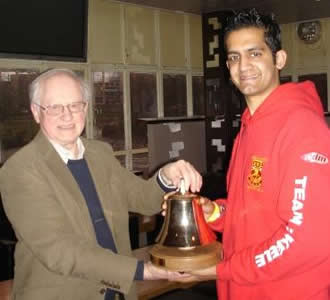
The AU bell was rediscovered - discarded and derelict - in the cellars of Keele Hall by one of Keele’s earliest students, Keith Clement. The bell served for many years as the base for a table lamp before Keith returned it to the University in 2007 with the wish that it should serve a useful purpose.
Photo left: Keith Clement (1955) presents the AU Bell to AU President Manminder Purewal (2008).
The bell was accepted by Keele University Athletic Union to be rung proudly in celebration of honours and colours awarded to Keele students. The Bell is also rung to announce the speeches and toasts at Keele reunions.
The mounting of this bell was organised by Phil Gay, a student at Keele from 1961 to 1965 and subsequently a long-standing member of the academic faculty. He received help from others, notably Graham Barnes of H E Butters (Engineers), and Stuart James who did the wood-turning. Phil Gay also researched expertly the history and provenance of the Bell.
The inscription on the base of the bell quotes Ignas Bernstein: "Do what you know best; if you're a runner, run, if you're a bell, ring!"
"I recall receiving a life-time achievement award in 1983 from the Keele Ladies Rugby Club. 1982/1983 was an important time in the development of women’s rugby and football. Encouraged by Moira MacDaid (1984) and other members of the Keele Ladies rugby team, I stood for chair of the Universities Athletic Union of England and Wales with an election promise of pushing for greater opportunity and equality in women’s university sport. I was elected student chair of the UAU and then sat on the Boards of BUSF, BSSF and the World Student Games Committee (now all under the BUCS’ umbrella). I am not aware of any other Keele student who has been elected chair of the UAU. I am sure that it helped my election chances that the majority of AU presidents from other universities at the time were women. In this capacity I was able to push through reforms and get the necessary funding for the first national UAU tournaments in both Women's Rugby and Women's Football. In 1983, Keele hosted the inaugural UAU Womens Rugby Tournament. I cannot recall where the first national football tournament was held but I think it was the same year. Women’s rugby was already doing well with clubs all over England and Wales at the time. Indeed, England had a national team in 1982 even though they did not play competitively against other national sides until the late 80s. When I went to Loughborough from Keele in 1983, I knew the England Women’s fly half and this was the year the Women’s Rugby Football Union was formed. But Keele certainly kick-started women’s university rugby as a nationally recognised competition."
Francis Bacon (1983)
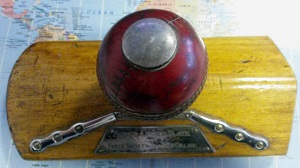 The 'Scott-Lusher' Plate is a very unusual trophy. It was presented to the winning team after the Alumni versus Students Cricket Match from 1959 onwards. The trophy comprises a cricket ball attached to a cricket bat by a metal pin. The pin was used to repair Brian "Ned" Lusher's leg after an accident while he was at Keele.
Brian was a Pioneer student at Keele from 1956 to 1960; when he passed away in 2016, his Keelite daughter Gina Lopez (Lindsell-Lusher) (1991) asked for this precious relic to be returned to the family if it was no longer in use. It may no longer be in the AU Trophy cabinet but it - and Ned - are not forgotten.
The main inscription reads "SCOTT-LUSHER PLATE - KEELE SOCIETY VERSUS THE COLLEGE and the smaller one - INSERTED JUNE 28 1958 / EXTRACTED JULY 1 1959 - the dates when the pin was inside Brian's leg.
"As far as I remember, the Scott mentioned in Ned Lusher's trophy was Dr Scott, medical officer at Keele during the 1950s. he was still in office when I left in 1961."
Sheila Everard (1961)
"I was at Keele from 1964 to 1968 and was secretary of the University Cricket Club in 1965-66. I recall playing for the students against the Keele Society in 1965. I also played from what we called Keele Past against Keele Present in 1973, 1974,1975, and 1976, organised by Brian Stokes (1954). In 1965, the students won by about 7 runs. We made about 154 (Roger Bayes (1967) got 70-odd) and the Society about 147 (a staggering 115 or so from a tall bloke called Chris Reiss (1964). The 1970s matches were all drawn except 1975. I was on the winning side. Keele Past got, I think, 212 for 5 with Roger Mayes (1968) scoring 102 not out. Keele Present (the students) made 186, so we won by 26 runs. I took four for 35 and Martin Dent took three wickets."
John Meager (1968)