

Freshers' Gate & Frank Godfer Hall
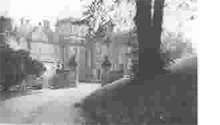
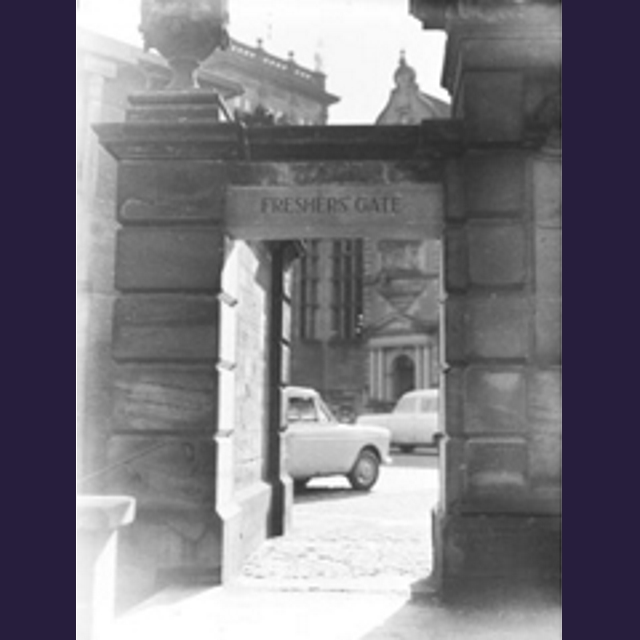
Everybody who has visited Keele Hall has walked through the little pedestrian gate that leads into Keele Hall courtyard. We have all read the mysterious inscription "Freshers Gate" above our heads, but few know its true origin and meaning. Now - after nearly fifty years - the truth can be told.
Who painted "Freshers Gate"
 The label "Freshers Gate" was the brainchild of Mike Vaughan (1961) and painted during one of my first three years as a student: 1957-1960. Mike, who was a contemporary student, did the painting while I held the paint pot. At the same time, we also painted the words 'Frank Godfer Hall' - a play on the University's motto 'Thanke God For All' - on the entrance to the now-demolished RAF Hut which was used as an annexe to the Refectory. That one was my brainchild. Again I held the paint pot for Mike. These labels were both put there at a time when buildings were being rather pompously labelled and I guess we were poking fun at the establishment.
John Grundy (1961 and staff 1963-2003)

"The gate was constructed sometime while I was at Keele - 1956-60. I think there were alterations to the entrance to Keele Hall courtyard to separate pedestrians from the increasing volume of vehicles - at least 10 a day! I don't know who thought up the “Freshers Gate” idea and painted the sign, though. During this era also, a wooden hut was brought into use as an overflow refectory. One morning we arrived for breakfast to find it bearing the legend 'Frank Godfer Hall'."
"Frank Godfer Hall was an RAF hut between Keele Hall and Horwood. I remember it well. It was used, I seem to remember, as an alternative dining facility, though I can’t remember why food was served there as well as in Keele Hall Refectory. We used FGH for rehearsals with our embryo orchestra when Moberly was not available at exam times. We had to wait to get in until meals had been cleared away, and the residual smell tested our musical resolve to the limit!"
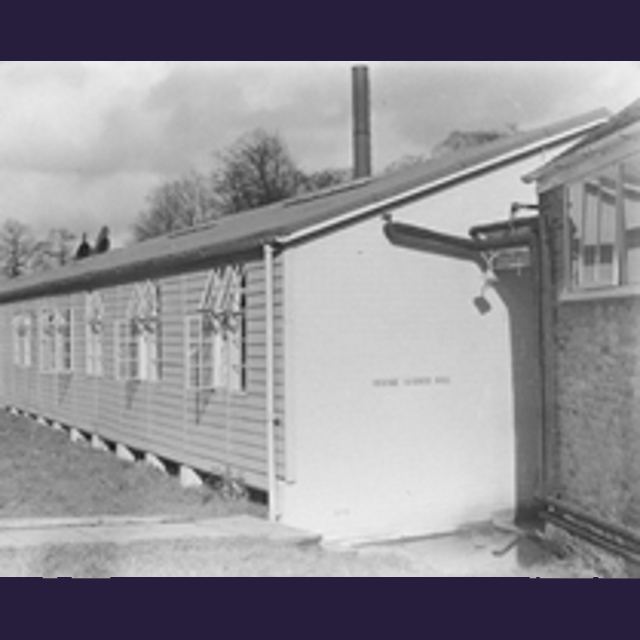
"My memory is that the hall was called something like 'the refectory annexe' and we used to have breakfast there. Then one morning we came and saw that it had a name written on it:'The Franke Godfer Hall'. As people queued up for food they would suddenly burst out laughing, as they realised it was indeed a joke based on the Sneyd motto 'Thanke God for All'. A student must have done this – I wonder who it was? It was a joke which I think most people enjoyed."
"I certainly remember eating at lunchtime on several occasions at the RAF Hut, which I think was just down a short leafy path off the main road to Keele Hall. Nearby was the hut where I had English tutorials with Prof Michael Lloyd. I think folk ate in the RAF Hut when Keele Hall got crowded; as far as I recall, it served the same food as the main refectory. My main memories of eating in the RAF Hut come from 1962-1963, partly because I remember having a conversation with Jake Murray about Ray Charles while in the lunch queue. I think Ray Charles was coming to play somewhere in the region. It was that same hut in which I tried, and failed, to learn to play golf one early semester - 1959? 1960? I had totally forgotten (did I ever know?) it was also called Frank Godfer Hall."
"I clearly recall MANY times sleeping in so late in F Block that I was often the last person allowed to eat lunch at the refectory. All that was left were green salads with a sort of mayonnaise dressing. I got used to it as breakfast and, indeed, it was probably pretty healthy. I have fond memories of very tasty gammon suppers at the RAF hut and being bewildered when, unannounced, the kitchen closed and I was forced to eat again at the Keele Hall refectory. I recall searching several times for Franke Godfer Hall but, for some reason, failing to find it Never got gammon again. I believe it led to bad dreams of looking for and not finding something important. "
"I think it's been long enough since it happened that the people involved should receive due credit, although they certainly needed to avoid it at the time. The first year I was at Keele (1959)..."
Read more about John Mainwaring (1963)
"Freshers Gate is the baby of tradition. The concept was never really originally Keelian; it's a direct descendant of the 19th century public schools like Rugby, where the class structure was firmly established. Tom Brown would have recognized it instantly, as would the British Army. Hierarchy was everything. Coming out of National Service, I nearly saluted before I walked through it, on the grounds that I hadn't earned the right to pass through the main gate! How's that for instinct?"
"I was at Keele from 1961-65. I believe that the sign appeared in 1961/2. I do not know who the presiding genius was at the time - which is interesting as the authors of such wheezes were usually congenitally unable to bask quietly in their success and therefore the identity of most of them soon emerged."
"I remember the Freshers Gate from my time at Keele 1960-64 (not sure if it was painted there in my time or before). I went through it on my way to lunch, if I didn’t eat at the Franke Godfer Hall. My impression is that both inscriptions arrived at the same time."
"The wonderful thing about Fresher Gate is the amount of attention it is causing. Somehow it must really touch a nerve much greater than the average daft prank. On my first day, I was with a group of new friends and we walked over to Keele Hall. I am not sure we realised exactly where the refectory was, and there it stood: Freshers Gate."
Read more about Richard Tedstone (1966)
"Ditto... same time, same place, same response."
"John Grundy (1961) also became head of counselling at Keele - I think taking over when Audrey Newsome left, and he retired in 2004. He'll be remembered by many students and staff for his counselling role here. One of the things which stuck in my mind most is him telling me that he held the can of paint whilst the painter painted 'fresher's gate' above the arch at Keele Hall. Every time I walk under it I smile. "
"I am fascinated to learn that no one who was a fresher would go through the gate and that no one who wasn't a fresher would go through it either. I’m sure it was at least Year P3 before I went through and on graduation day made a point of being photographed in it, in case I had never gone through before. "
Apostrophe catastrophe?
"This story revived interest in the "Freshers Gate" sign. After enduring but fading bdaly for nearly fifty years, it was repainted to its former glory in 2009 by a University signwriter. The eagle-eyed will notice that now is there is an apostrophe on one side and no apostrophe on the other. In my view there should either be no apostrophe or it read thus: Freshers' Gate. It so happens that it now reads Freshers Gate on one side and Fresher's Gate on the other. The explanation came finally came from a 2015 graduate who chooses to remain nameless in 2016."
John Easom (1981)
"The apostrophe on Freshers Gate was in fact added by me, assisted by a watchman from my course in mid-2013 and it had been absent up to that point. We felt the sign should have the apostrophe to be correct, but it was only weeks later we noticed the sign was painted on both We felt the sign should have the apostrophe to be correct, but it was only weeks later we noticed the sign was painted on both sides, and never got round to adding the second. I hope I don't get withdrawn retrospectively from my course."
Anonymous (2015)
And to show that legends grow quickly and can change just as quickly...
"Freshers Gate was painted on by the Women's Hockey Club one night between 1961-63 after the opening was made into Keele Hall courtyard to make it safer for pedestrians. Up till then, one diced with death in the form of staff cars which raced in and out of the courtyard. At about that time, there was a visit from the UGC and the main buildings of the university were renamed in honour of some of the members of the UGC - the conference hall became the WMB and the New Teaching Block, the Tawney building. The hockey club named a temporary dining hut The Franke Godfer Hall as a parody of the Keele motto and I believe that Freshers' Gate happened at the same time? Can anyone else remember? I can't remember if we tried to make the following year's freshers walk through it or not."
Hilary Lainé (1963)