

Early pranks and japes
Any student who has passed through Keele University has, at some point, thought about or taken part in a mischievous jape. Some are more memorable than others and live on in Keele’s memory.
One of the longest-lasting marks left by early pranksters can still be faintly seen in Keele Hall courtyard today..
"I recall the message on the inner wall of the courtyard very well. It read - GOOD LUCK LADS! I seem to think that it appeared on the morning of the very first Finals Examination in 1954 rather than the first Foundation Year exam in 1951 as suggested by others. I never found out who the pavement artists were, but it was a huge boost to some of the first finalists, including me."
Edward Derbyshire (1954)
"I have part responsibility for Good Luck Lads and it was 1954. I am glad it cheered up some of the first years on the eve of the exams. The paint used for the "Good Luck Lads" slogan was emulsion not gloss. We thought it was whitewash and would come off easily. In retrospect also sexist in tone. One of the more embarrassing memories I would prefer to forget!"
Philip Sheppard (1952-1954)
"On a wet day the last remnants of Good Luck Lads – the D" of Good, a vague outline of "Lads" and the "K" from Luck – can still be seen today. The sandstone walls must have absorbed enough of the white paint to endure the wind and weather for over sixty years. Clearly the women graduates of 1954 - who formed a very high percentage for the time - didn't need any luck with their exams, unlike the lads...."
John Easom (1981)
“Does anyone else remember Princess Margaret's visit, when a toilet was cemented over the entrance of what is now the Walter Moberly Hall? And dustbins were arranged on the grass draped in undergraduate gowns? Some people did this or something similar during my fresher year 1960-61, but my recollection is that we did it in the middle of the roundabout, having emptied their contents around it. This was conceived as a protest against all the cleaning and polishing that had gone on in the week before her visit. If I thought hard I might be able to remember who was involved. It must have been some of those dreadful bounders who went to the "republican party" which always coincided with Commemoration Ball. How about the huhaw about wearing CND badges when being presented to Margaret Windsor at graduation?”
Colin Smith (1964)
"On another occasion, we stole very early in the morning into the RAF hut (photo) the subsidiary eating hall on the way to Keele Hall, and removed every seating cushion from the chairs. We hid them in a nearby university gardening shed. We duly went to breakfast at the normal hour to observe the result, half expecting the seats to have been already found and restored to the chair frames. But they had not been found, and so everyone used the dining trays as impromptu seating surfaces. I think it may have been several days, even a week before the seats were restored to their former state. We never heard anything about this prank: no enquiry, no investigation, and no punishment."
Jeremy Steele (1962)
Cars and Motorbikes
"Items placed on top of the Refectory roof at different times during 1950-54 included a white porcelain toilet filled with purple rhododendron flowers and Clive Collier's (1954) motorbike. I was given to understand that Clive was lent a climbing rope with which to lower his machine to the ground - the same item had been used to raise it on high!"
Ian Cameron (1967)
"Regarding the motorbike on the roof, I was involved to the extent that it was my motorbike, a Velocette LE. It happened in early 1953. I always suspected Tex Cooper (1954), for two reasons, he knew something about scaffolding and was sufficiently familiar with the incident to be very helpful in getting the bike down. Another suspect was Russell Towns (1956). He was something of an expert on motorbikes and was said to have been in the Royal Signals Corps display team. Anyway, he too was sufficiently familiar with the situation to be helpful in getting the bike on to the ground."
Clive Collier (1954)
"I seem to recall that a certain gang of chaps dismantled the old car of a member of staff and put it back together again on top of the refectory, which of course in my day and age abutted onto Sneyd Hall. I think that it was made clear that if the car was returned in working order nothing would be said."
John Pearson (1958)
"The car which ended up on the refectory roof was a Morris Minor and belonged to Michael Lloyd, assistant Lecturer in English Literature."
Benita Plesch daughter of pioneer Professor of Chemistry, Peter Plesch
"A motorcycle combination (some unknown lecturer's) was dismantled, sent up to a roof possibly of the new Chemistry building, reassembled and ridden around by a group of pranksters. I never knew how much my father was telling the truth and how much was wishful thinking. It would be very interesting to hear confirmation of these events."
Tony Budd (1963)
"I remember the Keele Car Rally, the exact date escapes my memory (at age 83) but it was 1953-1954 The vehicles, mainly belonging to the Staff were lined up on the hard-standing in front of the Geology Department. Professor of Geology Wolverston Cope arrived with his sleek, expensive green Armstrong Siddeley 'Sapphire' complete with a chrome Sphinx as radiator mascot. He lifted the bonnet where the rubber-mounted engine purred away. Rally Rules were posted, including a warning that "all signs on the Campus must be observed". With the Sapphire's engine really warmed up the Prof. was flagged away and he zoomed off. The course involved timed stage checks, the first at the exit to the Newcastle road. Eventually, vehicles returned and were clocked in. The Sapphire with a triumphant Prof was first back. Had he won the Rally? No, he had exceeded the 15mph max speed limit on the campus road to the exit. Disqualified, the angry Prof and the Sapphire more slowly left the scene. Who won? A senior Physics Lecturer driving an old Morris 12! Those were the days!"
Peter Paice (1956)
"Did Professor Finer take part in the car rally? So small he could barely see out of the windscreen. I think he used a booster seat!"
Derek Evans (1957)
"In about 1963 or 1964 I was living in F Block and there was a fellow in the next building who had a skiff lying upside down on the grass. There was no better place to store it I guess. There was some left wing comment and grumbling so we conspired to relocate it to the fountain inside the Chemistry building. Around 2am eight of us heaved it up and travelled uphill with this beast of a vessel. It weighed much more than we had anticipated and the hill was steeper than we had. After rest stops and alarming encounters with people on their way back from evening trysts we deposited it in the pool, where it just fit. It was days before the hapless owner could mount the help necessary for its removal. It never graced the grounds after that. To this day I do not know on whom we played this trick."
Richard Barker (1966)
Thorns Student Garage 1977- 1981
Back in the day quite a lot of students managed to run cars at Keele, when petrol was charged in gallons and its price was measured in pence, and you could insure a car as a young driver without mortgaging the parental home and selling a kidney. The car parks were populated by a wonderful assortment of vehicles of varying vintages and conditions – from newish BMW’s (very scarce) to rattling old rust-buckets, for which the MOT was an annual ordeal to rival end of year exams. Their owners were without fail proud of them and delighted in the independence which they conferred on an impoverished undergrad.
"Keeping some of the cars operational however, was sometimes challenging and technical expertise varied widely among the motoring fraternity. Even with knowledge, there was the issue of tools and the prospect of having to work on a vehicle in howling gales, rain, sleet and snow till you couldn’t feel your nuts, washers or bolts. So, with enthusiasm and a spirit of goodwill engendered by a few pints of Ansells at our beloved Sneyd Arms – an idea formed. A proposition was taken to the Hall Council and Warden Carol Holder. We had learned that a small garage close by the warden’s house contained an electricity supply and an inspection pit . We later discovered the inspection pit contained about 150 gallons of stagnant water, oil and sludge. If the Hall Council would support the project with a small fund for cleaning materials, paint, a few specialist tools and cover the electricity – a few of us would contribute the manpower to make it into a usable garage to service cars. It would be available to any of the students who wanted it to do their own maintenance. For those who didn’t have the technical knowledge – we would contribute knowledge, use of tools and where necessary support, brute strength and the resourcefulness. We would help people learn where they wished to, or help them out when they didn’t. All without charge other than parts and consumables …. And “maybe a pint when you see us down the Sneyd”. The proposal was enthusiastically approved by Carol and the Hall Council and the Student Garage became a popular resource for a number of years. Tasks ranged from oil changes and tune ups to engine and gearbox rebuilds. Most people who used it also became willing helpers of the “Oily Rag” community. Happy days – and a far cry from car maintenance today when you can barely open the bonnet without IT support. And for the happy “grunts” who ran it the reward of seeing people able to enjoy their motors... and a steady supply of liquid thank yous."
Graham Boocock (1981)
Free Parking Permit Anyone?
"When I lived off campus there was a tremendous hassle every time I came on to campus as there were not nearly enough parking spaces – I think we were only allowed to park in the Union car park. I can’t remember what the porters actually did about it if we parked “illegally” and most were quite friendly but Charlie Wainwright was one of a kind. Now this may seem fantastic to you who cannot remember an age without computers or digital photography but I found a good, clear photo of Charlie’s head and with the aid of Letraset and the copying facilities in the union I managed to produce roundels pronouncing themselves as “University Parking Permits” and distributed them freely. Within a couple of days I think they’d become reasonably popular and were to be seen in quite a few windscreens – enough to cause a bit of a stir. Charlie was hopping mad but unfortunately I don’t remember what happened in the end, even though “they” found out it was me who’d produced them. It was 1972/73 perhaps?"
Adrian Stern (1976)
"While on the subject of pranks, I am surely not alone in remembering the special place occupied by the rising large building destined to house the Chemistry Department. I suppose this would have been in 1951-52, though I'm not sure. Anyway, we awoke one morning to see at the top of the huge chimney that made up part of the new building a message in starkly white paint near its top. The chimney had a rectangular cross-section, so offered a fine place for some graffiti. Next to a reasonably recognisable large white fish were the words “FRYING TONITE”. At about the same time, a song emerged among the campus community, the opening lines being – “Have you seen Prof Springall's erection? It gets bigger every day”, referring of course, to the new building."
Edward Derbyshire (1954)
"Having been informed during a conversation at the Pioneers Reunion that the perpetrator of “Frying Tonite” was Harold "Tex" Cooper (1954), I decided to phone him about it and he confessed, believing that the passage of time might spare him from the University’s wrath. Apparently he was invariably known as Tex Cooper to differentiate him from so many others in his year group called John. He was 24 when he entered Keele following deferral for National Service. Tex was British but a Wild West fan and always wore a Stetson... He was also an accomplished rock climber and his skills enabled him to ascend the chimney and to perpetrate the painting of the "Frying Tonite" graffiti on the Chemistry block chimney! Keele legend!"
John Easom (1981), based on “inside information” from Alfred Kendall (1962)
"I was involved with Tex on Frying Tonite, The Chandelier and probably some more now forgotten. Visiting the Hall recently I looked up at the impressive chandelier in the main staircase and wondered how on earth we managed to get it down."
Philip Sheppard (1954, Class of 1956)
The honour of perpetrating many other pranks also lay with Tex Cooper and his co-conspirators, but the truth is never easy to establish!
"I read that John "Tex" Cooper wore a Stetson hat. I was a contemporary of "Tex" and never saw him wear a Stetson hat. The name stuck to him because of his great knowledge of, and interest in, American Frontier History. We both read History and I recollect that his special subject was connected therewith. I also recollect that he came to Keele straight from school, not after national service."
Clive Collier (1955)
"Towards the end of the Easter term in 1962 I was returning from Geology lab to Unit B in Horwood Hall. In passing the Library – then still a building site – I noticed a truck unloading the large pole and copper ball which now tops the clock tower as a weather vane. That evening in Unit B we had our regular supper session (coffee and toast) and I suggested that our unit would look rather splendid with that pole on its roof. Eight of us formed the team that went into action (Col James, the late Geoff Banks, Alan Gill and four others whose names I cannot recall). Earlier I had explored the below ground tunnels carrying the heating and was confident that we could use it to get inside the security perimeter around the new library site. Hence, from inside Unit B, 4 of us with torches descended into the tunnels and within ten minutes were inside the library site. There was a security man but he made a circuit regularly every half hour. As son he had passed we popped out, grabbed the pole, and lifted it over the wire fence into the hands of the other four. It was then whisked away to Unit B. Two long ladders were borrowed from an adjacent building site and the pole was hauled up onto the unit roof. A convenient ventilation shaft was the perfect place for the pole – its diameter fitted preciously.
The next morning there was a commotion outside the unit once the missing pole had been brought to the attention of the builders. Two workmen were sent up to retrieve it. It proved to be too heavy for them to handle safely and they dropped it. Unfortunately one of the workmen was hit by the falling pole and in their anger they simply tipped the pole over the parapet and it fell like a missile onto the concrete. Net result – a rather sick looking pole no longer straight (I think that the copper ball was also dented). Naturally we were hauled up in front of Robert Rayne, our Warden, and of course no one knew anything about it.
There matters had to stand until a week or two later when one of the members of Unit B, who was not involved, ratted on us. We were then summoned to appear before the VC Harold Taylor. I had a sneaking feeling he had some admiration for the way we had tackled the logistics of getting it onto our roof without damage. But he nevertheless had to defend the Universities’ interests and account for the damage repair which I recall was something like £900, a monstrous sum in those days. Being not long before finals he showed compassion and permitted us to take the exams. We were each saddled with a £100+ debt to the university and we declared that we would do our best to raise the money. After finals we had a barbecue type event but I recall that at the best we hardly broke even. And we were allowed to graduate. I believe we also sent a “Get Well Soon” message to the unfortunate workman.
I presumed that the University has long since written off the cost since after leaving Keele I heard nothing further. It has just occurred to me that I now have an explanation for why, when I submitted for my Geology DSC in 1992, the fee went up from £110 to £550! After protest the lower figure was accepted and I passed!
Incidentally, earlier whilst exploring the tunnels in the Horwood site we found that we could get under the floor of Robert Rayne’s house. If we gently tapped on the underside of his floor his dog would go berserk being much more sensitive to vibrations than Robert who was oblivious of the cause!"Peter Worsley (1962)
"The weather vane was on B-Block (or Unit B as we used to call it!) The weather vane had been delivered to the library which was under construction and it was clear that the library would not be in need of such a fine item for some time! It consisted of a pole, perhaps 20 foot high, with a large copper ball half way up, with the actual vane at the top. It looked magnificent to us! It was very heavy! It took 10 of us to get the weather vane onto the roof of Unit B using ladders (courtesy of the library construction site) and ropes (courtesy of the climbing club).
For a day it was the envy of all of the other blocks in Horwood. But for some reason Bobby Rayne, our trusty warden, took exception to its location, and requested the maintenance staff to remove it. As Tony said, we had wedged the pole of the weather vane into the roof drain with several chocks. If Bobby had asked us to remove it we could have done quite easily. But alas, this was not the case! The two maintenance men chose to remove the chocks, unaware of the great weight of the pole. Gravity took over. The pole proceeded to plunge down the drain, flattening the copper ball, and the vane striking one of the maintenance men as he watched the disappearing pole with some alarm. We were very fortunate that he was not standing under the 'W' of the vane otherwise the outcome could have been much more serious than the sore head he did receive. The position of the arms of the vane changed from horizontal to almost vertical as they hit the roof, but they did prevent to pole from disappearing entirely into the roof drain! I am not sure how many maintenance men were dispatched to remove the battered weather vane from the drain hole, but it would have to have been more than the original two. I did see the damaged vane lying in a sorry state outside the library the following day, and it had lost all its glorious lustre.
There was great consternation about the injured maintenance man for we learned that he was in hospital as the result of his injuries, and we immediately owned up to Bobby Rayne and were called to meet the Vice-Chancellor. He was relatively new to Keele and seemed to be a little nonplussed that we would confess to such an activity. However, he dutifully fined us, and the fines were to pay for the repair of the weather vane.
On my last visit to Keele it was good to see that the weather vane still stands proudly over the library! They were great days."
Colin James (1962)
"When the library was opened in the early 1960s we all thought the little lions on top and the pole with an open book which was in front between the tow sets of steps were pretentious and not at all in keeping with the campus architecture (which was still army huts, mostly). The lions were soon crowned (my memory says with top hats, but chamber pots may have suited better) and the pole adorned with a red painted stripe going round it like a barber's pole. Unfortunately the paint soaked into the pole and could not be removed so that was the end of that expensive piece of sculpture."
Mo Waddington (Brown) (1965)
“John Hodgkinson, the Registrar, was reputed to have made a withering comment about the ‘pole with open book’. It was to tell people who couldn't read, that the building was a library."
Richard Barton (1964)
The Clock House drive chandelier
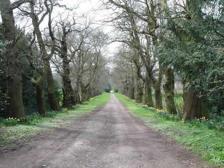
"Tex Cooper (1954) was something of a legend at Keele when I arrived in 1957. Mary Wilson told a story that he, and presumably others, dismantled one of the Keele Hall chandeliers and re-erected it in Clock House Drive. Apparently it was hung from the bridge, connected to a power supply and lit. She seemed to think that it had something to do with newly installed lamps on the drive between Horwood and Lindsay Hall huts to deter the amorous proclivities of students after the 7.00pm curfew. Students, until well after my time, were not allowed into rooms of the opposite sex after 7.00pm and Mary Wilson was in the habit of driving her car - MMA 838 - along the drive shining her headlights upon those engaged in fond farewells."
Sheila Everard (1961)
"One more thing on the Chandelier. It was connected to the mains via a lamp post and lit up. It is amazing we didn't electrocute ourselves doing that up a pole in the dark. Unfortunately, an early morning delivery truck severed the connection. As I remember it, we hung the chandelier in a tree which made it look like a Christmas tree."
Philip Sheppard (1954, Class of 1956)
During the busy buildings years, of the ‘50s and ‘60s, opportunistic students were supplied inadvertently with the building materials to “redesign” the campus. It is possible that the entrance to the courtyard and hence to Keele Hall was blocked up on more than one occasion. Certainly I remember it being blocked up some time in the first four years (1950-54). This was done with bricks on a Saturday night; leaving a small gap low down through which Lord Lindsay and a visiting dignitary had to crawl through on the Sunday morning. Lord Lindsay was less than amused! One of the perpetrators was the late Ron Ferrans (1954), a good pal of mine."
Pam Lloyd-Owen (1954)
"Pam is quite correct about the wall across the entrance to Keele Hall; it was a Saturday night when it was built, and dear Ron and I built it. As I have said once before Paul Rolo, assistant men's warden at the time was amazed that no one else was involved. We were 'gated' for two weeks for our sins."
David Harvey (1954)
"My own memories run to another hut bricking session but this was in Horwood Hall just up from Robert Raine's bungalow. I cannot remember why the victims were selected but it took a lot of labour to haul the bricks over - a full two huts’ worth of student power. Afterwards the contractor demanded the SU pay for the recovery of his materials. He was told to get the money from the students involved (it is safe to confess now given the law limiting the time of claims)."
Tony Scrase (1960)
"I remember being told that some years before my day the entrance to one of the huts, a woman’s hut containing a resident tutor, was bricked up overnight. If you recall, there was a kind of porch projecting from the side of each hut, so the interior door would have muffled the sound of trowel on brick. Normally, the only way out the next morning would have been through a window, but, this being a university, defenestration was the only means of egress."
Ian Cameron (1967)
Coronation day
"My father John Moulton (1954) would always tell of the pranks that were done in his time There was the painting of the Campus in Red, White and Blue paint on Coronation night (June 1-2 1953). Apparently the paint was mixed with cement so it would last. There was still evidence - albeit very faded - around the post box in my time."
Tony Budd (1963)
"Tex confessed to being the perpetrator of a legendary prank for Coronation Day of Queen Elizabeth II on 2nd June 1953 – Tex Cooper (1954) and a number of others painted the campus red, white and blue with hydrated lime coloured with red and white dye. This mixture was painted in stripes the width of a broom across every surface – buildings, tree trunks, roadside kerbs, etc. Although he confesses to be one of those who painted the campus, he notes with remorse that he was not one of those poor unfortunates assigned to scrub it all off again."
Alfred Kendall (1962)
The Magic Roundabout
Has anyone got any photos, from 1969-70 I think, just before my time there, when the hideous architects' department pink mobile shed, ironically placed blocking that lovely view of Keele Hall from the lake, was painted in Magic Roundabout style for a couple of days? I think it was for a Rag stunt? When I first went to Keele in 1970 I was shown a photograph by a student a couple of years ahead of me - and it showed the architect's hut painted with Magic Roundabout characters. I believe the story was that students did it one evening and it was painted over again a couple of days later. The architect's department was a standing joke at the time. Despite the campus still having lots of Nissen huts, to have this hideous building ruining the best view in the whole university - and housing the architects' department - seemed ridiculous."
Pauline Lowrie (1974)
Above: Gardeners restoring the Italian Gardens in 1985
I remember the giant pink sheds from my time in 1980-1981. They were removed in 1985 when the area was renovated. The sheds were demolished and the Italian Gardens were re-planted according to the original eighteenth century plans which were found in the archives. The box hedges, fountain and other features have restored the glory robbed by those ghastly pink huts.... At a Heritage Open Day in 2009 one of the visitors was Bernard Lufford who said it had been his job to restore the Italian Gardens and he spoke lovingly of the effort that was involved. He was foreman gardener and he laid out and planted the Italian gardens. He served as a gardener for 35 years at Keele and finally retired in 1989. He is the middle man of the three being presented to Princess Margaret. Of course the Italian Gardens are now among the most attractive locations on campus. Photos with permission of The Sentinel."
John Easom (1981)
Above: HRH Princess Margaret The Chancellor of Keele University officially opens the Gardens and thanks the gardening team.
Prankful painting - the red obelisk
"My father-in-law John Chidlow was one of a very rare breed of Englishmen who was trained as a stonemason, and his stay in Rome during the Second World War was undoubtedly enriched by what he saw in the stonemasonry work of the ancients. For me he made an indelible contribution to Keele. It concerns the entrance staircase outside the main Library, which was built during my residency at UCNS initially in one of the former Military Huts (#6) on campus. We ‘ancients of Keele' may recall that the original decoration placed as the centre-piece at the base of the staircase was a column on which a hand holding a book was mounted - clearly the symbol of a Library. The column was a finely hued piece of Portland Stone looking a bit like a Doric Greek column. In those days the clowning around and defacing objects was pretty common-place on campus and one morning we woke up to find the Library column and assembly had been painted RED! At the time everyone observed the shananickins, but little was said. Keele’s Administrators were forced to bring in a stonemason, the only one available in miles of Keele to first inspect the column and then remove it with a view to cleaning off the paint and restoring the assembly. That stonemason was John Chidlow. His task appeared simple enough until you start to realise the properties of Portland stone - to describe it as “blotting” paper would not be an exaggeration. Jack attempted to turn the surface of the column piece by piece only to find that the object ended up with a diameter of about six inches, incapable of supporting anything. The obelisque was lost to perpetuity, and the expense of replacement was considered too high for such venture to ever be carried out again - a great tribute to the clowns who destroyed the sculpture! But that’s just my opinion being vented over fifty years later. I graduated in 1961, but I remained at Keele as a graduate student in Chemistry until 1963, so the paint job may have been during that time (1961-63)."
Alan Jones (1961)
"It occurred shortly after the library was opened in 1961 or 1962. The pole was not entirely red. It was like the shop sign for a barber, a white base with a red 'scarf' wound around it. I have an early photograph of the 'New' library (i.e. not Stanley Stewart's domain in Keele Hall), but by then the obelisk had been removed."
John Samuel (1964)
"We've checked our photos and don't seem to have one showing the obelisk - in the view we've got - while the library was still being completed - it's definitely not there. But the subject of the other library "prank" is visible. The very tall weather vane is proudly mounted on the tower. So that must have been taken after the four or five guys from Horwood A-block (I think) had hijacked it while it was waiting to be installed. They hauled it up to the top of their block and wedged it into the central drain on the flat roof. When it was spotted next day, just two workmen were sent up to retrieve it! One held it, while the other removed the wedges, whereupon the guy supporting it lost his grip and it shot straight down the drain, with one of the bars on top hitting him on the head and seriously injuring him. Difficult to know who to blame - the original pranksters or whoever thought it was a two-man job to get it down. At least the other pranks from our time were funnier and less damaging: the Fresher's Gate logo (still there after 55 years), and Frank Godfer Hall, sadly long gone, but an excellent skit on the college motto and the re-naming of the Conference Hall and the New Teaching Block as we knew them. And let's not forget the mountaineering club's installation of a bicycle on the roof ridge of the (by then) Walter Moberley (né Conference) Hall - which I think we do have a photo of somewhere."
Tony Budd (1963) and Gill Budd (Garnett) (1963)
"I remember it very clearly. John Hodgkinson, the Registrar, was reputed to have remarked disparagingly it was to tell people who couldn't read, that the building was a library!"
Dick Barton (1964)
"I remember the column appearing... I think it is possible that the red paint was a spiral to make it look like a barber's pole."
Phil Gay (1965)
Ride of the Valkyries
"Back in the early '80s the bike club provided a motorcycle escort to the UGC's coach from Stoke station. The Ride of the Valkyries blared out as we swept in through the main gates. Unfortunately, the coach driver had other plans and carried on down to the Keele village entrance. I think it may have been filmed - any ideas where the footage might lie?"
Tom Macey (1984)
"Do you also remember those esteemed legal gentleman who removed the complete law reports from the library just to show it could be done? One is a professor of law in the US I believe and the other something important in the prison administration."
Adrian Stern (1976)
"I remember the much more famous CAFÉ put on the chapel roof (using cut up sheets) by the legendary ‘Commander’ Larry Southcombe, also famous for parking his mini hard by the library door so that no-one could get in. A legend!"
Gordon Mousinho (1975)
"Mark Kalisch (professor), Toj Brandon (was a prison governor, Parkhurst, now retired) and Ron Hawkes. All my year and did law with me (not noticeably well!)."
Gordon Mousinho (1975)
"Actually, the two I meant were a year ahead of us; Tony Waters (Prof) and Alex (damn I’ve forgotten his surname) since we’re naming names!"
Adrian Stern (1975)
"OK right – I thought it would be a stretch for Brandon and Hawkes (super straight) to do something like that. Kalisch on the other hand.."
Gordon Mousinho (1975)
"They both ended up as professors – Alex was in fact Professor Alec Spencer."
Adrian Stern (1975)
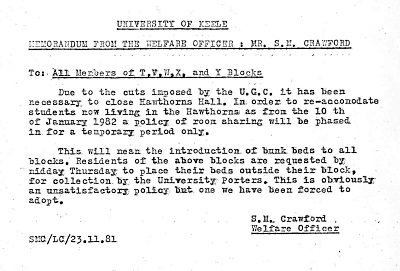 We are indebted to Steve Barks for recalling this memorable hoax:
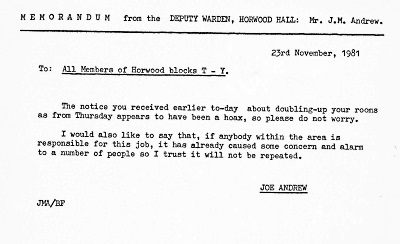
"Here is copy of the hoax message (left) sent to residents of T to Y blocks in Horwood Hall on 23 November 1981. The hoax memo suggested that we were all to be double up in bunk beds due to university cuts and to put out our single beds for collection. No one did but there were many concerned enough to contact the wardens and residential office leading to the official memo the same day. I don't know who was behind it - it might have been part of a campaign to raise awareness of the savage UGC cuts being imposed on the university that were putting the unique Foundation Year programme in jeopardy. Here is also (below) the official memo sent in reply by Deputy Warden - later Professor."
Joe Andrew
"Dick Hubbard (1969) regaled Alice, Sue, Al Forster and me with the tale of R J Mazurki. Dick lived where there were a lot of Polish people around. His gang invented Mr Mazurki as a missing Polish war hero and wrote letters to the local paper enquiring about him. It got out of hand when real Poles started replying to their letters, saying they remembered this chap Mazurki. The R J were Dick's own initials. He claimed the story got into the Daily Telegraph.... Dick said that one of his friends joined the Navy and signed Mazurki in on every course he attended. At the end of his training, he had to sit an exam. A paper had been set out for Mazurki. As a result Mazurki was listed as a deserter. To avoid accusations of contempt towards Poles, we told a Polish student at Keele, Frank Pajak (1970) about Mazurki. All he did was laugh himself silly. Scenting a good thing, we made use of Mazurki too. Alice Meager (Wild) (1969) signed him up for a Physical Society trip to Rugeley B Power Station, much to Mike Ridley's (1968) consternation. When Alice replaced Mike as Physical Society secretary, we were unable to pull a similar stunt on her. My greatest success was years later when I was teaching, getting a colleague to put his name up on a supervision list for absent staff and almost persuading the Deputy Head that he really existed. No doubt he has cropped up in many other places as well."
John Meager (1968)